SWITCHED AT BIRTH
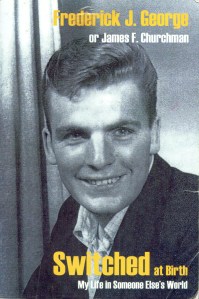
by Frederick J George (or James F Churchman)
><
Who is this man?
><
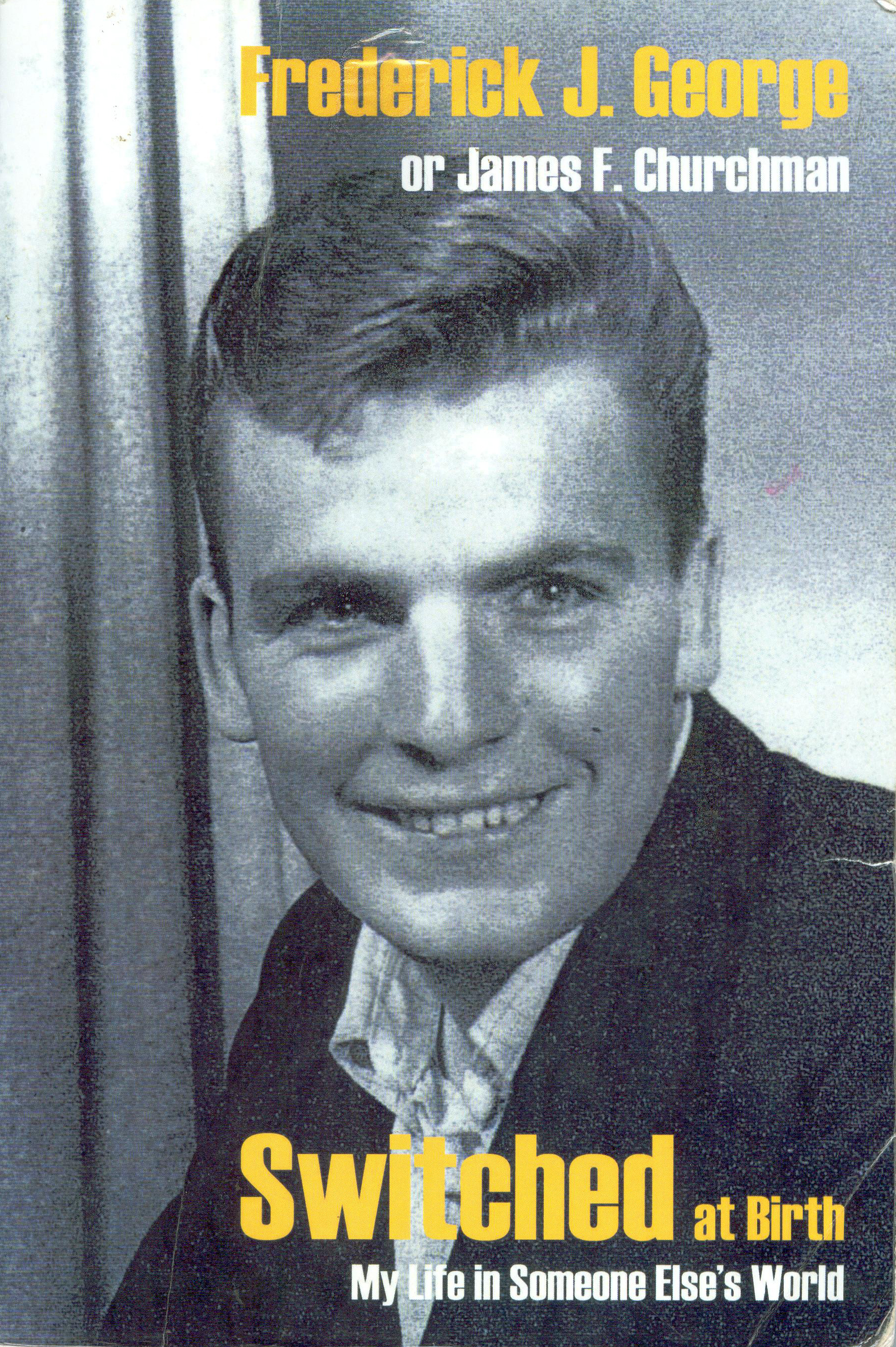
As a book lover I have been given many wonderful books, including biographies. One biography in particular stands out for its poignancy, Switched At Birth by Frederick J George in 2007.
Frederick George and James Churchman were switched at birth; we will never know the full story behind the switch. However, what we do know is that the respective mothers of Frederick and James loved their sons as they would their own flesh and blood.
It has meant much to Frederick that his biological mother, Helen Churchman was still alive when he discovered the truth of his birth. One of the things she was able to tell him was that although she never consciously doubted that James was her own son, she remembers remarking to the nurse a few days after the boys were born, ‘I think I may have Mrs George’s baby’ and that both women laughed. Mrs Churchman’s ‘son’ James had a thatch of black hair, while Mrs George’s ‘son’ Frederick was blonde like Mrs Churchman and the rest of her family.
In 2010 I had my own book published “Whatever Happened To Ishtar?” which like ‘Switched At Birth’ is about life in an immigrant Roman Catholic Lebanese family in Dunedin, New Zealand, during the mid to late 20th Century. At the time I wrote my book I knew nothing of Frederick’s story, although I knew of the large extended George family, and often saw family members around the streets of Dunedin. For various reasons, I didn’t know any of them well enough to engage in conversation. I had no knowledge of the Churchman family, even though James’ and Frederick’s families lived in close proximity to one another. This, as it turns out, is one of the most poignant aspects of the whole saga, but also one of its saving graces: at least the boys grew up together and knew their biological parents, albeit superficially.
In the book, Frederick recalls in detail his life growing up with the George family. His has mixed feelings about his ‘father’ John George and his volatile temper, (Not I might venture to say, unusual in Lebanese men). He further writes that the subject of his ‘suspicious’ parentage only ever came up within his immediate family when his father was angry about something Frederick had done that had displeased him. Then he would accuse his wife, Ngaire, of sleeping with another man when she conceived Frederick because he ‘sure doesn’t look Lebanese!’ Ngaire George, who was not Lebanese, would respond good naturedly and tell her husband not to be so ridiculous.
As fate would have it the George boys and the Churchman boys were good friends and hung around together playing sport and engaging in other social activities. The main difference between the Churchman and George families, apart from ethnicity, was religion; Presbyterian and Roman Catholic respectively.
The boys from both families were involved in the hustle and bustle of family life and the issue of the blonde boy in the Lebanese family and the black- haired boy in the Anglo-Saxon family, by and large remained unquestioned, at least publicly. But privately, Frederick writes: ‘I used to have these peculiar feelings …of being in another world, or in someone else’s identity’. He goes on to say ‘Actually, I was in someone else’s world, and so was Jim Churchman…he was in the world I belonged in and I was in the world he belonged in.’ James told Frederick that he used to have those same feelings. Ngaire George often said to Frederick, ‘You live in your own world!’ … ‘She was right, I did’.
Both mothers genuinely believed that each of their boys’ odd-one-out complexions were some sort of throwback to their genetic roots. Frederick writes of the many coincidences and parallel life experiences of members of the two families, and they are compelling, in hindsight and in light of knowledge of the switch.
Years later, the suspicion of a switch at birth became an urgent issue for ‘James Churchman’ (the real George boy) when he became seriously ill. In his fifties, he had a severe heart attack. This was particularly significant, because there was no history of heart attacks in the Churchman extended family, but there was in the George extended family. While James was recovering in hospital, he asked his best friend, Frederick’s Lebanese brother, to contact Frederick who was then living in the US and ask him to organise a DNA test for himself, while he James would do the same. The tests proved beyond any doubt that Frederick and James had been switched at birth.
As you can imagine, the news was life-changing for both families, but particularly for the men themselves. The saddest thing for James was that he never knew his biological parents intimately and never would. Out of both sets of parents, only Helen Churchman was still alive when the test results were revealed, and she was then in her eighties. James often spoke to Ngaire George when he called on her sons, not knowing who she was in reality.
Frederick says at the end of the book that he is left wondering what life would have been like with his biological family. What had he missed out on, if anything? How different would his life have been? Questions that will remain unanswered.
-Anne Frandi-Coory 24 February 2012





 anne frandi-coory