Archive

Monthly Archives: August 2013

Ezra Pound

I will always remember Ezra Pound;The Solitary Volcano by John Tytell for two reasons:

This is one of the most comprehensive and interesting biographies I have read, and I have read many.

The second and far less important reason, is a more tactile and visual one. The book was published by Anchor Press, Doubleday, USA and printed in 1988. A few pages had not been cut through along the bottom of the book, and the bottom edges of all the pages were so rough, they looked as though they had been cut with a chain saw. Normally I wouldn’t have bought such a book, but I spotted it at a book fair and was afraid I might not find another copy. I am surprised this edition was ever released for sale. The previous owner either didn’t bother to read the book at all or just read the accessible pages;either way they missed out on an exceptional biography!

However, I am happy to say that once I began reading about Ezra Pound, I soon forgot about the physical aspects of the book itself.

According to Poets.Org; From The Academy Of American Poets:

Ezra Pound is generally considered the poet most responsible for defining and promoting a modernist aesthetic in poetry. In the early teens of the twentieth century, he opened a seminal exchange of work and ideas between British and American writers, and was famous for the generosity with which he advanced the work of major contemporaries.
Pound admired Impressionist painters for their taking art out of the ‘dark ages’ and into the light of realism and he did the same for poetry. He believed earlier British poetry was stuffy and concentrated too much on set verses and rhyming. His mental energy was legendary and he left behind thousands of letters, a prolific amount of works including  poems, prose and translations.

Ezra Pound was a profoundly complicated man who didn’t listen easily to those whose opinions differed from his own; he could be very dogmatic and nasty, especially about political issues. He ranted and wrote throughout his adult life about his hatred of usury, Jews, banks, American politicians (especially Roosevelt) and America itself.   Pound’s vitriolic attacks against his own country began when as a student he alienated himself from the American university community with his strong political views and his sometimes outrageous behaviours. Later, he reveled in his powerful erudition and used it to discredit his country and its leaders.

He didn’t think much better of the British, informing Bertrand Russell that he was glad “you know your lousy country has paralysis” and wrote that the British Parliament was a collection of ‘six hundred apes’, and British universities were full of “hired pimps”.  During WW2, Pound relayed fascist propaganda across Italy’s radio waves, and openly wished that American and British politicians had the intelligence of his friend Mussolini (‘old Mussy’), whom he met only once and who actually believed Pound to be a nutcase.  Pound was convinced that because of Britain’s stupidity, Hitler and Mussolini were going to win the war. He was incensed that America would even consider entering the war. His reasoning for this might find favour with some readers.

That Pound’s friends and contemporaries were in awe of his works, and their sheer volume, there is no doubt. Apart from his poetry, prose and cantos, he translated Chinese and Japanese works into English, studied and translated Confucius (he believed Confucius to be infallible) and spent his early years in Paris and Italy supporting fellow poets and writers and promoting their works. Pound neglected his own work at times to find benefactors and publishers for his contemporaries such as James Joyce, WB Yeats, TS Eliot, and  Marianne Moore, to name but a few. Not surprisingly,  followers were well aware of Pound’s mercurial moods. It can’t have been easy listening to his long hateful diatribes on anything from anti-Semitism to miscegenation to Western economics. He could also be very insulting about  his friends’ friends and relatives. Even his letters to his friends and acquaintances consisted of pages of his views on what was wrong with America and Britain.  He didn’t think twice about writing to men in positions of power to offer advice on how their country should be run. Pound’s friends, fellow writers and poets nevertheless were loyal and were always there whenever he needed help, especially as he aged.  Pound could be very entertaining when he chose to be, and people would sit for hours listening to his recitations.  He received hundreds of letters from young poets and writers and ordinary citizens, addressed with such titles as ‘Dear Fatigued Prophet’.

In the last months of his life (he died in 1972 on his 87th birthday) he suffered from depression, and barely spoke. He was full of regret for the way he had neglected his children; a daughter by his lover Olga Rudge, who as an infant, was placed in the care of peasant farmers;  and a son by his wife, Dorothy Shakespear. Their son lived with Dorothy’s mother almost from birth and scarcely knew his father. Dorothy ‘understood’ that Pound’s numerous affairs with other women were a part of his ‘romantic, artistic nature’. Pound was also regretful about his strong political views and his public support of fascism and what it cost him: incarceration in a cage with iron bars for months, guarded by American soldiers in Italy,  until he could be taken to America to be tried for treason.  While in the cage, Pound suffered a complete mental breakdown and was never again the strong physical and mentally robust person he once was.   Upon arrival back in America psychiatrists assessed that Pound was insane and should not be imprisoned, so he was transferred to an asylum. He had his own room at the asylum and ran it like a Paris salon with all his books and papers on shelves around him. Poets, writers and followers visited him often under the watchful and caring eyes of his faithful wife, Dorothy.

It’s a testament to the respect fellow literati had for Pound in the way they rallied to have him released from the asylum. It’s interesting to read how for months they pressured powerful figures in America to have Pound’s indictment on treason charges dropped so he could be freed. Two of his psychiatrists at the asylum were also in sympathy with Pound and had ensured that  their weekly assessments of his mental condition would keep him from being transferred back to a high security prison and subsequent trial.  Though all agreed that they would ‘hate to see Ezra die ignominiously in that wretched place where he is for a crime which if proven couldn’t  have kept him all these years in prison’, they were also realistic… ‘neither you nor I would want to take him into our family or even into our neighbourhood’. He was finally released from the asylum after spending over twelve years there.

Soon after his release was finally secured, Pound set sail for Naples, declaring upon his arrival to assembled journalists “All America is an insane asylum!’. His friends were dismayed at Pound’s fascist salute and his ‘refusal to submit to forces more powerful than any single man’.

Pound outlived his friends Ford Madox Ford, Ernest Hemingway, Wyndham Lewis, TS Eliot, EE Cummings, WB Yeats, and William Carlos Williams. He died a semi recluse in Venice in the care of Olga, his mistress; his wife Dorothy was by then living in the UK with their son, Omar.

Anne Frandi-Coory 30 August 2013

Also here on Anne Frandi-Coory’s Facebook Page:

https://www.facebook.com/myhomelibrary/

short-story-boxed-in-a-curse-by-luciana-cavallaro

Boxed In A Curse  –

Short Story by Perth author Luciana Cavallaro

See trailer below for  ‘Accursed Women’ anthology including this short story and 4 others by the same author…

Teacher and historian, Luciana Cavallaro, is adept at weaving ageless legends within a modern motif, and in this case, a fable that can also hold children spellbound.

Boxed In A Curse is a story most of us have known as ‘Pandora’s Box’. However, the vessel that held the curse was actually a pithos or large jar, sealed tightly with wax to keep ‘the evil’ within. Many archaeologists and Ancient Greek historians interpret the pithos as an analogy for Pandora’s vagina, and the fear that men associate with the wicked female temptress, the cause of man’s ‘downfall’.  The author’s title is a telling one; ever since Pandora unwittingly released ‘bad things’ [via menstruation] into the world, women have been confined by deep prejudice to a role as the ‘ruin’ of mankind.

The Greek mythological narrative informs us that numerous gigantic and powerful gods fought for supremacy over the earth and universe.  Wars were commonplace, but after a particularly vicious and bloody war that lasted ten years, Zeus entrusted loyal brothers Prometheos and Epimetheos with the task of creating creatures. The former constructed man in the image of the gods while the latter created all kinds of animals and birds. Zeus, an over-zealous and jealous god, was very concerned with Prometheos’ creation; man with intelligence and guile could challenge the will of the gods! And to make matters worse, Prometheos gave the gift of fire to man, after stealing it from the home of the gods.  Zeus was furious! In his anger he ordered Hephiastos, the divine smith, to make an entity that would ‘serve to be a gift of poison to man’.

Various gods in the hierarchy were summoned by Zeus to fashion this new entity with dexterity, sexuality, love, fertility and other qualities. Hera, queen of the gods and of marriage, endowed Hephiastos’ project with curiosity, a trait that would ultimately set off a chain of catastrophic events for mortals.  The first mortal woman, she who was infused with the gifts of the gods, was named Pandora. Both man and gods were enthralled and fascinated by Pandora’s beautiful perfection.

Pandora’s early life was filled with carefree days enjoying the wonders of the world until Zeus gave Pandora as a gift to Epimetheos, which didn’t exactly please her.  After a struggle with her desire to control her own life, Pandora accepted that she could not defy the gods. Later, during the marriage ceremony, the gods watched each other and Pandora, constantly making smart remarks laced with sarcasm and at times, snarls.  Needless to say, Zeus was not impressed with the heckling and bantering.

A quiet lull in the festivities enabled Hermes, on behalf of Zeus, to present the bridegroom with the sealed pithos. He warned Epimetheos not  to ever open it, but could say no more. Hermes advised him to issue the same warning to Pandora.

Over the years, Pandora and Epimetheos lived happily enough, although Pandora’s curiosity about what was contained in the un-opened wedding gift, never left her in peace. She thought it odd that she and her husband were forbidden from opening what was rightfully theirs. Cunning Zeus knew how to exploit the weaknesses of Hephiastos’ creation. When Pandora could resist temptation no longer, she broke the wax seal and opened the jar. From that moment on life changed for both mortals and immortals, but in the end, Pandora does manage to partly redeem herself.

Many Christian legends about the first man and woman on earth, and the creation of the world, have obviously been transposed from Ancient Greek mythology. Luciana Cavallaro juxtaposes the two in her own unique style.  She depicts many scenes between mortals and immortals with vivid detail, almost as though she was there in person at the time.  This, along with the modern setting in which she places Pandora’s story, made Boxed In A Curse such a relevant and enjoyable read for me. Available here in e book format via Amazon

Anne Frandi-Coory  22 August 2013

lucianacavallaro_accursedwomen_web_final-e1380531653175

Luciana Cavallaro has published an anthology of 5 Greek classics including: ‘Boxed In A Curse

‘ACCURSED WOMEN’ book trailerhttp://www.youtube.com/watch?v=vTZVsoFkZPo&feature=youtu.be

the-curse-of-troy-by-luciana-cavallaro

The Curse Of Troy;Helen’s Story  – book review

A Short Story by Perth author Luciana Cavallaro

See trailer below for  ‘Accursed Women’ anthology including this short story and 4 others by the same author…

I have always loved the story of Helen Of Troy. What free spirited woman wouldn’t?  But any story I have read about ‘the face that launched a thousand ships’ has been narrated by someone else; usually by a person who couldn’t possibly have known Helen.

Luciana Cavallaro has introduced a young and handsome historian to interview the Spartan beauty. Helen can finally speak for herself! She discusses her union with Menelaos and the reader can quickly ascertain that she was bored with her arranged marriage. Menelaos was a ‘good man’, but his interests were centred around war, decrees and intrigues within and outside the kingdom. These took up most of his conversation and energy.  Even though Helen was the rightful heir to the throne when her father died, her husband became king, and he refused to discuss the politics of the day with her. Helen was relegated to mere Queen in name only.

The Queen of Sparta had loathed Menelaos’ brother Agamemnon ever since she was a child. And now he always had the ear of Menelaos in secret talks she was excluded from. Her distrust of her brother-in-law would be vindicated in the future. Although the classic story of Helen of Troy is that the Trojan war was caused by Helen running off with Paris, Prince of Troy, or that she was abducted by him, Luciana Cavallaro allows Helen the scope to give her side of the story.   Needless to say, Agamemnon was heavily involved in the preparations for war with treasure rich Troy. As the reader will discover, the Battle of Troy had very little to do with Helen.

I have always had a passion for Greek Mythology and ancient history. Luciana Cavallaro’s books are easy to read and bring a new vitality to ancient Greek Classics.  So easy to download onto my tablet and to read on the train or when I want a change from the heavy reading & writing I am often engaged in. Available here in ebook format via Amazon

  • Anne Frandi-Coory 19 August 2013

lucianacavallaro_accursedwomen_web_final-e1380531653175

Author Luciana Cavallaro has published

an anthology of 5 Greek classics including ‘The Curse Of Troy; Helen’s Story’

‘ACCURSED WOMEN’ book trailer: http://www.youtube.com/watch?v=vTZVsoFkZPo&feature=youtu.be

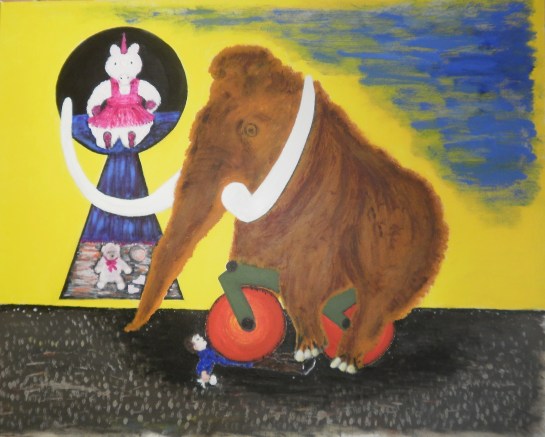
OLYMPUS DIGITAL CAMERA
Jack And His Mammoth Imagination
*****

 Painting and Poem  Jack And His Mammoth Imagination Copyright To Anne Frandi-Coory

-All Rights Reserved 18 August 2013

Painting – acrylic on canvas 60cm x 76cm

(This painting has been sold)

*****

Read my poem *Jack And His Mammoth Imagination

Dedicated to Jack Cathro

here in DRAGONS DESERTS and DREAMS

**************

2nd edition (2020) now available in Kindle e book and paperback


HERE at AMAZON