Archive

Monthly Archives: November 2013

A Book Review by Anne Frandi-Coory

…….

Michelangelo Pope's Ceiling_0001

….


Michelangelo Pope's Ceiling_0003

Michelangelo And Raphael In The Vatican. (Special edition for museums and papal galleries)

>><><><><><><><

‘Michelangelo & The Pope’s Ceiling’ by Ross King…  

…is a wonderful book all artists should read if they haven’t already. But then, anyone interested in the genius of Michelangelo would love it also.

The author, Ross King, intertwines Michelangelo’s private life and his many anxieties into the long and arduous travail that was the painting of the Sistine Chapel. And amidst all of this the disputes between the painter and Pope Julius II over money  and design give an insight into how closely the Vatican kept tabs on artists and the subjects of their works.

Compared to Raphael, Michelangelo was practically a saint. He worked long hours in Rome on the Pope’s most ambitious ‘project’ while at the same time handling all his family’s many problems, financial and otherwise, back at his home in Florence.

Michelangelo believed any sort of sexual liaison was dangerous to one’s wellbeing; ‘sapping’ a person’s vitality.  It is believed Michelangelo was celibate while his competitor Raphael, and Pope Julius, both had appetites for food, wine, and sex that were legendary. In fact, Raphael died in his late 30s from ‘a night of debauchery’. The pope suffered from syphilis and malaria. Many popes from that era suffered from syphilis and many had children. During this era, Rome, with a population of around 50,000, was infamous for the thousands of prostitutes working in that city. It goes without saying that among their clients were numerous Catholic clergy.

Often a pope’s son and heir, nephew,  or other relative, followed in his footsteps as head of the Roman Catholic Church. In those days, Popes and Bishops even went to war to win back papal states in Italy seized during invasions by other powerful countries. The fact that the Church used soldiers from ‘friendly’ countries to boost their own fighting power wasn’t a problem, neither were their looting and rampaging!

Being a history buff, I also enjoyed reading about the politics and life in Italy during the 15th and 16th Centuries. This book is well researched and equally well written.

In particular, I was fascinated by the techniques Michelangelo and Raphael used to paint their frescos. This method was used  to paint walls of palaces and churches, as well as the Sistine ceiling or ‘vault’. I always believed that the artists just painted the walls as though they were canvases. Not so. The method is painstaking, and requires much skill and patience. Several ‘plasterers’ are needed to assist the painter in mixing the correct ingredients and the painter applied pigments and sketches either to wet or dry plaster, depending on the effect required.

While I was in Rome in 1992, I bought a large book full of coloured glossy reproductions of Michelangelo’s and Raphael’s works during the reign of Pope Julius. I am so glad I did because there are no coloured plates in Ross King’s book,  therefore it would have been difficult for me to follow some of his more detailed discussions. For instance, as King explains in detail the various characters Michelangelo painted onto the Sistine ceiling, I was able to study them in this amazing book. It  made King’s book even more interesting from an artist’s perspective.

…….

Raphael-School-of-Athens

School of Athens by Raphael

The author also discusses at length, one of my favourite paintings by Raphael, ‘The School Of Athens’. This was commissioned by Pope Julius for a stanza in his new apartments. Donato Bramante, Pope Julius’ favourite architect helped Raphael paint the monumental and palatial scenes in ‘The School’. My glossy book of reproductions also has wonderful individual full coloured reproductions of the various students and ‘professors’ in ‘The School’, such as Plato and Aristotle.

plato aristotle twitter

Plato and Aristotle from ‘The School of Athens’


euclid

A glossy plate taken from ‘The School of Athens’ showing Euclid and his students


-Anne Frandi-Coory 25 November 2013

Also here on Anne Frandi-Coory’s Facebook Page:

https://www.facebook.com/myhomelibrary/


Origins Of The Italian Surname ‘Mansi’

This page and its contents, including all images, is Copyright To Anne Frandi-Coory All Rights Reserved 23 November 2013

……………

Manzo Coat of Arms

Original Manzo Coat of Arms

****************************

Raffaela Ishtar Arts

Raffaela Marisi Mansi Grego

********************************

Since doing research for my book ‘Whatever Happened To Ishtar?‘ I have become fascinated with the origins of surnames … My maternal great grandmother’s maiden name is recorded on original documents as Raffaela Marisi Mansi and her father’s name as Johannis Mansi (possibly reflecting Austrian origins).  It’s likely that Raffaela’s mother’s family name was the Italian Marisi. Raffaela was raped by a Catholic Priest in Rome when she was 13 years old. She was sent to London in disgrace when she became pregnant as a result of the rape … creating ripples which affected the fortunes of succeeding generations.

*********************************

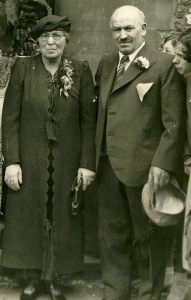
*Raffaela and Filippo Grego

**************************************************

*Author Anne Frandi-Coory’s maternal great grandparents.

The first Italian records showing variations of the surname Mansi were found in Venetia, northern Italy. The region of Venetia is named for the Veneti, a race related to the Illyrians who allied themselves with the ancient Romans and consequently prospered. From this famous region in Italy, the name Manzo, or Manso, emerges. Research shows that it is Germanic in origin and means ‘strength’. It is believed that the name became Italianized over time with various spellings according to dialect. For example, documents can be found in Friuli dating as far back as 1083, with such names as Patriarca di Aquileia Volserico Manzano. The history of the Venetia region begins with the invasion of the Ostrogoths and Vandals under Attila the Hun in the mid 5th Century CE.

******************************

The most famous city in the region is Venice which was created on the island of Rialto as a refuge for those fleeing from Attila and his army. The city of Venice remained a refuge for many centuries. After the Lombardi invasion of Italy in the 6th Century, more fled to its relative safety. Venice became a fully fledged city in the 8th Century when Duke Orso was elected and supported by Pope Gregory. However, it wasn’t until the Frankish invasion that Venice felt a true sense of unity, when an alliance was formed in order to retain its independence. In the 9th Century, while Charlemagne was king of Italy, the Eastern Emperor Nicephorus was lord over Venice. Thus Venice retained closer alliances with the East than with the rest of Europe. Venice became a religious rival of Rome when it received the remains of St Mark, for whom the Basilica Cattedrale Patriarcale di San Marco and the Piazza San Marco are so named.

********************************

The famous winged lion, which is considered to be the emblem of Venice, was originally the emblem of St Mark. Venice proved itself to be an economically strong city, noteworthy for its trade overseas and as a gateway to the major trade centres of Central Europe. It also maintained diplomatic ties with the East. Various forms of the surname gradually moved down the peninsula: Manzi, Manzo, Mansi, Manzano, Manzoni, Manzonni, Manzonno, Manzina, Manzino, Manzini, Mansone, Manzolino, Manzolina, Manzone, Manzano, Manzoli, to name a few variations. Artistic prosperity was one of the most important features of Venetian history. Many of the most famous painters in the history of art come from this region. The earliest Coat of Arms for the Manzo dynasty displays a blue shield with a lion holding a bull’s head and three fleur de lis. Prominent members who share the Manzo/Manso heritage include Torpe di Federico del Manzone of Sicily, a priest in Pisa for seven years. His son acquired the position after his death. Pierangelo Manzoli (Marcello Stellato) a poet and philosopher 1500 – c.1543 Cianciano Manzano was commander of the castle of Manzano the remains of which still stand in Friuli. The Manzini family of Modeno was one of the most powerful families in the city during the medieval period. Alessandro Manzoni was born in Milan in 1785. He was a poet and novelist of noble blood and wrote the historical novel I Promessi Sposi (The Betrothed)  published in 1827. It is regarded as the most famous and widely read novel in the Italian language.  In 1860, Manzoni was elected senator for the Kingdom of Italy. Pope Benedicto XlV born Prospero Lorenzo in Bologna 1675 to Marcello Lambertini. He died in Rome in 1758. He was a descendant of the Mansi family.   Lucida Mansi was a descendent of wealthy silk merchants and her family home, the Mansi Palace, still stands today in Lucca, Italy, as a museum owned by the state since 1957.  For more about the legend of Lucida Mansi see Silhouette in Bagni Di Lucca In 1680 the marriage between Arlo Mansi and Eleonora Pepoli, from a wealthy Bolognese family, increased the riches of the Mansi family. This was the first familial Roman/Italian connection with the Germanic Mansi clan. The Mansi family’s commercial enterprises sold silks, and other fabrics throughout France, Italy and Germany. The first members of the Mansi family arrived in Italy from Saxony in the 11th Century.

********************************

See Here: Frandi; My Fascination With Italian Surnames Part 2

For more information about my book,

Whatever Happened To Ishtar? – A Passionate Quest to Find Answers for Generations of Defeated Mothers and to purchase a copy HERE is the link:  https://frandi.wordpress.com/2010/04/15/publicaton-of-whatever-happened-to-ishtar/

Dedicated To The Beautiful People of The Philippines

Sampaguita

Sampaguita (Arabian Jasmine) National flower of the Philippines

*****

Painting and Poem Sampaguita Copyright  to Anne Frandi-Coory

All Rights Reserved 13 November 2013

acrylic on canvas  45cm x 45cm

***************

islands of verdant beauty

and stormy mountains

how you have suffered

Tempest Haiyan

meanest of gods

has sapped your life blood

uprooted mighty trees

savaged your homes

rice terraces drenched

your arms aching in

supplication.

you who were once so colourful

now fading into gray

but not for long

in your hearts

fierce strength abounds

sampaguita will flower again

***************

*****This poem has been published in The Australian Writer magazine > 

Issue 382    –  Dec 2013 – Feb 2014

More  here in DRAGONS DESERTS and DREAMS

Dragons, Deserts and Dreams 2nd edition published 2020

now available in Kindle e book & paperback

here from AMAZON BOOKS 

*********

….

Lucida Mansi sold her soul to the devil………find out more……..

http://www.tuscany-villas.it/to-tuscany/2013/tourist-attractions/legend-lucida-mansi-lucca

….

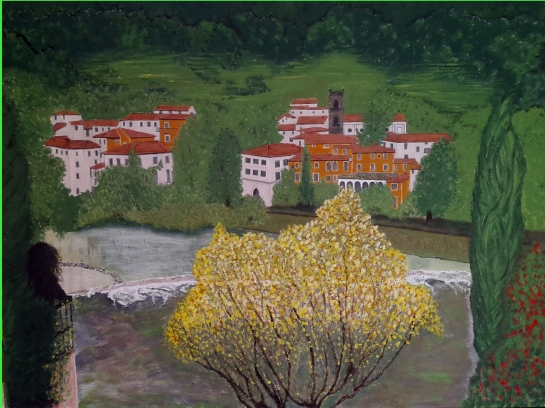
Nexus 4 Nov 027

Silhouette in Bagni Di Lucca

*****

Painting and Poem  Silhouette In Bagni Di Lucca   Copyright  To Anne Frandi-Coory –

All rights reserved 4 November 2013…..

Painting by afcoory –  acrylic on canvas 100cm x 75cm

*****

Oh Lucca

why do you hide your beauty?

no…

you’re not a Milan

a Rome

or even a Florence

but greens from every palette

adorn your hills and valleys

freshness pervades your air

water pure as crystal

What’s that I hear?

Lucida Mansi

her palazzo there

in Lucca town

filled with silken gold

treasured paintings

four poster draped exquisitely

how can that compare?

Lucida of my maternal line

was it you enticed me here?

Read the rest of my poem *Silhouette In Bagni Di Lucca

in Dragons, Deserts, and Dreams

Available now at AMAZON in Kindle e book and paperback 

***********

Reviews and more about DRAGONS DESERTS and DREAMS

Dedicated to my maternal great grandmother Raffaela Marisi Mansi Grego (Greco) -the Mansi name probably originated in Saxony. Mansi ancestors moved to Italy as wealthy silk traders when Italy was ruled by Germany.

Read more about the origins of the Mansi family name: My Fascination With Italian Surnames