1891, Jan to 1911 >>> 179 Private to Sergeant – Wgtn City Volunteer Rifles; Zealandia Rifle Volunteers
1911 up to 18 Jan >>> 179 Colour Sergeant AGL Frandi – ‘G’ Company, 1st Battalion Wellington Rifles.
1911 from 19 Jan >>> 179 Captain AGL Frandi – 31st Company, Senior Cadets, the Office i/c YMCA Cadets, Wellington
1914 enlisted WW1 >> 10/1169 Captain AGL Frandi – 9th Company, Wellington Infantry Battalion, NZEF – 2nd Reinforcements
I have worked the medal stuff out … I first went through the military service files of all five Frandi brothers, all of whom served in WW1 with only Alfred Joseph serving during WW2 as well (and also his son Reginald but of course he was a generation later).
These gave me a good sense of what military service the family had been involved with however I found an additional file of Ateo’s in the NZ Archives which ran into 96 pages and gave me the answers I needed. The other useful clue was the photo on your blog of Ateo sitting wearing a sword and the date year 1912 which confirmed my findings.
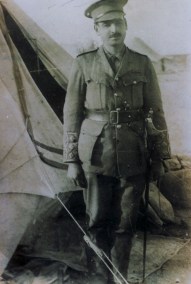
In the photo Ateo is a Captain and is wearing two medals. 1912 is the year the NZ Volunteer Militia system transitioned to the NZ Territorial Force. Ateo had enlisted in the Wellington City (Volunteer) Rifles on 19 Jan 1891 as a Private. By Feb 1902 he was a Sgt and had completed 11yrs 41 days of “Efficient” volunteer service. To be passed as Efficient in any one year, a soldier had to attend so many training days and attend an annual camp, plus pass all the requisite skills required of them – then the could be recorded as being “Efficient”.
Accordingly, in 1903 Sgt Frandi was awarded the NZ Volunteer Service Medal (inst1902-1911, plain khaki ribbon) for completing 12 years of Efficient service. His next award came four years later in 1907 having completed 16 years of Efficient service. At that point he (still a Sergeant) the NZ Volunteer Long and Efficient Service Medal (inst 1887-1931, maroon ribbon with two central white stripes).
In 1911, having now completed 20 years and 15 days Efficient Volunteer & Territorial service, Ateo applies for the Colonial Auxiliary Forces Long Service Medal (CAFLSM) – it is approved. This medal replaced the 16 years NZ LESM in 1911.
The two medals Ateo is wearing in the photo (dated 1912) is the 12 year NZ VSM (plain khaki ribbon) and the 20 year CAFLSM (plain dark green ribbon). This is proven by the design on the back of the medal posted on your blog (GR VII version). I cannot see any particular reason why he should not also be wearing the 16 yr NZ LESM as well unless. That was 1907….
So – the question, where his NZ LESM (maroon/two white stripes) might be now?
It also means the CAFLSM that was found was NOT obsolete, it was a valid medal to be wearing until Ateo’s death.
**********
In Mar 1910 Ateo, now a Colour Sergeant, transferred from the Wgtn City Rifles to the Zealandia Rifles Wgtn to start a new company of Cadets.
In Mar 1911 Ateo applies to be commissioned after 20 yrs of Volunteer service. This is where his file gets interesting. Ateo is commissioned in 1912 and almost immediately sits and passes his Captain’s promotion exam thereby confirming him in rank. Defence commissions a civilian (nil mil experience and not qualified by exam) also in the rank of Capt however with seniority for rank greater than Ateo’s! Result – to say Ateo is irate is an understatement as his file shows. Ateo resigns from the Volunteer Force after a flurry of public protestations. A public war of words erupts, covered in the NZ Times of the day (I guess even a man’s career wrangles with his boss was newsworthy in 1910s Wgtn).
Ateo writes to General Godley (head of NZ Military Forces then) …. the arguments for/against are all published in the newspapers ……… my take is that Ateo was technically in the right BUT, he was trying to overturn an entrenched Army policy …. junior officers’ never win those battles … you have to read his file to grasp it all (see NZ Times, see 20 Sep 1912) ….. The net result – Ateo publicly withdraws his resignation via public letter to Godley, and is reinstated.
**********
Ateo enlists for WW1 NZEF service 12 Aug 1914 at Trentham – goes first to Egypt for training; on 25 Apr 1915 he is a “First Day Lander” with the Wellington Battalion at Gallipoli. Killed by a sniper leading an attack between 6 and 10 May 1915. (8th selected arbitrarily) – body not located.
For his service in WW1, although mother: Annunziata Frandi was NOK, medals were sent to sister Italia [Corich] at 16 Murphy Street, Thorndon, Wgtn. Italia was sent Ateo’s medals in 1922 as follows: 1914/15 Star, British War Medal 1914-18, Victory Medal. Italia also received Ateo’s Memorial Plaque & Scroll (sometimes called Death Plaque, Death Penny, Deadman’s Penny etc) and a Certificate of Service.
So, Ateo’s medal bar should have SIX medals on it. If you or others in your family are interested, Replica medals are available and can be worn as being representative of a deceased ancestor’s awards – they are permitted to be worn on Anzac Day and Armistice/Remembrance Day by descendant relatives (and …. there is no limit to the number of relatives who can wear a replica set of medals). I can help with this if interested.
**********
NOW, THIS IS THE GOOD BIT –
In looking at the files of the brothers, I noted that three went to Gallipoli – Ateo, Alfred and Richard. Only two of these came home. In 1967, to commemorate the 50th anniversary of the landings at Gallipoli the Australian and NZ govts struck the ANZAC (Gallipoli) Commemorative Medallion. Eligibility for the plaque was for all living Gallipoli veterans, and the next of kin of those who were killed or who died within two years of leaving Gallipoli/returning home. Those Gallipoli veterans who returned alive also received a miniature version of the plaque with their service number on the back which was a lapel badge.
The unique thing about the plaque was that it had to be applied for – it was not automatically sent out to families (an impossible task 50 years after the landing anyway). This also allowed the plaques to be engraved with the soldiers name on the back. The medallion was not designed to be worn but comes in a black case and is a display piece.
Fifty years, on many veterans had died by 1967, or did not hear about the plaque’s availability, were not interested, families were not really aware they could claim for a dead family veteran. There were hundreds left in Defence, but after 100 yrs, all have now been disposed of. As a result of new claims being raised by descendants who have found they would have been entitled (were they alive) brand new ANZAC Plaques are being produced for descendants who are making valid and approved claims (when they hear about it – they do from me).
I have found no evidence on any of the eligible Frandi men’s files that their ANZAC Plaques have ever been claimed !! Normally there is a stamp on the top page of a file which is signed off and dated on the day the Plaque/lapel badge was issue – there is nothing.
So far I have arranged for the issue of 5 of these in the last two years that had never been claimed. So, as I see it this may be your lucky blog post. There are three ANZAC Plaques with the Frandi name on them if you want them – some proof of Ancestral connection is required of course, however I can talk you through the requirements and pass you the relevant applications if you are interested (providing they have not already been claimed of course?). Email me if you decide to pursue this and I can get the ball rolling.
I. D. Martyn
[Maj. Rtd – NZ Army]
Medals Reunited New Zealand©


 anne frandi-coory
Nice one Anne, Very complicated to me but utterly interesting. It just proves that people can be so helpful at times such as this. Hope all is well with you and family Anne.
LikeLiked by 1 person
Hello Rita, always lovely to hear from you. Yes, very interesting and it keeps Ateo’s memory alive among his descendants. We are all well and I hope it’s the same for you and your family. xxxx
LikeLiked by 1 person
Wow, Anne, that is incredible! I bet it took some research and unravelling.
LikeLiked by 1 person
Yes, and it’s great Luciana, that even after all these years, we are still discovering more about Ateo.
LikeLike