Archive

BOOKS In My Non-Fiction Collection-REVIEWS

The Silk Roads; A New History of the World

by Peter Frankopan, a senior research fellow at Worcester College, Oxford, and Director of the Centre for Byzantine Research at Oxford University.

*******

img20180301_11475993

*******

In 2013, Chinese President Xi Jinping announced the launch of both the Silk Road Economic Belt and the 21st Century Maritime Silk Road, infrastructure development and investment initiatives that would stretch from East Asia to Europe. The project, eventually termed the Belt and Road Initiative (BRI) but sometimes known as the New Silk Road, is one of the most ambitious infrastructure projects ever conceived. It harkens back to the original Silk Road, which connected Europe to Asia centuries ago, enriching traders from the Atlantic to the Pacific.

I think all current politicians and economists should read this book, because history repeats again and again but then, politicians and world leaders never seem to learn. Frankopan’s research is extensive and he presents many source testimonies and documents to support his claims. His writing moves along at a swift and thoroughly engaging pace. I would go so far as to recommend this book to college teachers. It gives a rare and independent insight into the political history of our world.

Historically, the Silk Roads were a network, with their geographical centre in Asia Minor, Central Asia, the Caucasus, China and the Middle East; territories that met, and traded with one another along arterial routes of communication. These routes influenced the world as we know it today. Ideas, cultures and religions were also spread via this network.

Bettany Hughes, whose book A Tale of Three Cities; ISTANBUL is also a great read, says of Frankopan’s ‘The Silk Roads’: How shamefully we in the West have been caught in the 20th and early 21st centuries with our strategic trousers around our ankles, … failing to remember why the map of the Middle East is drawn with such straight lines. Our ancestors would have been horrified by today’s wilful ignorance. Ancient reports of the region (studded, admittedly, with some fantastical nonsense) would put many modern memos to shame. Tellingly, Frankopan includes some recently released diplomatic cables and US political briefings describing Afghanistan, Iraq and Iran that are cringingly callow, and exemplify the danger of living in what the late historian Eric Hobsbawm called the ‘permanent present’, ignorant of our past.

In this vein, to quote Frankopan: The liberation of Christendom seemed to be at hand…it soon became clear how wrong these reports were…what was heading towards Europe was not the road to heaven, but a path that seemed to lead straight to hell. Galloping along it were the Mongols…Later the Mongols became increasingly interested in the techniques that had been pioneered by western Europeans, copying designs for catapults and siege engines created for the crusaders in the Holy Land and using them against targets in East Asia in the late thirteenth century. In this way Control of the Silk Roads gave their masters access to information and ideas that could be replicated and deployed thousands of miles away.

In the sixteenth century the age of empire and the rise of the west were built on the capacity to inflict violence on a major scale eg. the Americas. By then the best money was to be had in human trafficking and it was said to be ‘in league with the crown and with god.’ Before the discovery of the Americas, trading patterns ‘had begun to pick up’ and many scholars argue that this was due to improved access to precious metals and ‘the rising output of mines.’ But other scholars ‘point to the fact that tax collection became more efficient in the second half of the fifteenth century.’ [Perhaps our current political leaders and economists should take note]: ‘Economic contraction had forced lessons to be learned…’ and the collection and setting of taxes paid a crucial part in those valuable lessons.

I thought The Road to Empire a very interesting chapter and one which mirrors much of what is happening in our 21st Century:

Ottoman bureaucrats had proved to be highly skilled administrators, adept at centralising resources …as the empire swallowed up more territory in the fifteenth and sixteenth centuries, this had worked efficiently and smoothly. When the momentum of expansion slowed…the fragility of the system became apparent, under pressure from the cost of sustaining military action on two fronts- in Europe in the west and with Safavid Persia in the east…but also as a result of climatic change that had a particularly severe impact on the Ottoman world. [my emphases].

Frankopan discusses at length the different outcomes relating to the gap between rich and poor in Islamic countries as opposed to Christian countries in the west. It may not surprise many readers that Islamic countries had the more equitable laws which meant less concentration of wealth and property within a few elite families, including royal dynasties, as in the west.

Under the surface, powerful currents were swirling unseen…Robert Orme’s attitudes were typical of the eighteenth century; The first official historian of the East India Company, Orme penned an essay whose title On The Effeminacy of the Inhabitants of Indostan [India], reveals much about how contemporary thinking had toughened. A bullish sense of entitlement was rising fast. Attitudes on Asia were changing from excitement about profits to be made to thoughts of brute exploitation…It was the Wild East – a prelude to similar scenes in the west of North America a century later. Go to India, the memoirist William Hickey’s father told him, and cut off half a dozen rich fellows’ heads… and so return a nabob. Serving the East India Company in India was a one-way ticket to fortune.

The Road To Crisis is an intriguing chapter in which late eighteenth century Russia looms large as a threat to Britain. Anyone interested in the part Russia played in forming the geopolitical landscape of the 21st century, will find this very interesting, as I did. Much of what is happening in our world today, makes more sense, and I understand the reasons why China and Russia do not trust the west. This includes the aftermath of the Crimean war and Russia’s determination to claim back the Crimea peninsula.  The west would eventually help the spread of Islam in the East as a way of curtailing Russian expansionism.

‘In the late nineteenth century, Russian confidence, bullishness even, was rising fast.’ Britain planned to expand its territories into the far East, and in this quest, was in competition with Russia. But once China granted trading privileges to the British, they had little hesitation in using force to preserve and extend their position. Central to the commercial expansion was the sale of opium despite fierce protests by the Chinese, whose outrage at the devastating effects of drug addiction was shrugged off by the British authorities. The opium trade had expanded following the Treaty of Nanking in 1842, which opened up access to ports where the trade had been restricted previously, while also ceding Hong Kong to the British; further concessions were granted after British and French forces marched on Beijing in 1860, looting and burning the Old Summer palace.

Britain was also keeping a watchful eye on Russia which was meddling in one of Britain’s most prized possessions: Persia with its black gold. ‘Russian ghosts were everywhere. Anxious Foreign Office officials pored over a stream of reports on the activities of Tsarist officials, engineers and surveyors in Persia, that was flooding back to London.’

The reasons for the First World War: ‘World leaders go to war for their egos…’ in this case the fight over Persian oil, and the carving up of Ottoman Empire territories. Offerings of an ‘empire’ to leading figures in the Arab world were made in return for their support. The wheeling and dealing, involving Russia, Germany and Britain, while the first world war was raging, is sickening, and all the while Britain was fearful of ‘losing’ India. ‘The former British Prime Minister Arthur Balfour was anxious that ‘a rapid defeat of Germany’ would make Russia more dangerous still by fuelling the ambitions of the latter to the extent that ‘India might be at risk’. There was another worry: Balfour had also heard rumours that a well-connected lobby in St Petersburg was trying to come to terms with Germany; this he reckoned would be ‘as disastrous for Britain as losing the war’.

Both Britain and France passionately claimed to have noble aims at heart and were striving to set free ‘the populations subject to the bloody tyranny of the Turks’, according to The Times of London. ‘It was all bad’ wrote Edward House, President Wilson’s foreign policy adviser, when he found out about the secret agreement from the British Foreign Secretary. ‘The French and the British are making the Middle East a breeding place for future war’. [my emphasis]

…By the end of 1942, the thoughts of the new allies, Britain, the USA, and the Soviet Union were turning to the future…it was clear that the ‘effort, expense and trauma of another massive confrontation had exhausted western Europe’. It was already obvious that the old empires had to be wound down. Such chapter titles as The Road to Genocide, The Road to Super Power Rivalry, and The Road To Catastrophe are a good indication of what followed the Second World War. Most of us know some of this history, but The Silk Roads describes in detail, much of it in newly released source documents, the tragic consequences of this, to my mind, a completely unnecessary war. The claim in this book that world leaders go to war largely for their egos, is as true today as it has been throughout human history.

Post Second World War there was concern across the world for the seemingly out-of- control proliferation of nuclear weapons manufacture. Most readers will by now be well versed in the reasons for the later USA invasion of Iraq, but many will be surprised by the indirect involvement of Israel, USA, England, Italy, France and Russia in the years leading up to the invasion.   Few had doubts that the research reactors, powered by weapons grade uranium and other materials essential for dual use, as well as separation and handling facilities capable of extracting plutonium from irradiated uranium, were solely for energy purposes. The west turned a blind eye as and when needed. As Pakistani scientists noted ruefully: ‘…the western world was sure that an underdeveloped country like Pakistan could never master this technology…and yet at the same time western countries made hectic and persistent efforts to sell everything to Pakistan. They literally begged us to buy their equipment’.

Frankopan writes:

As it was, it was not hard to see how stern talk from countries like the US, Britain and France, which refused to be subject to the inspections and rules of the International Atomic Energy Agency, grated with those that did and had to conduct their research in secret; but the real hypocrisy, in the cold light of day, lay in the enthusiasm with which the developed world rushed to earn hard cash or gain access to cheap oil.

There were half-hearted attempts to curtail the spread of nuclear materials. In 1976, Kissinger suggested that Pakistan should wind down its processing project and rely instead on a US-supplied facility being built in Iran that was part of a scheme devised by none other than Dick Cheney, for the plant in Iran to serve as a hub for energy needs across the region. When the President of Pakistan turned down this offer, the US threatened to cut off the country’s aid package.

In 1980 US President Carter’s handling of the hostage situation and the Iranian oil embargo was a catastrophe. Operation Eagle Claw, the covert mission he authorised to rescue hostages… ‘was a propaganda disaster’… this was but one disaster in a changing world order. Countries were fighting back against the hypocrisy of the west.

In the mid-1980s, when the United Nations reports concluded that Iraq was using chemical weapons against its own civilians, the US responded with silence. Condemnation of Saddam’s brutal and sustained moves against the Kurdish population of Iraq was conspicuous by its absence. It was simply noted in American military reports that ‘chemical agents’ were being used extensively against civilian targets. Iraq was more important to the United States than the principles of International Law – and more important than the victims.

The chapter on the Soviet invasion of Afghanistan, its subsequent withdrawal of troops and weaponry, and the involvement of China, USA and Saudi Arabia in training and supporting Islamic militants is a must read.

Those resisting the Soviet army were supplied with money and weapons by the three countries. The long-term implications and consequences are now well known and documented, if not the initial struggle in ridding Afghanistan of the Soviet invaders.

Men of Saudi extraction who followed their conscience to fight in Afghanistan were highly regarded. Men like Osama Bin Laden – well connected, articulate and personally impressive – were perfectly placed to act as conduits for large sums of money given by Saudi benefactors. The significance of this of course, only became all too apparent later.

Frankopan lays out in detail how these events have made our world much more dangerous, and volatile, than it ever was.

Things were not going well between the USA and Iraq for various reasons, and there was mistrust on both sides. Rumours were rife that the USA was about to overthrow Saddam. Consequently, ‘…in one of the most damning documents of the late twentieth century, a leaked transcript’ of the then ambassador’s meeting with the Iraqi leader in 1990, reveals that she told Saddam that she had ‘direct instructions from President Bush to improve our relations with Iraq…we know you need funds…’. Iraq was running up debts in the war with Iran and the depressed price of oil presented problems for the economy. Saddam subsequently asked the ambassador what USA’s opinion was on his solution: to take over control of the Shatt al-Arab waterway, a region over which Iraq was involved in a long-running dispute with Kuwait. The ambassador answered, [to summarise], that ‘…the Kuwait issue is not associated with America’. Saddam had asked for a green light from the US, and he got one. The following week he invaded Kuwait.  Frankopan:

The consequences proved catastrophic. Over the course of the next three decades, global affairs would be dominated by events in countries running across the spine of Asia. The struggle for control and influence in these countries produced wars, insurrections and international terrorism – but also opportunities and prospects, not just in Iran, Iraq and Afghanistan, but in a belt of countries stretching east from the Black Sea, from Syria to Ukraine, Kazakhstan to Kyrgyzstan, Turkmenistan to Azerbaijan, and from Russia to China too. The story of the world has always been centred on these countries, but since the time of the invasion of Kuwait, everything has been about the emergence of the New Silk Road.

In conclusion, under the chapter The New Silk Road Frankopan warns, and I quote in full: In many ways, the late twentieth and early twentieth centuries have represented something of a disaster for the United States and Europe as they have played out their doomed struggle to retain their position in the vital territories that link east with west. What has been striking throughout the events of recent decades is the west’s lack of perspective about global history – about the bigger picture, the wider themes and the larger patterns playing out in the region. In the minds of policy planners, politicians, diplomats and generals, the problems of Afghanistan, Iran and Iraq seemed distinct, separate, and only loosely linked to each other…While we ponder where the next threat might come from, how best to deal with religious extremism, how to negotiate with states who seem willing to disregard international law, and how to build relations with peoples, cultures and regions about whom we have spent little or no time trying to understand, networks and connections are quietly being knitted together across the spine of Asia; or rather, they are being restored. The Silk Roads are rising again.

********


-Anne Frandi-Coory
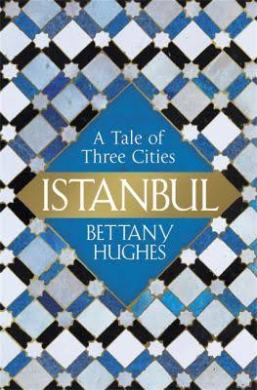
A Tale Of Three Cities ISTANBUL 

-Bettany Hughes

*****

A Book Review – 5 stars *****


Byzantion of Greece’s ancient past,  the capital of the Christian Byzantine Empire, famed Constantinople of New Rome and Muslim Ottoman Empire that today goes by the name of Istanbul, Turkish republic.

‘Istanbul is the city of many names’, writes Bettany Hughes: Byzantion, Byzantium, New Rome, Stambol, Islam-bol are just a few of them. And Istanbul today ‘is lapped by the Golden Horn, the Bosphorus, and the Sea of Marmara; to the north is the Black Sea and to the south, through the Hellespont or Dardanelles, the Mediterranean.’

A diamond mounted between two sapphires and two emeralds…the precious stone in the ring of a vast dominion which embraced the entire world as described in ‘The Dream of Osman’ c. AD 1280.

Hughes guides the reader around the city that I wish I had visited. It is obvious from reading this book that the author has walked Istanbul’s streets and knows the city well, and she has meticulously researched  its 8000 years of history. I can assure you that this is no dreary history book the likes of which bored us to tears at school. The ancient town of Byzantion’s King Byzas (legend has it that his father was Poseidon, his grandfather, Zeus) was well located at the intersection of trade routes. Eventually the Roman emperor Constantine decided that ‘Old Rome’ was too far away from all the action and over time the City of Constantine became Constantinople, the New Rome, capital of the Roman Empire itself. The gateway between East and  West. Constantinople’s Christian name was changed to Istanbul around 1923 after the fall of the Ottoman Empire.

The book has short chapters with clear and helpful titles, dated in both Western and Islamic calendar formats where appropriate.  It enables readers to navigate this vast book in piecemeal fashion, but I found it difficult to  put this book aside; it is so well researched and written, with personal written accounts from people who were present during many of the historical events, which made the book all the more fascinating. I particularly enjoyed the frequent references to current and recent archaeological digs the findings of which verify historical accounts.  Hughes includes several maps and colour plates, which I constantly referred to as I was reading. It is evident that the West owes far more to Eastern cultures than we have been ready to believe in the past. The Roman Empire pillaged much wealth from Egypt and the East and in turn the Ottomans pillaged from Roman territories. It is arguable that the rabble that made up early Western civilisation reached a turning point when it invaded and colonised Egypt.

*****

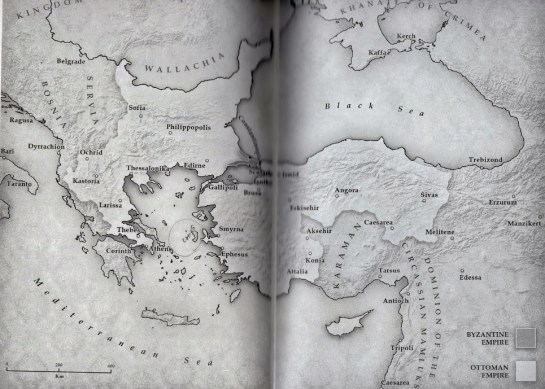
Ottoman and Byzantine territory in the east Mediterranean c. AD 1451


*****

Muslim and Christian lived in relatively peaceful harmony during the Ottoman era but both sides could be extremely brutal whenever their territories or power were threatened. The Ottomans, however, were far more than their harams and baths, which titillated and attracted travellers; they were skilled diplomats and traders. Christian slave boys ‘harvested’ from the West were trained as interpreters.  Called Dragomans, one of their critical attributes was their facility with languages, and some of them could speak up to seven languages which enabled the empire to spread its culture and bargain with valuable commodities to negotiate peace. When the Ottoman Empire began to crumble at the beginning of the twentieth century, Germany, France and Britain ‘fought over the spoils’ and it is apparent that the after-effects of this breaking up of once cohesive territories helped to turn Christianity and Islam against each other which we are still witnessing in modern times. Millions of refugees were displaced during the carve up of territories, and millions died.

This book, as well as being a great read, informs readers on how the current geo-political era came into being, and it does not always put the West in a good light. We owe so much of the great advances and wealth in our Western civilisation to the East, and let us not forget, to Islam

-Anne Frandi-Coory  27 October 2017

*****

Also here on Anne Frandi-Coory’s Facebook page: 

https://www.facebook.com/myhomelibrary/


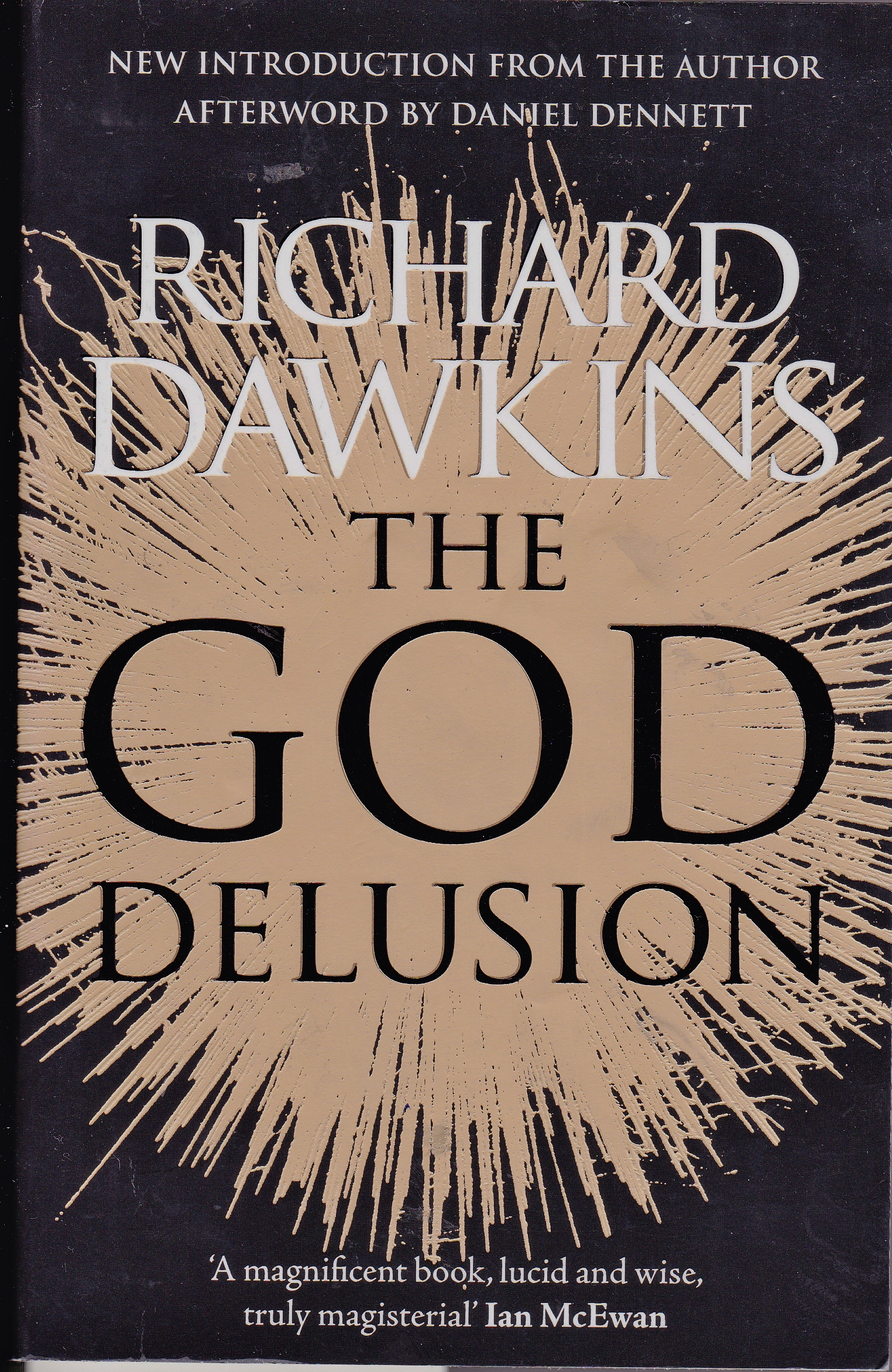
The God Delusion is a great read; funny and witty in places and deadly serious in others. The author, Richard Dawkins is a professor and a scholar of renown and of course the brilliant writer of several significant books.

The God Delusion

**********

The God Delusion is divided into chapters with the several headings within each chapter making the book easy to read.  Dawkins is an atheist who has written, and lectured on, a great deal about the harm religion does to children, by religious indoctrination, which he believes is a form of child abuse. This book was right up my alley, so to speak. Christianity, just as much as Islam, teaches  that unquestioned faith is a virtue.

Religion, whether either one or other of the three Abrahamic religions, Judaism, Christianity or Islam, is full of contradictions…no wonder children are confused. And it’s not just Muslims who are inspired to become martyrs. I can remember as a child revering those Christian martyrs whose stories we heard every day from the pulpit or in catechism classes. These three monotheistic religions have engaged in extreme violence against their respective ‘infidels’ and apostates. One only has to read the Qur’an to know that Islam is not a religion of peace.  Dawkins quotes Ralph Waldo Emerson “ …the religion of one age is the literary entertainment of the next”…Except, writes Dawkins, ‘we are not allowed to laugh at Islam, under threat of fatwas!’ And anyway, Dawkins comforts his fellow atheists by promising us that monotheism is doomed to subtract one more god and become atheism. It cannot come soon enough for me and the millions of other atheists around the world.

Another thing about monotheistic religions that has no place in 21st century in my view, is that they enjoy tax-free status and as Dawkins states: ‘… far better to abandon tax-free status for religions altogether… because it helps to promote them while allowing them to avoid the rigorous vetting imposed on secular charities.’  Dawkins has researched the huge amounts of money amassed by TV evangelists in USA unscrupulously ‘stolen’ from believers. And believe me, the amounts of tax-free ‘donations’ these religious thieves steal from the true believers are the only ‘awe’ inspiring thing about the capitalist religion of televangelists.

I was especially interested in the chapter in which the author, who is a biologist and supporter of the Darwinian theory of evolution, discusses his views on religion as a ‘by-product’ of something else. Once again evolution of the human species comes into play and indeed does make sense to me. A theory that posits a selective advantage to children’s brains that possess a  ‘rule of thumb’ in order to keep children safe and so preserve human life; e.g. the experience of previous generations. Obey your parents, obey your tribal elders, ‘especially when they adopt a solemn minatory tone.’ This makes perfect sense to me having been indoctrinated since infancy into Catholicism which ensures children do not question anything they are told, and never learn to think for themselves. It has perhaps allowed so many children to be sexually abused by clergy with impunity, for centuries. Believe, and obey without question!

I love Dawkins’ description: ‘The god of the Old Testament is arguably the most unpleasant in all fiction: Jealous and proud of it, a petty, unjust, unforgiving control freak. A vindictive, blood thirsty, ethnic cleanser. A misogynistic, homophobic, racist, infanticidal, genocidal, filicidal, pestilential, megalomaniacal, sadomasochistic, capriciously malevolent bully!’  What chance do children have when  they are inculcated from infancy, to believe in, and fear, this vile father figure of a god?

Many scholars, including the author, are of the view that it’s the very moderate inculcation of religious teachings that inspire suicide bombers, and Dawkins discusses this at length. He also enlightens the reader on the many arguments that arise between creationists and atheists, and this was intriguing and at times gobsmacking that creationists actually believe such pie in the sky fairy tales in the face of proven and widely accepted scientific research and findings.

Scientists posit that we humans have evolved and so are products of natural selection; so ‘we should ask what pressure or pressures exerted by natural selection originally favoured the impulse to religion’ and Dawkins gives us compelling answers. The roots of morality and why we are good is also a riveting chapter and I urge all those who believe that religion acts as humanity’s ‘moral compass’ to at least read this chapter. Morality was a factor in human existence long before religions came into being. Dawkins asks  if our moral sense has a Darwinian origin, and he suggests that readers will find no surprises in this chapter if they are well read and open minded, which of course those indoctrinated with religious dogma throughout their childhoods very likely won’t be! In any case, writes Dawkins, his purpose in analysing scriptures is to demonstrate  that most religious people who claim to derive their morals from scripture do not really do so in practice. But, he adds, ‘suicide bombers obviously do.’

As Dawkins states, the Bible and Qur’an are ‘plain weird…as you would expect of chaotically cobbled together anthologies of disjointed documents composed, revised, translated, distorted and improved by hundreds of different authors, writers, copyists, unknown to us and mostly unknown to each other, spanning several centuries.’  He also discusses at length the Old Testament stories taken from much older mythologies, which I found especially interesting.

One of the most ridiculous statements Dawkins elicited from an interview with a well-known televangelist, was that he blamed the disastrous flooding of New Orleans during Hurricane Katrina, on a lesbian who lived in the city at the time. And he recalls the statement by a certain Anglican bishop, ‘thank god Jesus spoke the Queen’s English.’  Historic Mecca, the cradle of Islam is being buried in an unprecedented onslaught by religious zealots, but as Dawkins avows, there isn’t an atheist in the world  who would want to bulldoze Mecca or the Buddhas of Bamiyan,in the mountains of Afghanistan, for example.

And of course we all know that scriptures are blatantly misogynist and the author highlights relevant, horrific passages, full of rapes incest, sodomy, which would have been enough to add to my childhood nightmares if I’d read them at that time. For instance, in one chapter, two male angels (whatever they are) were sent to Sodom to warn Abraham’s nephew, Lot,  to leave that city. Lot invited the angels into his house and when all the men of Sodom gathered around outside and demanded that Lot hand over the angels so they could sodomise them, Lot refused and instead offered his two daughters ‘which have not known men’ to do with whatever they wanted. However, he warned them to do nothing to the two men whom he was protecting under his roof! Eventually Lot’s wife is turned into a pillar of salt and Lot commits incest with his two daughters. Dawkins suggests here that parents do not use the bible to teach their children morality. It’s obvious that zealous protectors of the Bible and Qur’an cherry pick chapters pertaining to peace whenever it suits them, because neither of these books can support their claims  that their religion is a religion of peace and morality. Nothing could be further from the truth. And the latest ludicrous claim by some Muslim women that Islam is not only a religion of peace, but also a ‘feminist’ one, is laughable! And how does it help to engender equality of the sexes, when the men of Jewish faith pray and thank god every day, for not making them a woman?

Dawkins provides the reader with clear and concise reasons why he believes moderation in faith fosters fanaticism,  and I found his reasons for this perfectly feasible. He uses the phrase ‘moral zeitgeist’,  spirit of change, or ‘enlightened consensus’, of which the opposite is the dark side of religious absolutism or extremism. His point is, and this is important in [the 21st century],  that even mild or moderate religion helps to provide the climate of faith in which extremism naturally flourishes. It goes without saying of course, that indoctrination begins in early childhood because parents inflict their religious beliefs onto their children.

In his book, Dawkins quotes respected journalist, Muriel Gray, writing in the Glasgow Herald, 24 July 2005, with reference to the London bombings: Everyone is being blamed, from the obvious villainous duo of George W Bush and Tony Blair, to the inaction of Muslim ‘communities’. But it has never been clearer that there is only one place to lay the blame and it has ever been thus. The cause of all this misery, mayhem, violence, terror and ignorance,  is of course religion itself, and it seems ludicrous to have to state such an obvious reality, the fact is that the government and the media are doing a pretty good job of pretending that it isn’t so.

Religious indoctrination and absolutism  has, in my humble opinion, allowed children of all Abrahamic religions to be sexually abused by their own paedophile clerical minders and others of their own faith. Dawkins writes: ‘More generally, (and  this applies to Christianity no less than to Islam), what is really pernicious is the practice of teaching children that faith itself is a virtue. Faith is an evil precisely because it requires no justification and brooks no argument. Teaching children that unquestioned  faith is a virtue primes them, given certain other ingredients that are not too hard to come by, to grow up into potentially lethal weapons for future jihads or crusades. Faith can be very dangerous, and  deliberately  to implant it into the vulnerable mind of an innocent child is a grievous wrong. It is purely and simply a violation of childhood by religion.’

Dawkins quotes another scholar, Patrick Sookhdeo, director of the Institute for the Study of Islam and Christianity: The mantra, ‘Islam is peace’ is almost 1,400 years out of date. It was only for about 13 years that Islam was peace and nothing but peace…For today’s radical Muslims – just as for the mediaeval jurists who developed classical Islam, it would be truer to say ‘Islam is war’. One of the most radical Islamic groups in Britain, al-Ghurabaa, stated in the wake of the two London bombings, ‘Any Muslim that denies that terror is a part of Islam is kafir.’ A kafir is an unbeliever ( i.e. a non-Muslim), a term of gross insult…Could it be that the young men who committed suicide were neither  on the fringes of Muslim society in Britain, nor following an eccentric or extremist interpretation of their faith, but rather that they came from the very core of the Muslim community and were motivated by a mainstream interpretation of Islam?

Food for thought: Is the reason Muslims murder and torture those who criticise or make fun of Islam and their prophet, because they know that if Islam endures the same scholarly scrutiny that Christianity and Judaism have in recent decades,  that it will be revealed as the sham that it really is? I urge readers to place their Bible, Qur’an or Torah in their home library on shelves alongside other great classics of  literary fiction.

The other night I watched an Australian TV news item showing a Muslim child, barely five years old, at a kindergarten, dressed in a black hijab and full length black dress….while the other children around her were dressed in pretty, colourful clothing, their pretty hair tied up in dainty ribbons and bows  …how is this conducive to a small child feeling a part of the community she lives in? And why do Muslim women insist on wearing clothing that makes them stand out from the crowd and attract negative and sometimes abusive reaction from extremists of other religions? Surely religion is a private matter to be celebrated at home or in a church or mosque?

-Anne Frandi-Coory 20 June 2017


A Letter to Catana Tully, author of

Split At The Root – A Memoir of Love and Lost Identity

Dear Catana

I loved your book; so sad and yet uplifting to know the wonderful person you have become. I could relate to the essence of your story even though our stories are set in different parts of the world. It doesn’t matter what race or creed, life affects us in the same way, for better or for worse, for we are all too human and need love, just as much as nourishment, to thrive.

I find the hardest thing for me is that I cannot return to my childhood and change that which I yearn to do. Our identities were snatched from us and even after a lifetime, we still seem to be searching for something. Oh, we know our family history, I too researched mine for years before I wrote Whatever Happened To Ishtar?

I too was prevented from having any contact with my mother. The reasons are as varied as yours: her shame of unwed motherhood, and of course ethnocentric prejudice.  I know that your German parents loved you, but what right did they have to rob your mother of you, and you of your mother? Your poor mother was used as nothing more than a slave, and that is what my Lebanese father’s family surely wanted of me? You write about your mother Rosa, as being so tired from cooking and cleaning for your German family, that she must have lamented the time that she couldn’t spend with you. I wonder, did she believe that she wasn’t worthy enough to love and care for you, her baby,  as Mutti and Ruth did? My Lebanese extended family didn’t have a black slave, but they had me, a scapegoat child who would surely do the job!

Although your German family appeared to love you, and you had everything you could possibly have wanted, they stole your heritage, purely and simply. I too had a good, formal education, and I am grateful for that, but it could never make up for being separated from my mother as an infant, and never knowing her extended Italian family. A primal cut leaves a primal wound, which never stops bleeding. Our young mothers were vulnerable, both were naïve; more than likely coerced into an act they were not ready for,  by sexually experienced men. I find it interesting that your mother also became pregnant after one sexual encounter with your father. My mother was an innocent ex Catholic nun while the father of her firstborn son  was a soldier returning from the Second World War. He was already married with a young son, so she was left to fend for herself.  It is true that the relationship a mother has with her child is intimately affected by how that child was conceived.

Like your German family convinced you in subtle ways, your mother was to be shunned or even feared, my Lebanese family made sure that I knew my mother was a ‘fallen’ woman and that it was inevitable I would follow in her footsteps unless rigid controls were put in place. No man would want to marry me, so best that I become the family dogsbody who remains unmarried and cares for the household. I too was given another name, which I have now largely rejected.

Your German mother’s life goal was to make sure you married a man who, like her, could ‘frame’ you as being well educated, well brought up, in spite of your black skin. The nickname she gave you absolutely appals me. How could it not enter into your subconscious mind and influence your deep feelings of self-worth later in life?

Even though we had very different upbringings…yours infused with love and mine with hatred, the end result was the same; we lost our souls, our cultural and personal identity. I love that the Carib’s, your mother’s people, embraced you when you finally returned to her village, decades later. This I know takes enormous courage.

You write about dreaming of your mother Rosa being ‘at my bed’ and your Carib siblings talk of being aware of the scent of her favourite Jasmine flower whenever her spirit hovered in the vicinity. While writing Ishtar? my  mother’s nightly spiritual nagging urged me on whenever the book took too much of an emotional toll on my well-being and I just wanted to give the whole thing up. She wanted me to tell her heart-breaking story. I too believe, like your sister Adela does: ‘Back home we believe that there is no death, that when life in the body ends we return to our real essence; that of being spirits.’

All memories of the excluded mother who gave us birth  are erased from the surface of our minds only to be buried deeply within us. Our lives  were controlled, and as one of your reviewers has written: ‘Those who control the present control the past, and those who control the past, control the future.’

I am sure that our mothers’ spirits are now at peace. As I read your beautiful words within the pages of Split at the Root, they evoked vibrant images and enabled me to accompany you on your journey ‘home’. Thank you, Catana for sharing your life with us.

-Anne Frandi-Coory 7 March 2017


I’m Your Man; The Life Of Leonard Cohen

is an authorised biography by Sylvie Simmons published 2012, four years before Leonard Cohen’s death on 7 November 2016.

*************************************************************************************

leonard-cohen-im-your-man

****************************************************************************************

I have just finished reading this wonderful book which I bought at the Clunes Book Fair earlier this year.

What a book, what a man Leonard Cohen was. Poet, philosopher, author, scholar of the Hebrew Bible and Jewish Kabbalah. Simmons, a renowned music journalist and award winning writer, has written the ultimate Leonard Cohen biography of  531 pages, incorporating his life, his music, poetry and prose, and his deep spirituality. She records word for word, many of the dialogues she had with him, which add to the intimacy of the book. He was a humble man who valued his solitude, a frugal way of life  hidden from the limelight, and of course, his love for women. A man with a magnetic personality, he had many lovers, most of whom he remained close friends with. He could not live too long in a relationship with a woman though, not even with Suzanne Elrod (not the Suzanne who inspired his most famous song), the mother of his two children. But she says that he was a devoted father, generous and loving, although there were recriminations, for a time, following the breakup of their relationship.

The leading rabbi of Montreal’s Jewish community who knew the Cohen family well, understood Cohen’s devotion to a Buddhist monk and to Buddhism, and believed that Cohen would’ve made a brilliant rabbi because of his poetical way with words and his authoritative knowledge of the Hebrew Bible. Cohen was a very disciplined man who also loved to fast. He enjoyed vegetarian food and was always very slim, of quite a slight build; ‘There’s no excess to him at all” observed Simmons.

This is a riveting read for Leonard Cohen fans and anyone who is interested in the music scene of the 1960s through to the 1990s. Such artists as Janis Joplin, Jimmy Hendrix, Bob Dylan, Joni Mitchell, Judy Collins, Jeff Buckley and various music entrepreneurs; people like Phil Spector, John Lissauer, Nick Cave, and background singers such as Jennifer Warnes, Sharon Robinson, the Webb sisters,  and Anjani Thomas to name a few. Cohen preferred subtle musical instrumentation to accompany his works, and many of his songs feature him playing his beloved synthesiser, and his Spanish guitar. He had a ‘good ear’ for the sound he wanted; simple, so that his voice, poetry/lyrics were enhanced, not drowned out.

When Cohen began recording an album with Phil Spector, it developed into a worst nightmare for him.  Simmons recorded a dialogue she had with Cohen:

There were lots of guns in the studio [during the recording of the album ‘Death of a Ladies’ Man 1977] and lots of liquor [and drugs]. It was a somewhat dangerous atmosphere…he liked guns. I liked guns too, but I generally don’t carry one. There was no firing but it’s hard to ignore a .45 lying on the console. The more people in the room the more wilder Phil would get. I couldn’t help but admire the extravagance of his performance. But my personal life [before he entered the monastery] was chaotic, I wasn’t in good shape at the time mentally, and I couldn’t really hold my own in there [the recording studio].

Almost without exception, people who came into contact with Cohen describe him as being very kind, a gentleman and very generous; a seductive man. His friends and family told his biographer that Cohen was constantly writing and sketching. Many of his books and album sleeves are enhanced with his sketches and paintings. Cohen was always beautifully dressed, and he loved wearing suits, with his shoes always highly polished. Cohen’s extended family were tailors and owned up-market clothing stores, and he worked in one or two stores for a short time, but he really hated being involved in the family business. He once said to his biographer, Simmons, “Darling, I was born in a suit”.  But Cohen was too trusting of others. He signed one his most famous songs, Suzanne  over to a record label, believing he was just signing a ‘normal’ recording contract and later in his career, his then manager stole all of his money (approx.7.5 million) while he was living in the Buddhist monastery after he had given her power of attorney over his affairs. He then had to go on tour, which he never enjoyed in the past, to earn money for his retirement years. He was at that stage, aged in his early seventies. The tour, with handpicked musicians and background singers he felt comfortable with, lasted over three years. He and his band played to packed global audiences and he made much more money than had been stolen from him. At that time he had a personal friend, Robert Kory, as his very competent tour manager, who understood Cohen’s shyness and his need for solitude. Only those who had to be backstage were allowed there, no interviews were arranged, and there were  plenty of breaks for Cohen to recharge his batteries somewhere in solitude.

A deeply spiritual man who was proud of his Jewish heritage, Cohen spent about five years  as a monk (he was ordained) in a Buddhist Monastery, and he felt that Buddhism and Judaism complimented each other. Cohen lost his lifelong depression after his sojourn in the  monastery, belatedly in his sixties. For years Cohen had used a variety of drugs like  maxiton/speed, LSD, Mandrax, acid, amphetamines to lift him out of his dark depression, and many of his poems/songs reflect his angst and those dark periods. Then there were his experiences in the famous Chelsea Hotel in New York City, his home away from home in the early years, and which could fill a book on their own. Simmons also explores this time with Cohen throughout the book.

Cohen’s father died when he was nine years old, and he didn’t believe that his father’s death had a profound effect on him, because he was often ill in hospital or away somewhere else. But after having read this book, I believe his father’s death did have a profound effect on his life, even though he had very strong male role models within his family and the Montreal Jewish community. He was very close to his mother, and was also surrounded by loving women, in his private life and later in his musical life.

Cohen liked to live in simple cottage-like homes, and he spent his last years living in Los Angeles in a small sparsely furnished duplex where he lived upstairs while his daughter, Lorca lived downstairs. He also owned a very small cottage on the Greek island, Hydra which he bought in his thirties with money left to him by a relative, and in which he wrote many of his works and spent many happy days with Marianne, his lifelong muse and one time lover.

Always nervous on stage, Cohen preferred to be supported by musicians he knew well and who understood his type of simple music; music that didn’t drown out the lyrical poetry of his songs. He won numerous global and Canadian awards during his lifetime, for literature, poetry and music albums. He didn’t always believe he deserved them. He has written 12 books of poetry and prose.

Something Leonard Cohen said stayed with me while I read his biography. He said he didn’t rebel when he was growing up because essentially he had a privileged life brought up as he was in a wealthy and close Jewish neighbourhood in Canada, and that he had nothing to rebel against. But maybe he was too much the dutiful son, and maybe if he had rebelled, he wouldn’t have spent most of his life taking all manner of drugs to get him through life, the desperate need to spend so much of his time alone, and his fearfulness of making any kind of commitment to another person.  He was too polite, too shy, too forgiving and far too hard on himself. But then we wouldn’t have his legacy of poetry and songs, would we?

-Anne Frandi-Coory 1 December 2016


THE VATICAN DIARIES  A Behind-The-Scenes Look At The Power, Personalities and Politics At The Heart Of The Catholic Church

A Book Review by Anne Frandi-Coory

Vatican Diaries


**********************

It really is a joke that the Vatican considers itself a city state in its own right! More like a private boarding institution full of petulant school boys with eccentric masters in control of such departments as Congregation For Catholic EducationCongregation For The Causes of SaintsCongregation For The Clergy, Congregation For Institutes of Consecrated Life And Societies Of Apostolic Life etc. and where the competition for supremacy  over doctrinal matters is fierce.

What bothered me the most about the goings on in the Vatican as revealed in this book, was the total shutdown of any discussion about the thousands of cases of sexual abuse of children in USA, Australia and Ireland; the total lack of any consideration of the harm done to children by paedophile priests. The Vatican is a well-oiled machine that protects the Church at all costs, and I mean ‘all costs’!

The only noteworthy global/political stance the Vatican has taken in recent times, in my view,  was when Pope John Paul ll warned the USA of the terrible consequences if it invaded Iraq: ‘Four years earlier [George W ] Bush had dismissed Pope John Paul’s cautionary warnings about war during the build-up to the invasion of Iraq, leaving deep resentment at the Vatican. In the aftermath of Saddam Hussein’s demise, as terrorism, factional fighting and anti-Christian attacks increased, the Vatican said, essentially, “We told you so.”‘

It is truly incredulous how petty and ridiculous are the secrecy, the bitchiness, and to think this is the headquarters that directs the Catholic Faith for followers around the world! What a waste of time and money!! All the money the Catholic Church rakes in globally would surely feed the world’s poor? Instead it allows the clergy and the pope, to live in palaces, eat like kings, and be waited on day and night!

Just like Mother Teresa was a ‘cash cow’ for the Catholic Church, so too was the Legion of Christ whose Mexican founder, Marcial Maciel Degollado,  fathered several children to several different women but who the Vatican sponsored and feted because of the huge numbers of new priests flocking to his seminaries and the vast amounts of money his order collected in donations. He also embezzled millions for his own private use, and was accused of sexual abuse, but the Vatican protected him until he died.

And heresy isn’t a problem for the Catholic Church either these days, not if it brings in billions of dollars worldwide like the Lefebvrists do. This schism within the Holy Church, for which several bishops and priests were excommunicated, strongly advocates for the pre-Vatican Council ll Tridentine Rites, including the use of Latin for Mass. For this faction of Catholicism, strict Tradition is everything. It does show how little the sexual abuse of children by paedophile priests concerns the Vatican hierarchy when compared to apostasy.

The chapter in the book titled SEX   lays open the arguments within the Church about the problem of homosexuality of priests and it’s  very interesting indeed. There is little doubt that homosexual relationships between priests are condoned within the Vatican, and within parishes. In one case, a priest was caught on a hidden camera, attempting to seduce a young man on a white couch in his office!  It was a set up, and the whole affair was broadcast on Italian TV.  A few years ago, an investigation carried out by the Church,  employing expert psychiatrists, confirmed what the Church has always denied; that the Catholic priesthood is a haven for homosexuals and that teenage seminarians are the attraction. Also, research has revealed that by far the largest numbers of child abuse victims are pre-pubescent boys. One particular psychiatrist believes that celibacy is the prime cause of the fact that so many paedophiles join the priesthood. Many followers are dismayed that the Church will not soften its stance on celibacy, even though it allows its Eastern Orthodox priests to marry. One psychiatrist went so far as to advise the Vatican that allowing priests to marry would encourage more ‘socially mature’ men to become priests. The following is a significant expert opinion quoted by the author: ‘Dr Martin P Kafka, a psychiatry professor at Harvard Medical School, said he thought homosexuality, while not a cause of sexual abuse, was a “likely risk factor” that deserved further study. He stated that in comparison with the general population, abuse cases in the Church disproportionately involved homosexual male adults who’d molested adolescent males. The no-gay-priests faction did its best to ignore the fact that Dr Kafka had also wondered whether celibacy could also be a ‘risk factor’ in sexual abuse.  [My emphasis]

Is there a secret document emanating from the Congregation for Catholic Education, which oversees seminaries around the world, stating the Vatican’s new position on admitting homosexuals into the priesthood? Nothing has been confirmed, but… “The document’s position is negative based in part on what the Catechism of the Catholic Church says in its revised edition, that the homosexual orientation is ‘objectively disordered.’ Therefore independently of  any judgment on the homosexual person, a person of this orientation should not be admitted to the seminary and, if it is discovered later, should not be ordained.” One can’t help wondering whether the Catholic Church is no longer attracting enough priests into its fold because of the dwindling faith of its congregations or perhaps because of its restriction on the ordination of homosexuals?

This chapter also reveals the Vatican’s rules on the use of condoms and other forms of contraception, and once again I am amazed at the ridiculous pettiness of the detail of what is and isn’t allowed! For instance: “condoms are acceptable for prostitutes, because the sex they engage in is already sinful”…but some in the Vatican are concerned because that “would lead the Church to support the use of condoms for all ‘fornicators’ including sexually active teenagers.” I won’t go into the detail of the Vatican’s rules about the use of condoms for the prevention of the spread of HIV/AIDS, but they border on the utterly ludicrous!

The Vatican Diaries is a must read, especially for the faithful, because you really should know the truth of what is happening within your own Church!  It is not just a salacious exposé…John Thavis has written an engaging and at times, very funny book. He obviously has friends within the Vatican whom he trusts and admires, and he has been working as a journalist in this field for over thirty years. I did enjoy the chapters about the Vatican Museum, and the character of an irreverent priest who translated documents into Latin, and who constantly embarrassed tourists and the Vatican hierarchy who  would have dearly loved to have fired him, if he hadn’t been such a brilliant Latinist!

The comings and goings, the antiquated white and black smoke  used to inform an anxiously waiting public about progress in the election of a new pope, are enlightening, humourous, and left me wondering why an extremely wealthy city state still used smoke signals, emitted from a belching, cough inducing stove. Oh that’s right, Tradition.


-Anne Frandi-Coory 31 August 2016

Also here on Facebook: https://www.facebook.com/myhomelibrary/


The Atheist Manifesto

by Michel Onfray

Born to a family of Norman farmers, Michel Onfray was abandoned by his parents to a Catholic institution from age 10 to 14. Overcoming these early hardships, Onfray graduated with a PhD in philosophy. He has written over 80 books and teaches philosophy at a French university.

Michel Onfray portrait

Michel Onfray

A friend gave me The Atheist Manifesto not long after he had finished reading Whatever Happened To  Ishtar? which I had written in 2010, a book spawned of seventeen years of an indoctrinated childhood spent in various Catholic institutions.  ‘I know you will enjoy this book’, he told me, ‘but it’s a little too intellectual for me.’  He was right; I have since read it twice.

****************************

Michel Onfray

Was Monotheism born of the sand? Two paragraphs in  Manifesto’s  preface attempt to partly answer this question:

Desert Memory: After a few hours on the trail in the Mauritanian desert, I saw an old herdsman traveling with his family. His young wife and his mother-in-law rode camels; his sons and daughters were on donkeys. The group carried with them everything essential to survival-and therefore to life. The sight of them gave me the impression that I had encountered a contemporary of Muhammad. Burning white sky, scattered, scorched trees, uprooted thorn bushes blown by the desert wind across unending vistas of orange sand…the spectacle evoked the geographical and psychological background of the Koran, in the turbulent period of camel caravans, nomad encampments, and clashing desert tribes.

I thought of the lands of Israel, Judaea, and Samaria, of Jerusalem and Bethlehem, of Nazareth and the Sea of Galilee. Places where the sun bakes men’s heads, desiccates their bodies, afflicts their souls with thirst. Places that generate a yearning for oases where water flows cool, clear and free, where the air is balmy and fragrant, where the food and drink are abundant. The afterlife suddenly struck me as a counter world invented by men exhausted and parched by their ceaseless wanderings across the dunes or up and down rocky trails baked to white heat. Monotheism was born of the sand.

Michel Onfray analyses the fanatical belief in the afterlife by followers of Christianity, Judaism and Islam. The lives of these early followers of one God  were, every single day, a struggle for survival in a harsh and unforgiving climate, where death inflicted different kinds of terror in the living. Was the promise of an afterlife meant to alleviate that terror? For instance the Koran’s fantastic description of paradise: rivers of milk and wine, beautiful virgins, beds of luxurious cloth, celestial music and magnificent gardens? Why wouldn’t a man want to die and leave this endless struggle?

What better way to avoid looking at reality and inevitable death in the face, than to construct fantastical tales that the three religions are built on. And I love this from Onfray, so relevant to our 21st Century concerns over human-made Climate Change: The invention of an afterlife would not matter so much were it not purchased at so high a price: disregard of the real, hence wilful neglect of the only world there is. While religion is often at variance with immanence, with man’s inherent nature, atheism is in harmony with the earth – life’s other name.  For those of us who have given up on believing in the existence of God, saving planet earth is our passion, science our saviour.

The author tells us about the first tentative atheists, who weren’t really fully fledged atheists for one reason or another, which he outlines with some humour and sarcasm. And then along came Nietzsche! Onfray uses the sub-heading Philosophical Earthquake to describe this period  which is a perfect description of the upheaval this one man caused. But so much made sense to intelligent, thinking people!

Onfray goes on to ‘teach’ the case for atheism. He writes: Talmud and Torah, Bible and New Testament, Koran and the Hadith offer insufficient grounds for the philosopher to choose between Jewish, Christian or Muslim misogyny. Or to opt against pork and alcohol but in favour of the veil or the burka, to attend the synagogue, the temple, the church, or the mosque, all places where intelligence is ailing and where, for centuries, the faithful have practiced obedience to dogma and submission to the Law-and therefore obedience and submission to those who claim to be the elect, the envoys and the word of God. He suggests that instead of teaching monotheistic religions in schools we should be teaching atheism. He prefers the teachings of The Genealogy of Morals (1887) rather than the epistles to the Corinthians.  I happen to agree with him. Along with world conservation, less exploitation of this wonderful planet we live on!

In the chapter Towards an Atheology: Thirty centuries from the earliest texts of the Old Testament to the present day, teach us that the assertion of one God, violent , jealous, quarrelsome, intolerant and bellicose, has generated more hate, bloodshed, deaths, and brutality than it has peace…[for example] There is the Jewish fantasy of a chosen people, which vindicates colonialism, expropriation, hatred, animosity between peoples, and finally an authoritarian and armed theocracy.

The author pleads for the world to have an end to the linkage of the world’s woes to atheism:  God’s existence it seems to me, has historically generated in his name more battles, massacres, conflicts and wars than peace, serenity, brotherly love, forgiveness of sins, and tolerance. To my knowledge, no popes, princes, kings, caliphs, or emirs have excelled in the practice of virtue, so outstandingly did Moses, Paul, and Muhammad excel in murder, torture, and orgies of plunder-I call the biographies to witness. So many variations on the theme of loving one’s neighbour.

Onfray suggests that the times we live in are no longer atheist. We instead are in the midst of the era of  nihilism, which stems from the ‘turbulence of the transit zone between still very present Judeo-Christianity and timidly blooming post-Christianity…Jews, Christians and Muslims, construct for themselves, a made-to-measure morality. This implies selective borrowings (tailored to fit their needs) from their holy books in order to establish rules of play and participation by the community.’

Christians, particularly Catholics, know all too well, religious concepts of ‘purity’, and how it relates to sex, and we can mostly thank Paul of Tarsus/St Paul for that! The dichotomy of the female, whore/virgin, is still constantly preached as Canon Law by an ancient and all-male Vatican. The author delves into this topic with relish, and coming from a background of a childhood in Catholic institutions, I could relate to these chapters intimately.

Onfray explains that  Muslims share many of their fixations on purity with Jews; all food must be ritually prepared. Why the absolute prohibition of the consumption of pork, but not camel meat? Even on that matter, there is much disagreement. Some suggest the pig was emblematic of certain unpleasant memories of Roman legions, others believe it was the pig’s omnivorous diet, its consummation of public refuse. I have also read of another theory: the squeals of the pig as it was led to slaughter, was too reminiscent of the darkest days of sacrificial slaughtering of children in attempts to appease more ancient gods. The rituals connected to the cleansing of the body are rational, especially for life in the desert. The author explains in detail the similar ritualistic rules for respect of one’s body and bodily hygiene.

I found the chapter entitled Bonfires of the Intelligence; producing the holy books, particularly interesting. Onfray: The three monotheisms are seen as the religions of the book-but their three books are far from mutually supportive… Naturally they all preach brotherly love. Thus from the very start it seems to appear beyond reproach to our brethren of the Abrahamic religions. None of these books is a work of revelation. Who would have done the revealing? Their pages no more descend from heaven than those of Persian fables or Icelandic sagas.

The Torah is not as old as tradition claims; Moses is improbable. Yahweh dictated nothing-and in any case, Moses could not have written what Yahweh said unless he wrote in hieroglyphics, since the Hebrew script did not exist in the time of Moses. None of the evangelists personally knew Jesus. The testamental canon arose from later political decisions, particularly those reached when Eusebius of Caesarea, mandated by the emperor Constantine, assembled a corpus stitched together from twenty-seven versions of the New Testament in the first half of the fourth century. The apocryphal writings are more numerous than those that constitute the New Testament proper.

Muhammad did not write the Koran. Indeed, that book did not exist until twenty-five years after his death. The second source for Muslim authority, the Hadith, saw the light of day in the ninth century, two centuries after the Prophet’s death. Hence we must infer the very active presence of men in the shadows of these three Gods.

Science does not sit well within the three monotheistic religions, and the author discusses this at length and in detail. If they do embrace science, it is usually to enhance their dogma and this instrumentalisation of science  ‘subjects reason to domestic and theocratic uses’. For example, one Hadith indeed celebrates the quest for scientific knowledge as far afield as China, but always in the logic of its instrumentalisation via religion, never for the human ideal of social progress. The Catholic religion impeded the forward march of Western civilisation, inflicting on it, incalculable damage.

Then there is the female problem that the religions of the book have in common. Only mothers and wives are venerated. Judeo-Christianity promotes the idea that Eve was an afterthought, made from Adam’s rib; ‘an inferior cut off the prime beef, a humble spare rib‘.  She appears in the Koran as Adam’s wife but the fact that she is never named is revealing, because, as Onfray says, ‘the unnamed is unnameable.’

The ridiculous tenets of these three religions engender the worst kind of hypocrisy because we are all too human. The possibility of sex divorced from conception, and thus of sex alone, of pure sexuality-that is absolute evil. For the monotheist there can be no more hideous oxymoron than a barren, sterile woman! In the name of this same principle the three monotheisms condemn homosexuals to death…For his part, Paul of Tarsus saw in the solitary male the perils of lust, adultery and free sexuality. Hence given the impossibility of chastity, his endorsement of marriage –the least objectionable justification for the libido.

Onfray discusses at length the barbaric mutilation of female and male genitalia, practiced by monotheistic religions and their literature abounds in references to the extinction of libido and the destruction of desire. Onfray refers to them as ‘variations on the theme of castration’. From what I’ve read and seen on world news every day, none of these religions is achieving the total sexual control over their adherents that they initially set out to achieve. Catholic paedophile priests, Muslim child marriages, polygamy, Jewish paedophilia, to name a few.

All three religions have burnt books, whole libraries, whole towns, citizens, mosques, temples, churches, synagogues, slaughtered millions, and all for what or who? What God? There is no archaeological proof Jesus existed. The author covers this period in Christianity’s history in depth, with all of its subterfuges.

In the chapter headed Selective Exploitation of the Texts, Onfray writes:

Everyone knows of monotheism’s three books, but very few know their dates of origin, their authors, or the ups and downs attendant on establishing the three texts-the absolutely final, immutable texts. For the Torah, Old Testament, New Testament, and Koran took an unthinkably long time to emerge from history and claim that their texts issued from God alone, that they had no need to explain themselves to those who entered their prayer temples armed only with faith, unburdened of reason and intelligence. Considering Muhammad was illiterate it is ridiculous to believe that he wrote the Koran as God dictated it. And let’s be clear, there were several Korans from different periods which were merged into one, hundreds of years after Muhammad’s death!

We do not possess an official date of birth for the worship of one God…Jean Soler insists on the neighbourhood of the fourth and third century BCE-in other words very late…but the family line is very clear: the Jews invented it to ensure the coherence, cohesion and existence of their small, threatened people. The mythology they fashioned engendered belief in a warrior God, a fighter, blood thirsty, aggressive, a war leader highly effective at mobilising a people without a land. The myth of a chosen people thereafter blessed with a destiny.

Of that labour of invention, several thousand pages of canonical text survive-very few considering their worldwide influence over the course of more than twenty centuries. The Old Testament boasts a total of 3,500 pages, the New Testament 900 pages, the Koran 750, that is, little more than 5000 pages in which everything and its opposite is said once and for all. In each of these three founding texts, contradictions abound and Onfray gives us many examples of these.

Love of one’s neighbour as espoused by all three religions, was non-existent, and still does not exist in the 21st century! The Pauline texts, so useful in justifying submission to de facto authority, triggered results that went far beyond the legitimisation of wars and persecution. In the field of slavery, for example, which Christianity did no more than the other two monotheisms to deter. Indeed, in later centuries the small-scale slavery resulting from tribal raids evolved into the slave trade pure and simple, the sale and deportation of whole populations for use as chattels and beasts of burden.’

More than twenty centuries later has anything changed? Onfray:  ‘The commandments do not advocate any particular respect for one’s neighbour if he looks different, if he is not branded in the flesh by the rabbi’s knife. The non-Jew did not enjoy the same rights as members of the covenant. So that outside the confines of the book, the Other may be called on to account for himself, to be treated like an object, a thing: the goy by the Jew, the polytheist or animist by the Christian, the Christian by the Muslim, and the atheist, needless to say, by everyone.’ [My emphasis]

Onfray likens the three monotheisms to death cults. He asks ‘How can we escape the domination of [the death instinct] after so effectively killing off the life urge both within and outside of ourselves?’ Are we so terrified by the horror and void of death, that we believe in the ‘consoling fables and fictions that incite us to deny the use of our full powers?’ He posits that this ‘false world’ forces us to live in the here and now ‘buttressed by the hopes of a tinsel afterlife.’ Finally, he suggests that we are in the flux of a ‘post-Christian’ era, but that we must beware ‘religious secularism’ in which ‘the essential remains Judeo-Christian.’  He believes that the 21st Century has opened on a merciless war. On one side is a Judeo-Christian West, on the other side, a Muslim world. Monotheist religions are waging this war, and Onfray asks: Must we choose a side? There is much more to read in these chapters, but I will leave you to buy the book.

In the final chapter of MANIFESTO Onfray sums up where we are at in the fight for a genuine post-Christian secularism:

At this hour when the final battle –already lost-looms for the defence of the Enlightenment’s values against magical propositions, we must fight for a post-Christian secularism, that is to say, atheistic, militant and radically opposed to choosing between Western Judeo-Christianity and its Islamic adversary-neither Bible nor Koran. I persist in preferring philosophers to priests, imams, ayatollahs and mullahs. Rather than trust their theological hocus-pocus, I prefer to draw on alternatives to the dominant philosophical historiography: the laughers, materialists, radicals, cynics, hedonists, atheists, sensualists, voluptuaries. They know that there is only one world, and that promotion of an afterlife deprives us of the enjoyment and benefit of the only one there is. A genuinely mortal sin.


-Anne Frandi-Coory  18 August 2016

Also here on Facebook: https://www.facebook.com/myhomelibrary/


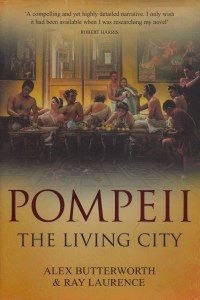
   POMPEII – The Living City

by  Alex Butterworth & Ray Laurence

Pompeii book cover

<><><><><p

Reviewed by Anne Frandi-Coory

(Click on images to enlarge)

About the authors:

Alex Butterworth is a writer and dramatist, who holds degrees from the University  of Oxford and the Royal College of Art. Ray Laurence is a Research Fellow in the Institute of Archaeology  and Antiquity at the University of Birmingham. He was previously a Senior Lecturer in Ancient History at the University of Reading. He has published seven academic books on Roman archaeology  and history.

I bought this wonderful book a few years ago and I must admit to only now getting around to reading it. The authors have written a compelling, valuable  book for any treasured collection.  I visited the partially reconstructed Pompeii in the early nineties, and even then I was amazed at how ‘modern’ and well equipped the ancient city had been.

Archaeologists have literally dug up a plethora of data out of what’s left of Pompeii revealing so much about life within the Roman Empire. Although there is a huge amount of excavation still to take place, there is enough information gathered so far, allowing scientists to gain an intimate insight into what life was like in a Roman city at that time.

Authors Butterworth and Laurence tell us that Pompeii contains probably the greatest density of data of any archaeological site in the world, but that only augments the challenge facing contemporary scholars. The sheer volume of material that can be drawn upon, along with the shortcomings in technique and record-keeping  of many of those who have worked on the site in the past, make the task of bringing all the disparate evidence into some meaningful relationship especially difficult. But the authors have managed to achieve that brilliantly,  bringing carefully selected data  together  into an enjoyable and informative read.  

Pompeii was a city ‘full of political tensions, and very strange customs.’ It was a place where competitive merchants vied for the best customers and trade routes.  Wealthy, powerful citizens pursued all manner of pleasures. But pleasures were legal only for the rich; the poor and slaves were denied such luxury. Successful merchants and renowned magistrates owned comfortable villas along the coast, exotic goods and food at their disposal. In the meantime, Emperor Nero sinks further into murder, despotism and debauchery.  Citizens of Pompeii certainly couldn’t rely on help from their Emperor after the earthquake, although he did visit some time later. Even then, although his empire was carrying massive debt because of his spending sprees, including  the building of his golden palace, he was treated to a massive orgiastic feast in one of the few luxurious villas still left standing.

Combining  the most recent archaeological and historical research,  POMPEII’s  story sucks the reader into a vivid portrait of the doomed city during the twenty five years in which the city suffered a massive, devastating  earthquake  followed 17 years later by the eruption of Mt Vesuvius which completely destroyed the city and surrounding areas beneath it. Only the wealthy living in well-built villas could afford to have their homes and water pipes repaired so that fresh water flowed  again, in the years after the earthquake.  Others moved away before the mountain blew its top. What modern scientists have learned  about earthquakes, with the help of the latest technology, is used to compare what the eruption of Vesuvius would have been like to witness and the damage it wreaked upon its environs. There is no doubt that the earthquake caused significant damage to the land on the mountain side as well as below on the plains. The death toll from the quake would have been huge, and those bodies which could not be retrieved, created even more nauseating smells with the high risk of disease . Following the upheaval livestock died from lethal fumes boiling up from the centre of the mountain through fissures opened up by the earthquake. The smell of sulphur added to the other foul odours that citizens of every city had to endure.  And since the earthquake, the people of Pompeii also had to live through frightening aftershocks which continued right up until the eruption 17 years later.

‘The earthquake that struck Pompeii and the surrounding region on 5 February,  AD 62, is thought to have measured over 7.5 on the Richter scale. In all likelihood it was the result of an upward flow of magma within the earth’s crust along the geological fault that ran under Vesuvius: having vented its fury it then subsided before finally forcing its way out in dramatic fashion during the mountain’s eventual eruption… In the cities that bore the brunt of the devastation, Pompeii and Herculaneum, the archaeological evidence suggests that scarcely a single building was left untouched.

Snippets from a couple of paragraphs in chapter entitled ‘Apocalypse’ convey  vividly the eruption of Mt Vesuvius:

‘An eruption of such force occurs, on average, only once in a thousand years: there would have been no precedent in recorded history and mythology afforded the only point of reference. It is greatly to the credit of the Younger Pliny and his scientific training that, even while he watched his uncle set sail to his death, [while attempting to rescue citizens from the erupting volcano] he was able to categorise his observations calmly enough to produce an accurate report sometime later. His account provided the textbook case of volcanic eruptions for decades to come. ..The sight of fire and stone roaring up to the heavens that Pliny witnessed from across the bay “thrusting, bulging and uncoiling , as if the hot entrails of the earth were being drawn out and dragged towards the heavens” would have been massively more terrifying when seen from Pompeii.’


************************************************

Graffiti Pompeii 1

********************************************

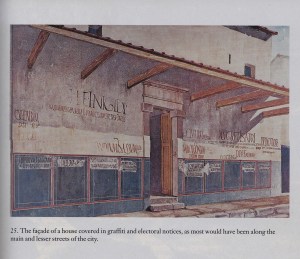
Much graffiti written on walls around Pompeii has been found which gives further insight into what ordinary citizens thought of officials and neighbours, among other things.

Rather than the ancient graffiti and political posters that once covered the walls and summoned the flavour of the lost world, the most resonant graffiti still visible in excavated Pompeii today is perhaps that in the toilets of the cafeteria: “If I’d wanted ruins I could have gone to Kabul.” ‘

However, ancient ‘graffiti, signs and especially electoral notices offer clues as to the ownership of particular dwellings within the city walls, but in the villas outside the city evidence is usually in the form of rings with name-stamps that were left there by freedmen who were most probably their bailiffs.’

A visitor seeking directions outside the city would find help in a graffito such as –  “At Nuceria ask for Volvellia  Primigenia in the Vicus Venerius by the Rome Gate.”  According to other graffiti,  Primigenia was an especially desirable prostitute.  Pompeii’s ‘red light’ district was known as the ‘Venus District’. Political graffiti were also very common inside and outside the city walls. “For the health, return, and victory of Gaius Julius Phillipus, here, to his lares, Publius Cornelius Felix and  Vitalis Cuspius make an offering .”

What makes this book even more interesting are the many vignettes of life in real time, in which are revealed the hardships  of a few slaves, freedmen and the money worries and tasks of magistrates, taken from notes  on clay tablets:

Stories had been circulating of the deadly vapours that had poured from the cracks in the hillside the previous year engulfing the flocks but also spreading pestilence to the farms and into the city. Magonimus, a doctor, trusted in his own theories though, and was glad when he and his companion had begun their climb through the vines and towards the thinner air of the mountains.He knew how the shepherds in their hilltop cabins lived to a ripe age while the dwellers on the plain and in the marshes died young and miserable. And he was relieved for awhile to be free of the mosquitos that swarmed down below, endlessly disturbing his sleep with the angry sound of their flight. …Gazing down into the broken city, its walls and gates still in ruins Magonimus’s mind drifted to the many stricken victims of the quake whom his ministrations had failed to save – their limbs twisted and bloody, their breath rasping and their clothes soiled from terror…The doctor could not rid himself of the feeling that the whole world was ailing. Pompeii was full of rumours. It was said that the subterranean cisterns that stored rainfall from the wet months were cracked and seeping, and the landowners unable to afford their repair. Water was  scarce while wine was simply being poured away. Whether from death or sudden impoverishment, buyers were failing to collect their part paid goods and so, as the law allowed, the vignerons were throwing out thousands of gallons to make space for the coming year’s vintage. And this was only the beginning of the landowners’ troubles.

Life for slaves was harsh and many barely survived. Only the luckiest were freed in adulthood and even then, if they were once the object of their master’s sexual proclivities,   some were required to be on call whenever their ex master desired. If a slave worked in the kitchens or as waiters at drunken feasts, the only food they could consume was at the end of a long  day, when they were permitted to eat the leftovers. Slaves were commodities to be traded; men, women and children, it didn’t matter, and during orgiastic feasts, were fair game to be groped, raped, or whatever the drunken guests desired.

It was not until two years earlier when Receptus had been promoted to vilicus at Fannius Synister’s farm that he had grasped the full misery that the master’s arrival could provoke. For eleven months out of twelve, Receptus’s word was law on the estate and he was loathed for it by every slave and hired hand who worked under him. It was he who saved money by cutting the rations to the sick; he who set a day-labourer adrift the instant they’d got their feet under the table; he who drove the slaves out in the face of storms and hailstones to dig pits for manure or scrub the farmstead clean, and who ordered the beatings of those who slackened at the task.

…And now , at dawn on the fourth day of his master’s visit, Receptus found himself at the Vesuvius Gate of Pompeii, dispatched to hire day-labourers from where they gathered beside the muleteers’ inn just inside the walls; specialists to graft the vines, even though he knew that the stems weren’t ready for it and wouldn’t be for another week at least…Knowing that even the best men would fail to win Synistor’s approval, Receptus chose carefully but quickly; better not to give his master time to scrutinise the slave gangs’  performance without him there to drive them on, or to intimidate the young slave girl Chloe who had been nervous for weeks since hearing that she was to meet her master for the first time. Synistor had not yet broken the news that he had decided to take her back to Rome with him as a gift for a friend.

Only certain officials such as magistrates and priests were permitted to wear the special purple of the  toga praetexta, and a man could be put to death for disobeying this law.


****************************************

Pompeii 1


***************************************************************************************************************

The detailed index at the back of the book is a great aid for future references. With an excellent bibliography for follow-up reading. The book contains several coloured plates and helpful maps.

-Anne Frandi-Coory  13 July 2016

Also here on Facebook: https://www.facebook.com/myhomelibrary/

******************************************************

As an aside:

While reading this book, I could not help comparing the Holy Roman Empire and its efficient bureaucracy with the Catholic Church. After all, the Catholic Church was the state religion of the Roman Empire, and the Church had centuries in which  to copy and implement many of the Empire’s cultures and laws [Canon Law]. The Catholic Church is one of the most far reaching and well organised religions in the world. Patriarchal, altar boys/slaves, temple priests, the popes as emperors in silk gowns and hats, purple also a significant colour within the Church’s hierarchy, still  today. That the Church has in modern times been engulfed in scandals relating to the rapes of hundreds of children mostly boys, over  decades, possibly centuries, adds another comparison that cannot really be ignored. – Anne Frandi-Coory

ASHBYGATE  

The plot to destroy Australia’s Speaker 

by Ross Jones 


Ashbygate


Tony Abbott took over the reins as Leader of the Opposition and of the Liberal National Coalition Party on 1 December 2009 and it is my personal opinion that from that day on Australian politics descended into ‘gutter politics’ in which no perceived enemy or opponent of Abbott was spared!  Abbott went on to lead the Coalition to the 2010 general election which resulted in a hung parliament.  Labor  formed  government with the help of the Greens and Independent MPs.  Abbott appears to be a vindictive and spiteful man, who  with the assistance of a large willing and supportive in-house  ‘team’ set about to undermine the Gillard Government, and consequently  destroyed  the Speaker of the House, Peter Slipper.  Abbott was re-elected as Liberal Leader unchallenged  and eventually  led  the Coalition to victory in the 2013 election  and was sworn in as the 28th Prime Minister of Australia on 18 September 2013. (Tony Abbott’s tenure as Prime Minister lasted for a year, when he was deposed by current PM Malcolm Turnbull.)

There is no doubt that a group of LNP politicians and others,   deployed a series of tactics to  undermine PM Gillard during her term of office, but this is beyond the scope of  Jones’ book  ASHBYGATE which deals solely with the destruction of Australia’s Speaker, the vital aspect of the plan to bring down Gillard’s Labor government.

Ross Jones’ book ASHBYGATE  is an account of the results of his investigation into how the Speaker was hounded from the Chair. The Speakership is the most important office in the House of Representatives. The House cannot operate without a Speaker because he/she  is the principal office holder in the House of Representatives. He/she is the House’s representative or spokesperson, the Chair of its meetings and its ‘Minister’ in respect of its support services. By all accounts, Peter Slipper was an efficient Speaker who valued his role dearly, but he also had enemies within…he had the temerity to resign from LNP to take on the role as Speaker in a Labor government. Peter Slipper and Tony Abbott were very close friends until Slipper’s  ‘betrayal’ . There wasn’t much about each’s personal life that the other didn’t know about.

Jones allows primary documents, in chronological order,  such as, emails and other correspondence, text messages, and Ashby vs Slipper court evidence,  to inform readers of the machinations that drove  the Ashbygate  saga and this gives them  the opportunity to form their own opinions about the politicians who were  involved and implicated in this sordid saga. It also gives the book validity as a valuable record of Australia’s political history.

Readers will read in the pages of ASHBYGATE   that Peter Slipper is no  paragon of virtue, and has never claimed to be.  Yes, at  times he acted foolishly, but I don’t believe he deserved the total destruction of his career and his private life which was essentially brought about by former colleagues who have themselves  much in their political histories  and private lives  to hide from scrutiny. In the end, Ashby withdrew all charges of sexual harassment against Slipper.  Slipper was cleared of all dishonesty charges relating to the fraudulent use of Commonwealth  Cabcharge dockets in 2010. Jones writes: This means the highly damaging  cases Mr Slipper had piling up against him – including claims of sexual harassment from his former media adviser, James Ashby, have been either withdrawn or  shown to have had no substance.

After reading   ASHBYGATE   I‘d like to pose  a few questions:

  1. Was Tony Abbott, along with his close advisers, and political colleagues,  the ‘brains’ behind  Ashbygate?  Is it conceivable that he would not have been involved given how and when the documented events took place?
  1. Was James Ashby so stressed during the short time he worked as press secretary for Peter  Slipper, not because of two or three  salacious texts and other real or imagined ‘overtures’ by Slipper, but because Ashby was unsuitable and unqualified for the position? Is there some evidence that his gay lifestyle  may have been a factor in his precarious  emotional state?
  1. Why did Peter Slipper employ Ashby, an ex DJ and strawberry farm advertising agent, for such an important role as press secretary in the first place, given Ashby’s lack of qualifications?
  1. If Peter Slipper had any case to answer, why did the Commonwealth cover the ‘shortfall between Slipper’s legal fees and the costs ultimately recovered as a result of the Rares judgement’?
  1. Why did James Ashby and Mal Brough approach Clive Palmer for funds for legal fees, which would amount to millions of dollars, in the pursuit of Slipper?  In any  event  Palmer refused, so someone  else must have assured Ashby of  financial backing; was it Christopher Pyne, as Ashby claims?
  1. Did Justice Rares make a judgment that Ashby’s sexual harassment claims were vexatious in order to protect the judge’s friends in high political places?  Would  his  finding  in favour of Ashby have led to the exposure of  Tony Abbott and other high profile politicians to a long drawn out trial, involving sworn testimony? [Vexatious litigation is legal action which is brought, regardless of its merits, solely to harass or subdue an adversary]
  1. What was the real reason Karen  Doane  sought to destroy her employer, Peter Slipper? According to her texts and emails, she was hardly ever in Slipper’s office, and spent much of the time leading up to Ashby’s public allegations,  on ‘sick’ leave?  Was Doane simply one of the most dishonest, disloyal, and laziest employees ever, or was there something more sinister in her behaviour? Whatever the reasons, she was on paid sick leave of over $1000.00 per week for years  until she finally received a huge payout of taxpayer funds in settlement for what?

In places,  ASHBYGATE  was an intense  read because of the many phone texts and emails  to work through, even allowing for the different fonts used to differentiate between the various senders and writers.  However, it is very much worth the effort. The comings and goings, the minutiae  of political office, and the effect on family life,  are intriguing . I fully realise  now,  how true is the time worn  cliché  that  ‘a week in politics is a long  time’.

There were a few minor spelling errors in the emails and texts, which may or may not have been senders’  errors, but there were also quite a number of  spelling errors in the author’s prose. Let me assure readers, that while typos  jumped out at me, they in no way detracted from what I consider to be a valuable book and a great read. Jones has obviously spent months accessing relevant documents and records, as well as  undertaking  several  interviews, in his research for this book. I congratulate him for bringing to light the story behind  Ashbygate.

I urge voters to read ASHBYGATE so they may gain insight into the actions of those politicians involved in the destruction of the Speaker of the House.

***************************************************************************

I am not an affiliate of any political party; I bought ASHBYGATE  from one of my favourite bookstores, Readings in Carlton.  I detest any form of injustice, and I believe  that  Peter Slipper has been served a great injustice.

-Anne Frandi-Coory   20 May 2016

Also here on Facebook: https://www.facebook.com/myhomelibrary/

Updated 23 May 2018

*****

THE PLANETS  &   LONGITUDE  –  Book Reviews

I think these two great little books by Dava Sobel go together:

THE PLANETS

Dava Sobel writes about science in a way that young readers and adults alike can enjoy without constantly referring  to a dictionary or a science magazine, although I did find having a simple map of our solar system at hand, very helpful.   “If reading these pages has helped someone befriend the planets, recognising in them the stalwarts of centuries of popular culture and the inspiration for much high-minded human endeavour , then I have accomplished what I set out to do” A quote from Dava Sobel in  The Planets. She could also add: and the inspiration for much romantic poetry.

solar_system_menu


Although I love reading the results of  research and discovery the world of  science brings us, I am not a science buff and too much science jargon can be confusing. I recommend these books to young readers with enquiring minds and adults who don’t read science publications,  because they are enthralling to read and the author takes readers through hundreds of years of brief history with such easy to read, beautiful prose.

I have to admit to being  a little blasé about planets and space travel; I have enough going on here on planet Earth without stressing about what’s happening on Mars and Mercury.  Until I read Dava Sobel’s The Planets, that is!

This is not quite a whodunnit, but I couldn’t put the book down once I read the first couple of pages. I learned in those  first pages the names of the nine planets and their order of distance from  the sun and committed them to memory using Sobel’s “appealing nonsense-sentence mnemonic” … My Very Educated Mother Just Served Us Nine Pies: Mercury Venus Earth Mars Jupiter Saturn Uranus Neptune Pluto  …I’m almost ashamed to admit that I didn’t know any of this before reading The Planets.

Readers will learn how planets were discovered, how they’re named and in recent years, through remarkable discoveries via  satellites, spaceships  and research stations, we have gained intricate information about the makeup of planets, and even when and how they were formed. We now know how long they take to orbit the sun, how often a planet  rotates on its own axis.  The author ventures into mythology and astrology, which adds to the fascinating stories surrounding   each planet.

Now ‘morning star’, now ‘evening star’, the bright ornament of the planet Venus plays a prelude to the rising sun, or post script to the sunset. –  Dava Sobel waxes lyrical about Venus.

Sobel tells us that Ishtar metamorphosed into Aphrodite, the Greek incarnation of love and beauty. She became the Venus of the Romans, revered by the historian Pliny for spreading a vital dew to excite the sexuality of earthly creatures…Only the Mayans and the Aztecs of Central America seem to have seen Venus as consistently male. The rhythmic  association between Venus and the Sun inspired meticulous astronomical observations and complex calendar reckoning in those cultures, as well as blood rituals to recognise the planet’s descent into the underworld and subsequent resurrection. [Obvious inspirations for gods and divine resurrections in so many religions]

But Sobel also brings us back to Earth so to speak, with the reality that is planet Venus: …some of her volcanoes may well be active. Right now, sulphurous gases hissing from Venusian fumaroles could be making their way up to the clouds above the planet, to augment them and sustain them, and thereby ensure the enduring brightness of Venus to our eyes. That fair appearance of unassailable purity once made Venus the darling of poets, whose words  still best express her effect on the night’s blue velvet – ‘a joy forever’, as Keats said , ‘ a cheering light / unto our souls’.

You’ve probably guessed that my favourite planet is Venus, and that’s because she was once thought by ancients to be Ishtar returning to the heavens. Poets wrote beautiful poetry in honour of  Venus:

Thou fair-haired angel of the evening,

Now, whilst the sun rests on the mountains, light

Thy bright torch of love; thy radiant crown

Put on, and smile upon our evening bed!

Smile on our loves, and, while thou drawest the

Blue curtains of the sky, scatter thy silver dew

On every flower that shuts its sweet eyes

In  timely  sleep. Let thy west wind sleep on

The lake; speak silence with thy glimmering eyes,

And wash the dusk with silver.

-William Blake  To The Evening Star

A reviewer for the Independent,  John Gribbin  wrote: ‘If you like your science lyrical, Sobel is the author for you.’  I can assure you though, Sobel knows her science. She is a former science journalist for the New York Times. Sobel informs us that we are very much in a golden age of spacecraft and they are on their way to Mercury, Pluto, and Mars. During  her extensive research for The Planets, the  thing  that was most surprising to Sobel, was the size discrepancy  between the Sun and the rest of the planets and she believes  that ‘really the Solar System is the Sun’. To be honest, there were many wonderful things that surprised and overawed me while  I was reading The Planets!

********************************

 LONGITUDE

Dava Sobel writes:

Here lies the real hard core difference  between latitude and longitude – beyond the superficial difference in  line direction that any child can see: The zero-degree of parallel of latitude is fixed by the laws of nature, while the zero-degree meridian of longitude shifts like the sands of time.  The difference makes finding latitude child’s play, and turns the determination of longitude, especially at sea, into an adult dilemma – one that stumped the wisest minds of the world for the better part of human history. Any sailor worth his salt could  gauge  his latitude well enough by the length of the day, or by the height of the sun or known guide stars above the horizon…the measurement of longitude meridians, in comparison, is tempered by time. To learn one’s longitude at sea, one needs to know what time it is aboard ship and also the time at the home port or another place of known longitude –at that very same moment. The two clock times enable the navigator to convert the hour difference into a geographical  separation…

Precise knowledge of the hour in two different places at once-a longitude prerequisite so easily accessible today from any pair of cheap wristwatches-was utterly unattainable up to and including the era of pendulum clocks. On the deck of a rolling ship, such clocks would slow down, or speed up, or stop running altogether. Normal changes in temperature en route from a cold country of origin to a tropical trade zone thinned or thickened a clock’s lubricating oil and made its metal parts expand or contract with equally disastrous results. A rise or fall in barometric pressure , or the subtle variations in the Earth’s gravity from one latitude to another, could also cause a clock to gain or lose time.

In Longitude, the author  takes us on an historical voyage through time, whipping up a storm of an exciting and intriguing brief history  of astronomy, navigation and clock making  at the centre of which, is the fascinating story of John Harrison the Yorkshire clock maker and his forty year battle to build the perfect time-keeper, changing sea navigation forever. Dava Sobel allows the ghosts of ancient seafarers  to walk through the pages…

Reading THE PLANETS  and LONGITUDE has increased my knowledge of the world around me;  the sea, the land and our solar system.  Thank you, Dava Sobel

-Anne Frandi-Coory 17 April 2016

Also here on Facebook: https://www.facebook.com/myhomelibrary/