Archive

BOOKS In My Non-Fiction Collection-REVIEWS

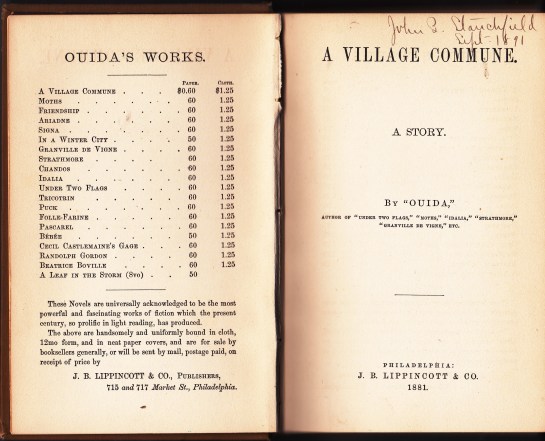
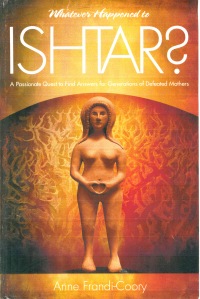
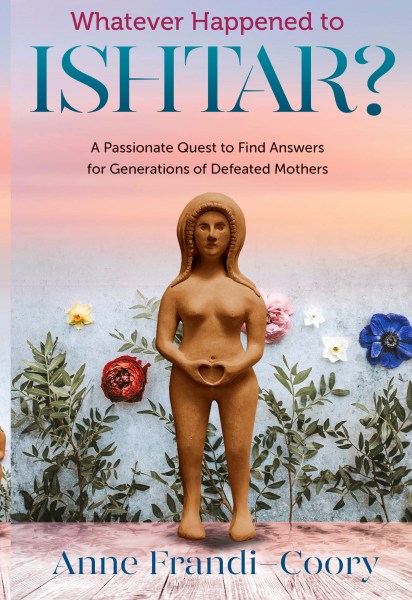
While doing research into my Italian ancestry for my book, Whatever happened To Ishtar? I read somewhere that if you wanted to know what it was like living in 19th Century Italy, you might wish to read Village Commune by Maria Louise Ramé, otherwise known by her pseudonym, Ouida. It turned out to be very good advice. I searched for the book online and found it  in a tiny obscure USA second hand book shop. When I received what is now a prized possession, I discovered it was a First Edition published 1881 by J. B. Lippincott & Co.  Philadelphia/

The Commune 2

Published in 1881

My great grandparents, Aristodemo and Annunziata Frandi experienced similar hardships to those described by Ouida in Village Commune. Many young men from poor families were conscripted into the regular army to fight against the Austrians, as was Aristodemo, who came from a family of farmers. The Frandi family, by then including three young children, emigrated to New Zealand in 1876 and I now fully understand why.  Although Aristodemo talked to family about life in Italy, both of his hated time barracked with the regular army  in the far north of Italy, and his time fighting in the south of Italy with Garibaldi, I had no real understanding of just how difficult life was at that time.

I had always thought of Italy as a wonderful country, full of poetry, art, fabulous food and generous citizens. I have visited the country often and I have never been disappointed. But of course there was, and is, another side to Italy altogether.

Ouida’s eloquently written and absorbing stories of life in northern Italy are heart-rending. Farmers and agriculturists, whose families had lived on the land for generations, had their land taken at the whim of wealthy, corrupt government officials and were left homeless and hungry. The burgeoning Industrial Revolution needed land for factories, and dwellings for workers moving onto the countryside. Land was also needed to build mansions for wealthy officials, and for railways.

<><><><><><><><><><><><><><><><><><><><><><><><><><><><><><><><><><><><><><><><><><><><><><><><><><>

The Commune

Note the prices listed for Ouida’s publications. The handwritten name and date came with the book.


><><><><><><><><><><><><><><><><><><><><><><><><><><><><><><><><><><><><><><><><><><><><><><><><><><><><><><><><>

The author connects on an emotional level with the reader, as she relates beautifully crafted, albeit harrowing, life stories.  One such story is of a young Florentine farming peasant :

He was a peasant who had been taken by conscription just as a young bullock is picked out for the shambles, and he had never understood why very well. His heart has always been with his fields, his homestead, his vines, his sweetheart. He had hated the barrack life, the dusty aimless marches, the drilling and the bullying, the weight of the knapsack and the roar of the guns; he had been a youth, ere the government had made him a machine…If the enemy had come into his country he would have held his own hamlet against them to the last gasp; but to be drafted off to Milan to wear a fool’s jacket and to eat black bread while the fields were half tilled, and the old people sore driven…no, he was not a patriot, if to be one, he must have been a contented conscript. 

 Ouida gives a vivid portrayal of the numerous Roman Catholic and other festivals:

Italian merry-making is never pretty. The sense of colour and of harmony is gone out of our people, whose forefathers were models of Leonardo and Raffaelle, and whose own limbs too, have still so often the mould of the Faun and the Discobolus. Italian merry-making has nothing of the grace and brightness of the French fairs, nor even of the picturesqueness and colour of the German feasts and frolics; even in Carnival, although there are gayety [sic] and grotesqueness, there is little grace and little good colouring. But the people enjoy themselves; enjoy themselves for the most part very harmlessly and very merrily when they forget their tax-papers, their empty stomachs, and their bankrupt shops.

Ouida writes extensively and in detail about the corruption and cronyism of government officials, and the cruelty they meted out to hapless villagers. If citizens had wealth, and were well connected, they had plenty of food and their sons escaped conscription! But peasants lived frugally off the land, and life for them was harsh and often brutal.

One of  Ouida’s famous quotes “petty laws breed great crimes” highlights her intimate knowledge and understanding of what life was like for the peasant landowner (agrario).

The commune of Vezzaja and Ghiralda, whose centre is the village of Santa Rosalia, is, like all Italian communes, supposed to enjoy an independence that is practically a legislative autonomy. So long as it contributes its quota to the Imperial taxes, the Imperial government is supposed to have nothing to do with it, and it is considered to be as free as air to govern itself. So everybody will tell you; and so inviolate is its freedom that even the prefect of its province dare not infringe upon it – or says so when he wants to get out of any trouble.

Anybody who pays five francs’ worth of taxes has a communal vote in this free government and helps to elect a body of thirty persons who in turn elect a council of seven persons, who in turn elect a a single person called a syndic, or as you would call him in English, a mayor. This distilling and condensing process sounds quite admirable in theory. Whoever has the patience to read the pages of this book will see how this system works in practice.

Now, in Vezzaja and Ghiralda the thirty persons do nothing but elect the seven persons, the seven do nothing but elect the one person, and the one person does nothing but elect his secretary; and the secretary, with two assistants dignified respectively by the titles of chancellor and conciliator, does everything in the way of worry to the public that the ingenuity of the official mind can conceive. The secretary’s duties ought to be the duties of a secretary everywhere, but by a clever individual can be brought to mean almost anything you please in the shape of local tyranny and extortion; the chancellor (cancelliere) has the task of executing every sort of unpleasantness against the public in general, and sends out his fidus Achates, the usher, all kinds of summons and warrants at his will and discretion; as for the conciliator (giudice conciliatore) his office as his name indicates, is supposed to consist in conciliation of all local feuds, disputes and debts, but as he is generally chiefly remarkable for an absolute ignorance of law and human nature, and for a general tendency to accumulate fees anywhere and anyhow, he is not usually of the use intended, [my emphasis] and rather is famous for doing what a homely phrase calls setting everybody together by the ears…Power is sweet and when you are a little clerk you love its sweetness quite as much as if you were an emperor, and maybe you love it  a good deal more.   

She elaborates further: Tyranny is a very safe amusement in this liberated country. Italian law is based on that blessing to mankind, the Code Napoleon, and the Code Napoleon is perhaps the most ingenious mechanism for human torture that the human mind has ever constructed. In the cities, its use for torment is not quite so easy, because where there are crowds there is always the fear of a riot and besides there are horrid things called newspapers , and citizens wicked enough and daring enough to write in them. But away in the country, the embellished and filtered Code Napoleon can work like a steam plough; there is nobody to appeal and nobody to appeal to. The people are timid and perplexed; they are as defenceless as the sheep in the hand of the shearer; they are frightened at the sight of the printed papers and the carabinier’s [sic} sword. There is nobody to tell them they have rights , and besides, rights are very expensive luxuries anywhere and cost as much to take care of as a carriage horse.

In Village Commune Ouida dissects the family lives of unfortunate peasants in 19th Century Italy. I believe that many of these soul destroying Italian tragedies are on a par with the famous Greek plays left to us by Aeschylus or Sophocles. There is much irony within the pages of Village Commune

There are far too many long sentences, semi-colons and commas in this book, but they take nothing away from the wit, sarcasm and  beautiful prose flowing from Ouida’s pen. I highly recommend this wonderful little book… if you can find a copy.

* *********************************************************************

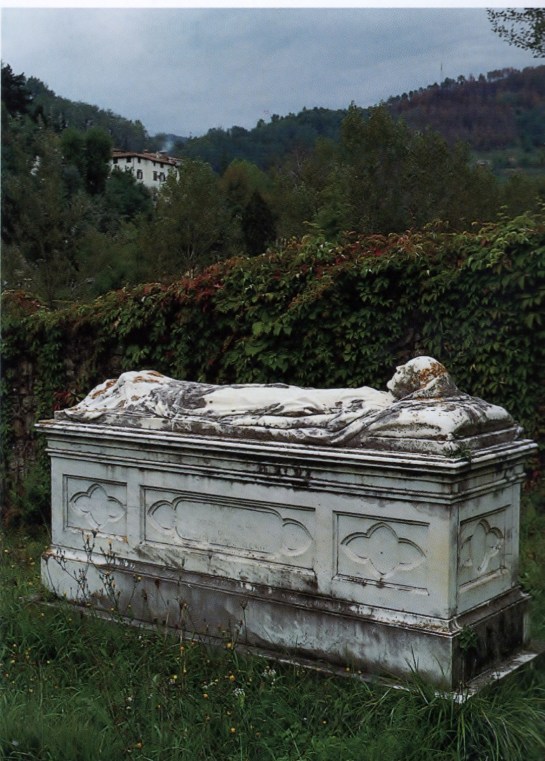
Ouida's headstone.jpg

OUIDA’S HEADSTONE


Ouida Tomb

OUIDA’S TOMB in Bagni di Lucca

**********************************************************************

‘Nature she knew by heart: on birds and flowers
She could discourse for hours and hours and hours.
Sententious, sentimental, repetitious, she
Would never choose one word if there were three. Pith was her weakness;
clichés were her strength. And here she lies now, as she wrote, at length.’
– Christopher Stace, from ‘At first seeing Ouida’s tomb in Bagni di Lucca’ as published in The New Yorker 


*****

Please visit Anne Frandi-Coory’s facebook page here: 

https://www.facebook.com/myhomelibrary/


Fay Eggeling

A Card – from Fay Eggeling

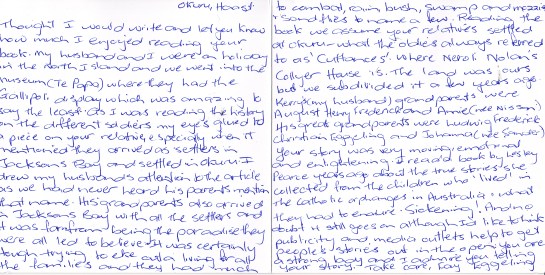
letter from Faye Eggeling

Okuru, Haast

I thought I would write and let you know how much I enjoyed reading your book, Whatever Happened To Ishtar? – A Passionate Quest To Find Answers For Generations Of Defeated Mothers.

********************************

Whatever Happened to Ishtar_cover 2020

Updated 4th edition (2020) available in paperback and Kindle ebook from AMAZON 

and here from ABE BOOKS  

***********************************************

My husband and I were on holiday in the North Island and we went into the museum (Te Papa) where they had the Gallipoli display which was amazing to say the least. As I was reading the history of the different soldiers my eyes glued to a piece on your relative,   Ateo Frandi   especially when it mentioned they [Frandi family] arrived as settlers in Jackson Bay and settled in  Okuru. I drew my husband’s attention to the article as we had never heard his parents mention that name [Frandi]. His grandparents also arrived in Jackson Bay with all the settlers and it was far from being the paradise they were all led to believe. It was certainly tough trying to eke out a living for all the families and they had much to combat; rain, bush, swamp, mozzies, and sandflies to name a few.

Reading the book we assume your relatives settled at Okuru – what the oldies always referred to as ‘Cuttances’, where Neroli Nolan’s Collyer House is. The land was ours but we sub-divided it a few years ago.

Kerry’s, (my husband) grandparents were August Henry Frederick and Annie (nee Nisson). His great grandparents were Ludwig Frederick Christian Eggeling and Johanna (nee Sander).

Your story was very moving, emotional and enlightening. I read a book by Lesley Pearce years ago about the true stories she collected from the children who ‘lived’ in the Catholic orphanages in Australia and what they had to endure. Sickening! And no doubt it still goes on although I like to think publicity and media outlets help to get people’s stories out into the open. You are a strong lady and I admire you telling your story.

Take care

– Fay Eggeling – 16 November 2015

Read more about Anne Frandi-Coory

and her Italian family history here:

Also here on Anne Frandi-Coory’s Facebook page 

https://www.facebook.com/myhomelibrary/


*****

img06052017_001

Updated 5 June 2017 

******************

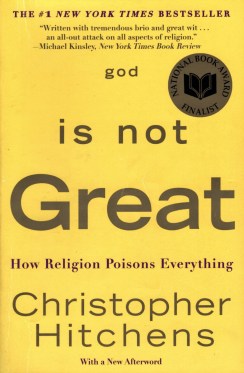
A must read for anyone interested in the background of the three monotheistic religions spawned in the Middle East:

Judaism, Christianity and Islam

Christopher Hitchens’ quotes from the book:

“There would be no such churches in the first place, if humanity had not been afraid of the weather, the dark, the plague, the eclipse, and all manner of other things now easily explicable. And also if humanity had not been compelled, on pain of extremely painful consequences, to pay the exorbitant tithes and taxes that raised the imposing edifices of religion.”

“What is religion, if not political in terms of governing the people?”

“As far as I am aware, there is no country in the world today where slavery is still practiced, where the justification of it is not derived from the Qur’an.”

Read about the blatant plagiarism by Christianity and Islam from ancient Judaism and Paganism, and the violence perpetrated by all of these religions against non-believers. Christopher Hitchens is a gifted writer, historian and philosopher; I could not put this book down once I began reading it. Now more than ever, this is a book for our times, with our world in jeopardy because of the war being waged between the Christian West and Islam.

There can no longer be any doubt that the religious indoctrination of children is child abuse.

– Anne Frandi-Coory

“Merciless…quite comical…trenchant and witty… God Is Not Great is a treasure house of zingers worthy of Mark Twain or Mencken.” – Daniel C. Dennett, Boston Globe

><><><><><><><><><><><><>

Are USA, Australia, Secularist or Theocratic Countries?

Although the following discussion refers to USA, it could easily refer to

LNP far right conservative  government of Australia in 2017: 

The Catholic Church, Jesus, Religion in State Schools, Nazi alliance with the Vatican, Islam, Jihad, Christianity

><><><><><><><><><><><><><><><><><><><><>

dawkins_hitchens in conversation photo Newstatesman

Richard Dawkins’ last interview with Christopher Hitchens in 2011 (photo; New Statesman)

*****

“Never be afraid of stridency”:

Richard Dawkins’ interview with Christopher Hitchens

Is America heading for theocracy?

How worrying is the rise of the Tea Party?

Christopher Hitchens and Richard Dawkins discuss God and US politics.

Transcribed by Richard Dawkins

RD: As an Orwell scholar, you must have a particular view of North Korea, Stalin, the Soviet Union, and you must get irritated – perhaps even more than I do – by the constant refrain we hear: “Stalin was an atheist.”

CH: We don’t know for sure that he was. Hitler definitely wasn’t. There is a possibility that Himmler was. It’s very unlikely but it wouldn’t make any difference, either way. There’s no mandate in atheism for any particular kind of politics, anyway.

RD: The people who did Hitler’s dirty work were almost all religious.

CH: I’m afraid the SS’s relationship with the Catholic Church is something the Church still has to deal with and does not deny.

RD: Can you talk a bit about that – the relationship of Nazism with the Catholic Church?

CH: The way I put it is this: if you’re writing about the history of the 1930s and the rise of totalitarianism, you can take out the word “fascist”, if you want, for Italy, Portugal, Spain, Czechoslovakia and Austria and replace it with “extreme right Catholic party”. Almost all of those regimes were in place with the help of the Vatican and with understandings from the Holy See. It’s not denied. These understandings quite often persisted after the Second World War was over and extended to comparable regimes in Argentina and elsewhere.

RD: But there were individual priests who did good things.

CH: Not very many. You would know their names if there were more of them. When it comes to National Socialism, there’s no question there’s a mutation, a big one – the Nazis wanted their own form of worship. Just as they thought they were a separate race, they wanted their own religion. They dug out the Norse gods, all kinds of extraordinary myths and legends from the old sagas. They wanted to control the churches. They were willing to make a deal with them. The first deal Hitler made with the Catholic Church was the Konkordat. The Church agreed to dissolve its political party and he got control over German education, which was a pretty good deal. Celebrations of his birthday were actually by order from the pulpit. When Hitler survived an assassination attempt, prayers were said, and so forth. But there’s no doubt about it, [the Nazis] wanted control – and they were willing to clash with the churches to get it. There’s another example. You swore on Almighty God that you would never break your oath to the Führer. This is not even secular, let alone atheist.

RD: There was also grace before meals, personally thanking Adolf Hitler.

CH: I believe there was. Certainly, you can hear the oath being taken – there are recordings of it – but this, Richard, is a red herring. It’s not even secular. They’re changing the subject.

RD: But it comes up over and over again.

CH: You mentioned North Korea. It is, in every sense, a theocratic state. It’s almost supernatural, in that the births of the [ruling] Kim family are considered to be mysterious and accompanied by happenings. It’s a necrocracy or mausolocracy, but there’s no possible way you could say it’s a secular state, let alone an atheist one.

Attempts to found new religions should attract our scorn just as much as the alliances with the old ones do. All they’re saying is that you can’t claim Hitler was distinctively or specifically Christian: “Maybe if he had gone on much longer, he would have de-Christianised a bit more.” This is all a complete fog of nonsense. It’s bad history and it’s bad propaganda.

RD: And bad logic, because there’s no connection between atheism and doing horrible things, whereas there easily can be a connection in the case of religion, as we see with modern Islam.

CH: To the extent that they are new religions – Stalin worship and Kim Il-sungism – we, like all atheists, regard them with horror.

RD: You debated with Tony Blair. I’m not sure I watched that. I love listening to you [but] I can’t bear listening to . . . Well, I mustn’t say that. I think he did come over as rather nice on that evening.

CH: He was charming, that evening. And during the day, as well.

RD: What was your impression of him?

CH: You can only have one aim per debate. I had two in debating with Tony Blair. The first one was to get him to admit that it was not done – the stuff we complain of – in only the name of religion. That’s a cop-out. The authority is in the text. Second, I wanted to get him to admit, if possible, that giving money to a charity or organising a charity does not vindicate a cause. I got him to the first one and I admired his honesty. He was asked by the interlocutor at about half-time: “Which of Christopher’s points strikes you as the best?” He said: “I have to admit, he’s made his case, he’s right. This stuff, there is authority for it in the canonical texts, in Islam, Judaism.” At that point, I’m ready to fold – I’ve done what I want for the evening. We did debate whether Catholic charities and so on were a good thing and I said: “They are but they don’t prove any point and some of them are only making up for damage done.” For example, the Church had better spend a lot of money doing repair work on its Aids policy in Africa, [to make up for preaching] that condoms don’t prevent disease or, in some cases, that they spread it. It is iniquitous. It has led to a lot of people dying, horribly. Also, I’ve never looked at some of the ground operations of these charities – apart from Mother Teresa – but they do involve a lot of proselytising, a lot of propaganda. They’re not just giving out free stuff. They’re doing work to recruit.

RD: And Mother Teresa was one of the worst offenders?

CH: She preached that poverty was a gift from God. And she believed that women should not be given control over the reproductive cycle. Mother Teresa spent her whole life making sure that the one cure for poverty we know is sound was not implemented. So Tony Blair knows this but he doesn’t have an answer. If I say, “Your Church preaches against the one cure for poverty,” he doesn’t deny it, but he doesn’t affirm it either. But remember, I did start with a text and I asked him to comment on it first, but he never did. Cardinal Newman said he would rather the whole world and everyone in it be painfully destroyed and condemned for ever to eternal torture than one sinner go unrebuked for the stealing of a sixpence. It’s right there in the centre of the Apologia. The man whose canonisation Tony had been campaigning for. You put these discrepancies in front of him and he’s like all the others. He keeps two sets of books. And this is also, even in an honest person, shady.

RD: It’s like two minds, really. One notices this with some scientists.

CH: I think we all do it a bit.

RD: Do we?

CH: We’re all great self-persuaders.

RD: But do we hold such extreme contradictions in our heads?

CH: We like to think our colleagues would point them out, in our group, anyway. No one’s pointed out to me in reviewing my God book God Is Not Great that there’s a flat discrepancy between the affirmation he makes on page X and the affirmation he makes on page Y.

RD: But they do accuse you of being a contrarian, which you’ve called yourself

CH: Well, no, I haven’t. I’ve disowned it. I was asked to address the idea of it and I began by saying it’s got grave shortcomings as an idea, but I am a bit saddled with it.

RD: I’ve always been very suspicious of the left/right dimension in politics.

CH: Yes; it’s broken down with me.

RD: It’s astonishing how much traction the left/right continuum [has] . . . If you know what someone thinks about the death penalty or abortion, then you generally know what they think about everything else. But you clearly break that rule.

CH: I have one consistency, which is [being] against the totalitarian – on the left and on the right. The totalitarian, to me, is the enemy – the one that’s absolute, the one that wants control over the inside of your head, not just your actions and your taxes. And the origins of that are theocratic, obviously. The beginning of that is the idea that there is a supreme leader, or infallible pope, or a chief rabbi, or whatever, who can ventriloquise the divine and tell us what to do. That has secular forms with gurus and dictators, of course, but it’s essentially the same. There have been some thinkers – Orwell is pre-eminent – who understood that, unfortunately, there is innate in humans a strong tendency to worship, to become abject. So we’re not just fighting the dictators. We’re criticising our fellow humans for trying to short-cut, to make their lives simpler, by surrendering and saying, “[If] you offer me bliss, of course I’m going to give up some of my mental freedom for that.” We say it’s a false bargain: you’ll get nothing. You’re a fool.

RD: That part of you that was, or is, of the radical left is always against the totalitarian dictators.

CH: Yes. I was a member of the Trotskyist group – for us, the socialist movement could only be revived if it was purged of Stalinism . . . It’s very much a point for our view that Stalinism was a theocracy.

RD: One of my main beefs with religion is the way they label children as a “Catholic child” or a “Muslim child”. I’ve become a bit of a bore about it.

CH: You must never be afraid of that charge, any more than stridency.

RD: I will remember that.

CH: If I was strident, it doesn’t matter – I was a jobbing hack, I bang my drum. You have a discipline in which you are very distinguished. You’ve educated a lot of people; nobody denies that, not even your worst enemies. You see your discipline being attacked and defamed and attempts made to drive it out.

Stridency is the least you should muster . . . It’s the shame of your colleagues that they don’t form ranks and say, “Listen, we’re going to defend our colleagues from these appalling and obfuscating elements.” If you go on about something, the worst thing the English will say about you, as we both know – as we can say of them, by the way – is that they’re boring.

RD: Indeed. Only this morning, I was sent a copy of [advice from] a British government website, called something like “The Responsibilities of Parents”. One of these responsibilities was “determine the child’s religion”. Literally, determine. It means establish, cause . . . I couldn’t ask for a clearer illustration, because, sometimes, when I make my complaint about this, I’m told nobody actually does label children Catholic children or Muslim children.

CH: Well, the government does. It’s borrowed, as far as I can see, in part from British imperial policy, in turn borrowed from Ottoman and previous empires – you classify your new subjects according to their faith. You can be an Ottoman citizen but you’re a Jewish one or an Armenian Christian one. And some of these faiths tell their children that the children of other faiths are going to hell. I think we can’t ban that, nor can we call it “hate speech”, which I’m dubious about anyway, but there should be a wrinkle of disapproval.

RD: I would call it mental child abuse.

CH: I can’t find a way, as a libertarian, of saying that people can’t raise their children, as they say, according to their rights. But the child has rights and society does, too. We don’t allow female – and I don’t think we should countenance male – genital mutilation. Now, it would be very hard to say that you can’t tell your child that they are lucky and they have joined the one true faith. I don’t see how you stop it. I only think the rest of society should look at it with a bit of disapproval, which it doesn’t. If you’re a Mormon and you run for office and say, “Do you believe in the golden plates that were dug up by Joseph Smith?” – which [Mitt] Romney hasn’t been asked yet – sorry, you’re going to get mocked. You’re going to get laughed at.

RD: There is a tendency among liberals to feel that religion should be off the table.

CH: Or even that there’s anti-religious racism, which I think is a terrible limitation.

RD: Romney has questions to answer.

CH: Certainly, he does. The question of Mormon racism did come up, to be fair, and the Church did very belatedly make amends for saying what, in effect, it had been saying: that black people’s souls weren’t human, quite. They timed it suspiciously for the passage of legislation. Well, OK, then they grant the right of society to amend [the legislation]. To that extent, they’re opportunists.

RD: But what about the daftness of Mormonism? The fact that Joseph Smith was clearly a charlatan –

CH: I know, it’s extraordinary.

RD: I think there is a convention in America that you don’t tackle somebody about their religion.

CH: Yes, and in a way it’s attributed to pluralism. And so, to that extent, one wants to respect it, but I think it can be exploited. By many people, including splinter-group Mormons who still do things like plural marriage and, very repulsively, compulsory dowries – they basically give away their daughters, often to blood relatives. And also kinship marriages that are too close. This actually won’t quite do. When it is important, they tend to take refuge in: “You’re attacking my fundamental right.” I don’t think they really should be allowed that.

RD: Do you think America is in danger of becoming a theocracy?

CH: No, I don’t. The people who we mean when we talk about that – maybe the extreme Protestant evangelicals, who do want a God-run America and believe it was founded on essentially fundamentalist Protestant principles – I think they may be the most overrated threat in the country.

RD: Oh, good.

CH: They’ve been defeated everywhere. Why is this? In the 1920s, they had a string of victories. They banned the sale, manufacture and distribution and consumption of alcohol. They made it the constitution. They more or less managed to ban immigration from countries that had non-Protestant, non-white majorities. From these victories, they have never recovered. They’ll never recover from [the failure of] Prohibition. It was their biggest defeat. They’ll never recover from the Scopes trial. Every time they’ve tried [to introduce the teaching of creationism], the local school board or the parents or the courts have thrown it out and it’s usually because of the work of people like you, who have shown that it’s nonsense. They try to make a free speech question out of it but they will fail with that, also. People don’t want to come from the town or the state or the county that gets laughed at.

RD: Yes.

CH: In all my tours around the South, it’s amazing how many people – Christians as well – want to disprove the idea that they’re all in thrall to people like [the fundamentalist preacher Jerry] Falwell. They don’t want to be a laughing stock.

RD: Yes.

CH: And if they passed an ordinance saying there will be prayer in school every morning from now on, one of two things would happen: it would be overthrown in no time by all the courts, with barrels of laughter heaped over it, or people would say: “Very well, we’re starting with Hindu prayer on Monday.” They would regret it so bitterly that there are days when I wish they would have their own way for a short time.

RD: Oh, that’s very cheering.

CH: I’m a bit more worried about the extreme, reactionary nature of the papacy now. But that again doesn’t seem to command very big allegiance among the American congregation. They are disobedient on contraception, flagrantly; on divorce; on gay marriage, to an extraordinary degree that I wouldn’t have predicted; and they’re only holding firm on abortion, which, in my opinion, is actually a very strong moral question and shouldn’t be decided lightly. I feel very squeamish about it. I believe that the unborn child is a real concept, in other words. We needn’t go there, but I’m not a complete abortion-on-demand fanatic. I think it requires a bit of reflection. But anyway, even on that, the Catholic Communion is very agonised. And also, [when] you go and debate with them, very few of them could tell you very much about what the catechism really is. It’s increasingly cultural Catholicism.

RD: That is true, of course.

CH: So, really, the only threat from religious force in America is the same as it is, I’m afraid, in many other countries – from outside. And it’s jihadism, some of it home-grown, but some of that is so weak and so self-discrediting.

RD: It’s more of a problem in Britain.

CH: And many other European countries, where its alleged root causes are being allowed slightly too friendly an interrogation, I think. Make that much too friendly.

RD: Some of our friends are so worried about Islam that they’re prepared to lend support to Christianity as a kind of bulwark against it.

CH: I know many Muslims who, in leaving the faith, have opted to go . . . to Christianity or via it to non-belief. Some of them say it’s the personality of Jesus of Nazareth. The mild and meek one, as compared to the rather farouche, physical, martial, rather greedy . . .

RD: Warlord.

CH: . . . Muhammad. I can see that that might have an effect.

RD: Do you ever worry that if we win and, so to speak, destroy Christianity, that vacuum would be filled by Islam?

CH: No, in a funny way, I don’t worry that we’ll win. All that we can do is make absolutely sure that people know there’s a much more wonderful and interesting and beautiful alternative. No, I don’t think that Europe would fill up with Muslims as it emptied of Christians. Christianity has defeated itself in that it has become a cultural thing. There really aren’t believing Christians in the way there were generations ago.

RD: Certainly in Europe that’s true – but in America?

CH: There are revivals, of course, and among Jews as well. But I think there’s a very long running tendency in the developed world and in large areas elsewhere for people to see the virtue of secularism, the separation of church and state, because they’ve tried the alternatives . . . Every time something like a jihad or a sharia movement has taken over any country – admittedly they’ve only been able to do it in very primitive cases – it’s a smouldering wreck with no productivity.

RD: Total failure. If you look at religiosity across countries of the world and, indeed, across the states of the US, you find that religiosity tends to correlate with poverty and with various other indices of social deprivation.

CH: Yes. That’s also what it feeds on. But I don’t want to condescend about that. I know a lot of very educated, very prosperous, very thoughtful people who believe.

RD: Do you think [Thomas] Jefferson and [James] Madison were deists, as is often said?

CH: I think they fluctuated, one by one. Jefferson is the one I’m more happy to pronounce on. The furthest he would go in public was to incline to a theistic enlightened view but, in his private correspondence, he goes much further. He says he wishes we could return to the wisdom of more than 2,000 years ago. That’s in his discussion of his own Jefferson Bible, where he cuts out everything supernatural relating to Jesus. But also, very importantly, he says to his nephew Peter Carr in a private letter [on the subject of belief]: “Do not be frightened from this inquiry by any fear of its consequences. If it ends in a belief that there is no God, you will find incitements to virtue in the comfort and pleasantness you feel in its exercise and the love of others which it will procure you.” Now, that can only be written by someone who’s had that experience.

RD: It’s very good, isn’t it?

CH: In my judgement, it’s an internal reading, but I think it’s a close one. There was certainly no priest at his bedside. But he did violate a rule of C S Lewis’s and here I’m on Lewis’s side. Lewis says it is a cop-out to say Jesus was a great moralist. He said it’s the one thing we must not say; it is a wicked thing to say. If he wasn’t the Son of God, he was a very evil impostor and his teachings were vain and fraudulent. You may not take the easy route here and say: “He may not have been the Son of God and he may not have been the Redeemer, but he was a wonderful moralist.” Lewis is more honest than Jefferson in this point. I admire Lewis for saying that. Rick Perry said it the other day.

RD: Jesus could just have been mistaken.

CH: He could. It’s not unknown for people to have the illusion that they’re God or the Son. It’s a common delusion but, again, I don’t think we need to condescend. Rick Perry once said: “Not only do I believe that Jesus is my personal saviour but I believe that those who don’t are going to eternal punishment.” He was challenged at least on the last bit and he said, “I don’t have the right to alter the doctrine. I can’t say it’s fine for me and not for others.”

RD: So we ought to be on the side of these fundamentalists?

CH: Not “on the side”, but I think we should say that there’s something about their honesty that we wish we could find.

RD: Which we don’t get in bishops . . .

CH: Our soft-centred bishops at Oxford and other people, yes.

RD: I’m often asked why it is that this republic [of America], founded in secularism, is so much more religious than those western European countries that have an official state religion, like Scandinavia and Britain.

CH: [Alexis] de Tocqueville has it exactly right. If you want a church in America, you have to build it by the sweat of your own brow and many have. That’s why they’re attached to them.

RD: Yes.

CH: [Look at] the Greek Orthodox community in Brooklyn. What’s the first thing it will do? It will build itself a little shrine. The Jews – not all of them – remarkably abandoned their religion very soon after arriving from the shtetl.

RD: Are you saying that most Jews have abandoned their religion?

CH: Increasingly in America. When you came to escape religious persecution and you didn’t want to replicate it, that’s a strong memory. The Jews very quickly secularised when they came. American Jews must be the most secular force on the planet now, as a collective. If they are a collective –which they’re not, really.

RD: While not being religious, they often still observe the Sabbath and that kind of thing.

CH: There’s got to be something cultural. I go to Passover every year. Sometimes, even I have a seder, because I want my child to know that she does come very distantly from another tradition. It would explain if she met her great grandfather why he spoke Yiddish. It’s cultural, but the Passover seder is also the Socratic forum. It’s dialectical. It’s accompanied by wine. It’s got the bones of quite a good discussion in it. And then there is manifest destiny. People feel America is just so lucky. It’s between two oceans, filled with minerals, wealth, beauty. It does seem providential to many people.

RD: Promised land, city on a hill.

CH: All that and the desire for another Eden. Some secular utopians came here with the same idea. Thomas Paine and others all thought of America as a great new start for the species.

RD: But that was all secular.

CH: A lot of it was, but you can’t get away from the liturgy: it’s too powerful. You will end up saying things like “promised land” and it can be mobilised for sinister purposes. But in a lot of cases, it’s a mild belief. It’s just: “We should share our good luck.”

RD: I’ve heard another theory that, America being a country of immigrants, people coming from Europe, where they left their extended family and left their support system, were alone and they needed something.

CH: Surely that was contained in what I just . . .

RD: Maybe it was.

CH: The reason why most of my friends are non-believers is not particularly that they were engaged in the arguments you and I have been having, but they were made indifferent by compulsory religion at school.

RD: They got bored by it.

CH: They’d had enough of it. They took from it occasionally whatever they needed – if you needed to get married, you knew where to go. Some of them, of course, are religious and some of them like the music but, generally speaking, the British people are benignly indifferent to religion.

RD: And the fact that there is an established church increases that effect. Churches should not be tax-free the way that they are. Not automatically, anyway.

CH: No, certainly not. If the Church has demanded that equal time be given to creationist or pseudo-creationist speculations . . . any Church that teaches that in its school and is in receipt of federal money from the faith-based initiative must, by law, also teach Darwinism and alternative teachings, in order that the debate is being taught. I don’t think they want this.

RD: No.

CH: Tell them if they want equal time, we’ll jolly well have it. That’s why they’ve always been against comparative religion.

RD: Comparative religion would be one of the best weapons, I suspect.

CH: It’s got so insipid in parts of America now that a lot of children are brought up – as their parents aren’t doing it and leave it to the schools and the schools are afraid of it – with no knowledge of any religion of any kind. I would like children to know what religion is about because [otherwise] some guru or cult or revivalists will sweep them up.

RD: They’re vulnerable. I also would like them to know the Bible for literary reasons.

CH: Precisely. We both, I was pleased to see, have written pieces about the King James Bible. The AV [Authorised Version], as it was called in my boyhood. A huge amount of English literature would be opaque if people didn’t know it.

RD: Absolutely, yes. Have you read some of the modern translations? “Futile, said the preacher. Utterly futile.”

CH: He doesn’t!

RD: He does, honestly. “Futile, futile said the priest. It’s all futile.”

CH: That’s Lamentations.

RD: No, it’s Ecclesiastes. “Vanity, vanity.”

CH: “Vanity, vanity.” Good God. That’s the least religious book in the Bible. That’s the one that Orwell wanted at his funeral.

RD: I bet he did. I sometimes think the poetry comes from the intriguing obscurity of mistranslation. “When the sound of the grinding is low, the grasshopper is heard in the land . . . The grasshopper shall be a burden.” What the hell?

CH: The Book of Job is the other great non-religious one, I always feel. “Man is born to trouble as the sparks fly upward.” Try to do without that. No, I’m glad we’re on the same page there. People tell me that the recitation of the Quran can have the same effect if you understand the original language. I wish I did. Some of the Catholic liturgy is attractive.

RD: I don’t know enough Latin to judge that.

CH: Sometimes one has just enough to be irritated.

RD: Yes [laughs]. Can you say anything about Christmas?

CH: Yes. There was going to be a winter solstice holiday for sure. The dominant religion was going to take it over and that would have happened without Dickens and without others.

RD: The Christmas tree comes from Prince Albert; the shepherds and the wise men are all made up.

CH: Cyrenius wasn’t governor of Syria, all of that. Increasingly, it’s secularised itself. This “Happy Holidays” – I don’t particularly like that, either.

RD: Horrible, isn’t it? “Happy holiday season.”

CH: I prefer our stuff about the cosmos.

***

The day after this interview, I was honoured to present an award to Christopher Hitchens in the presence of a large audience in Texas that gave him a standing ovation, first as he entered the hall and again at the end of his deeply moving speech. My own presentation speech ended with a tribute, in which I said that every day he demonstrates the falsehood of the lie that there are no atheists in foxholes: “Hitch is in a foxhole, and he is dealing with it with a courage, an honesty and a dignity that any of us would be, and should be, proud to muster.” – Richard Dawkins

><><><><><><><><><><><><><>

The 2011 Christmas issue of the New Statesman was guest edited by Richard Dawkins. 

It was to be Christopher Hitchens’ final interview; he died as it was published.

Christopher Hitchens was  a former journalist at the New Statesman

***

-Anne Frandi-Coory  3 September 2015

<><><>><><>


truth in the lie

I enjoyed every minute reading THE TRUTH IN THE LIE  15 captivating short stories by modern day nomad Mark Swain.

Mark is a world traveller of great repute and he weaves his incredible journeys into tales involving characters who are mostly larger than life. Most of all I love that he doesn’t confine his exploration of countries to tourist haunts. I would loved to have accompanied Mark on his quests to visit every corner of the globe!

  • Anne Frandi-Coory  21 August 2015

Also here on Facebook: https://www.facebook.com/myhomelibrary/


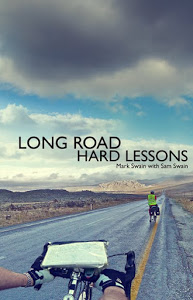
Long Road Hard Lessons

One day Mark Swain left his slippers by the fire and set off with his 18yr old son on a cycle expedition from Ireland to Japan. We will train on the way, he said. Physical challenges, border bureaucracy, health scares and traffic hazards were all anticipated. What they underestimated was the conflict they faced, spending 24hrs a day together under such arduous conditions. On one level, a life-changing travel adventure, this book also takes time to look at the psychological journey made by parents and children. The accounts of the son’s attempts to break away from his father, to find his own individual place in the world are moving and insightful. Yet at every turn, these thoughts are lightened by humour and juxtaposed with vivid descriptions of the countries and people they encounter along their way. We witness how conflict teaches us things that we did not expect to learn, and how much the parent can learn from the child. The book includes 25 glossy colour prints and 7 maps. –  more here on AMAZON


Mark Swain

Read more here about Mark Swain’s travels and follow his fascinating blog:

LONG ROAD HARD LESSONS


Also here on Facebook: https://www.facebook.com/myhomelibrary/

Our Italian Surnames

****************************

This page and its contents, including photographs is Copyright To Anne Frandi-Coory All Rights Reserved 13 July 2015

…..

I bought this book to help with my research into the origins of our Italian ancestors’ surnames.

Our Italian Surnames by Dr Joseph G. Fucilla was originally published in 1949 and is still widely regarded as the definitive book on Italian Surnames. Professor Fucilla, who earned a doctorate in Romance Languages (University of Chicago 1928),  has written hundreds of articles and numerous books on Italian, Spanish, and Portuguese linguistics. Onomatology,  the study of the origin and history of proper names and another facet of Dr Fucilla’s vast erudition, was the field out of which emerged Our Italian Surnames.

The information contained in this wonderful book is vast. Many names are derived from animals, occupations, geography, birds, botanica, music and the arts. For the purposes of this post, I am concentrating on the origins of the names Frandi and Greco (later Anglicised to Grego).

****

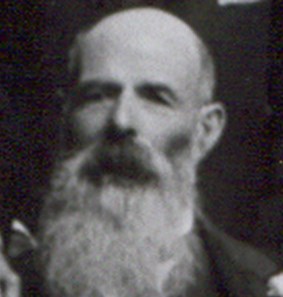
aristodemo-frandi

My maternal great grandfather Aristodemo Giovanni Frandi

********

The Evolution of Italian Surnames

Dr Fucilla writes: A surname or family name may be defined as an identification tag which has legal status and is transmitted by the male members of a family from generation to generation. It is a comparatively recent phenomenon.  It is in Italy perhaps more than any other nation that a person may be identified as a native of a definite section of the country or even of a particular province through his given name. 

Among the Hebrews, only one name used to be employed, but during the Greek and Roman dominations a second temporary name was adopted for individuals, such as Paul of Tarsus, Mary Magdalen (from Magdala). Christianity with its institution of a single baptismal name and the one-name system of the Germanic tribes who were soon to become the masters of Europe, eventually caused the collapse of the whole Roman name system. 

What causes names to be changed over time? Dr Fucilla posits that: These changes can be explained under six headings….

translations, dropping of final vowels, analogical changes, French influences, decompounded and other clipped forms, and phonetic re-spellings. By means of these it will be possible to explain the vast majority of those Italian surnames which we find in Anglicised form.

*********

Aristodemo Giovanni Frandi was born in Pistoia in Tuscany in 1833.  The original ‘Aristodemos’ is a Greco/Roman name. However, the only city in Italy I visited where there were people still living with the name Frandi was in Pisa, where two of Aristodemo’s children,  Ateo and Italia were born. The two men I traced worked for local government in Pisa.

The only historical name I could find that came even close to Frandi is Ferrandy or Ferrandi, which is very common in Italy, especially in the north. However, it does suggest Gallic origins and as was frequent in ancient times, Ferrandy/Ferrandi slowly became Frandi to fit in with other simplified Italian spellings which often end in ‘I’. When speaking to native Italians, they pronounce Frandi as Ferrrrrandi anyway, rolling their rrrs. Conversely, Ferrandi is a very common name in France!

Dr Fucilla studies add more weight to my view that the name Frandi/Ferrandy is a French derivative.  In his chapter headed Topographical Names, he writes: 

We may divide the natural and artificial topographical features that have given rise to Italian surnames …..   among them he lists several mineralogical and agrarian characteristics such as the prefix ferro which is the one we are interested in. This refers to iron (ore) generally but in the agrarian sense it refers specifically to the land and its minerals. We know that as a young man Aristodemo worked on the land as did most of his countrymen. When Aristodemo decided to emigrate with his family to New Zealand in 1875, the very real draw card was the allocation of 10 acres of free land on the West Coast. And later when the family settled in Wellington, their dream was to own a farm, which was eventually fulfilled.

In another chapter under the heading Geographical Names, which are frequently used in Italian surnames, Dr Fucilla  documents the French/Italian name La Fiandra which means ‘from Flanders’ which in parts of its history was ruled by the French. Italians with French connections added ‘La’ to their surnames. Aristodemo called his first born son, Francesco, a derivative of France.  It is possible that Frandi is a compound name of both La Fiandra and Ferrandy/Ferrandi. Dr Fucillo devotes a chapter to such compound names in which place names, nouns, occupations, religious references, and others, were compounded into abbreviated form.

In the mid 19th Century, when Aristodemo was in his 20s, all young men were conscripted into the regular army to protect territory in Northern Italy held at various times in more recent history by the Austrians, Germans, and the French. Most of the men were agricultural workers, and their loss was keenly felt by their families who needed them to tend the land.

Here are excerpts from my book ‘Whatever Happened To Ishtar?’ pages 286-287:

Aristodemo was conscripted into the regular army in 1859, 1865-1866 against the Austrians, at Ancona, a major port city at the base of the Apennines in the Marche region of the strategic East Coast of Italy which faced the Adriatic Sea. Then at Tirolo which is a tiny commune in the province of Bolzano-Bozen in the Italian region of Trentino-Alto-Adige in the far north of Italy, between Austria and Switzerland.

Aristodemo returned to Pisa to prepare for his marriage to Annunziata Gustina Fabbrucci in 1863. A year later the couple travelled north where Aristodemo was barracked with the regular army while Annunziata lived a few miles away in an Italian conclave.  It was during this conscription period that Annunziata gave birth to their first child Francesco, in 1866 at Lake Lugano.  Eventually, Aristodemo left the armed forces and worked for the fledgling Italian railways laying tracks, the best chance for work in an Italy in the throes of the industrial revolution and the confiscation of farmlands, which threw Italy into a new kind of poverty.

I have discounted Frandi as being derived from any form of the occupational prefix Ferra in its relationship to  Ferrari, metal worker, or Ferroviere, railway worker, as a surname. The use of  Ferroviere as a surname is very rare  and its use is a very recent phenomenon.

Interestingly, Aristodemo’s mother was named Caterina Degli Innocenti Cashelli …Italians often used their parents’ names, or other family names,  as middle names depending on where they come in the family hierarchy  eg firstborn etc. Degli Innocenti is not a family name. It is the name given to all babies who are orphaned or abandoned and who are placed as foundlings in convents or ‘foundling hospitals’ (Hospital of the Innocents) .  On one of our visits to Florence we came upon a beautiful building with coloured tiles depicting religious themes embedded above the doorway. Also written on the tiles were the words  ‘Ospedale Degli Innocenti’ and when I inquired as to what the purpose of the hospital was, this was the explanation...a foundling hospital or sanctuary. Children were only baptised with this name if they were foundlings. The origins of Caterina’s given surname, Cashelli, are unclear, but it is possibly related to casella or caselli meaning dairy

In 1928 a law was passed in Italy forbidding the imposition upon foundlings or illegitimates of names and surnames that might cast reflection on their origin. The law has probably stopped the increase of such names, but has hardly affected those already in existence. Ripples in a pond: this sort of stigma can and did affect the fortunes of  those so named.

Pistoia is an ancient city with remnants of Gallic, Ligurian and Etruscan settlements everywhere. It is possible to trace the origins of Pistoia back to the 2nd Century BC when the Romans established a settlement there for the provision of its militia during the wars against the Ligurians. The Oppidum Romano (fortified citadel) achieved a certain importance in the 4th Century AD and its growth was favoured by its position along the Via Cassia the road that connected Rome to Florence and Lucca. The origin of the name Pistoia is  possibly Pistoria Roman for bread oven. Roman troops were garrisoned and replenished there.

******

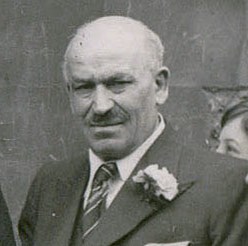
Filippo Grego

My maternal great grandfather, Filippo Grego (Greco)

Filippo Greco was born in 1869 in Amalfi, Italy. Amalfi had close connections with Gaeta, a Greek trading port, and Gaetano and Gaetana were Greco male and female family names respectively, so it’s more than likely Filippo’s extended family originated there. Gaeta has fortifications which date back to Roman times and these fortifications were extended and strengthened in the 15th century, especially throughout the history of the Kingdom of Naples (later the Two Sicilies). There is evidence that Filippo’s early ancestors came from original Greek settlements in Sicily.

Grego is the anglicised version of Greco, which was originally a name given to those living in Greek settlements in Southern Italy. Since the days of the Romans,  Greco has  been a synonym of astuteness and disloyalty and often connotes a stammerer.  Dr Fucilla suggests that some names such as Greco, have acquired a depreciative, figurative meaning which  may now and then have led to their application to native Italians.

To summarise Dr Fucilla’s  conclusions:

Anglicisation of Italian surnames is achieved by the drive of two strong forces converging upon their goal from opposite directions. One force, the most powerful of the two, represents non Italians who consciously or unconsciously in speech or in writing, make Italian names conform to English linguistic patterns, spelling, or individual names or types of names with which they happen to be acquainted. The other force represents the people of Italian origin who deliberately change their names or tolerate modifications made by outsiders as a concession to their new environment.

Finally, a very interesting paragraph from Dr Fucilla’s book:

Greek, Roman, Germanic and Hebrew Patronymical Names.

About 650 BC Ligurians, Illyrians, Umbrians, Etruscans, Sabini, Latini, Greeks, and Carthaginians occupied the various parts of Italy. They were all sooner or later, assimilated by Rome. After the fall of the Roman Empire a number of Germanic peoples including the Lombards, Franks and Normans, overran the peninsula. They too, were assimilated by their environment and with the others, through centuries of cross breeding fused into a fairly close-knit ethnical group now called the Italians. Yet despite fusion, traces still remain particularly in the guise of place names that carry us back to one or another of the stocks just mentioned. However, from the standpoint of personal surnames, a virtual monopoly is enjoyed only by three of the groups: Greeks, Romans and Germans. Their names eventually spread all over the country and from time to time through invasion, immigration, cultural tradition and religion, received reinforcements and accretions. A large mass of personal surnames was later adopted from an outside group, the Hebrews.

 See here: Mansi; My Fascination With Italian Surnames Part 1 

For more information about my book,

Whatever Happened To Ishtar? – A Passionate Quest to Find Answers for Generations of Defeated Mothers and to purchase a copy HERE is the link:  https://frandi.wordpress.com/2010/04/15/publicaton-of-whatever-happened-to-ishtar/


Updated 12 June 2019

The Hospital By The River

THE HOSPITAL BY THE RIVER exceeded all my expectations. I have always admired Dr Catherine Hamlin as an Australian heroine. What she has achieved in her lifetime, is a superhuman feat.

In her book, Dr Catherine Hamlin begins by writing about the family histories and medical backgrounds of both her and her husband, Dr Reg Hamlin, in Australia, New Zealand, and later in the UK. Both came from privileged backgrounds. Intertwined with the Hamlins’ wonderful work saving the lives of hundreds of mothers and their babies in Ethiopia, are expressions of their deep Christian faith, and the comfort it brings them. Even though I am not a religious person, I can fully understand how their faith kept them going through some very difficult and challenging times, not least of all, a dangerous war. The couple sacrificed a great deal in order to build their hospital and bring healing to hundreds of poor Ethiopian mothers and their babies. However, I felt that in following their God’s mission, their only son Richard, also paid a heavy price.

Dr Hamlin goes on to detail the travelling and begging the couple had to engage in to bring in funds to keep their dream, and the hospital they had built, afloat. She documents the perfection of surgical techniques used in the repair of fistulae to restore quality of life to their frail, and sometimes, dying patients. Many babies were born dead, sometimes jammed in the birth canal for days, because of protracted labours. Cultural practices mean mothers are made to squat for days during labour causing terrible injuries to their bladders, bowels, and vaginas. Some mothers’ uteri burst with devastating consequences. These injuries leave afflicted mothers with a life lived in misery, unable to control their bladders or bowels. They are abandoned by their husbands and families, left to fend for themselves in filth, and near starvation.

The hospital the Hamlins built in Ethiopia, with the help of worldwide financial donations, and the support of powerful Ethiopians, has given hope to thousands of women; more than 90% are fully cured. Those who cannot be cured, perhaps left with minor wounds, are able to live in adjacent hostels within the hospital compound.  Some of those who are cured, stay on to be trained as nurses and midwives. Others progress to operating assistants and surgeons.

The compelling stories of the lives of long suffering patients are truly heart rending, and yet uplifting, due to the vibrant spirit of Ethiopian women. These brave, often under-nourished women, walk for days, months or years, to get to the Hamlin hospital of hope, where they can have life saving surgery.  Be that as it may, I could not but help see the great irony within the pages of this book: The Hamlins, as Anglican Missionaries, worked tirelessly, operating on these poor, rejected mothers with horrific rectovaginal fistulae, mostly caused by giving birth too young, or by being raped. The majority of women they performed surgery on, were of a Christian Orthodox religion which culturally supports child marriages, often girls as young as eight. As an Orthodox priest remarked: “otherwise they will fall into sin like Western women who don’t have children until they are 30”!!  So here we have Christian missionary surgeons repairing horrific injuries which another Christian sect, in essence, fully condones!  No blame whatsoever attached to husbands or rapists.

At the end of the book, I couldn’t help but wonder, in an ideal world, would it not have been wiser and more efficacious for the Christian World to unite, and spend those millions travelling around Ethiopia, educating the men and empowering the women? But then the hallmark of religion has always been more about tradition than visionary reform.

********

Dr Catherine Hamlin celebrates 60 years in

Ethiopia in 2019.

*******************************************************************************

© To Anne Frandi-Coory All Rights Reserved 14 May 2015

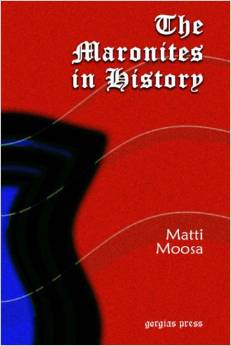
The Maronites in History

by Matti Moosa

*************************************

The Maronites in History

**************************************************************************************************************

I bought this very expensive book because I have always been interested in the Maronite religion of my Lebanese Grandparents, Jacob and Eva Coory. They were born and raised in the small village of Bcharre where the Maronite religion appears to have gained a strong footing around the 6th Century. There are very few books written about Lebanon’s  Maronites but I believe I have found a well written and well researched one in Moosa’s original Syracuse University Press publication The Maronites in History. Various essays on this subject can be found on many websites, but I found them to be emotive and with little basis in fact. Certainly no source documents were quoted, and most were based on hearsay passed down through generations. Still more were so badly written, it was difficult to follow the writer’s line of thought.

Matti Moosa opens the Preface of his book The Maronites in History with a question: Who are the Maronites and what is their importance to the existence of the Lebanese Republic?  This is a very good question, because so much folklore has been added to fact that it’s very difficult to know for certain. However, the author has embarked on a marathon investigation after being awarded a scholarship. He has extensively studied source documents housed in the Vatican Library as well as written testimonies from writers who lived in Lebanon from the 5th Century onwards.

The author states: In essence this book is a study and analysis of the origin of the Maronites , indeed of their whole historical heritage, an examination based on ancient and modern sources written in many languages, many of which are still in manuscript form.

Moosa goes on to explain in the preface: This book attempts to place the history of the Maronites in historical perspective. Maronites today suffer from a serious identity problem. They haven’t been able to decide whether or not they are descendants of an ancient people called the Marada  (Mardaites) or Arabs or of Syriac-Aramaic stock. Unless the Maronites solve this identity problem their conflicts with other minority religious groups in Lebanon will never be remedied. 

 Essentially, historical documents show that the Maronites originally professed the faith of Monophysitism, and later through edicts and threats of death or exile by various religious and state rulers, changed their beliefs to Monothelitism, both considered heretical by the Roman Catholic Church. Monothelitism though, is close to Catholic doctrine, so it appears the Church in Rome turned a blind eye to this heresy by Maronites for various strategic reasons which Moosa discusses at length in The Maronites. [My emphasis]

There are even disputes among Maronites and scholars over the origin of the name Maronite. The Maronite’s beloved monk St Marun and a later patriarch John Marun, have question marks over their actual existence. There is nothing in available ancient sources to indicate the name and location of the place where the ascetic Marun lived. However, the author concedes, one might be tempted, upon reading Theodoret of Cyrus, to conclude that a certain Marun lived in the vicinity of Cyrus in what was then known as Syria Prima, many miles to the north-east of Antioch. The failure to positively identify this place has caused much speculation by Maronites  as to its whereabouts. The Maronite Bishop Pierre Dib states that Marun lived on top of a mountain near Apamea  in Syria Secunda, an area far distant from Cyrus. Others claim that Marun lived in a cave near the source of the river Orontes (al-Asi) close to the Hirmil in Lebanon; they cite as evidence the name of the cave known until this day as the cave of Marun.  Other Bishops and writers state with the same certainty various other places in which the cave of Marun may have been situated.  Maronites and others cannot even agree on where or when a monastery of Marun was built but we may conclude that in Syria toward the end of the 6th or early 7th Century there existed more than one monastery bearing the name of Marun. One of them was located in or near Hama and Shayzar. It gained some notoriety in the early 7th Century when it adopted Monothelitism. The abbot of this monastery was named Yuhanna (John) and he became a Monothelite with many followers in Syria leading to the slow spread of Monothelitism into Lebanon. Those who followed him were called Maronites. Whether this monastery had any connection with the fifth century ascetic Marun is doubtful.

***************************************************

Mar-maroun-4

******************************************************

Efforts to date the Monastery of Marun from the 5th Century are sheer speculation. However, we have three documents which refer to a Monastery of Marun in Syria Secunda and all three documents attest that the monastery of Marun related to the doctrine of Monothelitism.

Commemorated on July 31st each year by the Maronite Church is the mythical massacre of 350 monks, ‘martyrs and disciples’ of the ascetic Marun. They were believed to have been slaughtered but this atrocity lacks strong historical substantiation. In fact there is no evidence that these were monks from the monastery of Marun.  Indeed, there is no mention of this in any pope’s correspondence of the times, nor is it mentioned in any Vatican or Church official documents.

There is no evidence that the Maronite Church ever commemorated these ‘martyrs’ before the year 1744. Even the Maronite Council assembled in Lebanon in 1736, which among other matters instituted the festivals and commemoration days for Maronite saints, did not list a commemoration day for these ‘martyrs’.

It is the author’s judgment following extensive research that the Maronites were and are closely linked to Syrian Orthodoxy. Probably for largely political reasons and the Roman Catholic Church’s need to gain a foothold in the Middle East, it overlooked the Maronite’s heretical interpretation of the Council of Chalcedon’s strict canons. [My emphasis]

In the Vatican’s push to gain a foothold in the Middle East, it allowed the Maronites to maintain their traditional patriarchs as head of their Church in Lebanon as they had done since the middle of the 8th Century. But in reality Rome considered them less than a Catholic bishop in status. It appears that only in the 8th Century did ancient church writers refer to the Maronites as a distinct Christian sect. [My emphasis]

Fortified for many generations in their mountain of Lebanon, the Maronites could claim more independence in their ecclesiastical affairs and therefore were and still are in a much more favourable position to revive their Syriac tradition and language. But instead of encouraging the Maronites to retain and cherish their Syriac heritage and revive the Syriac language  in order to become once more the lingua franca of the Maronite people the Latin missionaries (sent by Rome) discouraged the use of this language and denigrated the Syriac heritage and added more woe to the state of the already Arabised Maronites by Latinisng their Church and eventually their prayer books. The Maronites thus almost completely lost their Syriac identity. Since the 16th Century instead of taking pride in their Syriac legacy, the Maronites,in their desperation to find a legitimate origin of their Church and people have claimed that they were the descendants of  Marada (Mardaites) which is historically groundless.

Like the Nestorians the Rum (Byzantine) Orthodox, and the Syrian Orthodox People, the Maronites are of Syriac-Aramaic origin. The Lebanese Council of 1736 emphasised the use of the Syriac language first and Arabic second in the Maronite Church services. But this emphasis was not intended nor did it contribute to the revival of the Syriac language as the national symbol of the Church. Perhaps if the Lebanese Council’s recommendations had been followed, Lebanon may not be suffering the loss of identity it’s suffering from today. The least one can say for certainty is that the names of the villages and towns of Lebanon, especially Bcharre and three neighbouring villages, used the Syriac-Aramaic language as their lingua franca.

At the end of the 16th Century Maronite Patriarchs have often interfered in Lebanon’s political affairs in the belief that they were more than just the head of their Church. This has often exacerbated sectarian rivalries.

Many Maronites maintain vigorously that they have always adhered to the faith of Chalcedon and that their Church has never deviated therefrom; they were always united with the Church of Rome.

Moosa’s  research uncovers documents that clearly refute this argument. It indicates that until the 16th century the Maronites did not separate clearly and decisively from the mother Syrian Orthodox church in its beliefs, rituals and traditions. In fact, according to the calendar of festivals of the Maronite Church, whether in manuscript form or published in Rome since the 16th Century, it shares certain commemorative dates with the Syrian Orthodox Church.

Monophysitism: One incarnate nature of the divine logos – a doctrine which the Syrian Orthodox Church of Antioch has maintained to the present day and which ancient Maronite Syriac-Aramaic ritual and prayer books prove was also the doctrine held by the early Maronites.

Monthelitism: The Incarnation of two natures of Christ, the divine and the human, were united in one will and one energy – Until the late 16th Century Maronite ritual books contained this doctrine, at which time they were ‘purged’ by missionaries from the Roman Catholic Church to restore the Maronites to its fold. 

Catholicism (Chalcedonian): The Incarnation of the two natures of  Christ, the divine and the human, were united in one person yet  remained distinct after the union

Orthodox liturgies, prayer books and prayers themselves also caused friction between the Church of Rome and the Syrian Orthodox Church, which Moosa writes about in detail.

 Moosa sums up:

Several conclusions may be deduced from the foregoing opinions and speculations. The evidence addressed by Maronites and those who support their claims that there existed in the 5th Century in Syria Secunda a Monastery of Marun whose monks were Chalcedonians [followers of Catholicism] is untenable. Maronites (and others) cannot even agree who built the monastery of Marun or its exact location. Most of the evidence they do produce has no historical foundation. Historical fact does indicate , however, that there were several monasteries named Marun in Syria, but not that they were named after the particular ascetic Marun. More important, available evidence does not support that there was a Maronite community in Syria before the 7th or even 8th Century. While historical evidence does support the thesis that the pious anchorite named Marun lived, died, and was buried in the district of Cyrus in northern Syria, there is nothing to indicate that this Marun ever founded a religious community or inspired the name Maronite. Further, there is no evidence that he or his followers ever built a monastery in his name. Those Maronites who describe their ascetic Marun as ‘the Father of the Maronite Nation’ do so from the totally sentimental predisposition rather than assert it as a claim derived from objective fact.

Doctrines found in ancient books reveal that Maronites were of the Syrian Orthodox faith who believed in the Monophysite doctrine before they became a distinct community:

From the time of the Council of the Chalcedon in 451 to the first half of the 7th Century the first Maronites –the monks of the Monastery of Marun – became Monothelites by imposition of Emperor Heraclius. The statement is clear and positive on the point that these Maronite monks had been Monophysites (Syrian Orthodox), and though the heated controversy over the mode of the union of the two natures of Christ was finally thought to have been resolved by the Council of Chalcedon, the monks of the Monastery of Marun were recalcitrant in accepting the Council’s transactions. This recalcitrance was exhibited in anger and defiance on the part of these Monophysite monks who, like the majority of the Church in Syria, renounced the Council of Chalcedon and the definition of the faith. They remained Monophysites until the beginning of the 7th Century when they became Monothelites under the Chalcedonian formula of faith imposed on them by Emperor Heraclius in the interests of religious harmony. Though appearing to accept this faith through coercion the monks remained faithful to their Monophysite faith, which they kept intact in their ritual books. Subsequently the new creed of Monothelitism did not separate them drastically from the bulk of the Syrian Orthodox Monophysites. The point of separation was their apparent acceptance of the Council of Chalcedon under imposition of imperial power. It is through this acceptance of Chalcedon and of Monothelitism  as a doctrine that they became a distinct religious group in the middle of the 8th Century and not before.

This is a mammoth scholarly work by Matti Moosa with full bibliography and notes.

Arab, Byzantine, Ottoman and French states all played their part in the formation and divisions of Lebanon as we know it today. You will have to read this impressive work to fully comprehend 21st Century Lebanon. I can assure you, it is riveting reading. Moosa separates Maronite historical fact from fiction in a format and style that is very easy to read and follow, even allowing for the few minor grammatical and typographical errors.

© To Anne Frandi-Coory All Rights Reserved. Follow my blog: frandi.blog


BOOK REVIEW by Anne Frandi-Coory

>>>>>>>>>>>>

The Crusades

A Brief History of The Crusades; Islam And Christianity In The Struggle For World Supremacy  

by Geoffrey Hindley

“A history of the Christian war for faith and its bitter legacy”.

Were historical religious wars in reality an extension and prolongation of tribal hatreds?  Eventually the rise of the two major religions of Islam and Christianity would convert millions into faithful followers.  Each side would massacre hundreds of thousands of ‘infidels’ in the name of their respective one true god.

Anyone who has any doubts whatsoever that either Islam or Christianity was founded on peace and respect for human life, should read this book. Arabs initiated the Jihad wars of the 7th and 8th Centuries which conquered the Christian lands from Syria to Egypt, and the North African coast from the Christian Roman Empire and the Christian Kingdoms of Spain, also the aggressive conquest of the Greek Orthodox Byzantine Empire.  In the Middle Ages, the Christians initiated four barbaric crusades to fight not only Islam’s followers but also other Christian groups committing heresy.  Let’s not forget that both Christians and Muslims massacred their own followers for what seems to me, the most trivial of doctrinal differences.

Once Christianity became the state religion of the Eastern and Western Roman Empires, the Roman Catholic religion and politics were inextricably intertwined.  Pagans were massacred mercilessly if they didn’t convert to Christianity. It was no different for those who followed Allah. It wasn’t until the Arabs united under their own prophet in the 7th Century, did they have the power to take on the Christian infidels. Before the Arabs rampaged out of the deserts of Arabia, they had languished as disregarded and disunited pagan Arab tribes. In the words of an Arab envoy to the Shah of Persia: “Once the Arabs were a wretched race, whom you could tread underfoot at will….Now for our glory, Allah has raised up a prophet among us.”

Hindley’s book is well written, full of historical fact, and takes readers to wherever Christianity spread its tentacles: Russia, Europe, Middle East, Turkey,  Arabia, and North Africa. Kings, (particularly French) Bishops and Popes were on the forefront of the fight against infidels, and the terrible crime of heresy. During the four crusades and the Inquisition, torture was widespread and horrific. For instance, alarm bells were ringing in Rome that large numbers of heretic communities existed in the south of France, Provence and Aquitaine. In the town of Béziers alone in 1209 the entire population of 15,000 people were massacred in what was actually a frenzy of ethnic cleansing; probably no more than 700 were active Cathars.

The Maronites of Lebanon are another yet contradictory case in point. They are Christian followers of 3rd Century St Maron (St Maroun in Aramaic) who eventually came under the protection of the Roman Catholic Church around the 16th Century. However, the Roman Catholic Church had known about the small pockets of these early Christians hiding from the Muslim onslaught in the mountains of Lebanon, and in Antioch in modern Turkey, but didn’t consider them a threat. The Church expected that they would eventually be killed or die out from hunger and disease. When the Crusaders discovered them centuries later stubbornly hiding in the mountains, in caves and very poor, they were offered protection. The odd thing is that Rome allowed the Maronites to uphold certain doctrinal differences; priests could marry and Maronites held that Christ had a dual and divine human nature governed by a single divine will. Still, they had the full support and financial backing of Rome. This was even though Rome considered other Eastern Orthodox Christians’ doctrinal differences as ‘schismatic’ and a blatant insult to the supreme power of Rome and the Universal Church. But not evidently, heretical?

Excerpt concerning the end of the long and brutal campaign of the first crusade culminating in crusaders running amok in Jerusalem:

The assault was scheduled to start after dark on 13 July [1099] with two simultaneous attacks each led by one of the siege towers…It was the tower commanded by Godfrey of Bouillon on the northern sector that, on the morning of 15 July, established the first foothold. Seeing the enemy secure a bridgehead on the ramparts, the defenders in this sector streamed back to the temple area to rally for a last stand around the al-Aqsa Mosque, but they surrendered to Tancred and flew his banner over the mosque promising to pay a large ransom in the negotiations that should follow the capture. Meantime blood crazed crusaders were streaming over the walls and through the streets of the northern part of the city slaughtering every living thing that crossed their path. No banner was going to save lives in this shambles, while the Jewish population of the city were cut down – man, woman, and child – where they stood hoping for sanctuary in their chief synagogue. They can have had little hope. Months before, news of the pogroms in the Rhineland had reached the city and most of its Jewish community had sided with its Muslim defenders, fearful of their fate should the place fall to the Christians. Now that fate was upon them. …It is doubtful whether any other of the inhabitants of Jerusalem on that dreadful day survived. …The slaughter lasted the best part of two days.  When it was over, the crusade leaders went in solemn procession to the Church of the Holy Sepulchre  to give thanks to God… [my emphasis]

There was surely much to give thanks for. More than once over the years it had seemed that the army had survived only thanks to divine intervention. Even so some blenched at the butchery that had sealed their victory. …When reports did reach the West many churchmen expressed horrified dismay. Accounts of the shocking events reverberated through Muslim Syria.

************************

-Copyright to Anne Frandi-Coory and All rights Reserved  16 January 2015

Eleven *****  Book Reviews for  …

WHATEVER HAPPENED TO ISHTAR? – A Passionate Quest To Find Answers For Generations of Defeated Mothers

ishtar-front-cover

ishtar rear cover

1st edition front and rear cover 2010

More Information about updated 4th edition (2020) of ‘Whatever Happened To Ishtar?’  CLICK HERE: 

************************************************

13532888_1872936609398092_8979311431005462309_n

Bella Albert

This is an old photo of my precious Bellaboo, holding our copy of a book written by my great aunty, Anne Frandi-Coory, about our italian family;
-I’m honoured to hear from my psychologist and good friend Brett, who has told me he purchased a copy and had received it and is currently reading it; it really warms my heart to know this.
P.S aunty Anne -Brett says you write really well and is very impressed xx Michael Albert. – 2019

Michael Albert

Michael Albert, Bella’s father

Thank you, Michael …that is good to hear. Your psychologist will understand you better after reading my book, ‘Whatever happened To Ishtar?’ The ripples in the generational pond have spread far and wide…❤️💜🧡 I hope to meet you and Bella one day; such a beautiful girl.

*********************

This review originally posted here on AMAZON BOOKS 28 March 2017

New Zealand’s Elena Ferrante?…

I don’t write many book reviews, I don’t usually have the time,  but I felt compelled to write this one. I’ve read both of Anne Frandi-Coory’s books; her memoir Whatever Happened To Ishtar? (2010) and her latest publication Dragons, Deserts and Dreams (2016) and it seems to me both are the kinds of books that you keep in order to read again and again. I also follow her book reviews on Facebook closely because she reads the genres I enjoy and she writes great, honest  book reviews.

The honesty with which Anne Frandi-Coory has written her memoir makes me think of her as New Zealand’s Elena Ferrante. The author is a virtual recluse who writes about her childhood living in Catholic institutions and whose existence is violently shaken up periodically when she is taken by her father into his Lebanese immigrant family’s household not far from the institutions she has lived in for most of her formative years. There she endures what she calls the hypocrisy and brutality the women of the household direct toward her and her absent Italian mother who has long since been banished from the home of her in-laws.  The reasons are complex and include the sexual harassment of the author’s mother, an innocent ex Catholic nun. Frandi-Coory’s story is set in a slightly later era than Ferrante’s and dolls eerily feature in her childhood as well. I felt the need to check Frandi-Coory’s book reviews to ascertain whether she had been influenced at all by the Italian author in any way.  Yes, she had reviewed the Neapolitan Quartet Novels by Ferrante, but she had only read and reviewed those books in 2016 six years after she wrote her memoir.  I am amazed at the similarities in writing style as well as in the content and minutiae of the lives of mothers and daughters, even allowing for the authors living on opposite ends of the world. I suppose at the end of the day, women’s lot is universal.

Frandi-Coory embarks on years of research into the lives of her mother and Italian extended family which she was never permitted to have contact with even though the Coory family didn’t want her living with them after her father’s marriage to her mother broke down when she was an infant. She finds that many women in both the Lebanese and Italian extended families lived in patriarchal cultures reinforced by devotion to the beliefs of the Roman Catholic Church. Too many children, brutal husbands and a blind faith in a god who never seemed to answer any of their prayers.

I wonder if these families had not left their home countries to settle in such a raw and young country as New Zealand would their lives ever have come under such scrutiny?  As another reviewer of Frandi-Coory’s memoir stated, this is a mammoth book and well worth reading. I also recommend the author’s latest book which, although it contains short stories and poems as well as some of her artworks, cleverly connects the reader to many of the topics she writes about in her memoir.

-Zita Barna, Australia.  28 March 2017

                   *****************************************************

Hi Anne, I expect you are thinking what on earth I am on about when I said I would e mail you.

Rita Roberts 2

Rita Roberts-Archaeologist

Well, I watched a film called  ‘Not Without My Daughter’.  For some reason it made me think about your book  ‘Whatever Happened to Ishtar?’  documenting your traumatic childhood and I had to begin reading it again, because this film helped me understand my confusion with regard to your extended family. I honestly don’t know how you coped with all that hassle You were so brave and I admire you tremendously. I am also so pleased you have Paul and your lovely children making your life now happy. If you haven’t already seen this film you can see it on U tube, and it is a true story. Take care, Rita Roberts (Crete)

******************************************************

 images

*Anne Frandi-Coory’s reply to Rita Roberts  30 November 2016:

Dear Rita

I finally located a copy of the dvd ‘Not Without My Daughter’ (1990) starring Sally Field. Thank you for recommending it to me. I can see why the Iranian family in the movie reminded you of my immigrant Lebanese family that I wrote about in my memoir ‘Whatever Happened To Ishtar?’ and why it gave you a better insight into what my childhood, and my mother’s life,  must have been like.

The movie brought so much of my childhood flooding back to me. First of all, the women wearing black burqas evoked images of the nuns in the Catholic Mercy orphanage where I spent my infancy and early childhood. I always get a strong visceral reaction whenever I see women dressed like this, or nuns in black habits, and not because the Mercy nuns were especially cruel; in fact the sister who ran the orphanage nursery was very kind to me. But because I was traumatised by being abandoned at the nursery by my mother, I always feel the same distress all these years later.

The hateful looks directed at the American mother, by the Iranian women in the movie also reminded me of my aunts. My paternal Lebanese family, (grandparents and their 11 children),  all lived, and later,  often visited,  in the same three storey house, so that whenever my father took me to visit his family, I not only had one or two adults abusing or yelling and screaming at me, there were several, all at once. My father rarely intervened, and he was born in that Dunedin house, living there most of his life along with his brother and unmarried sister.  A couple of times I sat on my father’s knee when I was a little girl, and the look my aunts gave me frightened me so much, I never hugged him, or sat on his knee ever again! They didn’t like me or my Italian mother, and I can only imagine what it was like for her, living with them all. Of course, you will remember that my mother’s severe bipolar disorder took hold while she lived with her in-laws, after she married my father. The family screamed abuse at me often, and reminded me every other day that my mother was a ‘sharmuta’ (prostitute) because she had an illegitimate son, and her Italian culture was also demonised. The family’s racism was something I remember vividly.

My aunts often attacked me in the streets of Dunedin if they thought my clothing was in any way ‘revealing’; once when I was a teenager, two of my aunts attacked me because I was wearing a dress with a skirt that fell below my knees, had a high neckline, but the long sleeves were made of a see-through flimsy fabric. They were so enraged they almost ripped the sleeves off my arms. In the end, I was afraid to walk down the street in case I met them and all I could think of was moving to another New Zealand city to escape them, which I eventually did.

While my father’s family weren’t Muslim like the family in the movie, they brought their very strict Catholic Maronite religion and culture with them. They went to church every Sunday and often during the week. My grandmother, Eva Arida, had an altar in her bedroom dedicated to the Virgin Mary with a lighted candle 24/7. She prayed constantly from a little Aramaic prayer book and was habitually fingering rosary beads. My grandfather, Jacob Fahkrey, of devout priestly lineage, prayed aloud early every morning while walking around the rear yard of the family home. I can honestly say that it was the women of the family who were the most physically and verbally brutal.

I did a bit more research into the true story behind the movie and book Not Without My Daughter, and that was also very interesting. The little American girl who so loved her Iranian father when they lived in the USA, had such a traumatic experience living with her father’s family in Iran, that she refused to ever see him again after she and her mother barely managed to escape to the States. Her father eventually travelled to Finland, a neutral country, with a documentary team hoping to film a reunion with his adult daughter, but she declined.   

****************************************************************

Another 5***** Book Review by Linnea Tanner…

Whatever Happened To Ishtar?  by Anne Frandi-Coory is a well-written and haunting memoir of a woman who finds herself by exploring her family’s heritage that contributed to her growing up without the love and nurture of a mother she most desperately wanted. What first attracted me to this book was the title, Whatever Happened To Ishtar?. She is the Ancient Sumerian Mother Goddess who celebrates love, fertility, and sexuality. This title haunted me as I read the memoir because Anne’s mother, like many woman of her generation and previous generations, was harshly judged for her sexuality and had limited options to treat her mental illness and to fulfill her potential. The first part of the memoir is Anne’s account of her childhood while the second part provides a historical account of her Lebanese (father’s side) and Italian heritage (mother’s side).

Anne was institutionalized at the Mercy Orphanage of the Poor at South Dunedin in her early childhood. At the time, her father could not adequately care for Anne after he divorced her mother for infidelity. At the age of eight, Anne was removed from the orphanage and introduced to the real world under the care of her father’s family. However, they shamed Anne and associated her with her mentally ill mother they considered a whore. This part of the memoir is gut-wrenching and haunting because Anne had to overcome loneliness and self-doubt to find her full potential after marrying, having four children, and finding her life partner after a divorce.

However, what is most fascinating is the rich heritage and ancestral genealogy of both her father and mother to understand what nineteenth century immigrants to Australia faced. With no access to birth control, women faced multiple pregnancies or secretly resorted to self-induced abortions with crude knitting needles. The historical accounts that Anne researched help explain why her father and her mother were compelled to make their choices. I recommend this memoir because the story will stay in your memory as it covers universal issues of female sexuality, women’s roles and options, mental illness, and society’s harsh judgment that has defeated mothers for generations.

-Linnea Tanner 25 April 2016

Linnea Tanner

Linnea Tanner

****************************************************************

Book Review by FLAXROOTS  14 July 2015

Whatever Happened To Ishtar?  by author Anne Frandi-Coory

Anne.

Anne Frandi-Coory –  7 years old

This book is a memoir of the life of Anne Frandi-Coory the daughter of an Italian mother and a Lebanese father.

Having spent a childhood, peppered with abuse and harassment, between a Dunedin orphanage for the poor and her father’s Lebanese family Anne was regarded as a backward child. She describes the panic she felt as a toddler as her father departed after one of his visits, and goes on to relate episodes from her strict upbringing in the orphanage where she was segregated from her two brothers once the boys turned five years old. Memory of the order of happenings in her early life is sketchy and this is aptly conveyed in her narrative.

She was not well received by her father’s family though she lived with her father at his family’s house intermittently, but never feeling at ease there and alleging various kinds of abuse.
Married in her teens Anne gave birth to four children and devoted herself to nurturing them during which time her marriage failed and she struggled to avoid a mental breakdown.

Later in life Anne devoted herself to researching the Lebanese history of her father’s family and the Italian forebears on her mother’s side, hoping to understand her relationship with her Italian mother who was shunned by Anne’s father’s family and who couldn’t look after her children except for very short periods.
The account of the arrival of the Frandi family as assisted immigrants to New Zealand in 1876, as opposed to those arriving in a self funding capacity, makes interesting reading.
The poems and quotations at the beginning of each chapter have obviously been chosen with care and sensitivity and give an added dimension to the book. The same can be said for the inclusion of family photographs mostly lent by other family members. There is a certain poignancy here as Anne had few, if any, family photos while she was growing up; thus emphasising what she refers to as ‘her paper-thin sense of identity’
There is a freshness about the author’s style and she succeeds in conveying emotion about the lack of emotion and caring shown to her in her formative years.

Having, as a child, lived in fear of dire consequences if she didn’t follow strict rules and try to emulate the saints she may have developed the discipline to achieve a good education which, no doubt, helped in her later endeavours to track her forebears and learn the history of their migration to New Zealand.
The bibliography includes useful references and illuminates the paths she travelled.

With regard to the publication the title is apt and the cover is eye-catching. The paper edition is perfect bound but the biggest drawback is the lack of an adequate gutter making the book difficult to hold open for any length of time. There are three very minor identical grammatical inconsistencies plus an odd discrepancy about two rivers.

The author is to be congratulated on her enterprise in producing a valuable resource for her family and an interesting and instructive read for the rest of us.

It seems Ishtar has risen from the ashes!

***********************************************

WHATEVER HAPPENED TO ISHTAR? by Anne Frandi-Coory – Book Review by Pauline Csuba published in issue no. 387 The Australian Writer March 2015

Anne Marie Coory 1958

Anne Frandi-Coory – 10 years old

Haunted by her mother’s restless spirit filtering through every thought and dream, this book was written not only for the appeasement of her mother but for her children and grandchildren.  Anne Frandi-Coory has embarked on a journey of genealogy taking on a rich history, research, and unpleasant memories.

Distressed at the hands of her Lebanese father’s extended family and The Mercy orphanage for the poor – this story of lost generations, abandonment, abuse and gross neglect by those who should have known better – is a story of a personal account and the connection with the Catholic Church and its institutions. Brutality, emotional deprivation and lack of nurturing all culminated in a dark side of two families unable to communicate with one another. With the history of these Lebanese and Italian families and how they settled in New Zealand, this makes for an interesting read.

It is a mammoth book and I felt by removing some areas of repetitions may have freed the flow of emotion that could allow the reader to connect much sooner with the powerful experience being shared. I congratulate Anne for taking on this traumatic journey of her past and the long process of research, writing and editing of her work. It is wonderful to see she now has a loving partner and family who have supported her in this passionate quest. I recommend this book to those who are or have embarked on a similar journey.

-Pauline Csuba

 ************************************************

WHATEVER HAPPENED TO ISHTAR? by Anne Frandi-Coory – 5 star

https://www.goodreads.com/review/show/1165480328

When I started reading this book, I expected to finish it quite quick but in truth, it took time to digest the words and their significance. It is a journey, both biographical and autobiographical in approach. The author seeks to find her place not only in society but who she is. This is an extraordinary search which uncovers the history of her maternal and paternal lineage.

What is revealed is both heart-rending and powerful, a personal narrative. Ms. Frandi-Coory’s pursuit as to why her mother abandoned her while a baby is a difficult journey of self-discovery. How could a mother leave her children is the driving question behind the author’s plight. That, and trying to understand who she is and to identify with the family nexus and her place within it.

Her father, ill equipped mentally and economically to rear his daughter and son, placed them in an orphanage run by catholic nuns. It was not a pleasant time for either and the author gives vivid descriptions of her time incarcerated. Her father’s family weren’t the most pleasant people, abusive both verbally and physically. Why? Her mother was considered a harlot and mentally unstable, therefore she was of the same ilk. The cultural mix of Italian and Lebanese blood, the author is driven to learn more about both sides of the family and why they behaved in such a contrary manner.

I admire Ms. Frandi-Coory for writing this book. She revealed secrets most families would prefer to remain hidden to detriment of those who were and are victims. This is a brave expository, which shows the cycles of abuse can be stopped with determination and strength of character.

-Luciana Cavallaro 11 January 2015

serpent 3

Luciana Cavallaro

More About Luciana Cavallaro here: https://www.amazon.com/Luciana-Cavallaro/e/B009QHIKN2

**************************************************************

Gerald Gentz

Gerald Gentz

WHATEVER HAPPENED TO ISHTAR? by Anne Frandi-Coory – AMAZON BOOK REVIEW by Gerald Gentz USA 30 December 2014   

*4th Edition (pub. 2020) Whatever Happened To Ishtar? now available here at Amazon in paperback and Kindle ebook 

‘Whatever Happened To Ishtar?’ is more than a book and more than a story. It is the telling of a remarkable journey of discovery of one person’s difficult life. Anne Frandi-Coory spent much of her life trying to find a place and the love of a family. Book ended between a caring but weak father and mentally ill mother unable to care for her financially or emotionally, Anne and her brother, Kevin, suffered childhoods that no child deserves to experience. In the end, even the scars would not prevent them from making stable and successful lives.

Anne’s long research into both the paternal and maternal sides of her family is remarkable for it’s depth and acceptance. In doing so, she exposed her demons and the dysfunctions of her maternal and paternal families. The result is a culmination of her difficult journey to understand herself. Her greatest victory is her coming to understand the love of her mother and the realization of her love for her mother. Anne’s was a journey of discovery and healing.

This can be a difficult book to read at times because of the emotions it elicits. It was particularly emotional for me because of my realization that Anne is actually my cousin that I was not aware I had, her mother being my mother’s older sister. Anne’s book gave me a deeper awareness of my maternal family, and thus my mother, than I had before. So Anne Frandi-Coory’s journey of discovery was also mine in 373 pages.

Gerald Gentz

***********************************************

WHATEVER HAPPENED TO ISHTAR? by Anne Frandi-Coory – 5 star *****GOODREADS BOOK REVIEW by Susan Tarr 

https://www.goodreads.com/book/show/11168865-whatever-happened-to-ishtar

“WHATEVER HAPPENED TO ISHTAR? By Anne Frandi-Coory is a remarkable portrayal of New Zealand’s earlier Lebanese and Italian Catholic families. Although I was raised in the various vicinities this book covers, I had no idea there were established Lebanese families in New Zealand. And, for me, the whole Catholic religion was shrouded in mystique, so I had very little understanding of what was involved in being a part of the Catholic faith.

Set in New Zealand, the spartan buildings of the Catholic St Vincent’s orphanage mirrored in some part those of Seacliff Mental Asylum (Otago, NZ) in both outlook and care of those in their charge. Both would seem to have lacked a close affection for those who needed it most: the vulnerable and unloved.

This work is an amazing testimony for all mothers, a testimony we can probably all relate to. How many times do we feel inadequate, or feel we could have done better? We should never have such constraints placed on us as a mother to feel either of these. Whatever a mother is capable of at that time, for her child, is sufficient for that time.

As Frandi-Coory bears out, it is always possible to break mindsets, or break the mould, as it is said. I.e. the sins of the father… All it takes is an invincible will, which clearly she had and has.

Frandi-Coory recounts the histories of both her Lebanese and Italian families. She explains how the various mindsets occurred and how they were passed down through the generations.

I found I kept referring to the photographs as I formed opinions on the various players in this tapestry of life.

What is astonishing here, is that Anne Frandi-Coory and I never made a connection until after our respective books were published, in separate countries. It was through reading each others work that we realised our lives were very closely linked. In fact we may well have known each other through a mutual friend (Italian) during our college years in Dunedin, NZ. That is why I can vouch for the events, scenery, time frames and cultures in this amazing work.

It’s absolutely raw in its honesty.

Very well written, it’s a compelling read, from start to finish.

Kudos to Anne Frandi-Coory.

-Susan Tarr 14 October 2014

Susan Tarr

Susan Tarr

More about Susan Tarr here:http://www.amazon.com/Susan-Tarr/e/B00I0I3M9U

************************************************

MOMO Photo ABC ‘Let’s Read’…

 I am a member of a photo group where we get a prompt for every day and have to take an appropriate picture. Because we had the alphabet one month, I decided to do a book theme. I always added either the link to my blog or to the books. I have decided to post a picture every week so my booky friends can enjoy them, as well.
A is for … Autobiography.  Two biographies by some very strong women:

Anne Frandi-Coory  Whatever Happened To Ishtar? 
Immaculée Ilibagiza  Left to Tell: Discovering God Amidst the Rwandan Holocaust
 ><><><><

Momo 2014

 ************************************************

‘Whatever Happened To Ishtar?’ is

“An amazing journey – challenging, painful, and ultimately unforgettable”  – Tanith Jane McNabb, Owner of Tan’s Bookshop Marlborough NZ, 27 October 2014 on

************************************************

See here

*MORE reviews for Whatever Happened To Ishtar? 

Whatever Happened to Ishtar_cover 2020

You can buy the updated 4th Edition (pub. 2020) in paperback & Kindle e book 

here at AMAZON

And Here from AbeBooks 

><><><><

my story

><><><>

Whatever your political leanings or agenda, you would have to concede that Julia Gillard was an accomplished Prime Minister of Australia. During the three years as Australia’s first female PM, in which she led a minority government, a record amount of legislation was passed.

Not only did she have to constantly negotiate with minor parties, she had to endure some of the worst public sexism ever directed at a female PM in any country, most of it instigated by the then Opposition Leader Tony Abbott and the rest of his Liberal and National Coalition Party. As if that wasn’t enough to deal with,  Ms Gillard was vilified daily in the News Ltd Press, owned by ex-Australian, Rupert Murdoch, which was determined to see her government thrown out of office. Tony Abbott was Rupert Murdoch’s choice for Prime Minister, supported by the four Big Banks, and the huge Mining Corporations!  Once Tony Abbott moved into The Lodge, it was goodbye mining tax and carbon price! Don’t get me started on why his government can’t pass its ill-fated Budget, after more than one year in government!

So much has been written about Ms Gillard’s ‘deposing’ of her predecessor, Kevin Rudd, so I don’t want to go into the details here. However, it has now become clear that this man was a failed Prime Minister, who then made it his sole purpose in life for the three years Ms Gillard was in office, to undermine her every move.  If you are interested in how he went about the destruction of his own party, read The Stalking Of Julia Gillard: How The Media And Team Rudd brought down the Prime Minister. It was written by Kerry-Anne Walsh, an astute parliamentary journalist. A very interesting look at behind the scenes revelations.

><><><

the-stalking-of-julia-gillard

><><><

Julia Gillard is a 21st Century woman who made personal sacrifices in order to get to the top in politics. For her, a fairer system of funding for education in Australian public schools was a number one priority, with a more comprehensive disability insurance scheme a close second.  Time will tell how much of PM Gillard’s hard work on educational and disability reforms will be unraveled by this current government. The Carbon Price and Mining Taxes her government legislated for, were earmarked to pay for many of those reforms.

The Glass Ceiling  [dedicated to Julia Gillard]

By 2011, I was already a devoted fan of Julia Gillard’s. Not because she was a woman, but because she was by then, showing signs of becoming a great stateswoman. I presented Prime Minister Gillard with a copy of my book, ‘Whatever Happened To Ishtar?’ which had just been published. The reason I wanted her to have a copy, was to show that I agreed with her wholeheartedly that every child deserves to be given the chance of a good education, but even more especially, disadvantaged children.  My book is about the many generations of women in my family tree who never had the opportunity of a good education.  Marriage or the nunnery were their only choices.  I had a deprived and abusive childhood, but I did receive a good education which gave me so many more choices.

A few weeks after she received my book, the following letter arrived in my mail box:

><><><

Julia Gillard Letter

><><><>
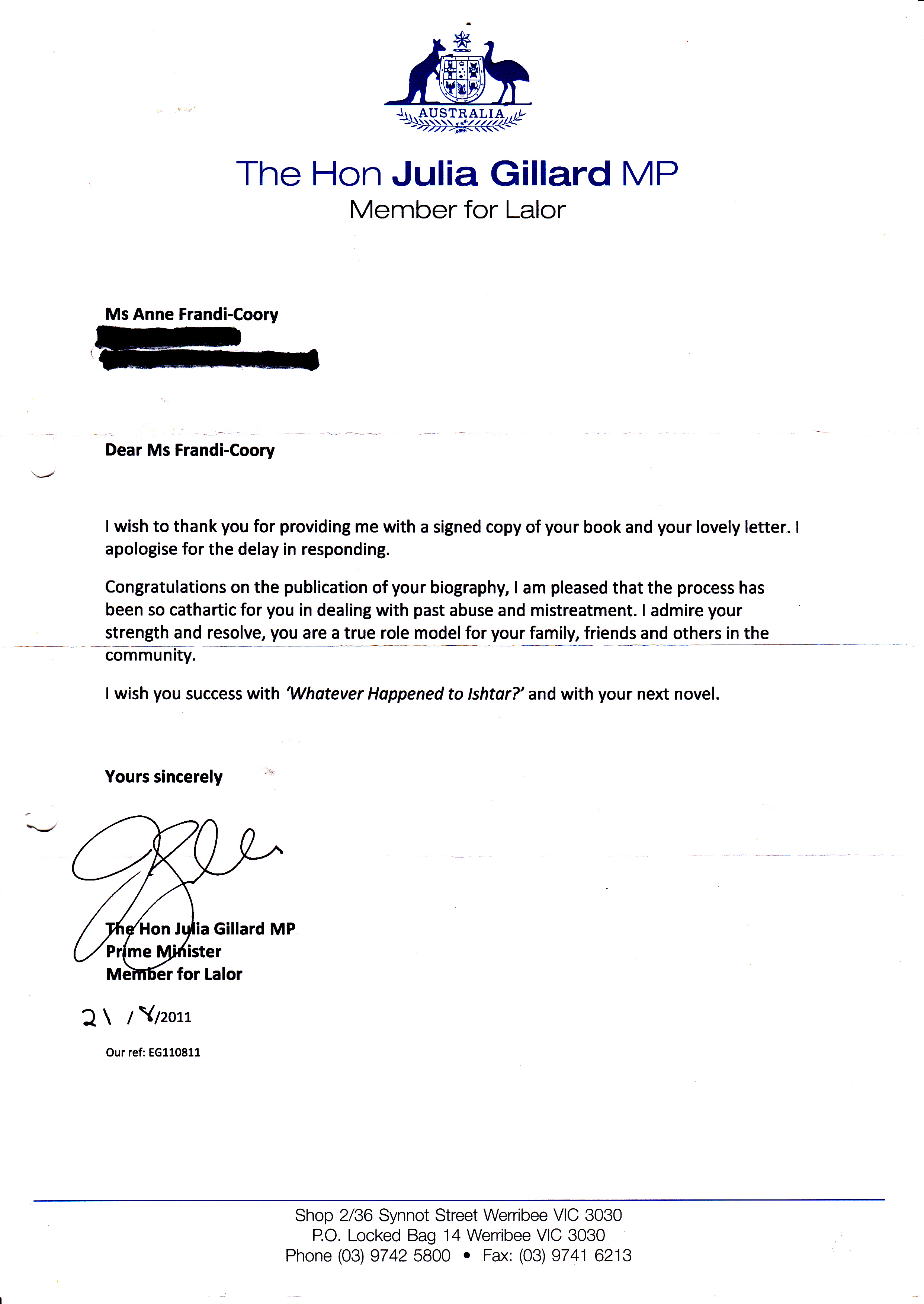
I was overjoyed, as I had never expected our Prime Minister to take time out of her enormous workload, to acknowledge my humble book. That was just one more of the many admirable attributes exhibited by this remarkable woman. In the last week or so I attended one of Ms Gillard’s book promotional talks which was attended by over 400 people. Afterwards, she autographed many, many copies of her book, ‘My Story’, including mine below:

><><><>

J GILLARD CROPPED

><><><>

This is a truly inspirational book by a woman who has reached the very top in Australian politics. It’s much more than a Prime Minister’s memoir of her time in office, though. It is also about her thoughts and feelings, and how she managed to keep her sense of self intact throughout those times of ruthless sexism and derogatory personal statements against her. As she herself stated during the talk she gave at the launching of My Story,  ‘politics can be bitter sweet, but my time as Prime Minister, was more sweet than bitter’. I thought she gave an impressive, spirited speech on the night I was present, and afterward answered many questions from the mixed gender audience. The whole enjoyable evening was interspersed with much clapping and laughter.

One thing I can assure readers of, is that Ms Gillard’s Story is much more riveting and enjoyable than any other political memoir I have ever read, and it is certainly never boring!

><><><><>

– Anne Frandi-Coory 13 October 2014