
This page, including text and images are copyright to Anne Frandi-Coory 2 August 2015 All Rights Reserved
…………………………………………………………………………………………………………………………………………………………………………………..
Italia Frandi’s Daughter, Elvira Corich Pengelly, Reminisces About Her Life Within The Extended Frandi Family.
Pam Frandi Parkhill, Francesco Frandi’s grand-daughter, was a great friend to Elvira Corich Pengelly, who was Italia Frandi’s daughter. Pam thought it essential to record these memories on tape as a valuable resource of Frandi Family history. The story telling took place in the lounge of Elvira’s home at 54 Weld Street, Wellington, not long before she died in 1996. Anne Frandi-Coory transcribed the interview from the tape recording in September 2005.
><><>><><><><

Pam Frandi Parkhill, Tony Pengelly, Elvira’s son, with Anne Frandi-Coory 2005
[Elvira is sometimes referred to as ‘Vera’, and her uncle Francesco as ‘Frank’ in the recording. Francesco Frandi is Alfredo’s oldest brother. Francesco’s wife, Assunta, ran off with a neighbour and left him with four young children, including William who was Pam Frandi Parkhill’s father.]
Elvira Begins by Talking About Her First Cousin Amelia Frandi.
Francesco’s only surviving daughter, Amelia, called Millie by her family, was twelve years older than Elvira. Elvira’s mother Italia included Amelia in many outings with her own daughter. But Amelia was an embarrassment to Italia in many ways. Elvira was always well groomed and dressed beautifully, as shown in the many photos of her, while Amelia always appeared unkempt. Amelia loved food and although there was always plenty to eat, she frequently “stole food and hid it under her bed, and” Elvira went on, “Amelia wasn’t to be trusted when you took her visiting.” This was because after their visits “things would be missing from the house.”
In 1913, when Amelia was 23 years old, she gave birth to a son out of wedlock, Kenneth Maxwell Frandi. His father’s name was not recorded on any documents. Kenneth died when he was three years old as the result of recurrent erysipelas (Fever and deep red inflammation of the skin) toxaemia over three months. On 27 July 1917, Amelia gave birth to another son, Maxwell Lawrence, who, it is believed, was later adopted by Cecil Taylor, the man Amelia would eventually marry in 1922. Elvira describes Cecil as “a first class boozer” although Amelia didn’t drink alcohol as far as she knew. Maxwell was re-named Albert Taylor, and their daughter Jean was born in 1925. Before she was married, Amelia worked for the Richard Seddon household as a house maid.
Francesco, the Pierotti and Russo Families
Francesco’s wife Assunta Pierotti left him with 9 year old Amelia, and three young sons, the youngest, 4 year old William, after they had been married for 11 years. They had two other daughters who died in infancy. Read: Francesco Garibaldi Frandi and Assunta Mary Pierotti. Assunta moved in with Charles Barnett in Whiteman’s Valley, Hutt Valley in Wellington, and they subsequently moved to Tasmania after the birth of their 11 children there. Two more children were born to them in Tasmania. They never married as Francesco and Assunta were both Roman Catholics and could not divorce. Assunta and Charles Barnett’s children did not know their parents were unmarried, nor did they know that Assunta had left behind four children and a husband until after Assunta had died.
Francesco’s parents, his sister Italia and his sister-in-law, Italia Pierotti Russo (auntie Kate) helped raise his four children after Assunta’s departure. Italia Pierotti married Bartolomeo (Bartolo) Russo, who emigrated from Stromboli Italy, and the Russo family bought property at Rona Bay in Wellington. As Elvira explains, “it is situated between Days Bay and Muratai, which was quite classy even then, and Rona Bay was often called Russo Bay because of the influence the Russo family had in the area”. Elvira remembers her mother quite often taking her over to the Russo’s, usually on a Sunday. They were very friendly people and had many visitors. She recalls that Rona Bay was just a “big beach” in those days, and quite undeveloped, but there was a ferry travelling around the bays. Elvira’s son Tony Pengelly, elaborates, and tells us that he clearly remembers the trips to Rona Bay with his mother and grandmother Italia on the ferry called Cobar.
Italia Pierotti Russo (auntie Kate) and her parents
Italia Russo’s parents Cesare and Luisa Pierotti embarked from Livorno to New Zealand when she was two years old. She and Bartolo lived in “a huge white house with a verandah all the way around it, which all the children used to play on and run around and at times the noise was deafening” recalls Elvira. All the while “auntie Kate would be working like a slave cooking lovely meals, and she also looked after the garden, which was beautiful, with vegetables and flowers”, remembers Elvira with admiration. When visitors were about to leave “auntie Kate would load them up with grapes and tomatoes, she had a big heart.” “It was such a happy place, and I loved going there”, reminisced Elvira, “because there was music; mandolin, banjo and wind instruments, and I liked playing with auntie Kate’s son Miro who was just a bit younger than me.”
Italia and Bartolo had four other children; Rita who was closer in age to Elvira’s sister Helena, Caterina, Bartolo and Cesare. Eventually “the sons moved to a stud farm in Cambridge”. Some of the family also lived in Tinakori Road for a time, an area where other ethnic groups lived.
The Makara Farm in Karori

Makara Farm Front row L t R: Aristodemo, Amelia and Helena sitting on front step, Annunziata, Menotte standing beside her, Antonio and Yolande standing in front doorway, Italia seated in front of them.
><><><><><><>
Another favourite place Elvira loved to visit was the farm at Makara on the outskirts of Wellington, which the Frandi family owned. It was such a treat for her and there was a girl her age about a mile away who she often played with. She and her mother and other relatives would often walk down to the beach which was “a horrible beach really, full of rocks and stones” but it was nice to be so close to the sea. Often when her mother was too busy to go, Francesco and his son William, would take her out to the farm. “My mother used to feel so guilty because she did not always have time to take me out there. We would go out to the farm on Friday night and return to the city at 7am Monday morning after the men had done the milk run on the horse and cart.” There is laughter in Elvira’s voice as she relates the story of the farm horse. “The men would drive the horse and cart to the city to pick us up, and the horse would know where to go, because the men would be so tired after a long day on the farm, that they would nod off, but the horse just kept going until it came to the Makara farm gate, and then stop”. More giggles. “The horse always whinnied when it got to the gate, so the men would wake up and jump down to open the farm gates.”
><><><><>
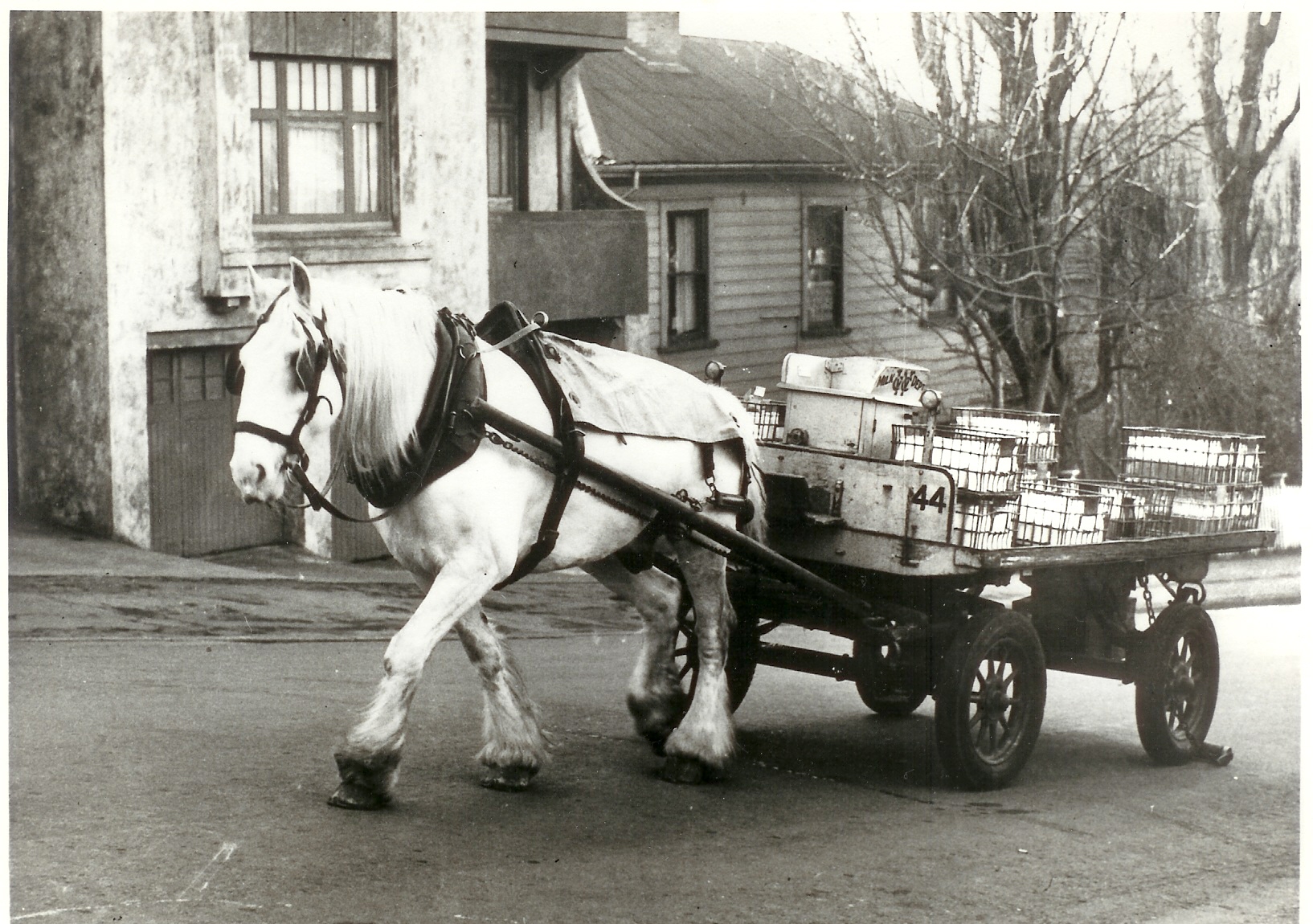
Milk Cart
Then Elvira remembers, with another chuckle, something else about the horse. “Granny Frandi (Annunziata) would have all the windows open – and when she baked she would put the scones or the rice buns on the sill to cool. But of course that horse could smell the baking, and steal the food, while granny was busy elsewhere. Then suddenly we could all hear granny shouting ‘that bloody horse!’ at the top of her voice”.
Elvira describes the farmhouse layout. “At the back of the house, there was a huge vegetable garden, and [from there] you would walk into a kind of shed where water was boiled in a big copper and the water [pipes] was attached to the back of the open fire and coal range”. This shed was where everyone left their coats and shoes before entering the farmhouse kitchen. The farm workers slept in the hay loft, “but they didn’t put boys and girls together, that wouldn’t have been right”.
Socialising at the Farm.
After milking was over and the evening meal finished, the adults would play cards. “The house opposite belonged to the Post Mistress and there was an Anglican and a Catholic church further down the road, so everyone was catered for”, Elvira tells us. Neighbours would “congregate outside the Post Mistress’ house when they collected their mail or bought something from the attached small shop”. Evidently, it was a good meeting place to stand and chat. Everyone liked to go to the local dance, but William was so shy “he would just stand there and watch everyone else dance”. “At the dance hall there was a ladies’ dressing room where mothers could look after babies and put them into the little beds at the hall, and there was beer and tea available”. “But”, Elvira suddenly recalled, “the men had to put on their milking gear and go to work straight after the dance!”
Amelia’s Three Brothers.
Describing her cousin Menotte as “happy go lucky, although a shingle short”, Elvira adds, “but he was very fond of my sister Helena”, intimating this redeemed his shortcomings. Menotte’s brothers “Ricciotti and William were very reserved and shy but everyone got along with each other very well on the farm”. Ricciotti was a “terrible gambler”, and there was a casino not far from where the family lived in Wingfield Street, “but he was very hard to get to know”. The extended Frandi family and their friends “loved going to the farm because it was such a happy place”, says Elvira dreamily, “and there used to be singalongs most nights, although everyone usually went to bed very early because the men had to get up about 5am to milk the cows and do the milk run”. Life at the farm was based on “a lot of friendships where there was an old record player, you know with the huge sound trumpet, and the women did embroidery, mending and made cushions. Granny Frandi was great at mending clothes, she was very, very neat. There was always a lot of laughter”, cackles Elvira as she relates those warm, happy times, “and although Francesco was very quiet he liked company, and there were a lot of sing songs”. Elvira illustrates, “Uncle Enrico played the clarinet, Uncle Antonio the trombone and the trumpet, while uncle Ateo played the piano. Uncle Alfred liked to sing and play the fool! There is a photo somewhere of uncle Antonio taken at the front door of the farmhouse” continues Elvira, “where there were two bedrooms there at the front, two more further down the hall and then a double bedroom which was grandpa and granny’s. Then you walked into a big room which was the dining and sitting room combined, and the kitchen was off that”, she finishes.
Elvira, Italia and the Convent.

Italia and and her daughter Elvira
><><><><><><><
Elvira once again turns the conversation back to her beloved mother, Italia. “We were forbidden, as children, to play outside in the street [Wingfield Street, Wellington] but my mother was quite happy for us to play on the huge lawn in the front of the house. She was very kind and my friends were often invited over for treats. One day my playmates were overheard by my mother to say that ‘Vera will get the strap’, and my mother questioned the girl as to why. My playmate then explained to my mother that on Monday mornings at school the Mother Superior would ask at assembly for those who did not attend Sunday School to raise their hands. And those who raised their hands got six straps on the hand which really hurt. After a couple of times I did not raise my hand any longer, to avoid the strap”. Elvira says her mother was furious and felt that the convent school was turning her daughter into a liar. “So”, Elvira carries on, “my mother goes to the convent and says to the Mother Superior, ‘I am Elvira’s mum, is it true that if the girls do not go to Sunday School, they get the strap?’ ‘Yes’, replied the nun, ‘that is our ruling’. My mother next explains to the austere nun ‘I can rarely go out, and the weekend is the only chance my daughter gets to go out to the Makara farm’. Then my mother lectures, ‘I think that you should check with each family about what their situation is – you are just encouraging my daughter to lie so she wont get the strap!’ So my mother removed me to a State School”, Elvira tells me with unconcealed pride. “But my mother did send me back to the convent years later to learn music”, she adds quickly.
Elvira Growing Up.
Elvira talks of her teenage years which she describes as “good”. “Cabaret had just started and I had nice things to wear, because mother was more affluent then, she even had a cigarette holder! These were the days of the Charleston; good times for me, and life started for me when I was 17 or 18 years old”. Then she speaks lovingly of Italia again, “The good things about me were all because of my mother’s upbringing, she was strict but very kind”. And obviously very talented and a good business woman. Italia was an accomplished dressmaker and clothes designer, and Elvira says her mother worked long hours, as she was a widow with no other means of support. “My mother was a great dressmaker and had many clients, who would call on her with descriptions of clothes they had seen at DIC and Kirkcaldies”, Elvira continues, the pride and love for her mother evident in her voice. “So she would walk to those stores and look at the respective garments and go home and copy them”. Italia had a tailor’s table upon which she cut out all the patterns and fabrics, and Elvira often heard her mother tell her clients, “on the funny phone we had”, ‘please do call in and if you like what I have done I’ll make it for you in the fabric of your choice’. She was a great dressmaker.”
Shops in the City

‘FERNGLEN’ 16 Murphy Street, Wellington, where Francesco and his sister Italia lived and ran a boarding house
><><><><><><><><><><><><><><><><><><><><
Elvira then discusses the shops in the vicinity of 20 Wingfield Street where the family lived before moving to 16 Murphy Street, which was a boarding house as well. The other streets are “Molesworth, Hill and Aitken Streets”, The shops include a “shoe repair, Prestons Butchers, horse and cart yard, and a big house with a very long verandah”. On the corner of Wingfield Street there was a Chinese shop with accommodation. “Our house had three steps up to the entrance, all the houses seemed to have three steps up to the doors”, noted Elvira as an aside. “In those days the Chinese had pigtails and they wore black caps, and kids would always try to pull their pigtails or else pull their caps off. They used to get angry and chase the kids with a knife, awful choppers they were”. This evokes memories of her dear sister Helena who was 14 years older than she. Even though most of the memories were happy ones for Elvira, there is obvious poignancy in her voice when she speaks of Helena, who died at the age of 30. The large age difference meant that Helena would have been like a second mother to Elvira, who was sixteen when her sister died and it would have had quite an effect on her young life. Elvira elicits that the Chinese “thought the world of Helena”.
><><><><>
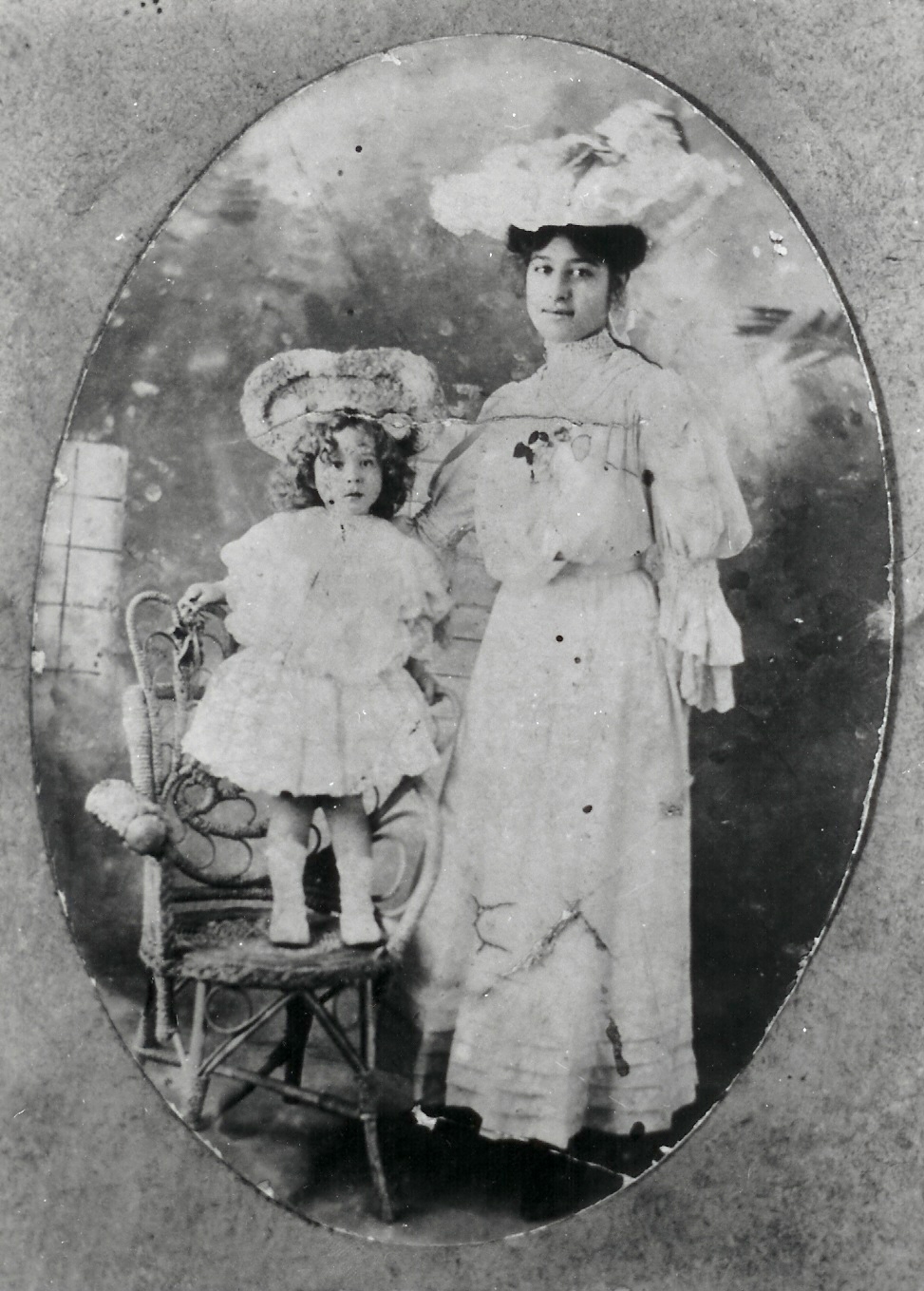
Elvira and Helena in beautiful costumes made by their mother, Italia
><><><><><<
The Neighbourhood
Elvira’s tone picks up again. “There was a small cake shop, then a wood and coal yard. Oh, and a fish shop and the grocer’s store. Opposite was the Prime Minister’s residence [Pipitea St] and the Post Office, and then along further there was the drapers and grocer’s shop combined, they had half of the shop each. And then there was the driveway and the baker’s shop, with a lane [Collina Tce] beside it”. The family was surrounded by all the suppliers they needed. Elvira then remembered that there was another Street next to the lane called “Hawkestone Street where there was a pub called the Shamrock which also had accommodation and I liked to go into the greengrocer’s shop. There were also lots of shops around Molesworth Street and a side street led to Tinakori Road which was very primitive, but it was all very friendly. My mother used to let me buy sixpence worth of broken biscuits as a treat, but she would say ‘now don’t eat the chocolate ones, Elvira’ ”
Doreen’s Life Within Her Family

Anne Frandi-Coory’s mother, Doreen with her younger sisters Joyce and Betty (photo: Karen Albert)
Italia always felt sorry for her niece Doreen as “she had a pretty hard childhood”, Italia had one day told Elvira. “She was the eldest girl and was responsible for helping around the house and caring for the three younger girls, Joyce, Betty and then Anne” and it was evident that Doreen was very attached to Italia. Anne, her youngest sister, also has stories to tell about the hardships of Doreen’s life, and the heartbreaking events she was a witness to. Although there were 16 years difference in their ages, Doreen and Anne were very close. Doreen’s son Kevin was also a part of the many sad times in her life and speaks eloquently of them. It is attested to by several members of the family, that Doreen’s mother Maria, or Millie as she was known within the family, was a morose woman in looks and in nature, and there are very few photos of her looking happy. Doreen reminded Tony very much of her mother Maria, in her features and demeanor; fragile and anxious.
Doreen’s youngest sister, Anne Frandi Albert (photo: Karen Albert)
><><><><><><><><
Elvira’s First Wedding
Elvira spends some time talking about her first marriage to William (Bill) Meban, whose photos show a very handsome man, with dark swarthy looks. “We were engaged after only knowing each other for three months”, she explains, with mirth in her voice. “My mother and both families had set a date, but Bill didn’t want to wait for that date, he wanted to get married straight away”. Pam states, “your mother didn’t get a chance to make the wedding dress”. “Well, yes and no” replies Elvira, and then she tells us that she and Bill decide that they will get married on a week night and plan for their secret event meticulously. “Bill was an engineer on the Ripple, a New Zealand Coastal ship, and we knew it had to be that particular week or we would have to wait for his next trip home”. Elvira then explains the hectic timetable they had devised for themselves. “I had a singing lesson that afternoon at the convent, which would explain why I was dressed to go out, and it was my chore to prepare the dinner that night, so I bought something quick to cook. Bill would be at our place for dinner, so we could head down to the Registry Office as soon as dinner was finished.” Elvira then says with girlish giggle, “I made a dessert for tea, it was huge – to last two or three days I told everyone”, but in reality it was to be for their wedding breakfast. “We left separately, and then met up at the Registry Office, and we had two witnesses, Edith Brown and the ship’s Chief Engineer. As we prepared for the ceremony, Bill suddenly exclaimed, ‘Vera, look at your frock!’ and I looked down to see blood had dripped onto it from the quick steak meal” she laughs. “I had borrowed that dress from Uncle Alfred’s wife Maria”, Elvira tells us. It is unclear whether Auntie Maria was in on the secret wedding plans.
Time To Own Up
So Elvira and Bill were married in secret, but their consciences soon got the better of them; “My mother didn’t deserve this treatment”, they had reasoned, “and we were worried someone might notice the ring. On his next trip home, we were sitting at the dinner table, all chatty and bright, when uncle Frank observed, smiling, ‘We’re a very jolly family tonight’ and looking over at family friend Skipper Bates, he asked, ‘have you been drinking Bates?’” Things started to get out of hand, their guilt consuming them, and after six weeks of subterfuge, Bill insisted to Elvira, “you have to tell your mother!” Elvira’s cackle filters through the noisy tape as she says “The marriage hadn’t even been consummated, even then.” Italia took the news well, although surprised and worried, “You wont be well received in Napier”, she cautioned. “Of course, mother was right, and Bill’s mother was furious!” and a more serious Elvira continues, “She called me a slut and asked Bill when the baby was due, to which he replied ‘there is no baby’”. Elvira and Bill agree to a second wedding ceremony in 1923 at Old St Paul’s Church down the road from Wingfield Street, ”because Mrs Meban performed so much.” Elvira’s father had died when she was four years old, so Francesco gave her away. But Elvira goes on to say that things were “never really reconciled with the Meban family”. She enlightens us further, “Bill’s father was a shoemaker and his brother was a sheep farmer in Napier”

Bill and Elvira Meban Wedding
><><><><><><><>
What might have been
Elvira confides that she and Bill had often discussed having children and what faith they might bring the children up in. And what church would they marry in? “Well we got married in an Anglican Church, my mother was a Roman Catholic and Bill was a Presbyterian”. However, Italia was relatively unconcerned, counselling her daughter that “God means you to be happy, so you decide, it’s up to you”.
Elvira’s Loss
Tragedy was about to strike the young couple. You could sense the sadness as the details of the tragedy slowly emerge; “I remember there was a severe storm that night [1924]. Oh there were often bad storms, but this was worse than the others. I got up in the morning after a sleepless night, and on the way to the bathroom, I could hear my mother talking to a lady, ‘You had a busy night last night, with the phone ringing constantly’”. Elvira recalls that the lady had replied “Get a good breakfast into Vera, the ship was wrecked with all lives lost in that terrible storm.” The news was absolutely devastating for Elvira. “Bill was in the engine room – not a hope of getting out, and Bill had always told me that the ship was a death trap. And the strange thing was, the Chief Engineer died in the night, the same hour as Bill died in the shipwreck, but he was in hospital with peritonitis,” she finishes quietly, obviously the memory is still painful for her after so many years have passed, and she changes the subject.
By all accounts, Elvira never really got over the heartbreaking loss of her first love, Bill. But Elvira was no stranger to tragedy, and neither was her mother. They lost a father and husband, Pietro Corich in 1906, a much loved sister and daughter, Helena, in the 1918 ‘flu epidemic, and the child Helena was carrying. Italia also had to deal with the death of one of her favourite brothers, Ateo, in WW1 at Gallipoli.
Elvira married her second husband Melville Pengelly in 1931. She died 7 May 1996 and is survived by her only son Anthony John Pengelly.
Postscript:
Thank you to Pam Frandi Parkhill and Tony Pengelly for their contribution to this piece of Frandi Family history.
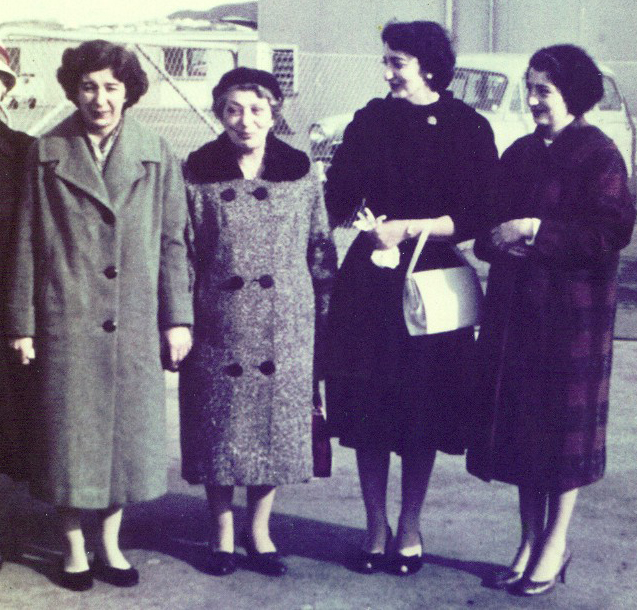



 anne frandi-coory