Archive

Tag Archives: Anne Frandi-Coory book reviews

****************************

********************************

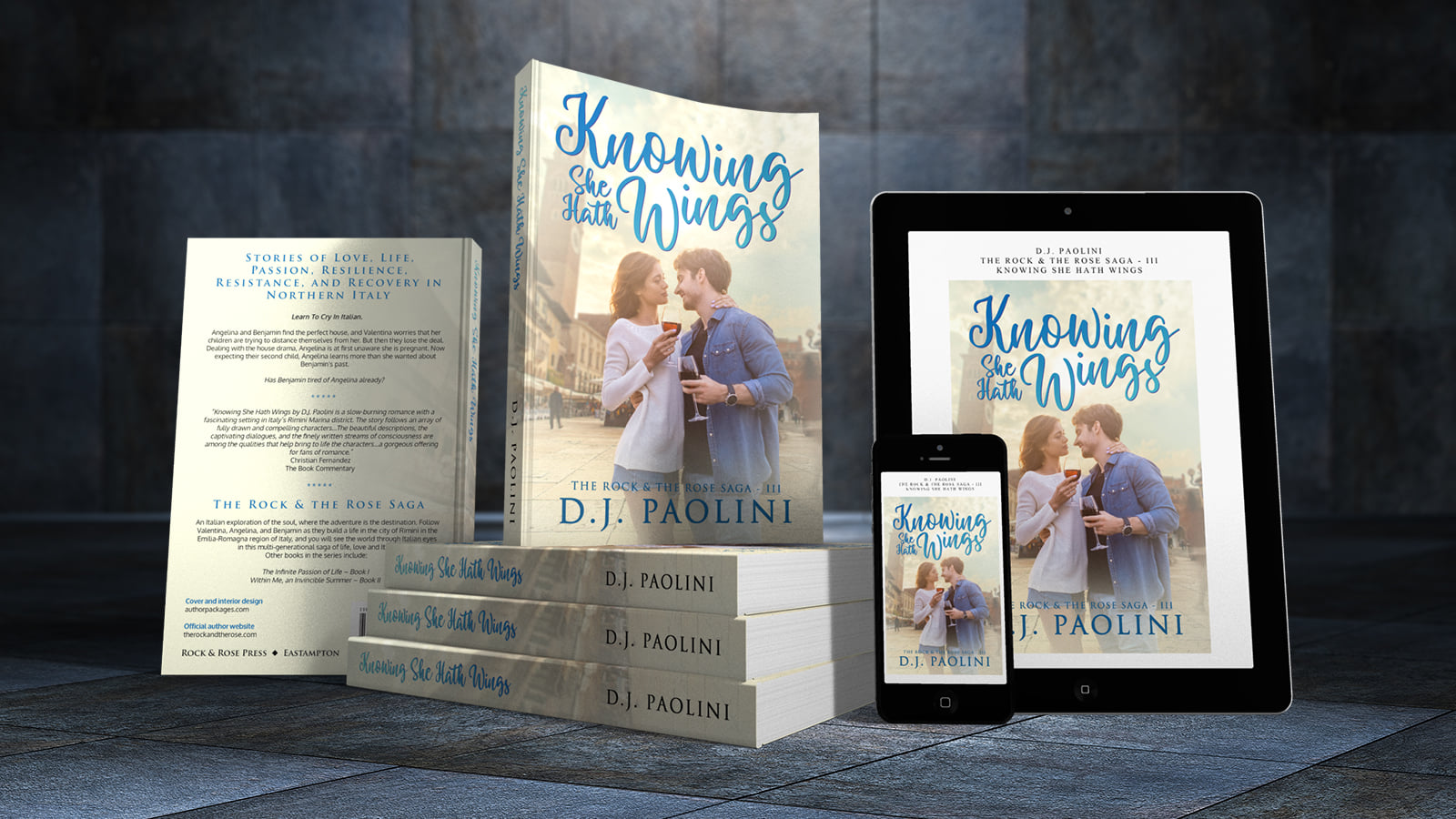
I absolutely loved reading this series of The Rock and The Rose Saga … I have just finished reading Book ll Within Me An Invincible Summer and Book lll Knowing She Hath Wings.

(My review of Book l The Infinite Passion of Life) HERE: https://frandi.wordpress.com/2020/12/29/the-infinite-passion-of-life-by-d-j-paolini-a-book-review/

I fully recommend these books to anyone who loves everything Italian, including the language. The author, D.J. Paolini, combines historical and current world events, intertwined with an intriguing multi-generational ongoing family saga. Added to the Italian family saga, Lebanon the country, and its language, heighten the intrigue around friendships, romance, and political affairs.

Coming from a Lebanese Italian family and heritage myself, along with their inherent tragedies and emotional dramas, not to mention the mixed languages, I could relate so well to all of these stories.

Read the whole series, I urge you. – Anne Frandi-Coory

*********************************

5 *****  

mind-behind-the-crime


Dr Helen McGrath is currently an adjunct professor at both Deakin and RMIT Universities.

Cheryl Critchley is a prolific investigative journalist.


The fifteen crimes analyzed in this book, all carried out in Australia,  involve three women and twelve men. The criminals were generally not diagnosed with a severe mental illness, however, they were all diagnosed as having a mental disorder, such as a personality disorder, and they were well aware that what they were doing was wrong. The difference between mental illness and a personality disorder is explained in detail at the beginning of the book.

The various personality disorders are delved into at length by the authors. MIND BEHIND THE CRIME is well set out, divided into chapters and parts  e.g. each chapter is devoted to one specific crime with the offender and victim/s involved in that particular crime listed at the beginning of the relevant chapter. Parts of the book are divided up into the specific, diagnosed disorders as they relate to each perpetrator’s behaviour and decision-making in the lead up to their horrendous crime.

PART 1: Filicide and familicide – Killing Your Own Family

‘Men commit nearly all familicides and filicides (92-97 %) and there is evidence that such mass murders are increasing in Australia.’

Filicide is the term used to describe a situation in which a parent intentionally kills one or more of their children …the parent may or may not then kill themselves. The motive and case history of each of these crimes is explored thoroughly.  Familicide and familicide-suicide are the two terms most commonly used to describe a situation in which one family member kills or attempts to kill all members of their direct family and then often suicides. Classification schemes are used to aid the reader in identifying the behaviours and mental disorders that motivated these murderers.

Family annihilation is described as a subcategory of mass murder, defined as the killing of four or more members of the one family in one location and during one event. Family annihilators are mostly men.

‘Associate professor Carolyn Harris Johnson, a leading expert in filicide and familicide…points out that the media frequently romanticises (saying they acted out of love) and sanitises this type of crime, to soothe the anxieties of the audience because the subject matter of child murder is taboo, or too confronting for most people. But this approach distorts the public’s understanding of why these events occur and the extent of the perpetrator’s responsibility. This makes it much more difficult to identify actions that can be taken as early warning signs and prevent such child murders in the future.’ [my emphasis]

A summary of each of four categories are:

The self-righteous killer-seeks to blame their partner for damage to family, breakdown of relationship, etc. Has been controlling and possessive in the past, engages in over- dramatic behaviour and comments, may attempt suicide to avoid facing the criminal justice system.

The disappointed killer – concludes their family has let them down, their family is an extension of their own needs and aspirations, self-obsession prevents them from seeing their children as separate entities.

The anomic killer – perceives they have damaged their family’s income or lifestyle, have lost their economic status, lost their job.

The paranoid killer – perceives there is an external threat (real or imagined) that will destroy their family e.g. social services may take their children.

 PART 2: Narcissistic personality disorder and malignant narcissism – arrogant, dangerous and sometimes vulnerable.

PART 3: Dependent personality disorder – desperately needy.

PART 4:  Paranoid personality disorder – you can’t trust anyone

PART 5: Antisocial personality disorder – Life outside the rules. People with ASPD can be dangerous and difficult to detect. They lurk in homes and workplaces, playing the role of the perfect partner or colleague until they decide to use and abuse those around them for their own ends.

PART 6: Criminal autistic psychopathy and sexual sadism disorder –

a dangerous combination:

1. autistic spectrum disorder.

2. Asperger’s syndrome.

3. pervasive developmental disorder.

A diagnosis of this disorder can be made when there is evidence of behaviours such as those listed in the following two categories:

1. behaviours that indicate deficits in social communication and interaction. (Deficits in social communication and interaction are listed in more detail in this section).

2. restricted and repetitive patterns of behaviour, interests or activities.

Every one of the above disorders is explained at length in each section to help the reader understand the mind and behaviours of the perpetrator at the time the crime was committed.

All of the cases chosen for this book are recent high-profile Australian murders most readers will already know about.  MIND BEHIND THE CRIME refers to the Diagnostic Statistical Manual and other classification schemes to help explain each disorder and the subsequent motives of the perpetrators involved.

The authors argue that no amount of mild to moderate depression excuses killing those closest to you. It is never justified and the perpetrators should be called what they are – murderers. They go on to say:

“A common myth about these crimes is that parents who kill their children do so out of love and that the extreme love they feel for their child/children means they can’t bear to be separated from them…loving fathers and husbands don’t kill their kids. And unless the public’s perception of these murderers changes, other men will continue to feel that if life gets too tough they, too, can take this option and be eulogized by their loved ones in the media rather than condemned  as they should be.’ Most children were killed in a brutal and violent way; in their last moments knowing that it was their father who killed them.

‘The positive way many of those who kill their children are described in the media has the potential to influence others to commit the same crimes. Such coverage also detracts from the victims’ suffering and makes the crimes seem less horrifying. It implies that nothing can be done about these killings because they are neither predictable nor preventable. This would not be the case if, as a society, we accepted the hard reality about these crimes and focused more on identifying potential warning signs.’

It is clear at the outset that the authors care deeply about the victims involved in these crimes. They warn of the dangers that men with these disorders pose to their wives/partners and children. There is an appendix at the rear of the book: ‘Where to go for help and support’.

This is a book for our times, and I recommend it to readers who may know of someone in their family who is at risk, or for anyone interested in trying to make sense of why these murders are occurring across Australia. There is also widespread concern that Australia’s Family Court system requires reform to ensure that justice is done and that families and children are better protected.

-Anne Frandi-Coory 14 December 2018


The Silk Roads; A New History of the World

by Peter Frankopan, a senior research fellow at Worcester College, Oxford, and Director of the Centre for Byzantine Research at Oxford University.

*******

img20180301_11475993

*******

In 2013, Chinese President Xi Jinping announced the launch of both the Silk Road Economic Belt and the 21st Century Maritime Silk Road, infrastructure development and investment initiatives that would stretch from East Asia to Europe. The project, eventually termed the Belt and Road Initiative (BRI) but sometimes known as the New Silk Road, is one of the most ambitious infrastructure projects ever conceived. It harkens back to the original Silk Road, which connected Europe to Asia centuries ago, enriching traders from the Atlantic to the Pacific.

I think all current politicians and economists should read this book, because history repeats again and again but then, politicians and world leaders never seem to learn. Frankopan’s research is extensive and he presents many source testimonies and documents to support his claims. His writing moves along at a swift and thoroughly engaging pace. I would go so far as to recommend this book to college teachers. It gives a rare and independent insight into the political history of our world.

Historically, the Silk Roads were a network, with their geographical centre in Asia Minor, Central Asia, the Caucasus, China and the Middle East; territories that met, and traded with one another along arterial routes of communication. These routes influenced the world as we know it today. Ideas, cultures and religions were also spread via this network.

Bettany Hughes, whose book A Tale of Three Cities; ISTANBUL is also a great read, says of Frankopan’s ‘The Silk Roads’: How shamefully we in the West have been caught in the 20th and early 21st centuries with our strategic trousers around our ankles, … failing to remember why the map of the Middle East is drawn with such straight lines. Our ancestors would have been horrified by today’s wilful ignorance. Ancient reports of the region (studded, admittedly, with some fantastical nonsense) would put many modern memos to shame. Tellingly, Frankopan includes some recently released diplomatic cables and US political briefings describing Afghanistan, Iraq and Iran that are cringingly callow, and exemplify the danger of living in what the late historian Eric Hobsbawm called the ‘permanent present’, ignorant of our past.

In this vein, to quote Frankopan: The liberation of Christendom seemed to be at hand…it soon became clear how wrong these reports were…what was heading towards Europe was not the road to heaven, but a path that seemed to lead straight to hell. Galloping along it were the Mongols…Later the Mongols became increasingly interested in the techniques that had been pioneered by western Europeans, copying designs for catapults and siege engines created for the crusaders in the Holy Land and using them against targets in East Asia in the late thirteenth century. In this way Control of the Silk Roads gave their masters access to information and ideas that could be replicated and deployed thousands of miles away.

In the sixteenth century the age of empire and the rise of the west were built on the capacity to inflict violence on a major scale eg. the Americas. By then the best money was to be had in human trafficking and it was said to be ‘in league with the crown and with god.’ Before the discovery of the Americas, trading patterns ‘had begun to pick up’ and many scholars argue that this was due to improved access to precious metals and ‘the rising output of mines.’ But other scholars ‘point to the fact that tax collection became more efficient in the second half of the fifteenth century.’ [Perhaps our current political leaders and economists should take note]: ‘Economic contraction had forced lessons to be learned…’ and the collection and setting of taxes paid a crucial part in those valuable lessons.

I thought The Road to Empire a very interesting chapter and one which mirrors much of what is happening in our 21st Century:

Ottoman bureaucrats had proved to be highly skilled administrators, adept at centralising resources …as the empire swallowed up more territory in the fifteenth and sixteenth centuries, this had worked efficiently and smoothly. When the momentum of expansion slowed…the fragility of the system became apparent, under pressure from the cost of sustaining military action on two fronts- in Europe in the west and with Safavid Persia in the east…but also as a result of climatic change that had a particularly severe impact on the Ottoman world. [my emphases].

Frankopan discusses at length the different outcomes relating to the gap between rich and poor in Islamic countries as opposed to Christian countries in the west. It may not surprise many readers that Islamic countries had the more equitable laws which meant less concentration of wealth and property within a few elite families, including royal dynasties, as in the west.

Under the surface, powerful currents were swirling unseen…Robert Orme’s attitudes were typical of the eighteenth century; The first official historian of the East India Company, Orme penned an essay whose title On The Effeminacy of the Inhabitants of Indostan [India], reveals much about how contemporary thinking had toughened. A bullish sense of entitlement was rising fast. Attitudes on Asia were changing from excitement about profits to be made to thoughts of brute exploitation…It was the Wild East – a prelude to similar scenes in the west of North America a century later. Go to India, the memoirist William Hickey’s father told him, and cut off half a dozen rich fellows’ heads… and so return a nabob. Serving the East India Company in India was a one-way ticket to fortune.

The Road To Crisis is an intriguing chapter in which late eighteenth century Russia looms large as a threat to Britain. Anyone interested in the part Russia played in forming the geopolitical landscape of the 21st century, will find this very interesting, as I did. Much of what is happening in our world today, makes more sense, and I understand the reasons why China and Russia do not trust the west. This includes the aftermath of the Crimean war and Russia’s determination to claim back the Crimea peninsula.  The west would eventually help the spread of Islam in the East as a way of curtailing Russian expansionism.

‘In the late nineteenth century, Russian confidence, bullishness even, was rising fast.’ Britain planned to expand its territories into the far East, and in this quest, was in competition with Russia. But once China granted trading privileges to the British, they had little hesitation in using force to preserve and extend their position. Central to the commercial expansion was the sale of opium despite fierce protests by the Chinese, whose outrage at the devastating effects of drug addiction was shrugged off by the British authorities. The opium trade had expanded following the Treaty of Nanking in 1842, which opened up access to ports where the trade had been restricted previously, while also ceding Hong Kong to the British; further concessions were granted after British and French forces marched on Beijing in 1860, looting and burning the Old Summer palace.

Britain was also keeping a watchful eye on Russia which was meddling in one of Britain’s most prized possessions: Persia with its black gold. ‘Russian ghosts were everywhere. Anxious Foreign Office officials pored over a stream of reports on the activities of Tsarist officials, engineers and surveyors in Persia, that was flooding back to London.’

The reasons for the First World War: ‘World leaders go to war for their egos…’ in this case the fight over Persian oil, and the carving up of Ottoman Empire territories. Offerings of an ‘empire’ to leading figures in the Arab world were made in return for their support. The wheeling and dealing, involving Russia, Germany and Britain, while the first world war was raging, is sickening, and all the while Britain was fearful of ‘losing’ India. ‘The former British Prime Minister Arthur Balfour was anxious that ‘a rapid defeat of Germany’ would make Russia more dangerous still by fuelling the ambitions of the latter to the extent that ‘India might be at risk’. There was another worry: Balfour had also heard rumours that a well-connected lobby in St Petersburg was trying to come to terms with Germany; this he reckoned would be ‘as disastrous for Britain as losing the war’.

Both Britain and France passionately claimed to have noble aims at heart and were striving to set free ‘the populations subject to the bloody tyranny of the Turks’, according to The Times of London. ‘It was all bad’ wrote Edward House, President Wilson’s foreign policy adviser, when he found out about the secret agreement from the British Foreign Secretary. ‘The French and the British are making the Middle East a breeding place for future war’. [my emphasis]

…By the end of 1942, the thoughts of the new allies, Britain, the USA, and the Soviet Union were turning to the future…it was clear that the ‘effort, expense and trauma of another massive confrontation had exhausted western Europe’. It was already obvious that the old empires had to be wound down. Such chapter titles as The Road to Genocide, The Road to Super Power Rivalry, and The Road To Catastrophe are a good indication of what followed the Second World War. Most of us know some of this history, but The Silk Roads describes in detail, much of it in newly released source documents, the tragic consequences of this, to my mind, a completely unnecessary war. The claim in this book that world leaders go to war largely for their egos, is as true today as it has been throughout human history.

Post Second World War there was concern across the world for the seemingly out-of- control proliferation of nuclear weapons manufacture. Most readers will by now be well versed in the reasons for the later USA invasion of Iraq, but many will be surprised by the indirect involvement of Israel, USA, England, Italy, France and Russia in the years leading up to the invasion.   Few had doubts that the research reactors, powered by weapons grade uranium and other materials essential for dual use, as well as separation and handling facilities capable of extracting plutonium from irradiated uranium, were solely for energy purposes. The west turned a blind eye as and when needed. As Pakistani scientists noted ruefully: ‘…the western world was sure that an underdeveloped country like Pakistan could never master this technology…and yet at the same time western countries made hectic and persistent efforts to sell everything to Pakistan. They literally begged us to buy their equipment’.

Frankopan writes:

As it was, it was not hard to see how stern talk from countries like the US, Britain and France, which refused to be subject to the inspections and rules of the International Atomic Energy Agency, grated with those that did and had to conduct their research in secret; but the real hypocrisy, in the cold light of day, lay in the enthusiasm with which the developed world rushed to earn hard cash or gain access to cheap oil.

There were half-hearted attempts to curtail the spread of nuclear materials. In 1976, Kissinger suggested that Pakistan should wind down its processing project and rely instead on a US-supplied facility being built in Iran that was part of a scheme devised by none other than Dick Cheney, for the plant in Iran to serve as a hub for energy needs across the region. When the President of Pakistan turned down this offer, the US threatened to cut off the country’s aid package.

In 1980 US President Carter’s handling of the hostage situation and the Iranian oil embargo was a catastrophe. Operation Eagle Claw, the covert mission he authorised to rescue hostages… ‘was a propaganda disaster’… this was but one disaster in a changing world order. Countries were fighting back against the hypocrisy of the west.

In the mid-1980s, when the United Nations reports concluded that Iraq was using chemical weapons against its own civilians, the US responded with silence. Condemnation of Saddam’s brutal and sustained moves against the Kurdish population of Iraq was conspicuous by its absence. It was simply noted in American military reports that ‘chemical agents’ were being used extensively against civilian targets. Iraq was more important to the United States than the principles of International Law – and more important than the victims.

The chapter on the Soviet invasion of Afghanistan, its subsequent withdrawal of troops and weaponry, and the involvement of China, USA and Saudi Arabia in training and supporting Islamic militants is a must read.

Those resisting the Soviet army were supplied with money and weapons by the three countries. The long-term implications and consequences are now well known and documented, if not the initial struggle in ridding Afghanistan of the Soviet invaders.

Men of Saudi extraction who followed their conscience to fight in Afghanistan were highly regarded. Men like Osama Bin Laden – well connected, articulate and personally impressive – were perfectly placed to act as conduits for large sums of money given by Saudi benefactors. The significance of this of course, only became all too apparent later.

Frankopan lays out in detail how these events have made our world much more dangerous, and volatile, than it ever was.

Things were not going well between the USA and Iraq for various reasons, and there was mistrust on both sides. Rumours were rife that the USA was about to overthrow Saddam. Consequently, ‘…in one of the most damning documents of the late twentieth century, a leaked transcript’ of the then ambassador’s meeting with the Iraqi leader in 1990, reveals that she told Saddam that she had ‘direct instructions from President Bush to improve our relations with Iraq…we know you need funds…’. Iraq was running up debts in the war with Iran and the depressed price of oil presented problems for the economy. Saddam subsequently asked the ambassador what USA’s opinion was on his solution: to take over control of the Shatt al-Arab waterway, a region over which Iraq was involved in a long-running dispute with Kuwait. The ambassador answered, [to summarise], that ‘…the Kuwait issue is not associated with America’. Saddam had asked for a green light from the US, and he got one. The following week he invaded Kuwait.  Frankopan:

The consequences proved catastrophic. Over the course of the next three decades, global affairs would be dominated by events in countries running across the spine of Asia. The struggle for control and influence in these countries produced wars, insurrections and international terrorism – but also opportunities and prospects, not just in Iran, Iraq and Afghanistan, but in a belt of countries stretching east from the Black Sea, from Syria to Ukraine, Kazakhstan to Kyrgyzstan, Turkmenistan to Azerbaijan, and from Russia to China too. The story of the world has always been centred on these countries, but since the time of the invasion of Kuwait, everything has been about the emergence of the New Silk Road.

In conclusion, under the chapter The New Silk Road Frankopan warns, and I quote in full: In many ways, the late twentieth and early twentieth centuries have represented something of a disaster for the United States and Europe as they have played out their doomed struggle to retain their position in the vital territories that link east with west. What has been striking throughout the events of recent decades is the west’s lack of perspective about global history – about the bigger picture, the wider themes and the larger patterns playing out in the region. In the minds of policy planners, politicians, diplomats and generals, the problems of Afghanistan, Iran and Iraq seemed distinct, separate, and only loosely linked to each other…While we ponder where the next threat might come from, how best to deal with religious extremism, how to negotiate with states who seem willing to disregard international law, and how to build relations with peoples, cultures and regions about whom we have spent little or no time trying to understand, networks and connections are quietly being knitted together across the spine of Asia; or rather, they are being restored. The Silk Roads are rising again.

********


-Anne Frandi-Coory

The NEAPOLITAN NOVEL quartet

by Elena Ferrante


Elena Ferrante

<><><><><

I have recently been introduced to Elena Ferrante novels, beginning with the Neapolitan Novel quartet: My Brilliant Friend, The Story of a New Name, Those Who Leave and Those Who Stay, and The Story of the Lost Child There is such an unsettling and brutal honesty in Ferrante’s writing, firstly about growing up poor and female in Naples, and subsequently trying to escape that seemingly inevitable life. The novels’ narrator, Elena Greco, recalls her childhood and her brilliant friend Lila, whom she at once loves and hates, first sexual experiences, the brutal men in their lives, their dreams of escaping the ‘neighbourhood’ and the fervent hopes that they will never become their mothers. Ferrante’s exquisite writing thoroughly engages the reader through girlhood fears, first boyfriends, harsh family lives, the deep seated religious division of whore and virgin, constant threats from local bullies, men and boys, and tensions of repressed sexual desires.

The mysterious author [Ferrante’s true identity is unknown] lays bare the psychological trauma of growing up female in the south; the culture of being owned by your father and then your husband. The expectation that a girl must get married, and bear children, the resultant crushing of her intellect and her creativity. There are only two ways to escape the hardships: excel at school, and gain access to universities and a better life in Pisa, Milan or Florence, even though every move to escape the inevitable life of poverty and domestic grind is greeted with age old suspicions and hatreds by family and friends. Elena Greco is one of the lucky ones. She excels at school, goes to university in the north, eventually marries into a well known northern Italian family, but is her life really any better than that of her brilliant friend Lila, who refuses to leave Naples? Lila chose instead to marry a local boy from a powerful, wealthy family, and even though she has sold her soul for a beautiful new house and everything that money can buy, her life becomes unbearable and the inherent dangers seem to multiply.

These novels contain the story of modern Italy…about those who left and those who stayed.

I have never read four books so quickly! I read all of the books with a total enthrall…impatiently wanting to do nothing else but be involved in the lives of Elena and Lila,  right to the very end.

-Anne Frandi-Coory 1 August 2016


Also here on Facebook: https://www.facebook.com/myhomelibrary/

Updated 12 June 2019

The Hospital By The River

THE HOSPITAL BY THE RIVER exceeded all my expectations. I have always admired Dr Catherine Hamlin as an Australian heroine. What she has achieved in her lifetime, is a superhuman feat.

In her book, Dr Catherine Hamlin begins by writing about the family histories and medical backgrounds of both her and her husband, Dr Reg Hamlin, in Australia, New Zealand, and later in the UK. Both came from privileged backgrounds. Intertwined with the Hamlins’ wonderful work saving the lives of hundreds of mothers and their babies in Ethiopia, are expressions of their deep Christian faith, and the comfort it brings them. Even though I am not a religious person, I can fully understand how their faith kept them going through some very difficult and challenging times, not least of all, a dangerous war. The couple sacrificed a great deal in order to build their hospital and bring healing to hundreds of poor Ethiopian mothers and their babies. However, I felt that in following their God’s mission, their only son Richard, also paid a heavy price.

Dr Hamlin goes on to detail the travelling and begging the couple had to engage in to bring in funds to keep their dream, and the hospital they had built, afloat. She documents the perfection of surgical techniques used in the repair of fistulae to restore quality of life to their frail, and sometimes, dying patients. Many babies were born dead, sometimes jammed in the birth canal for days, because of protracted labours. Cultural practices mean mothers are made to squat for days during labour causing terrible injuries to their bladders, bowels, and vaginas. Some mothers’ uteri burst with devastating consequences. These injuries leave afflicted mothers with a life lived in misery, unable to control their bladders or bowels. They are abandoned by their husbands and families, left to fend for themselves in filth, and near starvation.

The hospital the Hamlins built in Ethiopia, with the help of worldwide financial donations, and the support of powerful Ethiopians, has given hope to thousands of women; more than 90% are fully cured. Those who cannot be cured, perhaps left with minor wounds, are able to live in adjacent hostels within the hospital compound.  Some of those who are cured, stay on to be trained as nurses and midwives. Others progress to operating assistants and surgeons.

The compelling stories of the lives of long suffering patients are truly heart rending, and yet uplifting, due to the vibrant spirit of Ethiopian women. These brave, often under-nourished women, walk for days, months or years, to get to the Hamlin hospital of hope, where they can have life saving surgery.  Be that as it may, I could not but help see the great irony within the pages of this book: The Hamlins, as Anglican Missionaries, worked tirelessly, operating on these poor, rejected mothers with horrific rectovaginal fistulae, mostly caused by giving birth too young, or by being raped. The majority of women they performed surgery on, were of a Christian Orthodox religion which culturally supports child marriages, often girls as young as eight. As an Orthodox priest remarked: “otherwise they will fall into sin like Western women who don’t have children until they are 30”!!  So here we have Christian missionary surgeons repairing horrific injuries which another Christian sect, in essence, fully condones!  No blame whatsoever attached to husbands or rapists.

At the end of the book, I couldn’t help but wonder, in an ideal world, would it not have been wiser and more efficacious for the Christian World to unite, and spend those millions travelling around Ethiopia, educating the men and empowering the women? But then the hallmark of religion has always been more about tradition than visionary reform.

********

Dr Catherine Hamlin celebrates 60 years in

Ethiopia in 2019.

*******************************************************************************

© To Anne Frandi-Coory All Rights Reserved 14 May 2015

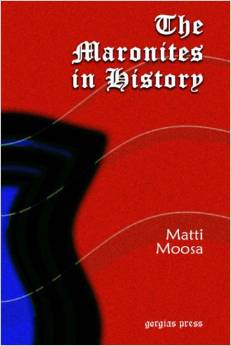
The Maronites in History

by Matti Moosa

*************************************

The Maronites in History

**************************************************************************************************************

I bought this very expensive book because I have always been interested in the Maronite religion of my Lebanese Grandparents, Jacob and Eva Coory. They were born and raised in the small village of Bcharre where the Maronite religion appears to have gained a strong footing around the 6th Century. There are very few books written about Lebanon’s  Maronites but I believe I have found a well written and well researched one in Moosa’s original Syracuse University Press publication The Maronites in History. Various essays on this subject can be found on many websites, but I found them to be emotive and with little basis in fact. Certainly no source documents were quoted, and most were based on hearsay passed down through generations. Still more were so badly written, it was difficult to follow the writer’s line of thought.

Matti Moosa opens the Preface of his book The Maronites in History with a question: Who are the Maronites and what is their importance to the existence of the Lebanese Republic?  This is a very good question, because so much folklore has been added to fact that it’s very difficult to know for certain. However, the author has embarked on a marathon investigation after being awarded a scholarship. He has extensively studied source documents housed in the Vatican Library as well as written testimonies from writers who lived in Lebanon from the 5th Century onwards.

The author states: In essence this book is a study and analysis of the origin of the Maronites , indeed of their whole historical heritage, an examination based on ancient and modern sources written in many languages, many of which are still in manuscript form.

Moosa goes on to explain in the preface: This book attempts to place the history of the Maronites in historical perspective. Maronites today suffer from a serious identity problem. They haven’t been able to decide whether or not they are descendants of an ancient people called the Marada  (Mardaites) or Arabs or of Syriac-Aramaic stock. Unless the Maronites solve this identity problem their conflicts with other minority religious groups in Lebanon will never be remedied. 

 Essentially, historical documents show that the Maronites originally professed the faith of Monophysitism, and later through edicts and threats of death or exile by various religious and state rulers, changed their beliefs to Monothelitism, both considered heretical by the Roman Catholic Church. Monothelitism though, is close to Catholic doctrine, so it appears the Church in Rome turned a blind eye to this heresy by Maronites for various strategic reasons which Moosa discusses at length in The Maronites. [My emphasis]

There are even disputes among Maronites and scholars over the origin of the name Maronite. The Maronite’s beloved monk St Marun and a later patriarch John Marun, have question marks over their actual existence. There is nothing in available ancient sources to indicate the name and location of the place where the ascetic Marun lived. However, the author concedes, one might be tempted, upon reading Theodoret of Cyrus, to conclude that a certain Marun lived in the vicinity of Cyrus in what was then known as Syria Prima, many miles to the north-east of Antioch. The failure to positively identify this place has caused much speculation by Maronites  as to its whereabouts. The Maronite Bishop Pierre Dib states that Marun lived on top of a mountain near Apamea  in Syria Secunda, an area far distant from Cyrus. Others claim that Marun lived in a cave near the source of the river Orontes (al-Asi) close to the Hirmil in Lebanon; they cite as evidence the name of the cave known until this day as the cave of Marun.  Other Bishops and writers state with the same certainty various other places in which the cave of Marun may have been situated.  Maronites and others cannot even agree on where or when a monastery of Marun was built but we may conclude that in Syria toward the end of the 6th or early 7th Century there existed more than one monastery bearing the name of Marun. One of them was located in or near Hama and Shayzar. It gained some notoriety in the early 7th Century when it adopted Monothelitism. The abbot of this monastery was named Yuhanna (John) and he became a Monothelite with many followers in Syria leading to the slow spread of Monothelitism into Lebanon. Those who followed him were called Maronites. Whether this monastery had any connection with the fifth century ascetic Marun is doubtful.

***************************************************

Mar-maroun-4

******************************************************

Efforts to date the Monastery of Marun from the 5th Century are sheer speculation. However, we have three documents which refer to a Monastery of Marun in Syria Secunda and all three documents attest that the monastery of Marun related to the doctrine of Monothelitism.

Commemorated on July 31st each year by the Maronite Church is the mythical massacre of 350 monks, ‘martyrs and disciples’ of the ascetic Marun. They were believed to have been slaughtered but this atrocity lacks strong historical substantiation. In fact there is no evidence that these were monks from the monastery of Marun.  Indeed, there is no mention of this in any pope’s correspondence of the times, nor is it mentioned in any Vatican or Church official documents.

There is no evidence that the Maronite Church ever commemorated these ‘martyrs’ before the year 1744. Even the Maronite Council assembled in Lebanon in 1736, which among other matters instituted the festivals and commemoration days for Maronite saints, did not list a commemoration day for these ‘martyrs’.

It is the author’s judgment following extensive research that the Maronites were and are closely linked to Syrian Orthodoxy. Probably for largely political reasons and the Roman Catholic Church’s need to gain a foothold in the Middle East, it overlooked the Maronite’s heretical interpretation of the Council of Chalcedon’s strict canons. [My emphasis]

In the Vatican’s push to gain a foothold in the Middle East, it allowed the Maronites to maintain their traditional patriarchs as head of their Church in Lebanon as they had done since the middle of the 8th Century. But in reality Rome considered them less than a Catholic bishop in status. It appears that only in the 8th Century did ancient church writers refer to the Maronites as a distinct Christian sect. [My emphasis]

Fortified for many generations in their mountain of Lebanon, the Maronites could claim more independence in their ecclesiastical affairs and therefore were and still are in a much more favourable position to revive their Syriac tradition and language. But instead of encouraging the Maronites to retain and cherish their Syriac heritage and revive the Syriac language  in order to become once more the lingua franca of the Maronite people the Latin missionaries (sent by Rome) discouraged the use of this language and denigrated the Syriac heritage and added more woe to the state of the already Arabised Maronites by Latinisng their Church and eventually their prayer books. The Maronites thus almost completely lost their Syriac identity. Since the 16th Century instead of taking pride in their Syriac legacy, the Maronites,in their desperation to find a legitimate origin of their Church and people have claimed that they were the descendants of  Marada (Mardaites) which is historically groundless.

Like the Nestorians the Rum (Byzantine) Orthodox, and the Syrian Orthodox People, the Maronites are of Syriac-Aramaic origin. The Lebanese Council of 1736 emphasised the use of the Syriac language first and Arabic second in the Maronite Church services. But this emphasis was not intended nor did it contribute to the revival of the Syriac language as the national symbol of the Church. Perhaps if the Lebanese Council’s recommendations had been followed, Lebanon may not be suffering the loss of identity it’s suffering from today. The least one can say for certainty is that the names of the villages and towns of Lebanon, especially Bcharre and three neighbouring villages, used the Syriac-Aramaic language as their lingua franca.

At the end of the 16th Century Maronite Patriarchs have often interfered in Lebanon’s political affairs in the belief that they were more than just the head of their Church. This has often exacerbated sectarian rivalries.

Many Maronites maintain vigorously that they have always adhered to the faith of Chalcedon and that their Church has never deviated therefrom; they were always united with the Church of Rome.

Moosa’s  research uncovers documents that clearly refute this argument. It indicates that until the 16th century the Maronites did not separate clearly and decisively from the mother Syrian Orthodox church in its beliefs, rituals and traditions. In fact, according to the calendar of festivals of the Maronite Church, whether in manuscript form or published in Rome since the 16th Century, it shares certain commemorative dates with the Syrian Orthodox Church.

Monophysitism: One incarnate nature of the divine logos – a doctrine which the Syrian Orthodox Church of Antioch has maintained to the present day and which ancient Maronite Syriac-Aramaic ritual and prayer books prove was also the doctrine held by the early Maronites.

Monthelitism: The Incarnation of two natures of Christ, the divine and the human, were united in one will and one energy – Until the late 16th Century Maronite ritual books contained this doctrine, at which time they were ‘purged’ by missionaries from the Roman Catholic Church to restore the Maronites to its fold. 

Catholicism (Chalcedonian): The Incarnation of the two natures of  Christ, the divine and the human, were united in one person yet  remained distinct after the union

Orthodox liturgies, prayer books and prayers themselves also caused friction between the Church of Rome and the Syrian Orthodox Church, which Moosa writes about in detail.

 Moosa sums up:

Several conclusions may be deduced from the foregoing opinions and speculations. The evidence addressed by Maronites and those who support their claims that there existed in the 5th Century in Syria Secunda a Monastery of Marun whose monks were Chalcedonians [followers of Catholicism] is untenable. Maronites (and others) cannot even agree who built the monastery of Marun or its exact location. Most of the evidence they do produce has no historical foundation. Historical fact does indicate , however, that there were several monasteries named Marun in Syria, but not that they were named after the particular ascetic Marun. More important, available evidence does not support that there was a Maronite community in Syria before the 7th or even 8th Century. While historical evidence does support the thesis that the pious anchorite named Marun lived, died, and was buried in the district of Cyrus in northern Syria, there is nothing to indicate that this Marun ever founded a religious community or inspired the name Maronite. Further, there is no evidence that he or his followers ever built a monastery in his name. Those Maronites who describe their ascetic Marun as ‘the Father of the Maronite Nation’ do so from the totally sentimental predisposition rather than assert it as a claim derived from objective fact.

Doctrines found in ancient books reveal that Maronites were of the Syrian Orthodox faith who believed in the Monophysite doctrine before they became a distinct community:

From the time of the Council of the Chalcedon in 451 to the first half of the 7th Century the first Maronites –the monks of the Monastery of Marun – became Monothelites by imposition of Emperor Heraclius. The statement is clear and positive on the point that these Maronite monks had been Monophysites (Syrian Orthodox), and though the heated controversy over the mode of the union of the two natures of Christ was finally thought to have been resolved by the Council of Chalcedon, the monks of the Monastery of Marun were recalcitrant in accepting the Council’s transactions. This recalcitrance was exhibited in anger and defiance on the part of these Monophysite monks who, like the majority of the Church in Syria, renounced the Council of Chalcedon and the definition of the faith. They remained Monophysites until the beginning of the 7th Century when they became Monothelites under the Chalcedonian formula of faith imposed on them by Emperor Heraclius in the interests of religious harmony. Though appearing to accept this faith through coercion the monks remained faithful to their Monophysite faith, which they kept intact in their ritual books. Subsequently the new creed of Monothelitism did not separate them drastically from the bulk of the Syrian Orthodox Monophysites. The point of separation was their apparent acceptance of the Council of Chalcedon under imposition of imperial power. It is through this acceptance of Chalcedon and of Monothelitism  as a doctrine that they became a distinct religious group in the middle of the 8th Century and not before.

This is a mammoth scholarly work by Matti Moosa with full bibliography and notes.

Arab, Byzantine, Ottoman and French states all played their part in the formation and divisions of Lebanon as we know it today. You will have to read this impressive work to fully comprehend 21st Century Lebanon. I can assure you, it is riveting reading. Moosa separates Maronite historical fact from fiction in a format and style that is very easy to read and follow, even allowing for the few minor grammatical and typographical errors.

© To Anne Frandi-Coory All Rights Reserved. Follow my blog: frandi.blog


Updated 28 January 2016

<><><

I loved every one of Jean Rhys novels listed on the book cover below.  I have read this book several times and each time find something new in each novel.

Rhys’ books are semi-autobiographical,  intensely personal and  often she utilises streams of consciousness to convey to the reader, her subject’s deep sense of rejection caused by the callousness with which she is treated by men. The women she writes about suffer from depression, although they don’t seem to be aware of this, which manifests itself in their lack of energy, and self esteem.  With no hope of a steady income, the women in her stories drift in and out of relationships with men who have no real love for them but who none the less finance the women’s accommodation, meals and clothes. The men obviously expect a sexual relationship in return, for only as long as it suits their own needs.

Complete Novels Jean Rhys_0001

Lovers, Place d’Italie – photograph by Brassai 1932

Jean Rhys The Complete Novels (including the classicWide Sargasso Sea’) are superbly written with an intense pathos, revealing the hardships single women experienced in Europe in the early Twentieth Century; loneliness, reliance on brief sexual relationships with various men for their living, difficult landladies, illegal abortions. Men had all the money, all the power and of course, all the best careers. Women were used and abused, by single and married men. Choices for women to earn their living were severely limited, and often young women resorted to prostitution and if they were lucky and attractive, the stage. Rhys, under several guises, daydreams and longs for her birthplace, and childhood, in the Caribbean. The Complete Novels is enhanced throughout with magnificent and scene-setting photography by Brassai.  Rhys also gives us a vivid picture of life in the London and Paris of the times.

Leaving Mr McKenzie

Streetwalker, Rue Quincampoix – photograph  Brassai 1932

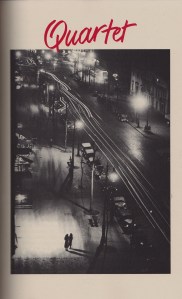
Quartet

Two Girls Looking For Tricks, Boulevard Montparnasse – photograph Brassai 1931


“I would never be part of anything. I would never really belong anywhere, and I knew it, and all my life would be the same, trying to belong, and failing. Always something would go wrong. I am a stranger and I always will be, and after all I don’t really care.” – Jean Rhys

portrait Jean Rhys

Jean Rhys

Jean Rhys, who was born in the Carribean island of Dominica on 24 August 1890, wrote her early novels between 1927 and 1939. Her friend and editor Diana Athill, who believes the five novels listed above to be her best, continues: “Then Jean Rhys disappeared and was almost forgotten. The second part of her career begins in 1966 with the publication in London of Wide Sargasso Sea.  The success of this novel led to the publication of her earlier books.”

older jean-rhys

Jean Rhys died 14 May 1979 aged 88 in Devon, England

<>><><>><><><><

-Anne Frandi-Coory 28 January 2016

><><><><><><><><><><><><><

My review of…  Wide Sargasso Sea