Archive

Tag Archives: BOOKS In My Non-Fiction Collection-REVIEWS

GARIBALDI  

by Jasper Ridley – A Book Review

Updated 6 December 2013

My  great grandfather, Aristodemo Giovanni Frandi, fought in Garibaldi’s ‘army’ and eventually emigrated to New Zealand in 1875. Many were the tales he told his family about the betrayals of the Catholic Church, of its priests and nuns, who informed on Garibaldi’s fighters time and again. Read more about Aristodemo and Annunziata Frandi


….

Garibaldi 001

The Catholic Church has the audacity to say that  Catholics made a fundamental contribution to creating a united Italy and a national identity, in a message marking the country’s 150th birthday.  Pope Benedict XVl has in the past stated that Christianity helped forge a national identity that resisted political fragmentation on the Italian peninsula,  and foreign domination.  He stated that the Church’s contribution came through education, literature and the arts in general, listing such personalities as Michelangelo, Caravaggio and Bernini, whose works were often commissioned for religious purposes.  Is the pope trying to publicise a dwindling Christianity in this age of free thinking and science?

Benedict obviously lives in a religious fantasy world.  Artists were stymied and never allowed to paint what they pleased in case it offended the Catholic Church.  Many artists lived a life of subsistence because of this and it is well documented how the Catholic clergy, including extremely wealthy popes and cardinals,  enforced their sexual proclivities on young artists.  The 19th Century Pope did all he could to quash any attempts at the unification of Italy.  It would mean that the papal states would shrink to the City of Rome and finally to Vatican City.  Giusseppe Garibaldi led the Risorgimento;  he and his followers hated the Catholic Church (Papal Rome) because so often they were betrayed by nuns, priests and cardinals.  It was Garibaldi and those politicians who supported his quest for unification, who finally forced Austria, papal sycophants, and France, out of Italy.  Garibaldi’s heartbreak was that Nice, his birthplace,  was ceded to France in 1861 by politicians, as part of the deal that they leave the peninsula.

It is such a joke that Pope Benedict could come out and say it was through Catholic education and literature that Italy was united.  The truth is, only ‘the list’ of books approved by the Church were available for the general populace to read.  Most literature that made its way to Italy was burned or hidden in heavily fortified libraries only accessible to Monks and Cardinals.  See previous post Vatican Library.   As for resisting political fragmentation; the only reason they exiled or brutalised any political opposition was because the Church did not want to lose the corrupted power base they possessed.   The Church was fully funded and supported by the Spanish, French and Austrians.

If any group can be held responsible for seeding the Risorgimento (resurgence) it was the people of Italy themselves; mostly peasant farmers, some elitists, and mercenaries who had fought with Garibaldi in South America.  Peasant farmers, led by Garibaldi, almost single-handedly drove foreign power out of Sicily, and this was the catalyst that began the unstoppable unification of the peninsula.  The Roman Catholic Church opposed unification simply because it would mean the end of the vice grip they held over Italy.  Read Garibaldi by Jasper Ridley, it is very enlightening and I would hazard a guess that it is not one of the Vatican’s favourite books.

– Anne Frandi-Coory 6 December 2013


See post:  Terroni by Pino Aprile    “All that has been done to ensure that the Italians of the South become ‘Southerners’…

There is a debate currently going on in Australia about giving school students the choice between taking either classes in Ethics,  or in Religious Studies.  Apparently the respective Christian Churches are not at all happy about this development.  Well, they wouldn’t be would they? They believe they are losing their grip over young minds.

Ethics clarified

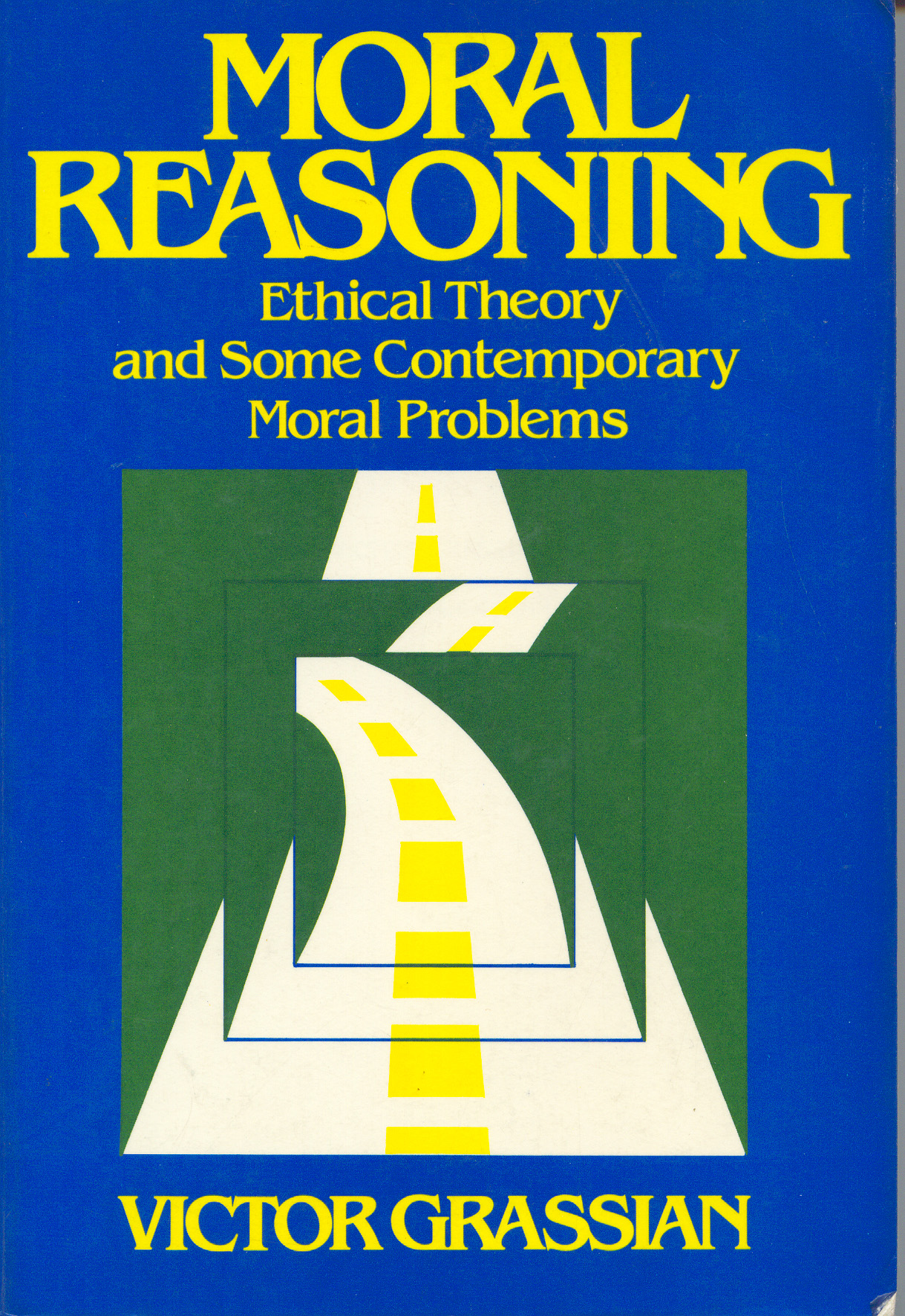
In his book  ‘Moral Reasoning; Ethical Theory And Some Contemporary Moral Problems’ Victor Grassian defines ethics as:

‘Ethics may be defined as the philosophical study of morality-that is, of right conduct, moral obligation, moral character, moral responsibility, moral justice, and the nature of the good life. The philosophical study of morality should be distinguished from the descriptive or scientific study of the same subject matter’.

Mr Grassian goes on to say… ‘Although a study of  ethics will not in itself make one into a good person, it can certainly provide us with more than the knowledge of abstract philosophical theories and terminologies that seem incapable  of aiding us in the solution of our own practical moral problems.  A study of ethics can serve to help us better understand and classify our own moral principles; most of all, it can help refine, develop, and sometimes change these principles’.

In other words it can help us to question and to think for ourselves.  I particularly identify with the following paragraph as I am sure a lot of my readers will do especially those who were indoctrinated with  Catholic dogma  from infancy:

‘The study of ethics can lead one from the blind and irrational acceptance of moral dogmas gleaned from parental and cultural influences, which were never subjected to logical scrutiny, into a development of a critical reflective morality of one’s own’.

Childhood ethics


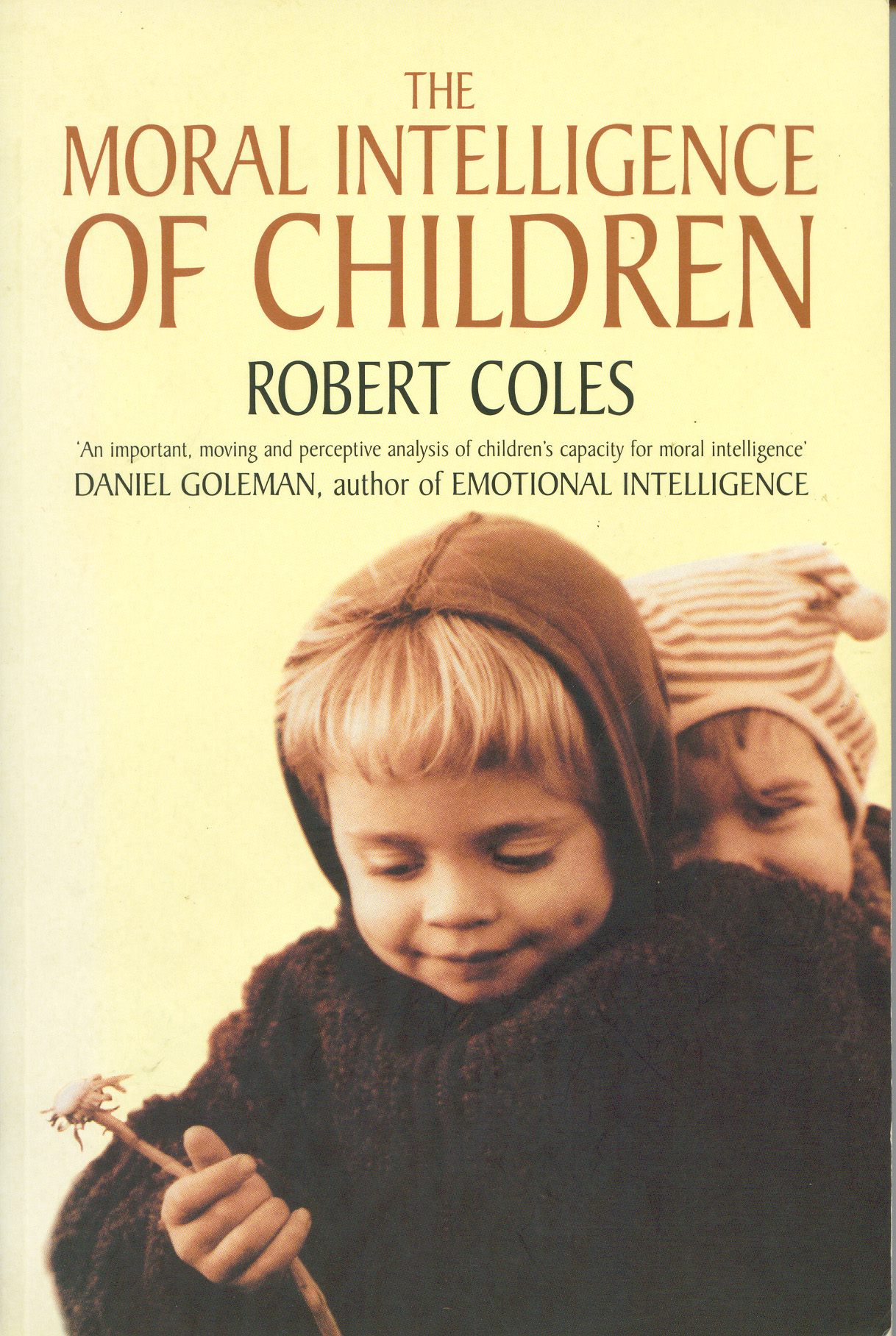
Robert Coles, who was a professor of psychiatry and medical humanities at Harvard Medical School,  also draws on his experience as a teacher and child psychiatrist in his book:

‘The Moral Intelligence of Children’. He writes about the confusion children feel when they are  caught between two parents who have different religious beliefs; who constantly clash over opinions  and values but who never-the-less expect their children to follow in their religious path unquestioningly.  Simply stated,  Mr Coles found in his research that children are morally intelligent and it is therefore beneficial to them to be raised in a home where they are encouraged to question and to think for themselves.  Parents who only see  issues in black and white can have a detrimental effect on their children’s outlook on life.  The problem begins when the child is expected to ‘learn by example’ from the adults in their family but has intelligently worked out for themselves that something is not right.  The atmosphere in the household is one in which the child is not permitted to question any ‘laws’ laid down by their parents and this includes religious beliefs.  At the same time the child is being bombarded by media images and peer group pressure.   Perhaps the high rates of depression in our young people is understandable when there is so much conflict in their world view.

Erik H Erikson, a child psychiatrist who knew only too well the psychological trauma caused by  strict and rigid upbringing in a religious household comments in ‘Moral Intelligence’:

It is a long haul, bringing up our children to be good; you have to keep doing that, bring them up, and that means bringing things up with them: asking; telling; sounding them out; sounding off yourself; teaching them how to go beyond why?……’

Lets hope then, that all schools will eventually allow students to choose Ethics over Religion in schools.  We might then see some changes taking place in the behaviour of young people and their readiness to take responsibility for their own actions.    <><><>

-Anne Frandi-Coory 20 October 2010

><><><

Also here on Anne Frandi-Coory’s Facebook page  

https://www.facebook.com/myhomelibrary/

See previous posts:  God in the Classroom?

&          Access Ministries Want Access to Childrens’ Minds

Updated 15 April 2015

Why is Mental Illness always at the bottom of the Public Health funding list when we all know that mental and physical health are intertwined!?

Mental health expert Patrick McGorry has just been voted Australian of the Year.  It is so good to see such a prevalent disorder as mental illness in the news and highlighted.  Mr McGorry  is also concerned with the plight of refugees, including women and children,  held for years in detention centres or ‘Asylums’.  It has been well documented how detrimental an effect long periods of  institutionalisation has on a person’s  mental health.

Xenophobia is alive and well but not just in Australia.  Western countries as well as developing countries are suspicious of, and fear those from different ethnic groups.  Throw in religion and it becomes a volatile mix which is evident in  the bloodshed in many countries around the world at the present time.

‘Unfortunate Folk; Essays on Mental Health Treatment 1863-1992’ is an  Otago University publication  researched and edited by postgraduate history students at University of Otago between 1972 and 2000.  Attitudes to mental illness in Australasia haven’t really changed that much I don’t think; political correctness has intervened and made the way we speak about mentally ill patients a little less hostile, that’s all.

My mother had a severe bi-polar disorder and spent many years in and out of a mental hospital where she often received Electro-Convulsive Therapy (ECT) in the 1950s and 1960s which eventually left her in a state of permanent mental lethargy.  Apparently it was important to keep her emotions tightly controlled in order to level out her mood swings, but in the process killed off all her creativity.  The right drugs were not available then.  My mother’s traumatic childhood and adolescence probably brought on the disorder and I am sure her stint in a Catholic convent trying unsuccessfully to outrun life in the natural world and become a nun,  added to the intensity of her affliction.  As I write in my book, Whatever Happened to Ishtar?’ mental illness and its attendant prejudices has had a lasting effect on subsequent generations of her family. The fact that she was Italian certainly played its part in other people’s perception of her displays of emotion.

ECT was introduced into mental hospitals in 1943 in Australasia and considerable experimentation with this method of treatment, and new drugs, was carried out on patients.  ECT  was first used without anaesthetic on patients who were suffering from “over excitability” and depression, both of which my mother “suffered” from.

A personal account from a medical student shown around Seacliff Mental Asylum in NZ in 1943:

“A consultant…brought them onto the stage and asked them about things and showed off how tragic they were, but I mean, it was a show and I think they were used to showing off as they were expected to. That was part of it, but the really awful thing was when we went around the wards.  One particular one that I remember…there was this great big ward and there were a whole lot of what looked like old and bedraggled women with white hair all over everywhere and they were all dressed the same, in white hospital things like you put on when you go for a  x-ray and they all came crowding round the trolley, clattering their spoons and tin plates and it was just like feeding the animals, it was absolutely horrendous.  That would have been around 1943 …it was just at the very earliest stages of shock treatment …it was certainly the first time of using unmodified ECT, and no anaesthetic, it was horrific”.

These places were worse than the prisons in which  criminals were incarcerated.  The sad thing is that many people still believe that the mentally ill should be locked away somewhere out of sight and out of mind.

Unfortunate  Folk;                          The Mentally Ill

The above book quotes many interesting statistics:  In 1874,  of in-patients in mental institutions in Otago NZ there were twice as many men as women (mostly gold miners) and the majority of the women were married.  “Most religious denominations were represented but the three major groups were Presbyterian, Anglican and Catholic. The numbers of Presbyterian and Anglican patients roughly mirrored their ratios to the general Otago population”…  “However, there were nearly twice as many Catholic patients as there should have been”… “The Irish, who made up the majority of Catholics,were over-represented to the same degree”.

The married women often had their children incarcerated with them in the mental institution.

In 1903, New Zealand’s then Prime Minister, Richard Seddon reported his genuine concern:

“To see the children in the asylum was heartbreaking.  Children of tender years were to be found with the adults, and, in some cases sitting on the floor. In any of the asylums they would find little boys and girls hopelessly and helplessly insane, and to keep them here with such surroundings as they had was not, to his mind, the right thing to do”.

The next significant group incarcerated in mental institutions were Chinese gold miners and they aroused strongly racist sentiment among some of the authorities.   The following is an inspector’s report which defies belief that it could be written by a government Health Official inspecting the institutions:

“There are seven Chinese lunatic patients in the Asylum [it is interesting that the term asylum is still being used in relation to refugees today] and considering the racial antipathy of the European to the leprous Mongolian, I am of the opinion that it is injurious to the European Lunatic being brought into daily contact with the Chinese, and that an additional ward and airing court should be provided for the latter without delay”


The last paragraph in the book is a summary regarding the boundaries between “madness and reason”:

“Patients, families, the public, politicians, and health professionals all upheld the boundaries between madness and reason. Progress in the decade under question was slow and fragmentary, although the seeds for more radical change were soon being laid. From the later 1950s, de-institutionalisation became the focus of mental health policy, and has remained in controversial favour ever since. Large and isolated mental hospitals became a thing of the past. But although this achieved some alteration in the social status of the mentally ill it has not completely destroyed the boundary between madness and reason. The legacy of madness as a separate world remains. In essence, the psychiatrist is still an ‘alienist’ treating those designated as ‘foreigners’ by their families, the public, and the medical profession”. Mr McGorry  might add here, “and the Australian Government’s  health system”.

-Anne Frandi-Coory  15 April 2015 

Charming book by author of ‘Romulus, My Father’, Raimond Gaita

Raimond Gaita tells illuminating stories about his dog and other animals he has known and loved, and the respect they earned from him.  He asks if we give animals and birds the credit they deserve and whether they are more like us than we think.  Can they think and love, and what of philosophy? He quotes Kato Indian creation story:  ‘ God went forth to create the world, and he took his dog with him’.

Catholic Nuns and priests taught us that we humans were made ‘special’  in the eyes of God and that animals were put on this earth to serve us.  Many of us  grew up with this Christian belief and the world has suffered for it; multiple extinctions, loss of habitats.  As someone said to me “animals and insects can live without us but we cannot live without them”.  Now, we understand ecology, the importance of balance in nature and bio-diversity.  I hope it is not too late.  The only saint I ever heard about who respected and loved animals was the hermit St Francis of Assisi, but I always felt as a child, that he was considered  a little bit strange compared to other saints.  Perhaps he knew more than those humans who lived  around him.

I have seen many instances overseas, where beasts of burden such as donkeys are treated with cruelty and virtually starved even though they are expected to work long hours.   People still believe that animals, if not here to serve us,  then they are here for us to eat, nothing more.  The conditions in which animals in some countries are slaughtered,  for human consumption, are heartbreaking. I cannot imagine how many millions of animals have been massacred in the name of sport; from the Romans and their blood sports in the coliseum to the safaris in Africa where men could prove their maleness and bravery by shooting elephants and lions, to name a few.

In  my book, Whatever Happened to Ishtar? I write about the time my father drowned two white mice in front of me.  I had brought them home from school, excited about my new pets. Without saying a word, he grabbed them from me, one in each hand and held them under a tubful of water, with me clinging to his arm and screaming as  I watched the little pink feet thrashing about.   My Lebanese extended family thought nothing of poisoning animals and I have my suspicions that my uncle killed my pet pigeon.   It wasn’t until I got married and had four children of my own, and we all lived with a menagerie of animals for many years,  with their birthing, sicknesses, and dying, that I learned to love and respect them.  We learned so much about life from our pets. Sometimes, I believe they are much smarter than humans and that they will probably be living on this earth long after humanity has extinguished itself.  I guess it is all about education and perspective;  thank goodness we have  TV,  the internet and science.  There is no excuse now.

Raimond Gaita has a forward in his book written by Cora Diamond:

“The difference between human beings and animals is not to be discovered by studies of Washoe or the activities of dolphins. It is not the sort of study or theology or evolutionary theory that is going to tell us the difference between us and animals; the difference is as I have suggested, a central concept for human life and is  more an  object of contemplation than observation (though that might be misunderstood; I am not suggesting it is a matter of intuition). One source of confusion here is that we fail to distinguish between ‘the difference between animals and people’ and ‘the differences between animals and people’;  the same sort of confusion occurs in discussions of the relationship of men and women. In both cases people appeal to scientific evidence to show that ‘the difference’ is not as deep as we think; but all that such evidence can show, or show directly, is that the differences are less sharp than we think. In the case of the difference between animals and people, it is clear that we form the idea of this difference, create the concept of the difference, knowing perfectly well the overwhelmingly obvious similarities”.

Updated 29 October 2018  

Two Princes: Jared Kushner, Donald Trump’s son-in-law and Crown Prince Mohammed bin Salman bin Abdulaziz Al Saud…

by Greg Olear, who asks: How complicit is the U.S. government in the murder of a Saudi journalist?    Read more here: MEDIUM POLITICS

safe_image

*********

THE HOUSE OF SAUD is a brilliant, well researched, and valuable historical record about the founding of the Kingdom of Saud, [Saudi Arabia], with detailed accounts of its early dealings with the USA,  Britain, what now is Turkey, and other Arab nations, and how it grew from a small desert tribe, into a powerful and obscenely wealthy Islamic state.  The authors also give readers insight into the Shiite disturbances that began in the 1970s  culminating in the seizure of the Grand Mosque, and the bloodshed that followed. “The siege of the Grand Mosque raised more fundamental questions relating to the legitimacy and credibility of the dynasty”.

Published 1981.

*****

house of saud

*****

The authors tell us that Saudi Arabia, as we know it today,  was founded around 1902 by a young, blood thirsty, Emir Abdul Aziz bin Abdul Rahman bin Feisal al Saud, better known by his given name, Abdul Aziz, Servant of the Beloved. Beloved being only one of the ninety-nine synonyms for the sacred name of Allah. Originally born of isolated Bedouin tribes of the desert, the House of Saud attaches great importance to the purity of the bloodline. Marriages between first cousins, or equivalent relations, are preferred, or else carefully selected partners of equal status and purity  in another tribe…

“As Islam permits each man to keep four wives at any one time, and as divorce is made easy for males under Koranic law, so that the magic number of four can be multiplied many times over in one man’s life, this custom begot not only large numbers of children by a single father, but also an immense ramification of family and tribal inter-relationships through several generations.  Nephews married aunts, uncles were wedded to nieces and their children married each other to form a close knit and, to the outsider, impenetrable mesh.” At the time of writing, the authors estimate that with about 500 princes descending from Abdul Aziz, together with wives, daughters and collateral branches of the family, “the House of Saud cannot number less than 20,000 people.” The number of Abdul Aziz’ wives has never been officially computed but official records show that he fathered 45 sons from 22 different women. In addition there were at least as many daughters from an even wider range of women, including no doubt some unacknowledged mothers among the various concubines and slave girls, not to forget ‘wives of the night’ whom it was customary [and still is] for Arabian men to enjoy whenever the opportunity arose. All they had to do was to ‘marry’ the woman or girl for as many hours as they desired, then divorce her by saying ‘I divorce you’.  Today, many women and girls are kidnapped from Yemen, and other surrounding Arab nations, for the purposes of this euphemism for a ‘one night stand’. [On the other hand, they can fly to western countries and pay huge money for the same ‘privilege’.]

In Islamic countries, the Koran and its inherent sharia law, or path to follow, supplies a total and explicit moral code but in Saudi Arabia it is even more than that. It remains there, the only recognised and enforceable code of law, so that the country is held in a ‘1300-year-old corset of town and desert morality that is deemed to be universally and eternally applicable.’ This desert morality is upheld and brutally enforced by Wahhabism:

“In the middle of the eighteenth century, in what now must be regarded as the most fateful meeting of minds in Arabia since  the time of Muhammad, Sheikh Muhammad bin Saud, ruler of Diriya, and great, great grandson of Mani, the first identifiable Saudi ancestor, gave shelter to an itinerant preacher of Nejd, named Sheikh Muhammad bin Abdul Wahhab. The preacher was a Muslim ‘revivalist’ and the world of Islam by then was much in need of rejuvenation and reform…Abdul Wahhab was a true zealot, come to cleanse the ‘stinking stables of Arabia’ once more with the Word of God. But the Word of God proved insufficient for the task. Like the Prophet, Abdul Wahhab needed a sword as well – and to his eternal joy, he found one in Muhammad bin Saud and his family…Although Muhammad bin Saud was only one of the numerous quarrelling Nejdi sheikhs at the time, little more important than the rest, he evidently grasped that a man who had a message would give him an edge over all his rivals, enabling him to unite Bedouin and townsfolk in a new jihad to extend his personal dominion…

…Accordingly, in 1744 Muhammad bin Saud married off his son, Abdul Aziz, to a daughter of the preacher and thus sealed a compact between the two families that has been continued unbroken by their descendants ever since…Contemporary Saudi Arabia, for all its money and the new corruption and idolatry that wealth has encouraged, remains in theory and to a surprising extent in practice, a Wahhabist state, officially dedicated to the preservation of pure Islam as propounded by Muhammad bin Abdul Wahhab.”

“A penetrating analysis and major contribution the the literature of the subject” – The Sunday Times.

“An impressive work by two distinguished British journalists” – New Statesman.

*****************************************************************************

2015

“The House of Saud…wealth and power to make the world tremble”… Saudi Arabia is USA’s partner in the Middle East… 

Saudi Arabia’s King Abdullah died on 23 January 2015  and Western governments lowered their countries’ flag to half mast…WHY? For a King who allowed women to be whipped, stoned, beheaded, or imprisoned for years for such things as being raped, driving a car, or speaking out about the Saudi Arabia’s disgusting treatment of women?  

Oh that’s right, Western Governments loved this King for his wealth and his oil! Who cares how he treats women, even his own daughters and granddaughters, as long as the oil keeps flowing?  And are we really sure slavery has been abolished in Saudi Arabia?

And what of the Saudi’s treatment of gays?

>>>>>>>>>>>>>>>>>>>>>>>>

When are Islamic countries going to face up to the fact that homosexuality exists in their countries  and that the majority of their people are just as human as most Westerners?  In my experience of life, religious righteousness and fervour only encourage hypocrisy.   Suppressing our true natures  and living a lie propped up by constant prayer and ritual can only cause grief and violence in the long run.  As I have stated previously on my blog,  many men from Islamic countries live a huge lie by following and enforcing Islamic laws and religious beliefs within their own countries, but once they step into  secular, liberated Western countries, they rape, or become the homosexuals they desire or pay for  glamorous prostitutes.  Some have mistresses and children in Western countries they would not like their Mullahs at home to find out about.

In their worlds  of make-believe, Islam and Catholicism are alike.

Prince Abdulaziz bin Nasser  Al Saud


News and prince’s photo from Express.Co.UK  and UK News:

The prince once beat his aide Mr Bandar Abdullah Abdulaziz so hard his right ear swelled up to three times its normal size, and after one attack, he had to wear a hat and sunglasses while eating at a top restaurant to hide his injuries, the jury was told.

It is alleged that Al Saud was caught on CCTV subjecting his aide to savage and prolonged beatings in the lifts at the five-star Landmark hotel in Mayfair.  The court had heard that behind closed doors, the hotel staff thought the two men were “just like a couple” who spent their time in bars and nightclubs.

Saud Abdulaziz bin Nasser al Saud, 34, is on trial in London after 32-year-old Bandar died during a brutal attack with a “sexual element” on February 15.  Two male escorts are alleged to have performed sex acts on the prince at the hotel in central London where he and Bandar were staying.  The jury in the case was told gay relationships are illegal under Saudi Arabia’s sharia law code.

In the early hours of February 15, fellow guests heard thuds coming from their room and the body of the servant was later found on a blood-spattered bed. His head and face were badly bruised, his teeth broken and his left eye swollen and closed. Bones in his neck had been fractured as if he had been strangled and there was deep bruising to his back, fractured ribs and “trauma” to his abdomen caused by punches or kicks, the court heard.

He had also suffered brain damage and there were bite marks to his cheeks, left arm and possibly to his ears, the jury was told. It was said that Al Saud stood over the body “very upset and crying” as he spoke on the telephone saying: “I don’t believe it”.

The prince  at first claimed he was not involved in the killing. He told police Bandar had died from injuries suffered in a street robbery three weeks earlier.

But blood stains suggested a series of assaults before the killing, the jury was told. Detectives also seized CCTV film said to show the prince beating him. Al Saud tried to make out that he was not gay and had a girlfriend in Saudi Arabia, the jury heard. Jonathan Laidlaw, QC, prosecuting, said: “The bare fact of his sexuality would ordinarily be of no relevance in a criminal trial.

But it is clear that his abuse of Bandar was not confined simply to physical beatings.” He added: “Concealing the sexual aspect to his abuse of the victim was for all together more sinister reasons.” Al Saud denies murder and causing grievous bodily harm. Mr Laidlaw told the jury the Saudi royal admits being responsible for his manservant’s death.

Follow-up World News Item 21/10/2010:

Saud Bin Abdulaziz Bin Nasir al Saud, 34, was jailed for life by a British court on Wednesday for murdering his male servant in a brutal attack at a London hotel after a long campaign of sexual abuse.  He was ordered to serve a minimum of 20 years by a judge at London’s Old Bailey, also known as the Central Criminal Court.

The court convicted Saud of beating and strangling Bandar Abdullah Abdulaziz to death on February 15 at the culmination of a lengthy period of sexual violence towards his employee. Saud – whose mother is a daughter of Saudi Arabia’s King Abdullah – had tried to claim diplomatic immunity when he was arrested following the discovery of his servant’s body in their shared suite at the luxury Landmark hotel.

The victim, also a Saudi, was left with severe injuries including bite marks on both cheeks which prosecutors said showed a clear “sexual element” to the killing. The prince’s lawyers argued that he could face the death penalty in Saudi Arabia over the revelations of homosexuality aired at the trial. (you mean the Saudi authorities aren’t too bothered about the brutal murder of another Saudi – it is homosexuality that is the major crime here!?) Witnesses had told the court that Bandar – an orphan who was adopted into the family of a low-ranking civil servant in Jeddah – was treated “like a slave”. A post-mortem found Bandar had suffered chipped teeth, heavy blows to the head, injuries to the brain and ears and severe neck injuries consistent with strangulation by hand, the trial heard.

The prince was subsequently sentenced to life imprisonment when in 2010, he was found guilty at the Old Bailey of murdering his servant Bandar Abdulaziz. In March, 2013 he was allowed to return to Saudi Arabia to serve the remainder of his term in a Saudi prison. According to the agreement between the U.K. and Saudi Arabia, he must serve at least 20 years before he can be released. 
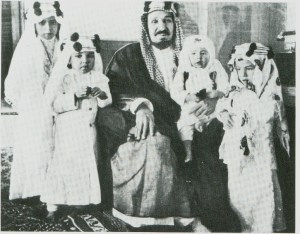
Abdul Aziz [Ibn Saud] with the eldest of his grandsons in 1935

Quote from the blurb of  ‘The House of Saud’:

At Riyadh, in 1902 the Desert Raider Ibn Saud [Abdul Aziz] tossed  the head of the town governor from a parapet down to his followers below…thus was the Kingdom of Saudi Arabia founded. Two-thirds of the size of India, it holds a quarter of the world’s oil and has six times more overseas assets than the USA.   A land of desert unchanged for centuries, with wealth and power to make the world tremble…the domain of the House of Saud

-Anne Frandi-Coory – Visit my blog at: frandi.blog


Pope Benedict the chief hypocrite of the Catholic Church

Updated 21 May 2015….the pope may have changed, but the Catholic Church hasn’t. Pope Francis appears to be making changes at the Vatican, but nothing convinces me that the welfare of child sex abuse victims has been put at the front and foremost by the Church.  In fact, it is still protecting paedophile priests, and Cardinal George Pell. Canon Law states that the sexual abuse of children must be covered up; this is the reason the current pope cannot do anything apart from advising these criminals to “spend the rest of their lives in prayer and penance, and to ask god for forgiveness”. 

Can you believe that  Pope Benedict,  ex chief of the  Office of the  Inquisition until 2005, (re-named the Office of the Congregation for the Doctrine of the Faith or CDF) truly believes that homosexuality between consenting adults is evil, along with divorce and abortion, yet through Canon Law, exonerates, forgives and protects from the criminal law of legitimate nations, paedophile priests who have  raped and ruined the lives of thousands of children. In his warped view, paedophile  priests are afflicted with an illness they cannot control!  It says much about the Catholic religion and its Canon Law; it considers gay relationships within the priesthood as  the most grievous of sins and  offending priests are to be excommunicated immediately! Yet those priests sodomising boys are protected by the Vatican while the victims are forced into silence.  As long as the paedophile priests  say extra hail marys after confession they will be protected forever by the Vatican.  This is the pope who has publicly stated that to ordain women as priests is an equivalent evil to sodomising children.

The Pope  visited African countries recently and warned against the evils of divorce and contraception but neglected to warn the people  about the paedophile priests who have been sent to that continent in their hundreds to shield them from certain imprisonment in Europe, Ireland,  America and other countries,  for the sexual abuse of innocents;  in order to protect the Vatican’s   vast assets and the reputation of the Catholic Church.  The welfare of the children so sexually abused is not considered.  It is estimated that when the child sexual abuse scandals do break in developing countries (in Asia as well) the total number of victims added to those already uncovered, could reach in excess of 100,000, and will as usual be the tip of the iceberg.

The little book with so much to say about Catholic paedophile priests and the Vatican ‘State’ which protects them

If you are, or have been,  a Catholic, this book will stun you.  I had believed the Vatican to be corrupt in the past, but I am absolutely incredulous at what the author has uncovered in his book.  That the pope and the officials at the Vatican could be so hypocritical and uninterested in the plight of all those hundreds of innocent victims is criminal.

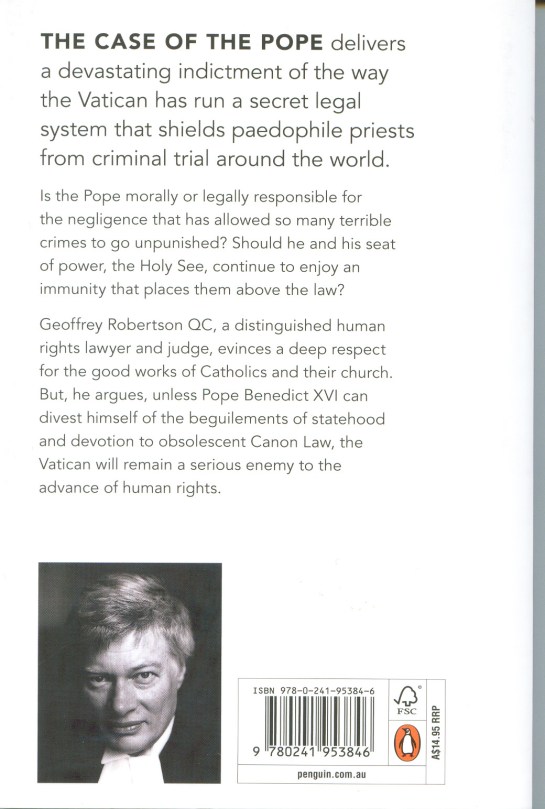
The Vatican and the pope protect,  from outside scrutiny, their highly secret documents and decisions regarding  abusive priests, through the process of Canon Law and  constantly declare that the Vatican is a sovereign state and by definition beyond the reach of the national criminal law of other countries.  However, Geoffrey Robertson the author of  ‘The Case Of The Pope; Vatican Accountability for Human Rights Abuse’ explores the legality of recognising the Vatican as a state.  He documents the vast numbers of child sex abuse cases around the globe which reached new heights during the reign of  the two previous popes before Pope Benedict, when he as Joseph Ratzinger, headed the Office of  Congregation for the Doctrine of the Faith.   The three were a formidable team.  When the first sex abuse scandals involving numerous priests erupted in America in 2001, various cardinals, Bishops and other Vatican spokesmen blamed: “Jewish journalists working on the  New York Times”, “petty gossips”, “natural enemies” of Catholics, “the American problem”, modernity, “the media’s treatment of Catholic church leaders is comparable to Hitler’s treatment of the Jews”.  When scandals broke in Ireland these spokesmen had to re-think who to blame.

“……Congratulations sent to Bishop Pican, with the approval of Pope John 2nd and Cardinal Ratzinger, for refusing to  report his paedophile  priest to the police; congratulations were also circulated to bishops to encourage them to do likewise.  This really disposes of the  fallacious argument that the Vatican would be quite content for law enforcers to arrest its guilty priests.”

I won’t quote any more from the book because you really need to read the book to grasp the extent of the scandals and the extreme failure of the Catholic Church to protect the innocent.  It is all about the protection of reputations, and wealth; no matter what the pope tells the families in his audiences, children are well down the list of priorities in the Vatican machine.  You will be overwhelmed by the sheer numbers of victims that individual priests abused.  The sections on the extensive results of research carried out into  celibacy and the effect on priests, the fact that around 80% of victims are boys,  and the lifelong consequences of the damage done to victims, is both heartbreaking and riveting.

How corrupt is the Vatican?  This so-called state which appears to be above international law, is currently being investigated for money laundering and several million dollars  have been seized! Robertson documents in detail how  the Holy See uses threats of excommunication towards Catholic politicians in foreign countries who do not follow the edicts of the pope and he explains graphically why e.g. the Catholic Church is so powerful in Australia.

You will also be amazed at how the Vatican and Holy See have managed to  maintain such a powerful hold over decisions made at the United Nations, World Health Organisation and other world groups even though the Vatican is not a recognised state: it has intervened time and again  to prevent family planning clinics from opening in third world countries and has banned the use of condoms for the prevention of aids.

reverse of book

The back cover

Read Opinion piece by Geoffrey Robertson QC Here:
Reverential fear’: The only reform that could tackle Catholic clerical sexual abuse


Exposing the great fraud?

UPDATED 15 MARCH 2016

There is a new pope in the Vatican, Pope Francis, and thousands of cases of sexually abused children at the hands of thousands of paedophile priests, have come to light.  Has anything really changed in the Catholic Church?

ARE WE BUT A MERE FLOCK OF SHEEP?

“Out of all of the sects in the world, we notice an uncanny coincidence: the overwhelming majority just happen to choose the one that their parents belong to. Not the sect that has the best evidence in its favor, the best miracles, the best moral code, the best cathedral, the best stained glass, the best music: when it comes to choosing from the smorgasbord of available religions, their potential virtues seem to count for nothing, compared to the matter of heredity. This is an unmistakable fact; nobody could seriously deny it. Yet people with full knowledge of the arbitrary nature of this heredity, somehow manage to go on believing in their religion, often with such fanaticism that they are prepared to murder people who follow a different one.” – Richard Dawkins (Quote taken from TGO’s Blog)


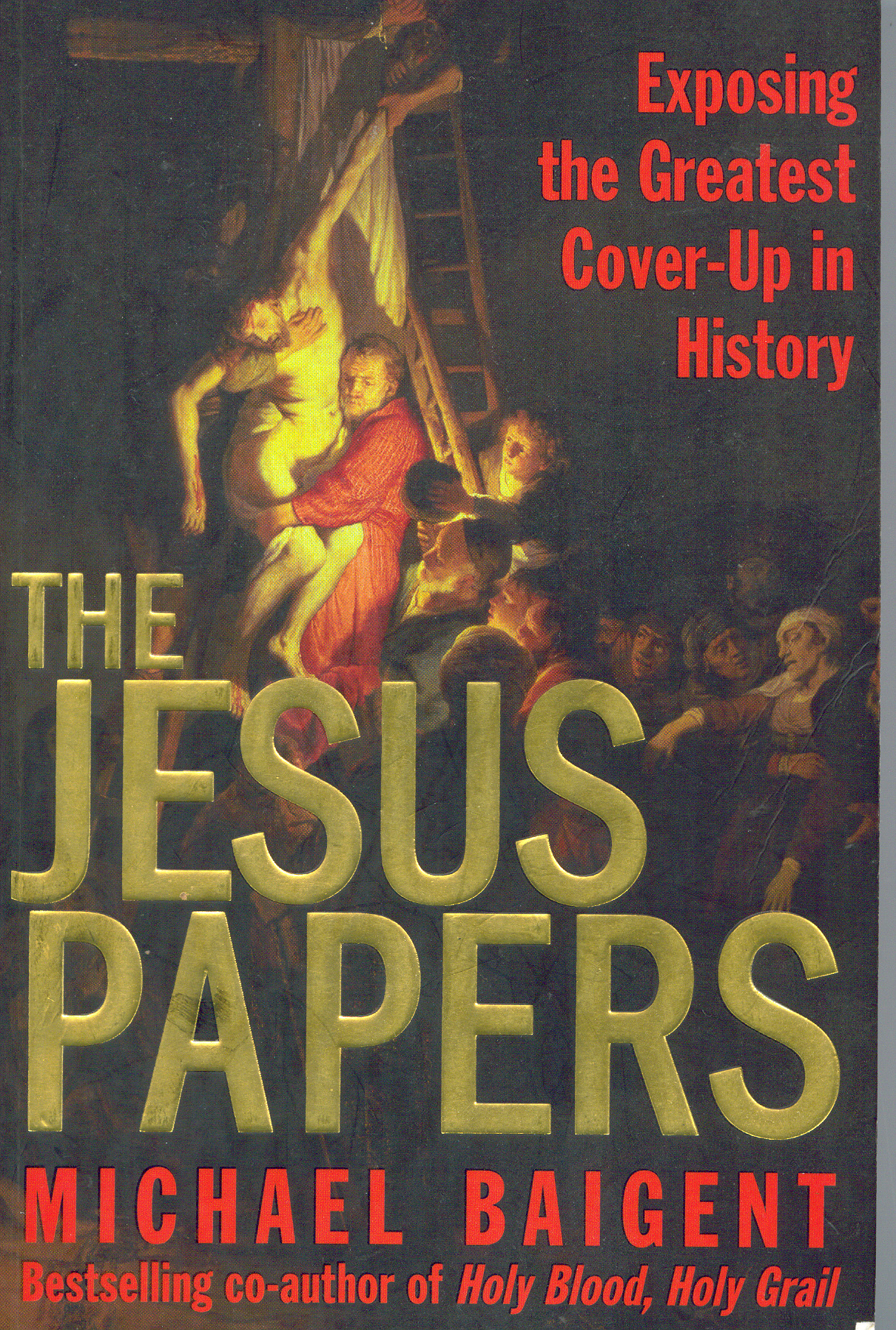
Michael Baigent  discusses historical fact –  he is enlightening. I have read previous books about the Dead Sea Scrolls and  other books co-authored by Michael Baigent and this book is just as good.  There is much information about the beginnings of Catholicism which will interest many of my blog readers.  The back of the book lists three questions:

  • What if everything we have been told about the origins of Christianity is a lie?
  • What  if a small group had always known the truth and had kept it hidden…until now?
  • What if there is incontrovertible proof that Jesus Christ survived the crucifixion?

I, and I am sure many other Catholics, are asking:

  • Did we suffer all that terrifying threat of hellfire and brimstone as children,  for the sake of a LIE’?
  • Are women being stoned to death for the sake of a LIE?
  • Is this the reason we have been labelled  ‘His flock of sheep’ and He ‘Our Shepherd’?
  • Are the reasons many thousands died during the Inquisition and the Crusades – all based on LIES?

The Inquisition was initiated by the cruel and fanatical Spanish monk, Dominic De Guzman  in the 13th Century and the Catholic Church named  Orders after him;   Dominican nuns and priests.  Guzman  was eventually canonised by the Vatican as a Saint, can you believe it?   As Michael Baigent says in his book, all roads might have led to Rome, but so did vast rivulets of blood!  Question marks still hang over the present German pope, Joseph Ratzinger, who as Cardinal Ratzinger, (from 1981 until 2005) headed the twice re-named Inquisition;   Sacred Congregation of the Holy Office in 1908 and during his reign as Cardinal in Charge (‘Grand Inquisitor’), Congregation for the Doctrine of the Faith in 1965.


-Anne Frandi-Coory 15 March 2015

Read more here:

Australian Royal Commission Into Institutional Responses Into Sexual Abuse Of Children  2013 -2017


Australasian Catholic Orphanage in the 1940s

Updated 11 April 2017

In an  article about Catholic adoptions, written by a reporter at the Guardian Newspaper  in 2009, excerpts appear from the book: The Lost Child of Philomena Lee’ by Martin Sixmith. (This story has been made into a film Philomena –  starring Judi Dench).  It  tracks the heartbreak of an unmarried  mother (fallen woman) whose  son was adopted out as an infant.  After years of trying to come to terms with her loss, Philomena attempts to track down her son and he in turn looks for her.  They are thwarted by various institutions and cruel nuns, her son dies before she finds him, not knowing that she was searching for him too.  The book encapsulates the hardships experienced by young mothers and their infants following the adoption process which was often forced on them by the Catholic Church.  Stories such as this  were repeated over and over in the 40s & 50s, not only in Britain and other parts of Europe, but also in Australasia.  My mother, Doreen Frandi (see my post   ‘Whatever Happened To Ishtar?’), experienced a similar fate at the hands of the Catholic Church.

Philomena tells the reader that after giving birth, the girls were allowed to leave the convent, only after they or their families paid the nuns one hundred pounds.  The vast majority couldn’t afford this sum, so lived a life of  ‘pay back’ drudgery for three years while living  in the convent.  They made artifacts and rosary beads and the Church kept the profits from their sales. [See post July 2010 ... Carla Van Raay’s book God’s Callgirl]. The young mothers were forced to sign a document giving away all their rights to their infants and surrendering them to the nuns.

None of the mothers wanted to give their infants up, but instead of assisting them to keep their babies, the nuns reminded them that they would not be able to keep their babies and work for their upkeep at the same time.  Even though she was in her 70s when the article was written,  Philomena still cried at the thought of what happened on the day the nuns took her little boy from her.  Because her family refused to allow her to return home,   she was sent by the Church to work at a home for delinquent boys.

After marrying and having children, Philomena set on a path to find her lost son.  She returned again and again to the convent, but the heartless nuns  just kept reminding her that she had signed a legal document stating she relinquished all rights to her son and that she would never attempt to find him.

Philomena quotes in the book “Early on in the search, I realised that the Irish Catholic hierarchy had been engaged in what amounted to an illicit baby trade.  From the end of the second world war until the 1970s, it considered the thousands of souls born in its care to be the Church’s own property. With or without the agreement of their mothers, it sold them to the highest bidder. Every year, hundreds were shipped off to American couples who paid ‘donations’ (in reality, fees) …the only condition laid down by archbishop McQuaid was that “… [the adopting parents] should be practising Catholics”.

Separated by fate, mother and child spent decades looking for each other and were repeatedly thwarted by the refusal of the Church to reveal information about the family who adopted the boy, each unaware of the other’s heart-breaking search.   Her son spent his last years in a downward spiral; tormented by his inability to find his mother and the orphan’s sense of helplessness, he didn’t know where he came from, who he was, or how he should live. He felt unloved by his adoptive family, especially his father.  When he contracted aids, he made one last emotional plea to the convent orphanage for information about his mother but they steadfastly refused to oblige this dying man’s final request.  He asked therefore if they would at least grant him permission to be buried in the convent cemetery where upon his headstone he could place enough details so that if his mother ever came looking for him (my emphasis) she would know where he was buried.   The nuns callously  remained tight-lipped about the fact that his mother had been searching for him for decades and that his maternal aunts and an uncle lived just a few miles down the road from the convent.  His mother found his obituary in a US newspaper.

Philomena Lee’s story

delinquent-angel

Shelton Lea

Delinquent Angel,  a biography about a Melbourne poet, Shelton Lea,  written by Diana Georgeff in 2007, is another  tragic story about a man’s futile search for his birth mother, the  Lea  family (NSW Darrell Lea chocolate dynasty) who adopted him and whose ulterior motives  didn’t include a loving family life.  Yes, and another Christian institution was involved.

Lea Family dynamics proved disastrous for Shelton and his adoptive mother placed him in a psychiatric institution at the age of three.  But his biological heritage eventually shone through and although his was a  brilliant talent, tragically it never reached its full potential.

-Anne Frandi-Coory 28 August 2013

Also here on Anne Frandi-Coory’s Facebook page

https://www.facebook.com/myhomelibrary/

The cover of Germaine Greer’s book

A quote from Germaine Greer’s  Sex And Destiny, p207, 1984 Secker & Warburg London:

And now sexuality has become a major commodity.  The sex merchants have a huge market among sexually repressed and starved people. While in earlier periods this market was restricted by Christian inhibitions, now that the sexual revolution has released us from the compulsions of secrecy, sexual commodities are flooding the market and are becoming the most profitable area of capitalism next to the market of aggression- the armaments industry. [Now, the largest and most recherché collections of pornography are owned by the sexually priveleged, not the sexually denied.]

Excerpts from an article by

Julie Bindel

Friday July 2 2010
The Guardian

The last time I saw Gail Dines speak, at a conference in Boston, she moved the  audience to tears with her description of the problems caused by pornography, and provoked laughter with her sharp observations about pornographers themselves. Activists in the audience were newly inspired, and men at the event,  many of whom had never viewed pornography as a problem  before, queued up afterwards to pledge their support. The scene highlighted Dines’s explosive charisma and the fact that, since the death of Andrea Dworkin, she has risen to that most  difficult and interesting of public roles: the world’s leading anti-pornography campaigner.

Dines is also a highly regarded  academic and her new book, Pornland: How Porn Has Hijacked Our Sexuality, has just come out in the US. She wrote it  primarily to educate people about what pornography today is really like, she says, and to banish any notion of it as benign titillation. “We are now bringing up a generation of boys on cruel, violent porn,” she says, “and given what we know about how images affect people, this is going to have a profound influence on their sexuality, behaviour and attitudes towards women.”  [We only have to read the news about young men (high porn viewers)  contracted to certain football codes to know this is true].

The book documents the recent  history of porn, including the technological shifts that have made it accessible on mobile phones, video games and laptops. According to Dines’s research the prevalence of porn means that men are becoming desensitised to it, and are therefore seeking out ever harsher, more violent and degrading images. Even the porn industry is shocked by how much violence the fans want, she says; at the industry conferences that Dines attends, porn makers have increasingly been discussing the trend for more extreme practices. And the audience is getting younger. Market research conducted by internet providers found that the average age a boy first sees porn today is eleven. “I have found that the earlier men use porn,” says Dines, “the more likely they are to have trouble developing close, intimate relationships with real women. Some of these men prefer porn to sex with an actual human  being. They are bewildered, even  angry, when real women don’t want  or enjoy porn sex.”

Porn culture doesn’t only affect men. It also changes “the way women and girls think about their bodies, their sexuality and their relationships,” says Dines. “Every group that has fought for liberation understands that media images are part and parcel of the systematic dehumanisation of an oppressed group . . . The more porn images filter into mainstream culture, the more girls and women are stripped of full human status and reduced to sex objects. This has a terrible effect on girls’ sexual identity because it robs them of their own sexual desire.” Images have now become so  extreme that acts that were almost non-existent a decade ago have  become commonplace. “To think that so many men hate women to the degree that they can get aroused by such vile images is quite profound,” says Dines. “Pornography is the perfect propaganda piece for  patriarchy. In nothing else is their  hatred of us quite as clear.”

Haifa,   in which pornography was shown changed her life forever. “I was astounded that men could either make such a thing or want to look at it,” she says. From then on, she knew she had to campaign about the issue. “Many on the liberal left adopt a view that says pornographers are not businessmen but are simply there to unleash our sexuality from state-imposed constraints,” she says. As a result of her research, Dines  believes that pornography is driving men to commit particular acts of violence towards women. “I am not saying that a man reads porn and goes out to rape,” she says, “but what I do know is that porn gives permission to its consumers to treat women as they are treated in porn.”

Sexual assault centres in US colleges have said that more women are reporting anal rape, which Dines attributes  directly to the normalisation of such practices in pornography. “The more porn sexualises violence against women, the more it normalises and legitimises sexually abusive behaviour. Men learn about sex from porn, and in porn nothing is too painful or degrading for women.” Dines also says that what she calls “childified porn” has significantly increased in popularity in recent years, with almost 14m internet searches for “teen sex” in 2006, an increase of more than 60% since 2004. There are legal sites that feature hardcore images of extremely young-looking women being penetrated by older men, with disclaimers stating all the models are 18 and over. Dines is clear that regular exposure to such material has an effect of breaking down the taboo about having sex with children.

She recently interviewed a number of men in prison who had committed rape against children. All were habitual users of child pornography. “What they said to me was they got bored with ‘regular’ porn and wanted something fresh. They were horrified at the idea of sex with a prepubescent child  initially but within six months they had all raped a child.” What can we expect next from the industry? “Nobody knows, including pornographers,” she says, “but they are all looking for something more extreme, more shocking.” In Dines’s view, the best way to  address the rise of internet pornography is to raise public awareness about its actual content, and name it as a public health issue by bringing together educators, health professionals, community activists, parents and anti-violence experts to create materials that educate the public. “Just as we had anti-smoking campaigns, we need an anti-porn campaign that alerts people to the individual and cultural harms it creates.”

“Myths about those of us who hate pornography also need to be dispelled in order to gain more support from progressives,” she says. “The assumption that if you are a woman who hates pornography you are against sex shows how successful the industry is at  collapsing porn into sex.” Would the critics of the employment practices and products at McDonald’s be accused of being anti-eating, she asks pointedly.

The backlash against Dines and her work is well-documented. Various pro-porn activists post accusations about her on websites, suggesting she is motivated by money, hates sex, and victimises women to support her supposed anti-male ideology. Dines is regularly criticised by pornographers in the trade magazines and on porn websites and she tells me that her college receives letters after any public event at which she is speaking, attacking her views.

Does she ever feel depressed by all this? “It gets me down sometimes, of course. But I try to surround myself with good things, my students,  colleagues, and my family.” She says the blueprint for her aims is the eradication of slavery in the US, which was achieved despite the fact that every single institution was geared to uphold and perpetuate it.   “What is at stake is the nature of the world that we live in,” says Dines.  “We have to wrestle it back.”

-Anne Frandi-Coory 13 July 2010

><><><><><><><><


God’s Callgirl-a memoir

My childhood was spent in Roman Catholic institutions and my mother was a novice nun before her marriage (see ‘Whatever Happened To Ishtar?’), so  this book was of personal interest to me.   But of course it is also a well written and interesting book in its own right, well worth the reading. Another great read I found in a second hand book shop.

Carla Van Raay’s book God’s Callgirl is a perspective of the depths, in my opinion,  of how far Catholicism has sunk since the beginnings of Christianity and the teachings of Jesus.  Carla tells us  about her life from her upbringing within a strict Catholic family,  sexual and physical abuse by her father,  to her entry into a convent as a teenager and her later life as a sex worker. Her life in the convent was spent in prayer and unpaid drudgery, such as cleaning, teaching and needlework (which the convent sold) and when she finally leaves the convent she discovers her parents, who were not well off, were charged by the nuns for Carla’s board and keep!  She re-enters the real world as an innocent in every sense of the word. The convent was run by spiteful and cruel nuns within a strict hierarchy.  The convent’s inhabitants were called ‘The Faithful Companions of Jesus’, ironic to say the least.  Carla triumphs despite the best efforts of her parents and Catholicism.

My mother’s life was also one of hardship and emotional abuse in her convent which was called the ‘Home Of Compassion’.  My mother and I,  like Carla,  never experienced or witnessed any real and heart-felt compassion in any Catholic institutions!  In light of what is being exposed within the Catholic Church in recent times, it brings to my mind that saying  ‘The higher you fly, the further you fall’.

-Anne Frandi-Coory 8 July 2010

<><><><><><><><><><><><><><><><><><><><><><><><><><><><><><><><><><><><><>