Archive

Tag Archives: cardinals

I first read In God’s Name in the early 1990s when I was at university, and although I was by then a lapsed, disillusioned Catholic, nothing prepared me for the revelations in the book. Until then I had no idea how deeply corrupt the Vatican/Catholic Church was, and specifically, the Vatican Bank. I have recently read it again.

Then I saw a Daily Mail post:

Mobster claims he helped Poison Pope John Paul I with cyanide and threatened to kill Pope John Paul II because they both tried to expose a billion dollar stock fraud scam involving cardinals and gangsters in Vatican City. (see full post below).

Needless to say, this time I was more prepared, what with the child sexual abuse scandal that has since rocked the Church to its core. The comments by the mobster confirm everything that investigative journalist David Yallop had revealed in  his book about the murder of a  pope… In summary:

During the late evening of September 28th or the early morning of September 29th,1978, Pope John Paul I, Albino Luciani, known as the smiling pope, died only thirty-three days after his election. The cause of death (Vatican officials refused to allow an autopsy) was announced to the world by the Vatican as ” myocardial infarction”. Yallop interviewed many people when he was writing In God’s Name including the pope’s  long  time personal physician. The doctor was absolutely shocked because as he told Yallop, his patient, a relatively young pope in his 60s,  was in perfect health and the only pills he took, were extra vitamins and  mild medication for low blood pressure.

During his research for the book, Yallop uncovered a huge chain of corruption  linking leading figures in financial, political, criminal, and clerical circles around the world in a conspiracy. The new pope was, although a humble man who enjoyed a simple lifestyle, a fierce opponent of corruption with an inner strength that must have alarmed his ‘minders’ when he ordered an investigation into the Vatican Bank, and the  methods employed by its President, Archbishop Paul Marcinkus. Yallop’s intensive research over three years maps the subsequent cover-ups and  upheavals within the Vatican,  and the actions of the mysterious and illegal branch of Freemasonry called P2  extending far beyond Italy in its accumulation of wealth and power , and also penetrating the Vatican.

In God’s Name is an informative and educational  read for Catholics and non-Catholics alike; for anyone who still believes that religious organisations are  in existence purely to set humanity’s moral compass or to direct the worship of culturally specific gods.  -Anne Frandi-Coory 

****************

The Daily Mail Post:
Mobster claims he helped Poison Pope John Paul I with cyanide and threatened to kill Pope John Paul II because they both tried to expose a billion dollar stock fraud scam involving cardinals and gangsters in Vatican City.

A mobster from the Colombo mafia family claims he helped poison Pope John Paul I with cyanide 33 days into his reign to stop the pontiff from exposing a billion dollar stock fraud scam. The startling revelation comes from 69-year-old Anthony Raimondi’s new novel When the Bullet Hits the Bone [published 2019].

Raimondi was a loyal member of the Colombo family – one of the notorious five Italian mafia families in New York City.

The Colombo family dealt in a host of criminal enterprises, including racketeering, contract killing, arms trafficking and loansharking.

The scene begins in 1978 when Raimondi, the nephew of infamous godfather Charles ‘Lucky’ Luciano, was recruited by his cousin Paul Marcinkus, who ran the Vatican bank in Vatican City.

The New York Post reports that Raimondi’s job was to learn the Pope’s daily habits and be there when Marcinkus spiked John Paul’s nightly cup of tea with Valium.

Raimondi notes that the Valium worked so well that the Pope wouldn’t have woken up ‘even if there had been an earthquake.’

He said: ‘I stood in the hallway outside the Pope’s quarters when the tea was served.’

‘I’d done a lot of things in my time, but I didn’t want to be there in the room when they killed the Pope. I knew that would buy me a one-way ticket to hell.’

Meanwhile, Marcinkus prepared a dose of cyanide for the Pope.

‘He measured it in the dropper, put the dropper in the Pope’s mouth and squeezed. When it was done, he closed the door behind him and walked away,’ Raimondi said.

Shortly after, a papal assistant reportedly checked on the Pope and screamed that ‘the Pope was dying!’

At which point, Marcinkus and two other cardinals rushed into the bedroom and pretended to be horrified by what they saw.

Raimondi said if the Pope had kept his mouth shut, ‘he could have had a nice long reign.’

Next on the list was John Paul II, who seemed set on exposing the inside job as well.

Raimondi, a [self] made man, was called back to the Vatican and told to prepare for a second murder at the behest of the fraudsters.

He reportedly told them: ‘No way. What are you going to do? Just keep killing popes?’

Knowing he risked being killed by the mobsters, John Paul II allegedly chose to keep quiet about the illegal dealings.

John Paul II would go on to serve the second longest reign in modern history before he died at age 84 in 2005.

This apparently prompted days of drunken partying for the mobsters and corrupt cardinals in Vatican City.

Raimondi said: ‘We stayed and partied for a week with cardinals wearing civilian clothes, and lots of girls.’

‘If I had to live the rest of my life in Vatican City, it would have been OK with me. It was some setup. My cousins all drove Cadillacs. I am in the wrong business, I thought. I should have become a cardinal.’

Raimondi dismisses those who question his story or say it closely resembles ‘The Godfather III.’

‘It was a terrible movie. To tell you the truth I don’t really remember it,’ Raimondi told The Post.

‘What I said in the book I stand by till the day I die. If they take [the pope’s body] and do any type of testing, they will still find traces of the poison in his system.’

Follow Anne Frandi-Coory’s blog HERE at: Frandi.blog

********
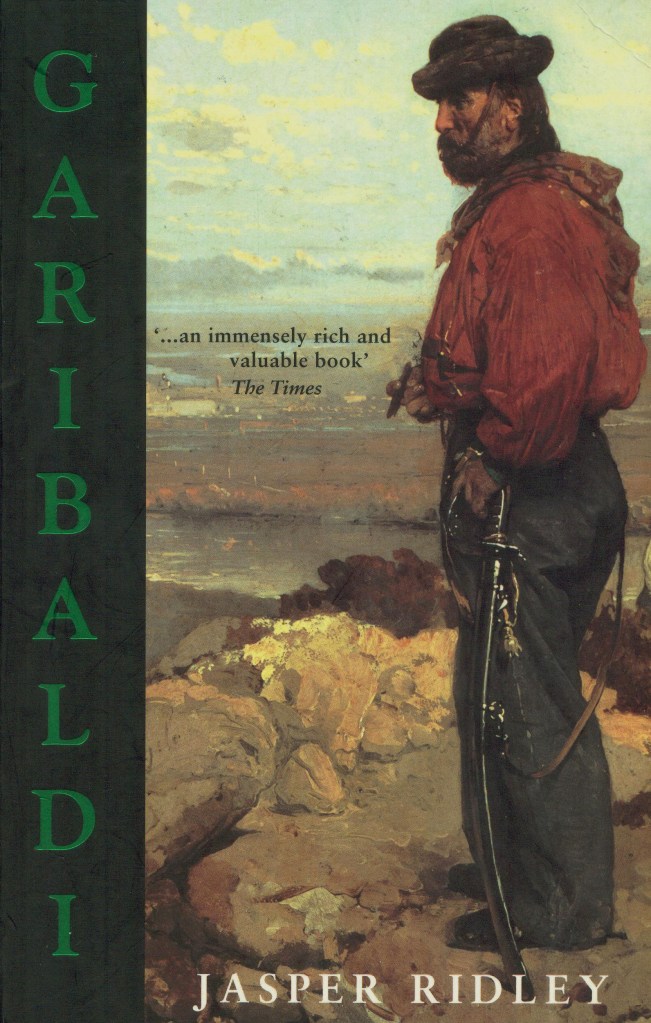
GARIBALDI  

by Jasper Ridley – A Book Review

Updated 6 December 2013

My  great grandfather, Aristodemo Giovanni Frandi, fought in Garibaldi’s ‘army’ and eventually emigrated to New Zealand in 1875. Many were the tales he told his family about the betrayals of the Catholic Church, of its priests and nuns, who informed on Garibaldi’s fighters time and again. Read more about Aristodemo and Annunziata Frandi


….

Garibaldi 001

The Catholic Church has the audacity to say that  Catholics made a fundamental contribution to creating a united Italy and a national identity, in a message marking the country’s 150th birthday.  Pope Benedict XVl has in the past stated that Christianity helped forge a national identity that resisted political fragmentation on the Italian peninsula,  and foreign domination.  He stated that the Church’s contribution came through education, literature and the arts in general, listing such personalities as Michelangelo, Caravaggio and Bernini, whose works were often commissioned for religious purposes.  Is the pope trying to publicise a dwindling Christianity in this age of free thinking and science?

Benedict obviously lives in a religious fantasy world.  Artists were stymied and never allowed to paint what they pleased in case it offended the Catholic Church.  Many artists lived a life of subsistence because of this and it is well documented how the Catholic clergy, including extremely wealthy popes and cardinals,  enforced their sexual proclivities on young artists.  The 19th Century Pope did all he could to quash any attempts at the unification of Italy.  It would mean that the papal states would shrink to the City of Rome and finally to Vatican City.  Giusseppe Garibaldi led the Risorgimento;  he and his followers hated the Catholic Church (Papal Rome) because so often they were betrayed by nuns, priests and cardinals.  It was Garibaldi and those politicians who supported his quest for unification, who finally forced Austria, papal sycophants, and France, out of Italy.  Garibaldi’s heartbreak was that Nice, his birthplace,  was ceded to France in 1861 by politicians, as part of the deal that they leave the peninsula.

It is such a joke that Pope Benedict could come out and say it was through Catholic education and literature that Italy was united.  The truth is, only ‘the list’ of books approved by the Church were available for the general populace to read.  Most literature that made its way to Italy was burned or hidden in heavily fortified libraries only accessible to Monks and Cardinals.  See previous post Vatican Library.   As for resisting political fragmentation; the only reason they exiled or brutalised any political opposition was because the Church did not want to lose the corrupted power base they possessed.   The Church was fully funded and supported by the Spanish, French and Austrians.

If any group can be held responsible for seeding the Risorgimento (resurgence) it was the people of Italy themselves; mostly peasant farmers, some elitists, and mercenaries who had fought with Garibaldi in South America.  Peasant farmers, led by Garibaldi, almost single-handedly drove foreign power out of Sicily, and this was the catalyst that began the unstoppable unification of the peninsula.  The Roman Catholic Church opposed unification simply because it would mean the end of the vice grip they held over Italy.  Read Garibaldi by Jasper Ridley, it is very enlightening and I would hazard a guess that it is not one of the Vatican’s favourite books.

– Anne Frandi-Coory 6 December 2013


See post:  Terroni by Pino Aprile    “All that has been done to ensure that the Italians of the South become ‘Southerners’…

Pope Benedict & his cardinals

By Nick Squires in Rome and John Bingham 5:46PM GMT 21 Nov 2010 –
(My Comments)

In a book to be published this week, Benedict XVI said there could be “justified individual cases” in which condoms could be used, softening Rome’s blanket ban on contraception, one of the most controversial issues facing the Church.

“In certain cases, where the intention is to reduce the risk of infection, it can nevertheless be a first step on the way to another, more humane sexuality,” the head of the world’s 1.1 billion Catholics said, giving as an example a male prostitute having sex with a client.

I wonder about a female prostitute who has aids or any other STD!

But he gave no guidance on the long-standing moral and religious question of whether it would be permissible for a married couple, in which one partner is HIV positive, to use condoms in order to prevent the other partner from becoming infected.  Just more confusion.

While the Pope restates Catholicism’s objections to contraception and stresses its emphasis on abstinence as the best policy to fight Aids, he says that using a condom could be a responsible act if it is intended to prevent the spread of the virus.   What about the spread of unwanted children with no chance for a decent life?

The pontiff’s comments are made in a book to be published by the Vatican this week, which has been the subject of increasing anticipation.   The publicists were not exaggerating when they sent out an email last week saying the Pope delivers “answers that will surprise and impress both critics and his fans”.

“Benedict XVI has shown himself time and again to be the ‘Pope of surprises’,” it said. After decades of staunch opposition from the Catholic Church to the use of condoms, his comments are likely to cause astonishment.

Not only does it represent a hugely significant shift in the Church’s teaching, but the softening in its position is coming from a Pope who took office with a reputation for being hardline and fundamentalist.  Perceived as the Vatican’s enforcer after heading its Congregation for the Doctrine of the Faith – formerly known as the Holy Office of the Inquisition, he is challenging this image by showing himself willing to embrace change.

The Pope’s reluctant support for condom use in certain circumstances is likely to dismay the most conservative Catholics who believe it is impossible to distinguish the use of condoms as contraceptives and their use as preventers of the transmission of Aids.

Yet it reflects a growing consensus amongst theologians that the stance now adopted by the Pope can be morally justified.

Cardinals, such as Godfried Danneels and Lozano Barragan, have argued that it must be better for an infected man to use a condom if the intention is not to avoid life but to prevent death.      But what if a man is using a condom for both reasons?  Will he go to hell?

Earlier this year, the Most Rev Vincent Nichols, the Archbishop of Westminster, indicated he was sympathetic to a more tolerant approach to condom use, saying he could see “why, in the short term, [the] means that give women protection are attractive”.

Cardinal Cormac Murphy-O’Connor, his predecessor, was told by Pope Benedict XVI – who was then Cardinal Ratzinger – that the Church needed to reach an agreed position on the morality of the use of condoms.  How pathetic!  when we consider all the really significant  problems the world has to deal with at  present; rampant paedophilia,  terrorism, brutal wars, aids, dying children etc etc.

Although they acknowledged that there was a need to clarify the Church’s teaching on the use of condoms, cardinals and senior figures in Rome were ultimately too concerned that it was impossible to do so without being misinterpreted.

These concerns appeared to be well founded after Pope Benedict was fiercely criticised for his comments in Africa, which were effectively no more than repeating a well-established Church view that condoms are not the solution to Aids.   Forget about the solution to Aids – what about the reality of  children infected with Aids suffering and dying in their millions?

Rather than promulgate an edict he has chosen to do it in an interview with Peter Seewald, a German journalist whom he trusts and knows well from his time as Cardinal Ratzinger.  Speaking at the Frankfurt Book Fair earlier this year, Mr Seewald said: “The events in the news around the abuse scandals and the wider situation of the Church naturally give this conversation an incredible explosiveness and I can only reveal to you now that you are expecting a very exciting, very extensive book.”

While the Pope tackles many controversial subjects in the book, from the sex abuse crisis to the Church’s teaching on clerical celibacy, his comments on condoms are likely to cause the greatest shock.  They may not go far enough to appease Catholics such as Cherie Blair, who argue for a total acceptance of contraception.

His stance will help to distance the Church from some of its more embarrassing statements, such as the claim by a cardinal that the HIV  virus can pass through tiny holes in the rubber of condoms.   What on earth can these cloistered, brain washed men,  possibly know about pregnancy, giving birth and the hardships of  life in the real world!   And then there is the hypocrisy;  The Catholic Church has financial interests in the manufacturing of contraceptives through the all-powerful Vatican Empire.

Crucially, it may go further in ensuring the Church’s relevance in public debate, presenting it as more humane and more flexible – even at the risk of people thinking the Church has changed its mind on the issue. This desire to secure the Church’s place in the public square is at the heart of Pope Benedict’s thinking and no doubt the guiding reason behind such a brave move.

What does he mean by these statements? …….”I was, naturally, not always simply against things, exclusively and as a matter of principle” ……………….. “Ultimately someone who is in opposition could probably not endure life at all”, quotes the Pope in the book.

><

See More…

Females Sex Workers Recognised by the Pope