Archive

Tag Archives: Catholic Church of Australia

*******************************************

The Prince   by David Marr, reveals a cleric at ease with power and aggression in asserting the conservative prerogatives of the Vatican. He charts Pell’s response – as a man, a priest, an archbishop and a prince of the church – to the scandal that has engulfed the Catholic world: the sexual abuse of children.

The author initially explores the life of George Pell, from his childhood and family life, his time as a seminarian, through to his rise as the most senior cleric of the Catholic Church in Australia.  Pell achieves his ultimate ambition to become a Cardinal and is eventually promoted by Pope Francis to glorified accountant for the Vatican.  Pell’s obvious skill at accounting has saved the Church in Australia many millions of dollars in compensation to victims of clerical abuse via Pell’s establishment of the Melbourne Response in which victims were dissuaded from reporting to police and awarded paltry sums in compensation. This extremely effective solution would not have escaped the attention of the Pontiff which had the added benefit, for a limited time, of silencing growing numbers of victims.

Pell allowed the payouts of meagre sums to victims while spending hundreds of millions of dollars on the establishment of a Catholic university, other buildings and renovations. Pell’s treatment of the families of victims and of victims themselves is heart rending. In one case, the parent of a young victim was so distraught, they cried and berated Pell for allowing the abuse to happen and his response was : “Have you said your hail Marys?” However, by then the tide was turning.

The last few years have been very difficult for Pell, not least because of his realisation that the Catholic Church can no longer escape secular scrutiny no matter how much he has tried to shield the church and its wealth from the scandal of the sexual abuse of children. This book paints a portrait of a man with an inflated ego and an over-riding ambition for absolute ecclesiastical power over Catholics in Australia. A portrait of hypocrisy which allowed a man to sexually abuse children  while making him blind to the suffering of children and their families.

Pell was convinced that most of the world’s problems could be solved by ensuring that Catholics adhered to the rule of Canon Law of which he was an expert. In his mind, Catholics were becoming too lax in their views regarding marriage, the sins of homosexuality, abortion and contraception. He obviously did not consider clerical paedophilia a sin.

With the revelations worldwide of Catholic clergy paedophilia and homosexual relationships among Catholic clergy, celibacy has to be one of the biggest cons ever perpetrated by the Catholic Church.  “Abortion is a worse moral scandal than priests sexually abusing young people” stated Pell, which was ridiculed around the world and I believe, turned even more Catholics away from their church, especially women.

David Marr explores the possibility that Pell’s lust for power sublimates his instinctual sexual desires. He loves the pomp and ceremony of High Mass, the luxurious gowns and head gear. More compensation for celibacy and the suppression of sexual desire?  Marr writes: “Everything about this man suggests the struggle against sex has come at a terrible price. I wonder how much the strange ordinariness of George Pell began sixty years ago when a robust Ballarat school boy decided as an act of heroic piety, to try to kill sex in himself?  How much empathy was crushed along the way? How ignorant has it left him of the human heart? The gamble priests take struggling with sex is that they may live their whole lives without learning what it is to be an adult in the real world, the world outside the (Catholic Church).”

There can be no doubt that Pell’s claims of being unaware that hundreds of children suffered sexual abuse at the hands of his Catholic clergy, especially in Ballarat in Victoria, were untrue. His professed ignorance of the moving of paedophile priests and brothers around parishes following complaints by parents and teachers was laid bare by the Royal Commission into Institutional Responses into Child Sexual Abuse.

In Australia, politicians and the Police force were breaking away from the power of the Catholic Church, and there is no doubt that Pell’s stature within Australia took a terminal hit. Pell’s appearance during the Royal Commission tarnished his inflated reputation in Australia and prompted more of Pell’s victims to come forward. This time police were prepared to listen and to take action.

Pell hid terrible secrets of his own. The nation’s most powerful Catholic, Cardinal George Pell, was eventually jailed  for child sexual assault. which was uncovered and judged in a “trial that convulsed the nation.” Then there are the allegations by several boys that Pell had sexually abused them, and too many of the boys had such similar stories to tell, it is difficult to believe that Pell is as innocent as he claims he is.

In recent years, thousands of cases of the sexual abuse of children by Catholic clergy, particularly in Ireland and the USA were being exposed by main stream media; three harrowing inquiries held in Ireland,  the explosive documentary, Spotlight and  “the first, best exposé of how the Catholic Church covered for paedophile priests” published by the Boston Globe in early 2002.

This 3rd edition of The Prince encompasses some relevant testimonies from the Royal Commission,  which dramatically altered the once high status of George Pell and his Catholic Church in Australia.  Marr comments on the brutal and effective questioning of Cardinal Pell by Commissioner McClellan on the bench and Gail Furness QC on the floor at the Royal Commission. This left the cardinal floundering for answers at times.  In one such round of questioning, he made the now infamous statement in answer as to whether he knew of the sexual abuse of children by Catholic clergy and the consequential shifting of paedophile priests between parishes, particularly in the case Gerald Ridsdale, Pell replied: “It’s a sad story, but it wasn’t of much interest to me.”
********

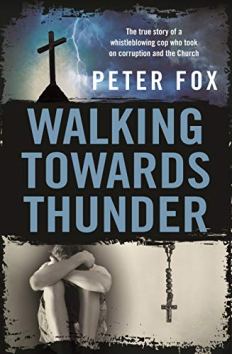
Author Peter Fox acknowledges in his book ‘Walking Towards Thunder’  that so many people supported  him, and joined with him, to pressure the then prime minister Julia Gillard to set  up the Royal Commission into Institutional Responses  into Child Sexual Abuse, but there is no doubt that Fox’s  fight to put children’s safety  ahead of the reputation of the Catholic  Church was the catalyst. As has often been stated since, only an atheist, female prime minister would have listened and acted; whatever the truth, the timing was crucial.

What is truly appalling is that a corrupt NSW Police Force destroyed Detective Chief Inspector Peter Fox’s exemplary career in order to protect the Catholic Church, its wealth and power in Australia. It’s difficult to fathom that this corruption could even take hold and destroy hundreds of children’s lives in a modern secular country like Australia.

Fox’s empathy for the children abused by Catholic clergy and their distraught families shines through the pages of this book.  The heart wrenching stories are even more soul destroying when no matter what Fox did, there was nowhere to turn to get help for these suffering children, while paedophile priests were shifted around from parish to parish, supported by bishops and archbishops. We now know that paedophile priests passed around the names of children they had abused to other priests so that some children were raped repeatedly by more than one priest and yet the NSW Police and the Church continued to attack Peter Fox and deny this was happening.

Fox’s attention to detail in writing reports and conducting interviews showed him to be an outstanding detective, but this did not save him from the endemic corruption within the NSW police force which allowed the Catholic Church to hide the crimes of its clergy for decades.  Peter Fox writes about the similar ‘brotherhoods’ operating within the Church and police force and how they close ranks to protect reputations at all costs, but these costs were too high for child victims, and for Detective Chief Inspector Peter Fox and his family.

The chapter on the NSW commission of inquiry into police corruption with Margaret Cunneen appointed as chief commissioner, will leave readers wondering just how deep corruption is within our justice system. The days of tortuous, seemingly aimless questioning  of Fox, whose health was visibly deteriorating;  a detective  who was doing his job and doing it diligently, is particularly harrowing to read. The intimidation of Fox’s wife in the courtroom during his interrogation is unsettling to say the least; it was devastating for Fox who was well aware of what was happening while he was being interrogated in the dock.

When the Child Abuse Royal Commission was finally announced many had expected the then NSW Premier Barry O’Farrell would abandon the planned  Cunneen NSW Police Inquiry as being a smaller inquiry covering the same matters.  However, the Police Inquiry proceeded.

Around the time the Cunneen Inquiry’s report was being  completed, and the Child Sexual Abuse  Royal Commission was about to begin, George Pell was promoted to cardinal by his Church and a “discreet farewell’ for him was attended by, among other dignitaries, NSW  Attorney General Greg Smith and NSW Premier O’Farrell, who expressed the “greatest respect” for George Pell and his Church.  One can only imagine how this made the victims and their families feel.  And  then O’Farrell made a statement that surely will go down in history as an indictment on the NSW state government which must have been  well aware of the children reportedly raped by Catholic clergy at the time, and in light of Pell’s later conviction for child sexual abuse: “In Australian society the [Catholic] Church always gets priority and central position.”

In my view, after reading ‘Walking Towards Thunder’ the Cunneen Inquiry appears to have been set up solely to destroy Peter Fox, along with the rape victims’ statements he recorded and other documented evidence he had collected.  Documents and statements mysteriously disappeared and police officers giving evidence at the Cunneen Inquiry claimed that those documents and statements never existed, even though victims, journalists and family members all confirmed Fox’s evidence which he gave under cross examination, which I have already noted was brutal.

These are my own assessments after reading ‘Walking Towards Thunder’ and I have no doubt that history will hold the NSW Police Inquiry up for what it was; a sham! The ABC later reported that the four-volume report, three volumes of which had been released by Commissioner Margaret Cunneen SC, uncovered no evidence to show that senior police ever tried to ensure child abuse offences were not properly investigated. History will not be kind to Commissioner Cunneen. We now know that Police did conceal evidence, destroyed or ‘lost’ statements by victims and witnesses, and police had evidence that the Catholic Church was intimidating witnesses and victims so they would not go to the police with their claims.  These matters were all later revealed during the Child Sexual Abuse Royal Commission.

It seems during the time covered in Peter Fox’s book, good priests who tried to expose child sexual abuse by fellow clergy were ostracised in their parishes, honest police were leaving the police force and school principals were driven out of their jobs for trying to protect children under their care. Every one of them paid a heavy price, some tragically more than others.

This is a well written book which may have been enhanced with a reference index notating names, important events and dates to enable the reader to traverse the wealth of information contained in the book.

‘Walking Towards Thunder’ will give readers a close up look at how a hard-working, honest police officer fought the powerful Catholic Church and the NSW police force to protect victims of clergy sexual abuse from further abuse and to stop more children being abused in the future. He and his family have paid a huge price. I have no doubt he will be vindicated. It is also a must read for all victims and survivors of child sexual abuse by Catholic clergy. Simply by victims revealing what had happened to them, meant they were vilified by people in their own parishes for tarnishing the reputation of their beloved church.  Most of the books about Catholic paedophilia I have read and reviewed, were written by victims and survivors or their families. Peter Fox’s book gives us a clear view of this Catholic scourge from a different angle, thereby revealing just how the Church hierarchy in Australia was able to coverup the rapes of hundreds of innocent children for decades.

-Anne Frandi-Coory 24 September 2019