Archive

Tag Archives: Catholic Orphanage

Out Of The Forest

**********

Most people who follow me on Social Media, and those who read my Blog ‘My Life and Rhymes; A Life in Two  Halves’ would find some common ground reading this engrossing biography ‘Out Of The Forest; The true story of a recluse’ written by Gregory P. Smith, about his childhood filled with violence and sexual abuse. And if that wasn’t soul searing enough, his mother one day out of the blue, piled Gregory and his sisters into the family car on the pretext of going on a road trip to visit an aunt they had never heard of. It eventually became apparent to the children that their mother had ‘dumped’ them like so much household garbage, at some sort of institution which resembled a small castle. She then hastily drove off never to be seen or heard of again for some time.

Once inside the orphanage, governed by the Catholic order of ‘Mercy’ nuns, Gregory is immediately separated from his sisters. The siblings do not see each other again while incarcerated in the orphanage, and Gregory soon realizes that the nuns hate all children, but more especially boys. Gregory is regularly sexually abused and humiliated by teenage girls who as ‘inmates’ have to bath the boys. He experiences, and witnesses, the cruel deprivation and humiliation of boys at the orphanage, particularly those boys who wet their beds.

When Gregory and his sisters are collected from the orphanage by their mother and taken home, they find everything is as it was before, only worse. Their father is even more violent after long sessions drinking at the pub…one of Gregory’s sisters later recalls that often after their father had severely beaten Gregory, usually while he was trying to protect his sisters from their father’s wrath, it left blood on the walls and her brother covered in blood. Teenaged Gregory finally ran away from home to live on the streets.

The next few years are spent living on the streets, stealing money and food, and running from the police. At one stage Gregory was incarcerated in a youth correction facility. As he grew older, his eruptions of violent anger involved him in countless drunken brawls. Occasionally he was able to find employment, at times earning a reasonable amount of money, but his demons wouldn’t let him be; his childhood trauma ran too deep.

While living on the streets, he mostly kept hunger at bay by rummaging through rubbish bins for discarded food. Calling himself ‘William H. Power‘ had enabled Gregory to hide from who he really was (albeit superficially),  and where he came from. There was too much of his past shadowing him in and around Tamworth where he was born so he wanted to put as much distance between that town and his battered mind and body as he could. There was also the matter of his juvenile police record; he didn’t want anyone to alert the police as to his whereabouts.

Homeless Gregory morphs into an anonymous, yet familiar vagabond wandering around  towns and byways; thumbing rides, walking for hundreds of  kilometres along lonely country roads, and skirting isolated homesteads. One day, while Gregory was sitting in one of the   parks he frequented, wearing disheveled clothing and sporting a long, scraggly beard; talking philosophy with a group of Indigenous people and ‘hippy backpacker types’ it seemed that he was creating quite the impression.  A few people believed he was Jesus Christ, returned to earth. “Come and listen to this! Come and listen. You should hear what he’s got to say! Hey, man, it’s Jesus! He’s back!” they shouted. He admits he was drinking port and smoking pot at the time:

“I was much more comfortable being plain old William H. Power than I was being Jesus H. Christ… While I was only a god for one night, there were plenty of other times I found myself around a fire on the beach with a group of people letting my inner guru out. The dope would flow and they’d inevitably start to share their thoughts on the deep stuff. Metaphysics is big in Byron Bay. Time and time again I’d be the centre of attention, the group in my thrall with the added drama of being able to see my mountain [up in the rain forest]  from the Byron Bay beach.“

Surely there is not such a great leap from there in the park, preaching to followers, to being a lecturer at a university?

However, Gregory spends most of the following years, in varying states of oblivion, homeless and later in the rain forest, most of the time spaced out on drugs and grog. There is a future episode which brings Gregory’s homeless and aimless life into sharp focus: he discovers, following a long period of socialization, an official record of his marriage to a woman, of whom he has no recollection, much less the actual marriage and later, the divorce.

The peace and solitude of the rainforest in northern New South Wales keeps calling  Gregory back and he subsequently makes himself a  permanent home there for more than a decade, where he survived mostly on bush tucker. He built a bed made from ferns and established a constant campfire.  He had decided earlier on not to kill any more animals for food after he had killed and eaten a small wallaby he caught in a trap. The guilt got to him; he missed the little creature which he often spied wandering around his camp. From that point on his health began to deteriorate rapidly.

The long process of rehabilitation back into human society had its genesis in an epiphany which the hermit experiences while lying beside his campfire, in a near comatose state, suffering from malnutrition and long-term gastroenteritis. His ancestors visit him, and while sitting around the camp fire, they tell him ancestral stories and then finally cajole him into leaving the forest and getting help. Otherwise, they caution him sternly, he will die.

With a mind cloaked in a dense fog, Gregory has no memory as to how he managed to walk out of the forest and find help; he had lost track of time and found it difficult to concentrate on anything at all. His body was emaciated and poisoned by rotten grog, drugs, and lack of food. His ancestors wouldn’t let him rest and hassled him with ghostly conversation.

After a long battle and considerable help from many people along the arduous road to recovery, Gregory finally achieves success as a scholar eventually gaining  a PhD in Social Sciences.  He is later employed as a university lecturer.  Oh how far this remarkable man has travelled.

The author informs the reader that he chose Social Sciences as the subject of his thesis because he wanted to study how human society actually functioned. It had been a mystery to him up to that time.

-Anne Frandi-Coory.  26 February 2020
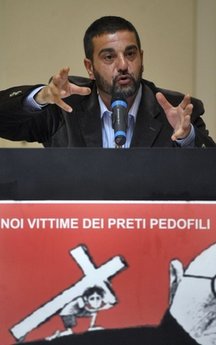
I feel vindicated in writing about the generational sexual abuse in Catholic Lebanese and Italian families which I uncovered during the research for my book ‘Whatever Happened to Ishtar?’ . If  paedophile priests were sexually abusing children why would we be surprised when we find fathers and uncles doing the same thing?  At last the abused can speak out about what has been covered up by the Catholic Church, not for decades, but for centuries!

The woman’s testimony below reminds me how complicit nuns were, if not in the sexual abuse, then certainly in the physical and emotional abuse, of children in Catholic orphanages and schools.    My brother wrote a story in his early teens (Hypocrisy of the Catholic Church; my brother’s story) about the time he and our mother were starving,  yet they were  turned away by a fat priest who was on his way to his roast dinner which the pair could smell wafting from the kitchen of the presbytery.

><

 Italian victim & former priest,  Domolo speaks out. Caption above: “We are victims of paedophile priests”

><

The Vatican, under global pressure,  has just raised the statute of limitations for reporting sexual abuse, to twenty years from the time the victim turns eighteen.  However, most human rights activists agree there should be no statute of  limitation as occurs in most western countries.

Excerpts from Associated Press:

VERONA, Italy – Italian victims of a paedophiliac clergy want such sexual abuse declared a crime against humanity, and they launched an international appeal on Saturday during the first public gathering of such victims in Italy.

Organizer Salvatore Domolo, a former victim and an ex-priest, said the group is looking abroad for solidarity because justice for pedophile victims is hard to come by in Italy with a statute of limitations of 10 years.

“Here there is no hope. By the time a victim arrives at the awareness of having been a victim, legal intervention is not possible,”  Domolo said in a country that has long been reluctant to confront the Vatican in its own backyard.

“The complicity of the hierarchy, together with the enormity of the numbers and vast geography of these crimes, should lead us to consider that we are facing a crime against humanity carried out by a political-religious organization,” Domolo told a news conference before the victims met, his delivery bearing the cadence of a homily.  “With this gathering, we want to ask civilian justice to do its duty in full freedom and truth, without being intimidated by the clerical culture.”

The meeting was held opposite Verona’s heavily visited Roman colosseum and advertised with placards outside. Passers-by were free to enter, but few did.

Another will be held in Rome at the end of October, but Verona was chosen for the first gathering because it is the home of a school for the deaf where 67 former students have alleged suffering sexual abuse, paedophilia and corporal punishment from the 1950s to early 1980s.  About 40 former victims inquired by e-mail — but many are still reluctant to come forward, organizers said.

The Vatican has been reeling for months as thousands of victims around the globe have spoken out about priests who molested children, bishops who covered up for them and Vatican officials who turned a blind eye to the problem for decades. In the latest admission, hundreds of victims came forward in Belgium with tales of horrific abuse linked to at least 13 suicides.

While Italian bishops have acknowledged 100 sexual abuse cases that warranted church intervention in the last decade, victims believe the true number in Italy is much higher because the reluctance to speak out in Italy is especially strong.  “This gathering is fundamental because we live in a social situation in which the presence of the Catholic church reduces the possibility of talking about the situation,” Domolo said. “They do it all over the world, but in Italy even more. That we are just now having the first gathering of victims indicates that only in the recent months is something exploding in Italy.”

Domolo, now 45, said he had been a victim of his parish priest from age 8 to 12, and that he was forced to confess “as if I had sinned.   The church has known for 50 years this has been going on but kept it quiet in a disgusting way,” he said.

Domolo was a priest for 15 years. He renounced both the priesthood and his Roman Catholic faith after meeting another victim on a trip to Ireland in 2001. A man named Francesco from Padova, who did not give his surname, told the group he had been abused both by priests and nuns who used punishment as an excuse to touch him inappropriately. “The worst was my family. They refused to believe it was true,” he told the group, adding he has only been able to come to grips with it through therapy.

A 58-year-old deaf woman, who only gave the nickname given to her by the nuns of Verona’s Antonio Provolo Institute for the Deaf, carefully annunciated her words as she told her story. During her 15 years at the institute, she was only alone with priests once a week for confession. Recalling her first confession, she said she asked the nuns what to say, and they asked her what she had done. “I told them I scratched myself everywhere because I had too much wool clothing. The nuns said, ‘Tell them you touched yourself.”‘

At that, she said, the priest asked her to lift her clothing to show him where. And so it continued, she said, “little by little, week after week. We girls didn’t do anything, and we had to confess. The priests, who sinned, did they ever confess, I ask?”

Australasian Catholic Orphanage in the 1940s

Updated 11 April 2017

In an  article about Catholic adoptions, written by a reporter at the Guardian Newspaper  in 2009, excerpts appear from the book: The Lost Child of Philomena Lee’ by Martin Sixmith. (This story has been made into a film Philomena –  starring Judi Dench).  It  tracks the heartbreak of an unmarried  mother (fallen woman) whose  son was adopted out as an infant.  After years of trying to come to terms with her loss, Philomena attempts to track down her son and he in turn looks for her.  They are thwarted by various institutions and cruel nuns, her son dies before she finds him, not knowing that she was searching for him too.  The book encapsulates the hardships experienced by young mothers and their infants following the adoption process which was often forced on them by the Catholic Church.  Stories such as this  were repeated over and over in the 40s & 50s, not only in Britain and other parts of Europe, but also in Australasia.  My mother, Doreen Frandi (see my post   ‘Whatever Happened To Ishtar?’), experienced a similar fate at the hands of the Catholic Church.

Philomena tells the reader that after giving birth, the girls were allowed to leave the convent, only after they or their families paid the nuns one hundred pounds.  The vast majority couldn’t afford this sum, so lived a life of  ‘pay back’ drudgery for three years while living  in the convent.  They made artifacts and rosary beads and the Church kept the profits from their sales. [See post July 2010 ... Carla Van Raay’s book God’s Callgirl]. The young mothers were forced to sign a document giving away all their rights to their infants and surrendering them to the nuns.

None of the mothers wanted to give their infants up, but instead of assisting them to keep their babies, the nuns reminded them that they would not be able to keep their babies and work for their upkeep at the same time.  Even though she was in her 70s when the article was written,  Philomena still cried at the thought of what happened on the day the nuns took her little boy from her.  Because her family refused to allow her to return home,   she was sent by the Church to work at a home for delinquent boys.

After marrying and having children, Philomena set on a path to find her lost son.  She returned again and again to the convent, but the heartless nuns  just kept reminding her that she had signed a legal document stating she relinquished all rights to her son and that she would never attempt to find him.

Philomena quotes in the book “Early on in the search, I realised that the Irish Catholic hierarchy had been engaged in what amounted to an illicit baby trade.  From the end of the second world war until the 1970s, it considered the thousands of souls born in its care to be the Church’s own property. With or without the agreement of their mothers, it sold them to the highest bidder. Every year, hundreds were shipped off to American couples who paid ‘donations’ (in reality, fees) …the only condition laid down by archbishop McQuaid was that “… [the adopting parents] should be practising Catholics”.

Separated by fate, mother and child spent decades looking for each other and were repeatedly thwarted by the refusal of the Church to reveal information about the family who adopted the boy, each unaware of the other’s heart-breaking search.   Her son spent his last years in a downward spiral; tormented by his inability to find his mother and the orphan’s sense of helplessness, he didn’t know where he came from, who he was, or how he should live. He felt unloved by his adoptive family, especially his father.  When he contracted aids, he made one last emotional plea to the convent orphanage for information about his mother but they steadfastly refused to oblige this dying man’s final request.  He asked therefore if they would at least grant him permission to be buried in the convent cemetery where upon his headstone he could place enough details so that if his mother ever came looking for him (my emphasis) she would know where he was buried.   The nuns callously  remained tight-lipped about the fact that his mother had been searching for him for decades and that his maternal aunts and an uncle lived just a few miles down the road from the convent.  His mother found his obituary in a US newspaper.

Philomena Lee’s story

delinquent-angel

Shelton Lea

Delinquent Angel,  a biography about a Melbourne poet, Shelton Lea,  written by Diana Georgeff in 2007, is another  tragic story about a man’s futile search for his birth mother, the  Lea  family (NSW Darrell Lea chocolate dynasty) who adopted him and whose ulterior motives  didn’t include a loving family life.  Yes, and another Christian institution was involved.

Lea Family dynamics proved disastrous for Shelton and his adoptive mother placed him in a psychiatric institution at the age of three.  But his biological heritage eventually shone through and although his was a  brilliant talent, tragically it never reached its full potential.

-Anne Frandi-Coory 28 August 2013

Also here on Anne Frandi-Coory’s Facebook page

https://www.facebook.com/myhomelibrary/