Archive

Tag Archives: catholic schools

*******************************************

The Prince   by David Marr, reveals a cleric at ease with power and aggression in asserting the conservative prerogatives of the Vatican. He charts Pell’s response – as a man, a priest, an archbishop and a prince of the church – to the scandal that has engulfed the Catholic world: the sexual abuse of children.

The author initially explores the life of George Pell, from his childhood and family life, his time as a seminarian, through to his rise as the most senior cleric of the Catholic Church in Australia.  Pell achieves his ultimate ambition to become a Cardinal and is eventually promoted by Pope Francis to glorified accountant for the Vatican.  Pell’s obvious skill at accounting has saved the Church in Australia many millions of dollars in compensation to victims of clerical abuse via Pell’s establishment of the Melbourne Response in which victims were dissuaded from reporting to police and awarded paltry sums in compensation. This extremely effective solution would not have escaped the attention of the Pontiff which had the added benefit, for a limited time, of silencing growing numbers of victims.

Pell allowed the payouts of meagre sums to victims while spending hundreds of millions of dollars on the establishment of a Catholic university, other buildings and renovations. Pell’s treatment of the families of victims and of victims themselves is heart rending. In one case, the parent of a young victim was so distraught, they cried and berated Pell for allowing the abuse to happen and his response was : “Have you said your hail Marys?” However, by then the tide was turning.

The last few years have been very difficult for Pell, not least because of his realisation that the Catholic Church can no longer escape secular scrutiny no matter how much he has tried to shield the church and its wealth from the scandal of the sexual abuse of children. This book paints a portrait of a man with an inflated ego and an over-riding ambition for absolute ecclesiastical power over Catholics in Australia. A portrait of hypocrisy which allowed a man to sexually abuse children  while making him blind to the suffering of children and their families.

Pell was convinced that most of the world’s problems could be solved by ensuring that Catholics adhered to the rule of Canon Law of which he was an expert. In his mind, Catholics were becoming too lax in their views regarding marriage, the sins of homosexuality, abortion and contraception. He obviously did not consider clerical paedophilia a sin.

With the revelations worldwide of Catholic clergy paedophilia and homosexual relationships among Catholic clergy, celibacy has to be one of the biggest cons ever perpetrated by the Catholic Church.  “Abortion is a worse moral scandal than priests sexually abusing young people” stated Pell, which was ridiculed around the world and I believe, turned even more Catholics away from their church, especially women.

David Marr explores the possibility that Pell’s lust for power sublimates his instinctual sexual desires. He loves the pomp and ceremony of High Mass, the luxurious gowns and head gear. More compensation for celibacy and the suppression of sexual desire?  Marr writes: “Everything about this man suggests the struggle against sex has come at a terrible price. I wonder how much the strange ordinariness of George Pell began sixty years ago when a robust Ballarat school boy decided as an act of heroic piety, to try to kill sex in himself?  How much empathy was crushed along the way? How ignorant has it left him of the human heart? The gamble priests take struggling with sex is that they may live their whole lives without learning what it is to be an adult in the real world, the world outside the (Catholic Church).”

There can be no doubt that Pell’s claims of being unaware that hundreds of children suffered sexual abuse at the hands of his Catholic clergy, especially in Ballarat in Victoria, were untrue. His professed ignorance of the moving of paedophile priests and brothers around parishes following complaints by parents and teachers was laid bare by the Royal Commission into Institutional Responses into Child Sexual Abuse.

In Australia, politicians and the Police force were breaking away from the power of the Catholic Church, and there is no doubt that Pell’s stature within Australia took a terminal hit. Pell’s appearance during the Royal Commission tarnished his inflated reputation in Australia and prompted more of Pell’s victims to come forward. This time police were prepared to listen and to take action.

Pell hid terrible secrets of his own. The nation’s most powerful Catholic, Cardinal George Pell, was eventually jailed  for child sexual assault. which was uncovered and judged in a “trial that convulsed the nation.” Then there are the allegations by several boys that Pell had sexually abused them, and too many of the boys had such similar stories to tell, it is difficult to believe that Pell is as innocent as he claims he is.

In recent years, thousands of cases of the sexual abuse of children by Catholic clergy, particularly in Ireland and the USA were being exposed by main stream media; three harrowing inquiries held in Ireland,  the explosive documentary, Spotlight and  “the first, best exposé of how the Catholic Church covered for paedophile priests” published by the Boston Globe in early 2002.

This 3rd edition of The Prince encompasses some relevant testimonies from the Royal Commission,  which dramatically altered the once high status of George Pell and his Catholic Church in Australia.  Marr comments on the brutal and effective questioning of Cardinal Pell by Commissioner McClellan on the bench and Gail Furness QC on the floor at the Royal Commission. This left the cardinal floundering for answers at times.  In one such round of questioning, he made the now infamous statement in answer as to whether he knew of the sexual abuse of children by Catholic clergy and the consequential shifting of paedophile priests between parishes, particularly in the case Gerald Ridsdale, Pell replied: “It’s a sad story, but it wasn’t of much interest to me.”
Updated 30 June 2015

Comment  on my post dated 9/12/2011,  from David Anthony in America:

To Anne Frandi-Coory: – What a touching note.   [from post: My Father, Joseph Jacob Habib Eleishah Coory].

Anne blog

Anne Frandi-Coory

><><><><

David writes: You mention Aramaic: I have a little story for you…

About 30 years ago, about 1978-1980, my jidoo [grandfather] was visiting my house when a distant cousin from Lebanon visited.  My jidoo’s parents came to America in 1892. He was raised speaking what he and we thought was Arabic. He spoke it fluently- after all, it was what was spoken in his household growing up.

Well, when my cousin, who recently came from Lebanon fleeing the civil war, visited, they (my cousin and my grandfather) both spoke to each other in [what they thought was] Arabic. They couldn’t understand one another. My cousin said my grandfather wasn’t speaking Arabic, but a language much older. He said it was like an Italian listening to Latin.

So I came to find out that my jidoo didn’t really speak Arabic. The language he spoke so fluently was ancient Syriac- as you know, a version of Aramaic. The “Arabic” words I picked up as a youth tended much more towards Aramaic. In fact, many years after my jidoo passed away, a very good friend of mine from Zahle told me that the few Lebanese Aramaic words my dad and I spoke had a strong northern (Ehden) accent. :-)

Just one other note: Anxiety runs rampant in the Lebanese side of the family. For some, the levels of anxiety run so high that it’s disabling. I’m wondering if there’s a similar issue in your family.

Two reasons; 1) Lebanese boys were forced to sit in the back of all classes. Italian and Irish boys sat in front. 2) As my dad had terrible nearsightedness, and he wasn’t allowed to sit in the front of the class because of his skin color, he could never see the blackboard. In order to take any notes, he’d copy notes from the student sitting next to him. When he got caught by a nun, which was often, he’d get sent to the Principal for copying notes. The Principal would tell him to put out his hand, which would then get beaten pretty badly.

Finally,one day, when he was in 8th or 9th grade or so, he came home with such a beaten hand that my sitoo [grandmother] noticed. After she insisted he tell her what happened, my dad then explained what happened. Right away they went and bought him his first pair of glasses. After that, he could see the blackboard better- and his grades went sky high.

But the damage was done. By tenth grade, he left school to work in a factory, partly driven, I’m sure, by the beatings.– David Anthony.

><

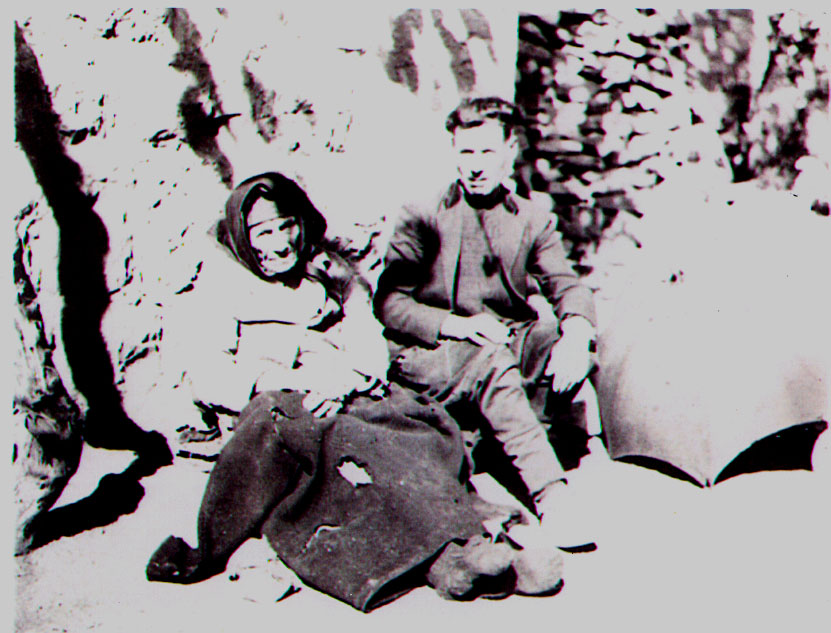
A very old photo of my grandmother, Eva Coory’s mother and brother, taken in Bcharre, Lebanon.

><

Dear David

How wonderful to hear your story. Yes, Aramaic is derived from an ancient form of Syriac and is now spoken only by small pockets of Syrian peasants and by Maronites in Bcharre, Lebanon. It was also the language that Jesus spoke. I did much research into my grandparents’ history and the history of Lebanon in general. My grandfather’s ancestors moved to the hills of Lebanon (Bcharre) around the 14th Century, from Iraq.

It is uncanny how similar are our fathers’ stories. My father, Joseph, was also beaten by the Catholic Brothers at school, and finally one day he ran home and refused to return to school. He was also shortsighted and told me he was often beaten because he couldn’t speak English, only Aramaic!

You may be interested in my book ‘Whatever Happened To Ishtar?’ A personal story, but which also delves deeply into the ancient history of my ancestors and the Aramaic language, which was eventually swamped by the advance of Islam and Arabic, which became the lingua franca of the Middle East.  BTW, Zahle is a name that pops up in my grandfather, Jacob Habib Fahkrey’s family tree.

Anxiety runs deep in my family tree as well.  In both the Lebanese and Italian sides of my family, volatile personalities reign.  My children have inherited the tendency to anxiety, although nowhere near as intense as preceding generations. Of course, both Lebanese and Italian peoples express the whole range of emotions vividly, which can sometimes be quite intimidating to others.

I agree with you about the blatant racism that thrived in those times. Once again, both my Lebanese and Italian ancestors experienced this.

I would love to hear more of your story.

Best wishes,
Anne

Read Here:  The Maronites In History 

Catholic Convent School run by Mercy Sisters in the 1950s   Photo: ©Anne Frandi-Coory

><

Love them or hate them, state schools at least spread literacy quickly throughout the Western world.  The Roman Catholic Church can also take much credit for their educational infrastructures which enabled schools to be established quickly within communities around the world.  Convents and seminaries created ready-made teachers at an economical and speedy rate.  Catholic Schools provided education for the faithfuls’  children so that while being educated, their souls could be saved. Now in the light of  priest sex abuse scandals, millions paid out to victims, and dwindling numbers of priests and nuns,  Catholic schools are closing down while Islamic schools are spreading.

In the past, Catholic schools fought for supremacy over state schools which largely followed Protestantism. Protestant Church leaders were terrified lest papist teachings crept into state school curriculums.   I can remember when I was attending a convent primary school in New Zealand, I was terrified of state school children who shouted at me and my school friends on the street, “Catholic dogs stink like frogs and don’t eat meat on Fridays”.  Of course, in my narrow world I had no idea then of the wars of religious domination raging throughout the world.  I only knew that we were not allowed to walk into a Protestant church or make friends with the children at state schools, ( I wondered what heinous things children in state schools got up to!)  To transgress this rule was tantamount to committing a mortal sin in my mind.

Even in those days in New Zealand there were savage disputes between Protestant and Catholic groups, and in America there were deadly riots over the use of the King Jame’s Bible in state schools.  We were instructed during catechism lessons, never to read any other bible than the King Jame’s version. I never in my childhood’s wildest dreams had any notion of the politics these two Christian faiths were engaged in.

The problem arising is that religious schools have received, and still receive, financial assistance from respective governments out of tax revenue.  Should this continue unchecked?  Perhaps a better use of taxpayers’ money would be investment in more public secular schools.  I can see in the future that this current rise in religious segregation could create problems of separatism.  Schools should have a common purpose:  to educate children and not classify them into separate religious groups.

There is dialogue taking place at the present time in America about this issue, between Perry L. Glanzer, associate professor at the Baylor University and School of Education and Institute of Church-State Studies, and Charles Haynes, senior scholar for the First Amendment Centre in Washington DC.   In America, voucher programmes tend to redirect tax dollars into religious schools.  There have already been tensions over publicly funded charter schools which offer Arabic-language instruction.  Haynes posits that while religious parents should have a choice of schools to send their children to, those schools shouldn’t be funded by tax dollars. He says that “despite all their flaws state schools have played a key role in building one nation out of many faiths and cultures, something that should be appreciated in any debate about choices”.

“There’s really only one institution in the United States where we learn to live with our differences and that’s public schools…the less we do that the more challenging it’s going to be” says Mr Haynes.

State schools are certainly more tolerant these days of other ethnicities and religions than in the past.  Notwithstanding this, history is repeating itself.  Again.  I can see parallels in the current situation of secular state schools versus Islamic Schools, and Protestantism versus Catholicism.

><

More…Access Ministries Access Children’s Minds

&           God in the Classroom?