Archive

Tag Archives: corrupt vatican

Updated 6 February 2017 – From today and over the next three weeks archbishops from every state (except Tasmania) will take the stand. 

Some statistics from the Royal Commission on first day of proceedings involving archbishops of Australia,  in just 5 Dioceses here in Australia:

Figures much worse for religious orders: 20.4% Marist Brothers, 21.9% Salesians, 22% Christian Brothers 40.4%, St John of God.

“The following five archdioceses or dioceses with priest members which had
the highest overall proportion of priests who ministered in the period 1950
to 2010 and who were alleged perpetrators: 


a. 11.7% of priests from the Diocese of Wollongong were alleged
perpetrators
b. 13.9% of priests from the Diocese of Lismore were alleged
perpetrators
c. 14.1% of priests from the Diocese of Port Pirie were alleged
perpetrators
d. 14.7% of priests from the Diocese of Sandhurst were alleged
perpetrators
e. 15.1% of priests from the Diocese of Sale were alleged
perpetrators”.

The disturbing figures were revealed by senior counsel assisting, Gail Furness, SC. She also revealed that the Holy See had refused to hand over documents involving Australian priests accused of abuse.

“The royal commission hoped to gain an understanding of the action taken in each case,” Furness said. “The Holy See responded, on 1 July 2014, that it was ‘neither possible nor appropriate to provide the information requested’,” she said

“Children were ignored or worse, punished. Allegations were not investigated. Priests and religious [brothers] were moved. The parishes or communities to which they were moved knew nothing of their past,” she said. “Documents were not kept or they were destroyed. Secrecy prevailed as did cover-ups.”

Read more here: Clerical Paedophilia; Centuries-Old Timebomb

*********************************************
The Inquiry into the sexual abuse of children by Catholic and other religious clerics is now underway in Australia.

‘Royal Commission Into Institutional Responses Into Sexual Abuse Of Children’ will carry out its investigations throughout Australia. The Chairman at the Inquiry is Justice Peter McClellan.

Thanks to the courageous work of PM Julia Gillard’s team, the Inquiry began its work in April 2013.

On 7 May 2013 Cardinal George Pell admitted that the Catholic Church covered up hundreds of cases of sexual abuse of children. The Church did this to protect the reputation of the Church, its wealth, and its priests.  Since he made that statement, Pell has been given refuge at the Vatican so that he has not taken the stand in these proceedings, which to many victims, is a travesty of justice!

>>>>>>>>>>>>>>>>

Below is a book which is a must read for anyone interested in the proceedings of the Inquiry:

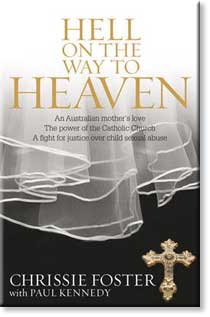
‘Hell On The Way To Heaven’ is written by Chrissie Foster, mother of two daughters who were raped by a 70+ year old Catholic Priest, Father Kevin O’Donnell. He died before justice prevailed. It’s a heartbreaking story. Chrissy Foster tells us that she was so indoctrinated by Catholic dogma she couldn’t see the signs that her daughters were at risk of sexual abuse by this paedophile. Father O’Donnell had total power over his diocese and the Catholic school the girls attended. He was free to wander among the children at any time and free to take them out of classes when he chose.

It is believed that this paedophile sexually molested and raped hundreds of boys and girls. The Catholic Church did not warn the community that there had been complaints against Kevin O’Donnell spanning 50 years.  O’Donnell was eventually defrocked by the Catholic Church but boys continued to visit him at his unit. When George Pell was informed by parishioners about O’Donnell’s continued association with children, he replied that it was no longer anything to do with the Catholic Church!

For everyone’s sake in our community, so this never happens again, please take the time to read this book.

>>>>>>>>>>>>>>

An Inquiry into the sexual abuse of children within the Catholic Church is long overdue in Australia.

The stress and heartbreak that the victims of sexual abuse, and their families, go through is horrendous. I do not believe that the Catholic Church even comes close to understanding this. If it did, would the Vatican have allowed this abuse to go on for centuries? Perhaps it’s not a question of understanding and empathy. It’s most likely all about power, wealth and status. I believe that the number of reported abuses is just the tip of the iceberg, because research has shown that is the tendency with all forms of sexual abuse. It can take half of a victim’s lifetime, or more, to just gain the strength to talk about the abuse. To quote Chrissie Foster: “It takes 40 or 50 years for children to talk about what has happened to them, and it just never stops”.

…….

For more details see: How Catholic Dogma Aided Paedophile priests

………..
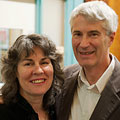
Chrissie & Anthony Foster

><

It one such case, two of Chrissie and Anthony Fosters’ daughters were raped by a Catholic Priest. In an article about the Fosters in Catholica, March 2011, the writer refers to the abuser as “A Holy Roman Catholic Priest”.  I think this is indicative of the mentality of the Catholic hierarchy, in that they choose this highly inflated title to describe a paedophile. It sends a message that this rapist continues to be treated with respect by his peers and the Vatican!

Chrissie and Anthony Foster are the parents of three daughters, two of whom were raped as little girls by a paedophile priest, Kevin O’Donnell. One of the daughters eventually took her own life in despair after a long period of self harm. The second daughter who was raped, after a similarly long period of self harm, walked in front of a speeding car while intoxicated and today requires round the clock nursing care that will continue for the rest of her life.

Mrs Foster has written a book ‘Hell on the Way to Heaven‘ in which she cites six bishops who failed to take decisive action following several parents’ complaints regarding Kevin O’Donnell. It is difficult to comprehend why Cardinal Pell is still in Office given what has been presented in Mrs Foster’s book. “Cardinal Pell has more front than Myers Department Store and it will probably wash over him like water off a duck’s back”.  Read Mrs Foster’s book and judge for yourself, the failure of these six bishops to protect children from sexual abuse by Kevin O’Donnell.  Cardinal Pell appears to bury his head in the sand over this issue, and still there has been no effective inquiry.

><
><

The Fosters are driving the push for an inquiry into sexual abuse by clergy in Victoria.  As quoted in the Waverley Leader September 13, “Two signatures stand between an inquiry into the alleged sexual abuse of two Oakleigh girls, and other alleged victims by Victorian clergy”.  Labour MP, Anne Barker handed the proposed terms of reference for an inquiry to Attorney-General Robert Clark, recently. If Mr Clark and Premier Ted Baillieu, sign  the four page document, a Royal Commission of Inquiry will be launched.  The Terms of Reference state that: “Since 1993, more than 65 clergy who have served in Victoria, have been convicted of abuse”. These figures are staggering. But the Catholic hierarchy have stipulated that they will not deviate from its ‘Melbourne Response Programme’ which was implemented 15 years ago. However, going on past experience of the way the Catholic Church has protected its paedophile priests, we must have nothing less than a Royal Commission of Inquiry, which would be  totally outside the influence of the Vatican. Mr Foster believes A  Royal Commission is the only way to expose the secretive behaviour of the Church, and bring it under full scrutiny. A decision is pending. Let’s hope that in the event of a Royal Commission of Inquiry in Victoria, other states will follow suit.

-Anne Frandi-Coory 20 December 2011

><><><>><><><>

See  previous posts:  Clerical Paedophilia         /    Irish PM Blasts Vatican

GARIBALDI  

by Jasper Ridley – A Book Review

Updated 6 December 2013

My  great grandfather, Aristodemo Giovanni Frandi, fought in Garibaldi’s ‘army’ and eventually emigrated to New Zealand in 1875. Many were the tales he told his family about the betrayals of the Catholic Church, of its priests and nuns, who informed on Garibaldi’s fighters time and again. Read more about Aristodemo and Annunziata Frandi


….

Garibaldi 001

The Catholic Church has the audacity to say that  Catholics made a fundamental contribution to creating a united Italy and a national identity, in a message marking the country’s 150th birthday.  Pope Benedict XVl has in the past stated that Christianity helped forge a national identity that resisted political fragmentation on the Italian peninsula,  and foreign domination.  He stated that the Church’s contribution came through education, literature and the arts in general, listing such personalities as Michelangelo, Caravaggio and Bernini, whose works were often commissioned for religious purposes.  Is the pope trying to publicise a dwindling Christianity in this age of free thinking and science?

Benedict obviously lives in a religious fantasy world.  Artists were stymied and never allowed to paint what they pleased in case it offended the Catholic Church.  Many artists lived a life of subsistence because of this and it is well documented how the Catholic clergy, including extremely wealthy popes and cardinals,  enforced their sexual proclivities on young artists.  The 19th Century Pope did all he could to quash any attempts at the unification of Italy.  It would mean that the papal states would shrink to the City of Rome and finally to Vatican City.  Giusseppe Garibaldi led the Risorgimento;  he and his followers hated the Catholic Church (Papal Rome) because so often they were betrayed by nuns, priests and cardinals.  It was Garibaldi and those politicians who supported his quest for unification, who finally forced Austria, papal sycophants, and France, out of Italy.  Garibaldi’s heartbreak was that Nice, his birthplace,  was ceded to France in 1861 by politicians, as part of the deal that they leave the peninsula.

It is such a joke that Pope Benedict could come out and say it was through Catholic education and literature that Italy was united.  The truth is, only ‘the list’ of books approved by the Church were available for the general populace to read.  Most literature that made its way to Italy was burned or hidden in heavily fortified libraries only accessible to Monks and Cardinals.  See previous post Vatican Library.   As for resisting political fragmentation; the only reason they exiled or brutalised any political opposition was because the Church did not want to lose the corrupted power base they possessed.   The Church was fully funded and supported by the Spanish, French and Austrians.

If any group can be held responsible for seeding the Risorgimento (resurgence) it was the people of Italy themselves; mostly peasant farmers, some elitists, and mercenaries who had fought with Garibaldi in South America.  Peasant farmers, led by Garibaldi, almost single-handedly drove foreign power out of Sicily, and this was the catalyst that began the unstoppable unification of the peninsula.  The Roman Catholic Church opposed unification simply because it would mean the end of the vice grip they held over Italy.  Read Garibaldi by Jasper Ridley, it is very enlightening and I would hazard a guess that it is not one of the Vatican’s favourite books.

– Anne Frandi-Coory 6 December 2013


See post:  Terroni by Pino Aprile    “All that has been done to ensure that the Italians of the South become ‘Southerners’…


Updated 10 March 2018

The Catholic Church is the largest, most powerful, most efficient bureaucracy in the world…every child, from the day they’re baptised, is tracked wherever they go in the world; the Church catches up with them again upon confirmation, and later when they marry. The Church owns you! You didn’t really think baptism was about saving humans from ‘original sin’ did you, people? How else could the Church know when every new baby was born?

*********************************

At last the Vatican’s centuries of corruption and hypocrisy have caught up with it.   I guess that the Catholic Church has millions of  sexual abuse compensation claims outstanding and this close scrutiny of its bank could not have come at a worse time for it.

See my previous  posts:

Islam, Christianity & The Vatican Library

Vatican Bank or Office of Religious Works

Sexual Abuse;  The Pope & The Vatican


ARTICLE BELOW – Source:

VICTOR L. SIMPSON and NICOLE WINFIELD, Associated Press


VATICAN CITY – This is no ordinary bank: The ATMs are in Latin. Priests use a private entrance. A life-size portrait of Pope Benedict XVI hangs on the wall.   Nevertheless, the Institute for Religious Works is a bank, and it’s under harsh new scrutiny in a case involving money-laundering allegations that led police to seize euro23 million ($30 million) in Vatican assets in September. Critics say the case shows that the “Vatican Bank” has never shed its penchant for secrecy and scandal.

The Vatican calls the seizure of assets a “misunderstanding” and expresses optimism it will be quickly cleared up. But court documents show that prosecutors say the Vatican Bank deliberately flouted anti-laundering laws “with the aim of hiding the ownership, destination and origin of the capital.” The documents also reveal investigators’ suspicions that clergy may have acted as fronts for corrupt businessmen and Mafia.  The documents pinpoint two transactions that have not been reported: one in 2009 involving the use of a false name, and another in 2010 in which the Vatican Bank withdrew euro650,000 ($860 million) from an Italian bank account but ignored bank requests to disclose where the money was headed.

The new allegations of financial impropriety could not come at a worse time for the Vatican, already hit by revelations that it sheltered paedophile priests. The corruption probe has given new hope to Holocaust survivors who tried unsuccessfully to sue in the United States, alleging that Nazi loot was stored in the Vatican Bank. Yet the scandal is hardly the first for the centuries-old bank. In 1986, a Vatican financial adviser died after drinking cyanide-laced coffee in prison. Another was found dangling from a rope under London’s Blackfriars Bridge in 1982, his pockets stuffed with money and stones. The incidents blackened the bank’s reputation, raised suspicions of ties with the Mafia, and cost the Vatican hundreds of millions of dollars in legal clashes with Italian authorities.

On Sept. 21, financial police seized assets from a Vatican Bank account at the Rome branch of Credito Artigiano SpA. Investigators said the Vatican had failed to furnish information on the origin or destination of the funds as required by Italian law.  The bulk of the money, euro20 million ($26 million), was destined for JP Morgan in Frankfurt, with the remainder going to Banca del Fucino. Prosecutors alleged the Vatican ignored regulations that foreign banks must communicate to Italian financial authorities where their money has come from. All banks have declined to comment.

In another case, financial police in Sicily said in late October that they uncovered money laundering involving the use of a Vatican Bank account by a priest in Rome whose uncle was convicted of Mafia association.  Authorities say some euro 250,000 euros, illegally obtained from the regional government of Sicily for a fish breeding company, was sent to the priest by his father as a “charitable donation,” then sent back to Sicily from a Vatican Bank account using a series of home banking operations to make it difficult to trace.

“I don’t trust them,” he said. “After the previous big scandals, they [The Vatican] said ‘we’ll change’ and they didn’t. It’s happened too many times.”   He said the structure and culture of the institution is such that powerful account-holders can exert pressure on management, and some managers are simply resistant to change.   The list of account-holders is secret, though bank officials say there are some 40,000-45,000 among religious congregations, clergy, Vatican officials and lay people with Vatican connections.

The bank chairman is Ettore Gotti Tedeschi, also chairman of Banco Santander’s Italian operations, who was brought in last year to bring the Vatican Bank in line with Italian and international regulations. Gotti Tedeschi has been on a very public speaking tour extolling the benefits of a morality-based financial system.  “He went to sell the new image … not knowing that inside, the same things were still happening,” Nuzzi said. “They continued to do these transfers without the names, not necessarily in bad faith, but out of habit.”  It doesn’t help that Gotti Tedeschi himself and the bank’s No. 2 official, Paolo Cipriani, are under investigation for alleged violations of money-laundering laws. They were both questioned by Rome prosecutors on Sept. 30, although no charges have been filed.  In his testimony, Gotti Tedeschi said he knew next to nothing about the bank’s day-to-day operations, noting that he had been on the job less than a year and only works at the bank two full days a week.

As the Vatican proclaims its innocence, the courts are holding firm. An Italian court has rejected a Vatican appeal to lift the order to seize assets.  The Vatican Bank was founded in 1942 by Pope Pius XII to manage assets destined for religious or charitable works. The bank, located in the tower of Niccolo V, is not open to the public, but people who use it described the layout to the AP.  Top prelates have a special entrance manned by security guards. There are about 100 staffers, 10 bank windows, a basement vault for safe deposit boxes, and ATMs that open in Latin but can be accessed in modern languages. In another concession to modern times, the bank recently began issuing credit cards.   In the scandals two decades ago, Sicilian financier Michele Sindona was appointed by the pope to manage the Vatican’s foreign investments. He also brought in Roberto Calvi, a Catholic banker in northern Italy.

Sindona’s banking empire collapsed in the mid-1970s and his links to the mob were exposed, sending him to prison and his eventual death from poisoned coffee. Calvi then inherited his role.  Calvi headed the Banco Ambrosiano, which collapsed in 1982 after the disappearance of $1.3 billion in loans made to dummy companies in Latin America. The Vatican had provided letters of credit for the loans.  Calvi was found a short time later hanging from scaffolding on Blackfriars Bridge, his pockets loaded with 11 pounds of bricks and $11,700 in various currencies. After an initial ruling of suicide, murder charges were filed against five people, including a major Mafia figure, but all were acquitted after trial.   While denying wrongdoing, the Vatican Bank paid $250 million to Ambrosiano’s creditors.

Both the Calvi and Sindona cases remain unsolved.

See  JP Morgan Closes Its Branch At The Vatican

___