
**********
I have always been interested in why people do the things they do; why they commit crimes, particularly murder. Was it nature or nurture, or a combination of both? I have read many biographies for this reason, and I love British criminal investigation series like Vera and Silent Witness, to name only two. Criminal profiling has come into prominence in recent years, and I find this method of investigating crimes fascinating, ever since I watched the British TV series ‘Cracker’ about a psychologist/police profiler played by Robbie Coltrane.
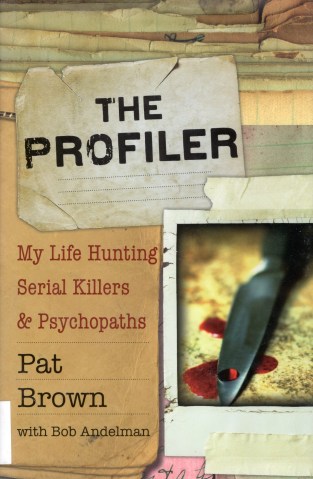
I spotted The Profiler by Pat Brown, on display in a book store, bought it and raced home to read it. I find reading books so relaxing and it helps clear my mind after I’ve spent the day as a key board warrior on social media taking politicians to task, posting my opinions on the state of the world in general. In between, answering questions on my blog, or my email accounts, and responding to various comments.
The cases Pat Brown has investigated and writes about in The Profiler are all very interesting and varied. She has also investigated suicides and, how, although they are relatively easy to investigate compared to complicated murder scenes, families find it difficult to believe that their loved ones would want to kill themselves. It is another level of heartbreak for them.
Pat Brown’s successful career as a criminal profiler intrigued me, especially the round-about-way she qualified and became such a success at it. To be honest, I didn’t expect that a large part of the book would be taken up with her story as a mother who not only home-schooled her three children but who also worked nights interpreting for deaf suspects being interviewed by police. She was a mother who wasn’t happy with the standard of education at the only school in the area and decided that she would home-school them. She describes herself as being an ‘earth mother’ and she relished the role. Not only that, she also took in foster children and a boarder to help finance their large home and their lifestyle. Once her children had left school and had embarked on their own life journeys, she decided to use the language skills she had honed, to study. I enjoyed this part of the book almost as much as I enjoyed the criminal profiling cases Brown actually got down to writing about. All-in-all Brown spent about ten years working in the emergency rooms at a Washington hospital centre and Howard University. In these establishments Brown says she learned a lot about forensics when her deaf clients rolled in on stretchers and she acted as interpreter. This was one of the most violent wards in Washington DC. Subsequently, Brown studied criminal profiling in depth and was eventually proficient enough in the field to work with police, families, or to be hosted on TV shows to discuss various crimes and give her opinion using her skills. It took her several years to prove herself, and to be taken seriously, especially by police.
The cases Brown investigates in the book are varied, and she takes us through each stage meticulously. Many of the cases remain unsolved because of police carelessness in ’losing’ evidence, concentrating on the wrong suspect, or as in one case, possibly protecting the main suspect because of their connections ‘high up’. Brown wished to join the FBI as a criminal profiling agent, but she was too old among other things that I won’t delve into here. Brown largely educated herself by reading hundreds of books and studying various textbooks. She eventually earned a Masters degree in criminal justice from Boston University in order to “learn more about police operations and procedures and the challenges of the criminal justice system in general.” She later developed the first accredited Criminal Profiling and Investigative Analysis programme in the country for Excelsior College where she is an adjunct professor.
It is alarming to discover how many brutal murders remain unsolved in the US and the reasons are many, but the majority are unsolved because of the lack of funds to investigate crimes in depth, and of course more serious crimes are happening more often and there just aren’t enough police or resources to continue on-going investigations for any length of time. Brown is aghast at the carelessness by which some police initially investigate serious crimes, such as not taking good photographic evidence of the crime scenes, not sealing off crime scenes, neglecting to interview all suspects, or take samples of blood or other body fluids left at the scene of the crime for DNA testing. Brown is constantly asked by families to investigate cold cases involving the murder or suspected suicide of a loved one because they don’t believe the police have done their job thoroughly enough and have reached the wrong conclusions.
I was a little disappointed that none of the crimes Pat Brown investigated resulted in an arrest or a conviction. The main reasons for this were because they were cold cases, in which evidence was lost or was insufficient to enable a conviction. From what I read, the police were at the very least, careless in their investigations of the crimes, and at best, negligent, especially at the initial stages when the crime scene was first discovered. The police who were involved were often not willing to assist Pat Brown by allowing her access to evidence when they did have it, and in one case, the judge sealed evidence and refused to release it. Never-the-less, Brown was able to proceed with criminal profiling in spite of these set-backs, by interviewing police, suspects, family members, witnesses and obtaining autopsies. She also used lie-detectors on some suspects.
I recommend this as a great read for anyone who has a keen interest in criminal profiling. There is no doubt that a female author writes criminal profiling from a whole new angle when compared to male authors. I have to admit to enjoying the change of perspective.
-Anne Frandi-Coory 15 August 2018
 anne frandi-coory