Archive

Tag Archives: homosexuality

*******************************************

The Prince   by David Marr, reveals a cleric at ease with power and aggression in asserting the conservative prerogatives of the Vatican. He charts Pell’s response – as a man, a priest, an archbishop and a prince of the church – to the scandal that has engulfed the Catholic world: the sexual abuse of children.

The author initially explores the life of George Pell, from his childhood and family life, his time as a seminarian, through to his rise as the most senior cleric of the Catholic Church in Australia.  Pell achieves his ultimate ambition to become a Cardinal and is eventually promoted by Pope Francis to glorified accountant for the Vatican.  Pell’s obvious skill at accounting has saved the Church in Australia many millions of dollars in compensation to victims of clerical abuse via Pell’s establishment of the Melbourne Response in which victims were dissuaded from reporting to police and awarded paltry sums in compensation. This extremely effective solution would not have escaped the attention of the Pontiff which had the added benefit, for a limited time, of silencing growing numbers of victims.

Pell allowed the payouts of meagre sums to victims while spending hundreds of millions of dollars on the establishment of a Catholic university, other buildings and renovations. Pell’s treatment of the families of victims and of victims themselves is heart rending. In one case, the parent of a young victim was so distraught, they cried and berated Pell for allowing the abuse to happen and his response was : “Have you said your hail Marys?” However, by then the tide was turning.

The last few years have been very difficult for Pell, not least because of his realisation that the Catholic Church can no longer escape secular scrutiny no matter how much he has tried to shield the church and its wealth from the scandal of the sexual abuse of children. This book paints a portrait of a man with an inflated ego and an over-riding ambition for absolute ecclesiastical power over Catholics in Australia. A portrait of hypocrisy which allowed a man to sexually abuse children  while making him blind to the suffering of children and their families.

Pell was convinced that most of the world’s problems could be solved by ensuring that Catholics adhered to the rule of Canon Law of which he was an expert. In his mind, Catholics were becoming too lax in their views regarding marriage, the sins of homosexuality, abortion and contraception. He obviously did not consider clerical paedophilia a sin.

With the revelations worldwide of Catholic clergy paedophilia and homosexual relationships among Catholic clergy, celibacy has to be one of the biggest cons ever perpetrated by the Catholic Church.  “Abortion is a worse moral scandal than priests sexually abusing young people” stated Pell, which was ridiculed around the world and I believe, turned even more Catholics away from their church, especially women.

David Marr explores the possibility that Pell’s lust for power sublimates his instinctual sexual desires. He loves the pomp and ceremony of High Mass, the luxurious gowns and head gear. More compensation for celibacy and the suppression of sexual desire?  Marr writes: “Everything about this man suggests the struggle against sex has come at a terrible price. I wonder how much the strange ordinariness of George Pell began sixty years ago when a robust Ballarat school boy decided as an act of heroic piety, to try to kill sex in himself?  How much empathy was crushed along the way? How ignorant has it left him of the human heart? The gamble priests take struggling with sex is that they may live their whole lives without learning what it is to be an adult in the real world, the world outside the (Catholic Church).”

There can be no doubt that Pell’s claims of being unaware that hundreds of children suffered sexual abuse at the hands of his Catholic clergy, especially in Ballarat in Victoria, were untrue. His professed ignorance of the moving of paedophile priests and brothers around parishes following complaints by parents and teachers was laid bare by the Royal Commission into Institutional Responses into Child Sexual Abuse.

In Australia, politicians and the Police force were breaking away from the power of the Catholic Church, and there is no doubt that Pell’s stature within Australia took a terminal hit. Pell’s appearance during the Royal Commission tarnished his inflated reputation in Australia and prompted more of Pell’s victims to come forward. This time police were prepared to listen and to take action.

Pell hid terrible secrets of his own. The nation’s most powerful Catholic, Cardinal George Pell, was eventually jailed  for child sexual assault. which was uncovered and judged in a “trial that convulsed the nation.” Then there are the allegations by several boys that Pell had sexually abused them, and too many of the boys had such similar stories to tell, it is difficult to believe that Pell is as innocent as he claims he is.

In recent years, thousands of cases of the sexual abuse of children by Catholic clergy, particularly in Ireland and the USA were being exposed by main stream media; three harrowing inquiries held in Ireland,  the explosive documentary, Spotlight and  “the first, best exposé of how the Catholic Church covered for paedophile priests” published by the Boston Globe in early 2002.

This 3rd edition of The Prince encompasses some relevant testimonies from the Royal Commission,  which dramatically altered the once high status of George Pell and his Catholic Church in Australia.  Marr comments on the brutal and effective questioning of Cardinal Pell by Commissioner McClellan on the bench and Gail Furness QC on the floor at the Royal Commission. This left the cardinal floundering for answers at times.  In one such round of questioning, he made the now infamous statement in answer as to whether he knew of the sexual abuse of children by Catholic clergy and the consequential shifting of paedophile priests between parishes, particularly in the case Gerald Ridsdale, Pell replied: “It’s a sad story, but it wasn’t of much interest to me.”
The Vatican has advised bishops around the world  of the importance of co-operating with police if complaints have been laid about specific priests raping and molesting children. Bishops were asked to develop guidelines for preventing sex abuse by May 2012.

How can Bishops prevent sex abuse by following ‘guidelines’ unless the priest under suspicion is reported to police immediately and is barred from performing official duties while under investigation?  Neither of these necessary actions have been insisted on by the Vatican.

The communique from the Congregation for the Doctrine of the Faith (formerly Office of the Holy Inquisition) made no provision to ensure the bishops actually follow any guidelines, and victims groups immediately denounced the recommendations as “dangerously flawed” because they stress the exclusive authority of bishops to determine the credibility of abuse allegations.  And we all know where that has led.  It seems that this is another release from the Pope to lull the faithful into a false sense of security regarding their children in the hands of priests, while nothing has changed!

“There’s nothing that will make a child safer today or tomorrow or next month or next year,” said Barbara Dorris, outreach director for the main U.S. victims group Survivors Network for Those Abused by Priests.

The sexual abuse of children continues:

The communique is being issued at a time when the sex abuse guidelines of the U.S. bishops have been put into question after a Philadelphia grand jury earlier this year indicted a high-ranking church official on child endangerment charges for allegedly transferring predator priests. Four co-defendants — two priests, an ex-priest and a former Catholic school teacher — are charged with raping children.

The grand jury found “substantial evidence of abuse” committed by at least 37 other priests who remained in active ministry at the time of the report. Philadelphia’s archbishop, Cardinal Justin Rigali, initially insisted that no archdiocesan priests in ministry had an “admitted or established allegation” against them. But he later suspended two dozen of the 37 priests. The archdiocese says many of the 37 were accused not of actual molestation but of so-called “boundary issues,” including inappropriate touching or sharing porn with minors — the latter a canonical crime in and of itself.  These are mere “boundary issues”??

How about this for a pathetic excuse: It was explained by a spokesman that the Vatican didn’t make reporting abuse cases to police mandatory because different countries have different laws which bishops must abide by. The Vatican states such a binding  rule would be problematic for priests working in countries with repressive regimes.  Who would the leaders of repressive regimes be more harmful to, the abusive priests or the abused children?

If this is the Vatican’s idea of a ‘transparency drive’, perhaps the Vatican hierarchy needs to look up the meaning of transparency in the dictionary, that’s if they possess one.  The newly published guidelines also outline the different ways that abusive priests can be disciplined by the church’s internal courts [my emphasis]. In “very grave cases”, (aren’t they all grave?) the pope may issue a decree dismissing a priest from the clerical state.   You mean the ‘E’ word?  But this has never yet happened, has it?

><

The Vatican Speaks

><

The following statement has to be the most idiotic the Vatican has ever released in relation to paedophile priests:

The pope’s secretary of state, Cardinal Tarcisio Bertone risked new controversy by claiming that paedophilia was linked to homosexuality. “Many psychologists and psychiatrists have shown that there is no link between celibacy and paedophilia but many others have shown, I have recently been told, that there is a relationship between homosexuality and paedophilia,” he told a news conference in Santiago.   Can we please have the names of these many psychiatric experts, and are they all Catholic?  What about the thousands of ‘celibate’ priests who have raped hundreds of thousands of girls and boys?  Still more questions than answers.

Perhaps The Church’s fantastical teachings has made it easy for priests to delude themselves into believing that they weren’t really having sex with their victims.  It was women, those evil temptresses they had to avoid, as I write in  Catholic Dichotomy of Females.  I cannot believe that the problem is solely down to paedophilia or homosexuality.  It is much more psychologically complicated than that.

More…Vatican, Is It The Gay Men’s Club?

&   Celibacy and Sexual Abuse

&    Paedophilia In Italy

&    Kiss Of Betrayal

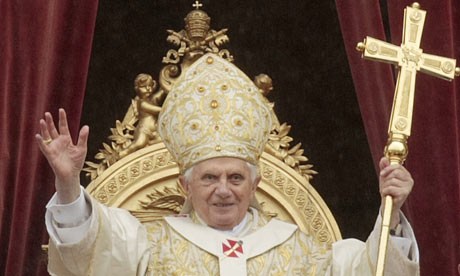
Pope Benedict & his cardinals

By Nick Squires in Rome and John Bingham 5:46PM GMT 21 Nov 2010 –
(My Comments)

In a book to be published this week, Benedict XVI said there could be “justified individual cases” in which condoms could be used, softening Rome’s blanket ban on contraception, one of the most controversial issues facing the Church.

“In certain cases, where the intention is to reduce the risk of infection, it can nevertheless be a first step on the way to another, more humane sexuality,” the head of the world’s 1.1 billion Catholics said, giving as an example a male prostitute having sex with a client.

I wonder about a female prostitute who has aids or any other STD!

But he gave no guidance on the long-standing moral and religious question of whether it would be permissible for a married couple, in which one partner is HIV positive, to use condoms in order to prevent the other partner from becoming infected.  Just more confusion.

While the Pope restates Catholicism’s objections to contraception and stresses its emphasis on abstinence as the best policy to fight Aids, he says that using a condom could be a responsible act if it is intended to prevent the spread of the virus.   What about the spread of unwanted children with no chance for a decent life?

The pontiff’s comments are made in a book to be published by the Vatican this week, which has been the subject of increasing anticipation.   The publicists were not exaggerating when they sent out an email last week saying the Pope delivers “answers that will surprise and impress both critics and his fans”.

“Benedict XVI has shown himself time and again to be the ‘Pope of surprises’,” it said. After decades of staunch opposition from the Catholic Church to the use of condoms, his comments are likely to cause astonishment.

Not only does it represent a hugely significant shift in the Church’s teaching, but the softening in its position is coming from a Pope who took office with a reputation for being hardline and fundamentalist.  Perceived as the Vatican’s enforcer after heading its Congregation for the Doctrine of the Faith – formerly known as the Holy Office of the Inquisition, he is challenging this image by showing himself willing to embrace change.

The Pope’s reluctant support for condom use in certain circumstances is likely to dismay the most conservative Catholics who believe it is impossible to distinguish the use of condoms as contraceptives and their use as preventers of the transmission of Aids.

Yet it reflects a growing consensus amongst theologians that the stance now adopted by the Pope can be morally justified.

Cardinals, such as Godfried Danneels and Lozano Barragan, have argued that it must be better for an infected man to use a condom if the intention is not to avoid life but to prevent death.      But what if a man is using a condom for both reasons?  Will he go to hell?

Earlier this year, the Most Rev Vincent Nichols, the Archbishop of Westminster, indicated he was sympathetic to a more tolerant approach to condom use, saying he could see “why, in the short term, [the] means that give women protection are attractive”.

Cardinal Cormac Murphy-O’Connor, his predecessor, was told by Pope Benedict XVI – who was then Cardinal Ratzinger – that the Church needed to reach an agreed position on the morality of the use of condoms.  How pathetic!  when we consider all the really significant  problems the world has to deal with at  present; rampant paedophilia,  terrorism, brutal wars, aids, dying children etc etc.

Although they acknowledged that there was a need to clarify the Church’s teaching on the use of condoms, cardinals and senior figures in Rome were ultimately too concerned that it was impossible to do so without being misinterpreted.

These concerns appeared to be well founded after Pope Benedict was fiercely criticised for his comments in Africa, which were effectively no more than repeating a well-established Church view that condoms are not the solution to Aids.   Forget about the solution to Aids – what about the reality of  children infected with Aids suffering and dying in their millions?

Rather than promulgate an edict he has chosen to do it in an interview with Peter Seewald, a German journalist whom he trusts and knows well from his time as Cardinal Ratzinger.  Speaking at the Frankfurt Book Fair earlier this year, Mr Seewald said: “The events in the news around the abuse scandals and the wider situation of the Church naturally give this conversation an incredible explosiveness and I can only reveal to you now that you are expecting a very exciting, very extensive book.”

While the Pope tackles many controversial subjects in the book, from the sex abuse crisis to the Church’s teaching on clerical celibacy, his comments on condoms are likely to cause the greatest shock.  They may not go far enough to appease Catholics such as Cherie Blair, who argue for a total acceptance of contraception.

His stance will help to distance the Church from some of its more embarrassing statements, such as the claim by a cardinal that the HIV  virus can pass through tiny holes in the rubber of condoms.   What on earth can these cloistered, brain washed men,  possibly know about pregnancy, giving birth and the hardships of  life in the real world!   And then there is the hypocrisy;  The Catholic Church has financial interests in the manufacturing of contraceptives through the all-powerful Vatican Empire.

Crucially, it may go further in ensuring the Church’s relevance in public debate, presenting it as more humane and more flexible – even at the risk of people thinking the Church has changed its mind on the issue. This desire to secure the Church’s place in the public square is at the heart of Pope Benedict’s thinking and no doubt the guiding reason behind such a brave move.

What does he mean by these statements? …….”I was, naturally, not always simply against things, exclusively and as a matter of principle” ……………….. “Ultimately someone who is in opposition could probably not endure life at all”, quotes the Pope in the book.

><

See More…

Females Sex Workers Recognised by the Pope