
The following post about the life of Italia Frandi’s daughter Helena, is an excerpt taken from the…
1918 Influenza Karori Cemetery Project
Researched and written by Max Kerr and Jenny Robertson
********************************
WOODWARD, Helena Arethusa
Born July 1888; died 28 November 1918; buried 28 November 1918
Helena WOODWARD’s mother, Italia Maria FRANDI, was born in the Tuscan city of Pisa in 1869.

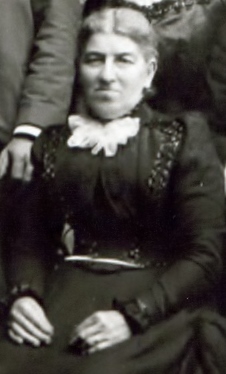
Italia Maria Frandi (35 Years)
***********************************************************
Italia was the second child and only daughter of Aristodemo and Annunziata Frandi (née FABBRUCCI) and had an older brother (Francesco Garibaldi, 1866), and a younger one (Ateo, 1873) born in Pisa before the family left Italy for the other side of the world:
*Aristodemo Frandi:

*Annunziata Fabbrucci Frandi
******************************************************
*Author Anne Frandi-Coory’s maternal great grandparents.
“The Frandi family travelled to New Zealand on an assisted passage upon the steamship Gutenberg, which left Livorno, Toscano Coast, Italy, on 15 December 1875 and arrived in Wellington, on the North Island of New Zealand, on 23 March 1876. From there they travelled by ship to Jackson Bay on the west coast of the South Island and then on to the ‘Special Settlement’ at Okuru…….”
…From Anne Frandi-Coory’s book Whatever Happened to Ishtar? A Passionate Quest to Find Answers for Generations of Defeated Mothers pp. 279-280. (2010). Anne Frandi-Coory is a great-niece of Helena….
“While living in the Okuru Settlement Aristodemo built a hut for his family to live in and Annunziata gave birth to two more sons, Italo Giovanni in 1877 and Antonio Raffaelo in 1878. When the Okuru settlement failed the family moved to Wellington, where Annunziata gave birth to four more sons: Enrico Carlo in 1880, Benito Ranieri in 1883 (lived for three months), Alfredo Guiseppe (my grandfather) in 1884 and Giovanni (stillborn) in 1887.”
****************************************
Aristodemo appeared on the 1896 Wellington electoral roll as a fishmonger with premises in Molesworth Street, a business that he continued for at least 15 years.
Italia Frandi married on Christmas Day 1886 in what was then known as St Mary’s Cathedral, Hill Street (i), when she was 18. Her husband, John CARRENGE/CURRANGE, originally KARENTZE, was also a native of Pisa who had migrated to New Zealand. It appears that he was of Greek heritage and was employed as a wharf labourer. The couple had a daughter in 1888, registered with the name Ellen Harriet but from at least the time she was enrolled for school, she was known formally as Helena Arethusa and within the family and at school, usually as Lena. A son, named Aristidemo Leo, was also born to the marriage in 1890 but died at 7 months old around February 1891.
Lena grew up in Thorndon, attending Thorndon School from 1896 until 1901, when according to her school record she left on ‘doctor’s orders’. The family lived either in the same or adjoining houses with Italia’s parents and some of Lena’s uncles in Murphy Street or Wingfield Street (a narrow street that used to run off Molesworth Street towards Murphy Street, alongside what is now the National Library). This would have been a convenient location for Lena, close to school, handy for her grandfather working at his fish shop, and convenient also for her father working on the wharves.
**********************************
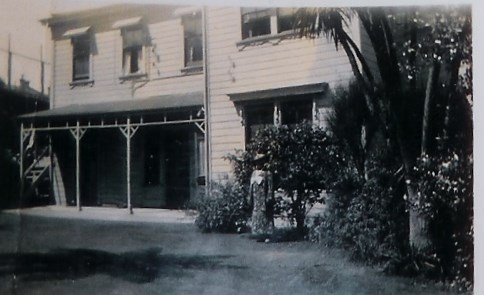
‘Fernglen’ – 16 Murphy Street Wellington
As a young girl, however, Lena may have witnessed scenes of domestic violence. In April 1900, Lena’s mother appeared before the divorce court seeking a dissolution of her marriage on grounds of cruelty and drunkenness. Lena’s father had deserted his family some 6 weeks earlier (ii). The Evening Post reported (on 9 April 1900) that almost from the start of the marriage, Italia’s husband ‘had given way to drink’ and that he had frequently ill-treated her. When she had remonstrated with him, he told her to clear out. The judge granted a decree nisi.
In the following year, Italia married a second time. Her new husband was Peter CORICH, a seaman of Austrian descent who had come to New Zealand in about 1885 and who was naturalised in 1899. The new couple had a daughter, Elvira Maria, known as Vera, in 1902.

Elvira and Helena on the right, dressed in clothes designed and made by their mother Italia
In 1889 (iii) Italia had established a dressmaking business to support herself, working from home, and around the time of the divorce she was advertising for ‘improvers’ (or apprentice workers or more likely, beginners) as well as a girl for housework. With the business being run from home, it is likely that Lena would have made herself useful with small sewing tasks and creative uses of fabric from an early age. Peter Corich died in 1906 and was buried in the Catholic section of Karori Cemetery. It was fortunate therefore that the enterprising Italia had developed her own income-generating business.
When she left school, Lena found work in a related occupation, as a milliner. She was employed by Cenci’s, primarily a millinery establishment when it was founded in about 1900 in premises in Vivian Street, but business growth over the next few years led to a broadening of its range to ladies’ outfitting in general and relocation to new premises at the corner of Lambton Quay and Panama Street. In 1905, at the firm’s annual picnic, Lena was reported to be the winner of the 440 yards handicap race for junior millinery hands (New Zealand Times 18 March 1905).
On 7 October of that year, Lena married Frank Hubert WOODWARD in St Paul’s Cathedral. The Social Gossip column in the Free Lance (3 November 1916) reported on the wedding. Lena wore ‘a pretty cream gabardine suit, with a wide Leghorn hat’ (that is, one made of fine plaited bleached straw), and her sister Elvira acted as bridesmaid. The paper added:
The bride is a niece of the late Captain Frandi (iv), who was last year killed at Gallipoli. She has many other relatives whose names are on the Roll of Honour, and some of whom have made the supreme sacrifice. Naturally, the luncheon after the wedding in the Rose Tea Rooms was of a very quiet kind, only relatives and very intimate friends being present (v).
Lena’s husband Frank was the eldest son of Helen and Charles Woodward, then living in Ellice Street, Mount Victoria. Like Lena, Frank was aged 28 when they married. Born in Lewisham, London, he migrated with his parents after serving with the East Surrey Regiment in 1904–05 and joined the Zealandia Rifles, one of the volunteer groups set up during the 1900s. At the beginning of 1914 he wrote to the Army District Headquarters in Palmerston North seeking a place on a course for aviation instructors, explaining that had studied the principles of ‘mechanical flight’ and as an amateur pilot had experience with two types of monoplane. It is not clear what came of this request, but in September 1914 he attested in Awapuni with the Main Body of the NZEF. In March of the following year he was transferred back to the District as unfit for camp duty. He re-attested in Trentham on 2 October 1916 and embarked for Plymouth (England) later that month, less than 2 weeks after his marriage. He served in Europe until his discharge in April 1918 when he was deemed no longer physically fit for war service because of ‘defective vision’. He was then taken on the strength of the Wellington Military District as Area Sergeant-Major and so continued to serve as a soldier.
Not long after Frank’s return Lena became pregnant and on 26 November 1918 she gave birth to a premature daughter, whom they named Helena, but the infant lived for just 6 hours. Lena was probably already sick with influenza and she died 2 days later, on 28 November, at the age of 30. Lena and Frank were living with her mother Italia in Murphy Street, Thorndon, at the time. Lena and her daughter were both buried on the same day, 28 November, in plot 142E in the Anglican section at Karori Cemetery. The headstone on Lena’s grave incorporates a Latin quotation ‘Anchoram habeus animae tutam ac firman’ (translated as ‘The anchor we have of the soul, safe and firm’) based on Hebrews 6:19 about the central importance of hope.
**********
 anne frandi-coory