Archive

Tag Archives: Italy

While doing research into my Italian ancestry for my book, Whatever happened To Ishtar? I read somewhere that if you wanted to know what it was like living in 19th Century Italy, you might wish to read Village Commune by Maria Louise Ramé, otherwise known by her pseudonym, Ouida. It turned out to be very good advice. I searched for the book online and found it  in a tiny obscure USA second hand book shop. When I received what is now a prized possession, I discovered it was a First Edition published 1881 by J. B. Lippincott & Co.  Philadelphia/

The Commune 2

Published in 1881

My great grandparents, Aristodemo and Annunziata Frandi experienced similar hardships to those described by Ouida in Village Commune. Many young men from poor families were conscripted into the regular army to fight against the Austrians, as was Aristodemo, who came from a family of farmers. The Frandi family, by then including three young children, emigrated to New Zealand in 1876 and I now fully understand why.  Although Aristodemo talked to family about life in Italy, both of his hated time barracked with the regular army  in the far north of Italy, and his time fighting in the south of Italy with Garibaldi, I had no real understanding of just how difficult life was at that time.

I had always thought of Italy as a wonderful country, full of poetry, art, fabulous food and generous citizens. I have visited the country often and I have never been disappointed. But of course there was, and is, another side to Italy altogether.

Ouida’s eloquently written and absorbing stories of life in northern Italy are heart-rending. Farmers and agriculturists, whose families had lived on the land for generations, had their land taken at the whim of wealthy, corrupt government officials and were left homeless and hungry. The burgeoning Industrial Revolution needed land for factories, and dwellings for workers moving onto the countryside. Land was also needed to build mansions for wealthy officials, and for railways.

<><><><><><><><><><><><><><><><><><><><><><><><><><><><><><><><><><><><><><><><><><><><><><><><><><>
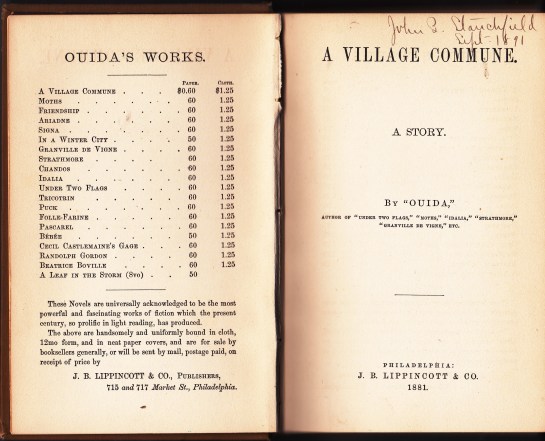
The Commune

Note the prices listed for Ouida’s publications. The handwritten name and date came with the book.


><><><><><><><><><><><><><><><><><><><><><><><><><><><><><><><><><><><><><><><><><><><><><><><><><><><><><><><><>

The author connects on an emotional level with the reader, as she relates beautifully crafted, albeit harrowing, life stories.  One such story is of a young Florentine farming peasant :

He was a peasant who had been taken by conscription just as a young bullock is picked out for the shambles, and he had never understood why very well. His heart has always been with his fields, his homestead, his vines, his sweetheart. He had hated the barrack life, the dusty aimless marches, the drilling and the bullying, the weight of the knapsack and the roar of the guns; he had been a youth, ere the government had made him a machine…If the enemy had come into his country he would have held his own hamlet against them to the last gasp; but to be drafted off to Milan to wear a fool’s jacket and to eat black bread while the fields were half tilled, and the old people sore driven…no, he was not a patriot, if to be one, he must have been a contented conscript. 

 Ouida gives a vivid portrayal of the numerous Roman Catholic and other festivals:

Italian merry-making is never pretty. The sense of colour and of harmony is gone out of our people, whose forefathers were models of Leonardo and Raffaelle, and whose own limbs too, have still so often the mould of the Faun and the Discobolus. Italian merry-making has nothing of the grace and brightness of the French fairs, nor even of the picturesqueness and colour of the German feasts and frolics; even in Carnival, although there are gayety [sic] and grotesqueness, there is little grace and little good colouring. But the people enjoy themselves; enjoy themselves for the most part very harmlessly and very merrily when they forget their tax-papers, their empty stomachs, and their bankrupt shops.

Ouida writes extensively and in detail about the corruption and cronyism of government officials, and the cruelty they meted out to hapless villagers. If citizens had wealth, and were well connected, they had plenty of food and their sons escaped conscription! But peasants lived frugally off the land, and life for them was harsh and often brutal.

One of  Ouida’s famous quotes “petty laws breed great crimes” highlights her intimate knowledge and understanding of what life was like for the peasant landowner (agrario).

The commune of Vezzaja and Ghiralda, whose centre is the village of Santa Rosalia, is, like all Italian communes, supposed to enjoy an independence that is practically a legislative autonomy. So long as it contributes its quota to the Imperial taxes, the Imperial government is supposed to have nothing to do with it, and it is considered to be as free as air to govern itself. So everybody will tell you; and so inviolate is its freedom that even the prefect of its province dare not infringe upon it – or says so when he wants to get out of any trouble.

Anybody who pays five francs’ worth of taxes has a communal vote in this free government and helps to elect a body of thirty persons who in turn elect a council of seven persons, who in turn elect a a single person called a syndic, or as you would call him in English, a mayor. This distilling and condensing process sounds quite admirable in theory. Whoever has the patience to read the pages of this book will see how this system works in practice.

Now, in Vezzaja and Ghiralda the thirty persons do nothing but elect the seven persons, the seven do nothing but elect the one person, and the one person does nothing but elect his secretary; and the secretary, with two assistants dignified respectively by the titles of chancellor and conciliator, does everything in the way of worry to the public that the ingenuity of the official mind can conceive. The secretary’s duties ought to be the duties of a secretary everywhere, but by a clever individual can be brought to mean almost anything you please in the shape of local tyranny and extortion; the chancellor (cancelliere) has the task of executing every sort of unpleasantness against the public in general, and sends out his fidus Achates, the usher, all kinds of summons and warrants at his will and discretion; as for the conciliator (giudice conciliatore) his office as his name indicates, is supposed to consist in conciliation of all local feuds, disputes and debts, but as he is generally chiefly remarkable for an absolute ignorance of law and human nature, and for a general tendency to accumulate fees anywhere and anyhow, he is not usually of the use intended, [my emphasis] and rather is famous for doing what a homely phrase calls setting everybody together by the ears…Power is sweet and when you are a little clerk you love its sweetness quite as much as if you were an emperor, and maybe you love it  a good deal more.   

She elaborates further: Tyranny is a very safe amusement in this liberated country. Italian law is based on that blessing to mankind, the Code Napoleon, and the Code Napoleon is perhaps the most ingenious mechanism for human torture that the human mind has ever constructed. In the cities, its use for torment is not quite so easy, because where there are crowds there is always the fear of a riot and besides there are horrid things called newspapers , and citizens wicked enough and daring enough to write in them. But away in the country, the embellished and filtered Code Napoleon can work like a steam plough; there is nobody to appeal and nobody to appeal to. The people are timid and perplexed; they are as defenceless as the sheep in the hand of the shearer; they are frightened at the sight of the printed papers and the carabinier’s [sic} sword. There is nobody to tell them they have rights , and besides, rights are very expensive luxuries anywhere and cost as much to take care of as a carriage horse.

In Village Commune Ouida dissects the family lives of unfortunate peasants in 19th Century Italy. I believe that many of these soul destroying Italian tragedies are on a par with the famous Greek plays left to us by Aeschylus or Sophocles. There is much irony within the pages of Village Commune

There are far too many long sentences, semi-colons and commas in this book, but they take nothing away from the wit, sarcasm and  beautiful prose flowing from Ouida’s pen. I highly recommend this wonderful little book… if you can find a copy.

* *********************************************************************

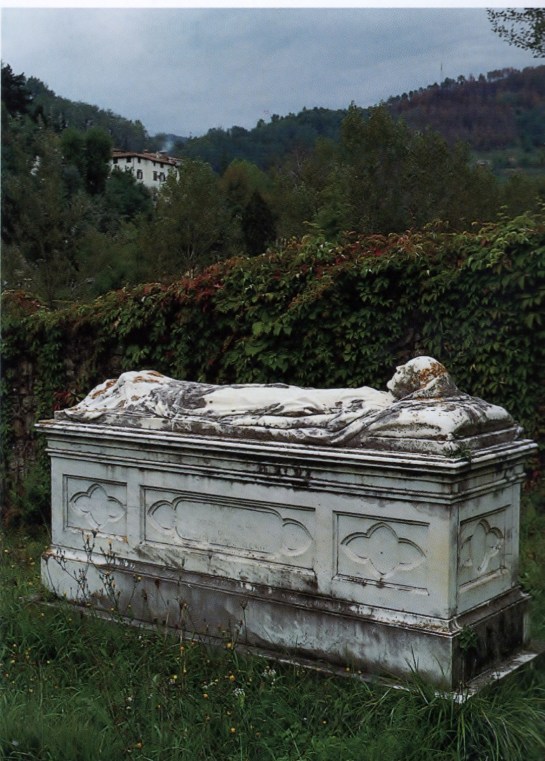
Ouida's headstone.jpg

OUIDA’S HEADSTONE


Ouida Tomb

OUIDA’S TOMB in Bagni di Lucca

**********************************************************************

‘Nature she knew by heart: on birds and flowers
She could discourse for hours and hours and hours.
Sententious, sentimental, repetitious, she
Would never choose one word if there were three. Pith was her weakness;
clichés were her strength. And here she lies now, as she wrote, at length.’
– Christopher Stace, from ‘At first seeing Ouida’s tomb in Bagni di Lucca’ as published in The New Yorker 


*****

Please visit Anne Frandi-Coory’s facebook page here: 

https://www.facebook.com/myhomelibrary/


….

Lucida Mansi sold her soul to the devil………find out more……..

http://www.tuscany-villas.it/to-tuscany/2013/tourist-attractions/legend-lucida-mansi-lucca

….

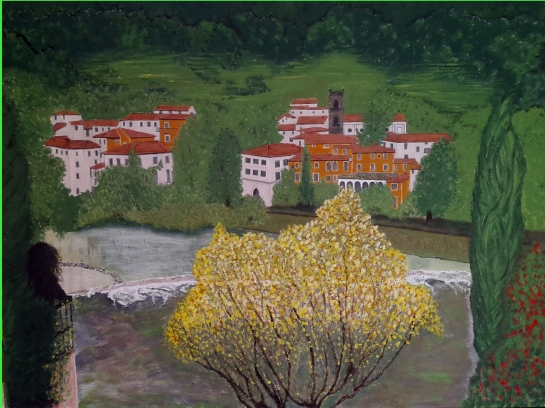
Nexus 4 Nov 027

Silhouette in Bagni Di Lucca

*****

Painting and Poem  Silhouette In Bagni Di Lucca   Copyright  To Anne Frandi-Coory –

All rights reserved 4 November 2013…..

Painting by afcoory –  acrylic on canvas 100cm x 75cm

*****

Oh Lucca

why do you hide your beauty?

no…

you’re not a Milan

a Rome

or even a Florence

but greens from every palette

adorn your hills and valleys

freshness pervades your air

water pure as crystal

What’s that I hear?

Lucida Mansi

her palazzo there

in Lucca town

filled with silken gold

treasured paintings

four poster draped exquisitely

how can that compare?

Lucida of my maternal line

was it you enticed me here?

Read the rest of my poem *Silhouette In Bagni Di Lucca

in Dragons, Deserts, and Dreams

Available now at AMAZON in Kindle e book and paperback 

***********

Reviews and more about DRAGONS DESERTS and DREAMS

Dedicated to my maternal great grandmother Raffaela Marisi Mansi Grego (Greco) -the Mansi name probably originated in Saxony. Mansi ancestors moved to Italy as wealthy silk traders when Italy was ruled by Germany.

Read more about the origins of the Mansi family name: My Fascination With Italian Surnames

Maria Grego cropped 2

EVA Exiles

*****************

EXILES

Exiled from home. The far sea rolls

between them and the country of their birth;

the childhood-turning impulse of their souls

pulls half across the earth. Exiled from home.

No mother to take care that they work too hard,

grieve not too sore;

no older brother nor small sister fair

no father any more.

Exiled from home; from all familiar things;

the low browed roof, the grass surrounded door;

accustomed labours that gave daylight wings;

loved steps on the worn floor.

Exiled from home. Young girls sent forth alone

when most their hearts need close companioning;

no love and hardly friendship may they own,

no voice of welcoming.

Blended with homesick tears the exile stands;

to toil for alien household gods she comes;

a servant and a stranger in our lands,

homeless within our homes.

><

– Charlotte Perkins Gilman. (1914)

********

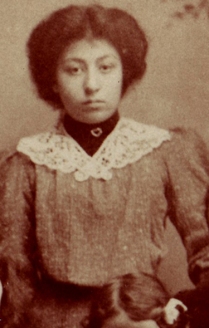
Above left: Anne Frandi-Coory’s maternal Italian grandmother, Maria Cajetan Grego Frandi

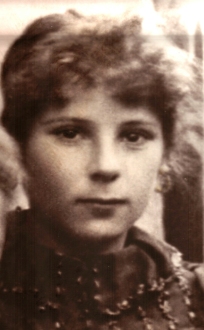
Above right: Anne Frandi-Coory’s paternal Lebanese grandmother, Eva Arida Fahkrey (Coory) 15yrs old & married, in Bcharre, Lebanon, on her way to New Zealand. 

*********

See later post: Italian Villa With Virgin

See Immigration & The Promise

GARIBALDI  

by Jasper Ridley – A Book Review

Updated 6 December 2013

My  great grandfather, Aristodemo Giovanni Frandi, fought in Garibaldi’s ‘army’ and eventually emigrated to New Zealand in 1875. Many were the tales he told his family about the betrayals of the Catholic Church, of its priests and nuns, who informed on Garibaldi’s fighters time and again. Read more about Aristodemo and Annunziata Frandi


….

Garibaldi 001

The Catholic Church has the audacity to say that  Catholics made a fundamental contribution to creating a united Italy and a national identity, in a message marking the country’s 150th birthday.  Pope Benedict XVl has in the past stated that Christianity helped forge a national identity that resisted political fragmentation on the Italian peninsula,  and foreign domination.  He stated that the Church’s contribution came through education, literature and the arts in general, listing such personalities as Michelangelo, Caravaggio and Bernini, whose works were often commissioned for religious purposes.  Is the pope trying to publicise a dwindling Christianity in this age of free thinking and science?

Benedict obviously lives in a religious fantasy world.  Artists were stymied and never allowed to paint what they pleased in case it offended the Catholic Church.  Many artists lived a life of subsistence because of this and it is well documented how the Catholic clergy, including extremely wealthy popes and cardinals,  enforced their sexual proclivities on young artists.  The 19th Century Pope did all he could to quash any attempts at the unification of Italy.  It would mean that the papal states would shrink to the City of Rome and finally to Vatican City.  Giusseppe Garibaldi led the Risorgimento;  he and his followers hated the Catholic Church (Papal Rome) because so often they were betrayed by nuns, priests and cardinals.  It was Garibaldi and those politicians who supported his quest for unification, who finally forced Austria, papal sycophants, and France, out of Italy.  Garibaldi’s heartbreak was that Nice, his birthplace,  was ceded to France in 1861 by politicians, as part of the deal that they leave the peninsula.

It is such a joke that Pope Benedict could come out and say it was through Catholic education and literature that Italy was united.  The truth is, only ‘the list’ of books approved by the Church were available for the general populace to read.  Most literature that made its way to Italy was burned or hidden in heavily fortified libraries only accessible to Monks and Cardinals.  See previous post Vatican Library.   As for resisting political fragmentation; the only reason they exiled or brutalised any political opposition was because the Church did not want to lose the corrupted power base they possessed.   The Church was fully funded and supported by the Spanish, French and Austrians.

If any group can be held responsible for seeding the Risorgimento (resurgence) it was the people of Italy themselves; mostly peasant farmers, some elitists, and mercenaries who had fought with Garibaldi in South America.  Peasant farmers, led by Garibaldi, almost single-handedly drove foreign power out of Sicily, and this was the catalyst that began the unstoppable unification of the peninsula.  The Roman Catholic Church opposed unification simply because it would mean the end of the vice grip they held over Italy.  Read Garibaldi by Jasper Ridley, it is very enlightening and I would hazard a guess that it is not one of the Vatican’s favourite books.

– Anne Frandi-Coory 6 December 2013


See post:  Terroni by Pino Aprile    “All that has been done to ensure that the Italians of the South become ‘Southerners’…

I feel vindicated in writing about the generational sexual abuse in Catholic Lebanese and Italian families which I uncovered during the research for my book ‘Whatever Happened to Ishtar?’ . If  paedophile priests were sexually abusing children why would we be surprised when we find fathers and uncles doing the same thing?  At last the abused can speak out about what has been covered up by the Catholic Church, not for decades, but for centuries!

The woman’s testimony below reminds me how complicit nuns were, if not in the sexual abuse, then certainly in the physical and emotional abuse, of children in Catholic orphanages and schools.    My brother wrote a story in his early teens (Hypocrisy of the Catholic Church; my brother’s story) about the time he and our mother were starving,  yet they were  turned away by a fat priest who was on his way to his roast dinner which the pair could smell wafting from the kitchen of the presbytery.

><

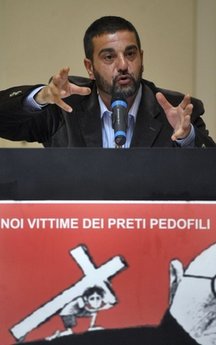
 Italian victim & former priest,  Domolo speaks out. Caption above: “We are victims of paedophile priests”

><

The Vatican, under global pressure,  has just raised the statute of limitations for reporting sexual abuse, to twenty years from the time the victim turns eighteen.  However, most human rights activists agree there should be no statute of  limitation as occurs in most western countries.

Excerpts from Associated Press:

VERONA, Italy – Italian victims of a paedophiliac clergy want such sexual abuse declared a crime against humanity, and they launched an international appeal on Saturday during the first public gathering of such victims in Italy.

Organizer Salvatore Domolo, a former victim and an ex-priest, said the group is looking abroad for solidarity because justice for pedophile victims is hard to come by in Italy with a statute of limitations of 10 years.

“Here there is no hope. By the time a victim arrives at the awareness of having been a victim, legal intervention is not possible,”  Domolo said in a country that has long been reluctant to confront the Vatican in its own backyard.

“The complicity of the hierarchy, together with the enormity of the numbers and vast geography of these crimes, should lead us to consider that we are facing a crime against humanity carried out by a political-religious organization,” Domolo told a news conference before the victims met, his delivery bearing the cadence of a homily.  “With this gathering, we want to ask civilian justice to do its duty in full freedom and truth, without being intimidated by the clerical culture.”

The meeting was held opposite Verona’s heavily visited Roman colosseum and advertised with placards outside. Passers-by were free to enter, but few did.

Another will be held in Rome at the end of October, but Verona was chosen for the first gathering because it is the home of a school for the deaf where 67 former students have alleged suffering sexual abuse, paedophilia and corporal punishment from the 1950s to early 1980s.  About 40 former victims inquired by e-mail — but many are still reluctant to come forward, organizers said.

The Vatican has been reeling for months as thousands of victims around the globe have spoken out about priests who molested children, bishops who covered up for them and Vatican officials who turned a blind eye to the problem for decades. In the latest admission, hundreds of victims came forward in Belgium with tales of horrific abuse linked to at least 13 suicides.

While Italian bishops have acknowledged 100 sexual abuse cases that warranted church intervention in the last decade, victims believe the true number in Italy is much higher because the reluctance to speak out in Italy is especially strong.  “This gathering is fundamental because we live in a social situation in which the presence of the Catholic church reduces the possibility of talking about the situation,” Domolo said. “They do it all over the world, but in Italy even more. That we are just now having the first gathering of victims indicates that only in the recent months is something exploding in Italy.”

Domolo, now 45, said he had been a victim of his parish priest from age 8 to 12, and that he was forced to confess “as if I had sinned.   The church has known for 50 years this has been going on but kept it quiet in a disgusting way,” he said.

Domolo was a priest for 15 years. He renounced both the priesthood and his Roman Catholic faith after meeting another victim on a trip to Ireland in 2001. A man named Francesco from Padova, who did not give his surname, told the group he had been abused both by priests and nuns who used punishment as an excuse to touch him inappropriately. “The worst was my family. They refused to believe it was true,” he told the group, adding he has only been able to come to grips with it through therapy.

A 58-year-old deaf woman, who only gave the nickname given to her by the nuns of Verona’s Antonio Provolo Institute for the Deaf, carefully annunciated her words as she told her story. During her 15 years at the institute, she was only alone with priests once a week for confession. Recalling her first confession, she said she asked the nuns what to say, and they asked her what she had done. “I told them I scratched myself everywhere because I had too much wool clothing. The nuns said, ‘Tell them you touched yourself.”‘

At that, she said, the priest asked her to lift her clothing to show him where. And so it continued, she said, “little by little, week after week. We girls didn’t do anything, and we had to confess. The priests, who sinned, did they ever confess, I ask?”