
Damascus Gate
by Robert Stone
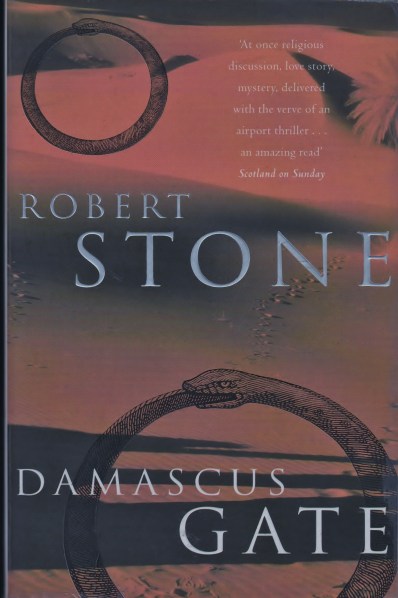
What is it about authors who have been incarcerated in Catholic orphanages and other religious institutions during their formative years? This is another book I found at Clunes Book Festival in Victoria and I wonder, is it the title that attracted me or the intense stories about faith written within its pages? The author Robert Stone has himself a past bathed in religious upheaval and search for identity. He was raised by his schizophrenic mother until he was five, when she was committed to an asylum for the insane. Five year old Robert, whose father abandoned the family, was then taken in by a Catholic Orphanage, who Stone describes as having the ‘social dynamic of a coral reef’. The violence the boy experienced at the hands of men posing as carers, is a heart rending story retold many times over by children raised in religious institutions. I think it must be the passion and fearlessness with which these authors take on ‘taboo’ subjects that attracts my undivided attention. Someone wrote that books, once written, have no need of their authors. That is true enough, but I must admit to seeking out most books by author, rather than title or genre. I like to know more about the background of the author, particularly if a book has had a deep effect on me, and Damascus Gate is just such a book. You can never judge a book by its cover in my view, especially when it’s a good read you are looking for.
At the centre of the Damascus Gate story is struggling free-lance journalist, Chris Lucas (Catholic mother, Jewish father), who teams up with a psychiatrist in Jerusalem to write a book about religious zealots, some insane, of all persuasions who come to the Holy City to ‘find the truth’ a condition labelled the ‘Jerusalem Syndrome’. The two men enlist the help of an archaeologist, who himself seems to have caught the ‘combative spiritualism’ endemic in Jerusalem. Little does Lucas realise that he is being followed, photographed and controlled by various groups fulfilling their own agendas. The Jerusalem Syndrome is a label attached to a group of mental phenomena involving the presence of either religiously themed obsessive ideas, delusions or other psychosis-like experiences that are believed to be triggered by a visit to the city of Jerusalem. Followers of the three Abrahamic religions of Judaism, Christianity and Islam can be equally affected by the syndrome. There is no doubt that with the Israeli army surrounding the city, and with its spies everywhere, the religion of Judaism appears to have the upper hand and control of the city and its environs with the help of its watch towers and road blocks at every twist and turn. The best known manifestation of Jerusalem Syndrome is whereby a person who seems previously balanced and devoid of any signs of psychopathology becomes psychotic after arriving in Jerusalem. The psychosis is characterised by an intense religious mania and most often resolves to full recovery for the afflicted over time or immediately following their departure from the city.
Even those of little faith, or atheists, sense ‘there is something here in Jerusalem’, but what, they cannot say.
Damascus Gate is set in Jerusalem and surrounding areas, is fiction based on fact; we all know what a powder keg Jerusalem is with its struggle to contain the three religions within a relatively harmonious state. Making the situation even more volatile, are the various sects of Christianity, Islam and Judaism competing to have their ‘truth’ realised, even though archaeological proof is yet to be discovered for any of their respective claims. This book is a great read and highlights the sectarian differences between Christians, Muslims and Jews whose followers all fight for supremacy over this small historically important city. Each sect has its own neighbourhood and if you’re not one of them, you are forewarned to avoid walking through its streets alone without an approved escort. It can be a very dangerous city and riots between Jews and Arabs can erupt at any time for the slightest of motives. Not only that, this fraught city attracts all manner of religious lunatics hell bent on ‘saving’ their respective Messiah’s or Holy Prophet’s relics from the infidel. Drugs, money and sexual favours add to the heady religious mix, and anything can happen at any time. Herman Melville’s quote sits revealingly on the front page of Damascus Gate: ‘Enigma and evasion grow; And shall we never find Thee out?’
A Jewish extremist underground movement exists in Jerusalem and it aspires to rebuild the Temple. To achieve this, the mosques must be blown sky high. The Israeli Defence Force and Mossad know that if this happens Armageddon will erupt in Jerusalem which will surpass its many past destructions, the effects of which will be felt across the globe. There is not much going on in Jerusalem that these two forces don’t know about. The tensions are deep and ancient, with their thousands of years of history fought over every day and at every religious festival. Serious political games are being played out at the very highest levels where murder, intrigue and ‘religious authority’ are used to control and incite violence which is forever simmering at a very shallow depth beneath the surface of this ancient land.
Israelis and Palestinians both claim Jerusalem as their capital, and the state of Israel maintains its primary governmental institutions there. One of Israel’s Basic Laws, the 1980 Jerusalem Law refers to Jerusalem as the country’s undivided capital. All branches of the Israeli government are located in Jerusalem, including the Knesset (Israel’s parliament), the residences of the Prime Minister, President and the Supreme Court while the State of Palestine ultimately foresees the city as its seat of power. However, neither claim is widely recognized internationally. In latter years Muslim extremists have become more powerful and dangerous making Jerusalem even more volatile than ever. Staff of non-government organisations such as the UN and Save the Children, feature in this story and all play an integral part in the intrigue and hidden agendas.
One reviewer says of Damascus Gate: ‘Stone has a journalist’s eye for detail, but a novelist’s eye for irony’…and I believe that this is what makes the book such a great read. Stone manages to capture all the intrigue, all the religious fervour and menace in his words and all the while there is the ‘festering menace of Gaza’.
-Anne Frandi-Coory 23 January 2017

 anne frandi-coory