Archive

Tag Archives: KEVIN COORY’S STORY

Doreen Frandi during WWll. Photo: afcoory

Dear *Francine

I finished reading your PhD thesis *Virginia’s Story last night.  Thank you for giving me the opportunity to read it in the first place – I feel it was meant to be, like a chance encounter!

While taking in Virginia’s words, I had a little cry, because so much of what she is crying out for – dignity, personhood – is what I so wanted for my mother, Doreen.  She never did receive much of that respect in her life; not from hospitals, men, or from family.  This was my chief motivation for writing Whatever Happened To Ishtar? – A Passionate Quest To Find Answers For Generations of Defeated Mothers’.

By the time I had the chance to really know my mother, it was too late; the drugs and ECT had taken their toll.  Much of what she had experienced in psychiatric wards and throughout the manic, psychotic,  and depressive phases of her life, was passed on to me by my brother, Kevin, who lived with her until he was married.  After that, he spent time with her either at his home or at her council flat in Wellington, otherwise he spoke to her daily by phone.  I tried to obtain her records from Porirua Psychiatric Hospital, but they would not release them to me because I was not listed as her next of kin.  However, as I reveal in Whatever Happened To Ishtar?, Doreen’s psychiatrist did phone me and answered most of the questions I asked of her regarding Doreen’s psychiatric history.  Obviously, she did not volunteer information, so I only have knowledge of a small section of my mother’s official records of the times she was confined at the hospital.

Even though I was never admitted to a psychiatric ward, I came close to a mental breakdown when I was a young woman and my marriage was failing.  I can well understand, therefore, Virginia’s desire to leave her marriage, which was draining her physical and mental strength.   I also experienced what it was like to be denied personhood and dignity, when I was a child and teenager. I was branded and often humiliated by my Lebanese extended family because of who my mother was; her bipolar disorder and her Italian descent.  What I hated most was the way they branded her a “sharmuta” (prostitute) when she was nothing of the sort and could not defend herself.  There are many parallels in my, Doreen’s,  and Virginia’s stories.  I regret so much that Doreen only took Kevin with her when she left Dunedin for Wellington,  and abandoned me.  I believe that as her daughter, I may have been able to empathise more with her, and given support to my brother.  Sadly, I will never know for sure what the outcome would have been in that scenario.  Thank goodness Virginia at least had a loving daughter to look after her welfare.

I was very interested in what you had to say in your thesis about biographies vs autobiographies; about creativity and whether or not bipolar disorder is actually a mental illness.  Many brilliant artists as you know, exhibit facets of the disorder.  I read a medical paper recently which suggested that bipolar disorder and schizophrenia are symptoms brought about through the brain evolving, which of course it has been doing for thousands of years.  An interesting theory.

I intend to contact Bipolar networks in Australia, and perhaps give talks about my and my brother’s experiences with Doreen and her disorder.  If you have any contacts here, I would be grateful if you could pass their name or names on to me.  Alternatively, members of bipolar networks can contact me via this blog and request a copy of the book .

At your suggestion, I called at the  office of the  Bipolar Network after our meeting and donated a copy of ‘Ishtar?‘ which they were very pleased to receive. I told them they could purchase more copies at  University Book Shops. Although the Public Library acquisitions officer requested to buy copies directly from me when I met with her to promote my book, I told her the normal process was that the library purchase copies through  University Book Shops.

Thank you once again for taking the time to meet with me, and for buying copies of my book for the Dunedin University Book Shop.

Kind regards

Anne Frandi-Coory

><

Bipolar Disorder Blog   (The Crazy Rambler)

Bipolar Disorder; The Little We Know

><

*Names have been changed for privacy reasons
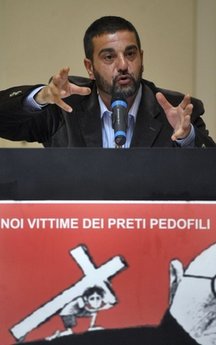
I feel vindicated in writing about the generational sexual abuse in Catholic Lebanese and Italian families which I uncovered during the research for my book ‘Whatever Happened to Ishtar?’ . If  paedophile priests were sexually abusing children why would we be surprised when we find fathers and uncles doing the same thing?  At last the abused can speak out about what has been covered up by the Catholic Church, not for decades, but for centuries!

The woman’s testimony below reminds me how complicit nuns were, if not in the sexual abuse, then certainly in the physical and emotional abuse, of children in Catholic orphanages and schools.    My brother wrote a story in his early teens (Hypocrisy of the Catholic Church; my brother’s story) about the time he and our mother were starving,  yet they were  turned away by a fat priest who was on his way to his roast dinner which the pair could smell wafting from the kitchen of the presbytery.

><

 Italian victim & former priest,  Domolo speaks out. Caption above: “We are victims of paedophile priests”

><

The Vatican, under global pressure,  has just raised the statute of limitations for reporting sexual abuse, to twenty years from the time the victim turns eighteen.  However, most human rights activists agree there should be no statute of  limitation as occurs in most western countries.

Excerpts from Associated Press:

VERONA, Italy – Italian victims of a paedophiliac clergy want such sexual abuse declared a crime against humanity, and they launched an international appeal on Saturday during the first public gathering of such victims in Italy.

Organizer Salvatore Domolo, a former victim and an ex-priest, said the group is looking abroad for solidarity because justice for pedophile victims is hard to come by in Italy with a statute of limitations of 10 years.

“Here there is no hope. By the time a victim arrives at the awareness of having been a victim, legal intervention is not possible,”  Domolo said in a country that has long been reluctant to confront the Vatican in its own backyard.

“The complicity of the hierarchy, together with the enormity of the numbers and vast geography of these crimes, should lead us to consider that we are facing a crime against humanity carried out by a political-religious organization,” Domolo told a news conference before the victims met, his delivery bearing the cadence of a homily.  “With this gathering, we want to ask civilian justice to do its duty in full freedom and truth, without being intimidated by the clerical culture.”

The meeting was held opposite Verona’s heavily visited Roman colosseum and advertised with placards outside. Passers-by were free to enter, but few did.

Another will be held in Rome at the end of October, but Verona was chosen for the first gathering because it is the home of a school for the deaf where 67 former students have alleged suffering sexual abuse, paedophilia and corporal punishment from the 1950s to early 1980s.  About 40 former victims inquired by e-mail — but many are still reluctant to come forward, organizers said.

The Vatican has been reeling for months as thousands of victims around the globe have spoken out about priests who molested children, bishops who covered up for them and Vatican officials who turned a blind eye to the problem for decades. In the latest admission, hundreds of victims came forward in Belgium with tales of horrific abuse linked to at least 13 suicides.

While Italian bishops have acknowledged 100 sexual abuse cases that warranted church intervention in the last decade, victims believe the true number in Italy is much higher because the reluctance to speak out in Italy is especially strong.  “This gathering is fundamental because we live in a social situation in which the presence of the Catholic church reduces the possibility of talking about the situation,” Domolo said. “They do it all over the world, but in Italy even more. That we are just now having the first gathering of victims indicates that only in the recent months is something exploding in Italy.”

Domolo, now 45, said he had been a victim of his parish priest from age 8 to 12, and that he was forced to confess “as if I had sinned.   The church has known for 50 years this has been going on but kept it quiet in a disgusting way,” he said.

Domolo was a priest for 15 years. He renounced both the priesthood and his Roman Catholic faith after meeting another victim on a trip to Ireland in 2001. A man named Francesco from Padova, who did not give his surname, told the group he had been abused both by priests and nuns who used punishment as an excuse to touch him inappropriately. “The worst was my family. They refused to believe it was true,” he told the group, adding he has only been able to come to grips with it through therapy.

A 58-year-old deaf woman, who only gave the nickname given to her by the nuns of Verona’s Antonio Provolo Institute for the Deaf, carefully annunciated her words as she told her story. During her 15 years at the institute, she was only alone with priests once a week for confession. Recalling her first confession, she said she asked the nuns what to say, and they asked her what she had done. “I told them I scratched myself everywhere because I had too much wool clothing. The nuns said, ‘Tell them you touched yourself.”‘

At that, she said, the priest asked her to lift her clothing to show him where. And so it continued, she said, “little by little, week after week. We girls didn’t do anything, and we had to confess. The priests, who sinned, did they ever confess, I ask?”