Updated 15 April 2015
Why is Mental Illness always at the bottom of the Public Health funding list when we all know that mental and physical health are intertwined!?
Mental health expert Patrick McGorry has just been voted Australian of the Year. It is so good to see such a prevalent disorder as mental illness in the news and highlighted. Mr McGorry is also concerned with the plight of refugees, including women and children, held for years in detention centres or ‘Asylums’. It has been well documented how detrimental an effect long periods of institutionalisation has on a person’s mental health.
Xenophobia is alive and well but not just in Australia. Western countries as well as developing countries are suspicious of, and fear those from different ethnic groups. Throw in religion and it becomes a volatile mix which is evident in the bloodshed in many countries around the world at the present time.
‘Unfortunate Folk; Essays on Mental Health Treatment 1863-1992’ is an Otago University publication researched and edited by postgraduate history students at University of Otago between 1972 and 2000. Attitudes to mental illness in Australasia haven’t really changed that much I don’t think; political correctness has intervened and made the way we speak about mentally ill patients a little less hostile, that’s all.
My mother had a severe bi-polar disorder and spent many years in and out of a mental hospital where she often received Electro-Convulsive Therapy (ECT) in the 1950s and 1960s which eventually left her in a state of permanent mental lethargy. Apparently it was important to keep her emotions tightly controlled in order to level out her mood swings, but in the process killed off all her creativity. The right drugs were not available then. My mother’s traumatic childhood and adolescence probably brought on the disorder and I am sure her stint in a Catholic convent trying unsuccessfully to outrun life in the natural world and become a nun, added to the intensity of her affliction. As I write in my book, ‘Whatever Happened to Ishtar?’ mental illness and its attendant prejudices has had a lasting effect on subsequent generations of her family. The fact that she was Italian certainly played its part in other people’s perception of her displays of emotion.
ECT was introduced into mental hospitals in 1943 in Australasia and considerable experimentation with this method of treatment, and new drugs, was carried out on patients. ECT was first used without anaesthetic on patients who were suffering from “over excitability” and depression, both of which my mother “suffered” from.
A personal account from a medical student shown around Seacliff Mental Asylum in NZ in 1943:
“A consultant…brought them onto the stage and asked them about things and showed off how tragic they were, but I mean, it was a show and I think they were used to showing off as they were expected to. That was part of it, but the really awful thing was when we went around the wards. One particular one that I remember…there was this great big ward and there were a whole lot of what looked like old and bedraggled women with white hair all over everywhere and they were all dressed the same, in white hospital things like you put on when you go for a x-ray and they all came crowding round the trolley, clattering their spoons and tin plates and it was just like feeding the animals, it was absolutely horrendous. That would have been around 1943 …it was just at the very earliest stages of shock treatment …it was certainly the first time of using unmodified ECT, and no anaesthetic, it was horrific”.
These places were worse than the prisons in which criminals were incarcerated. The sad thing is that many people still believe that the mentally ill should be locked away somewhere out of sight and out of mind.
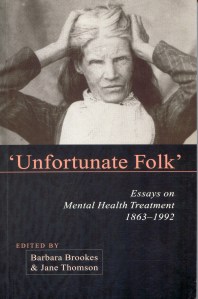
Unfortunate Folk; The Mentally Ill
The above book quotes many interesting statistics: In 1874, of in-patients in mental institutions in Otago NZ there were twice as many men as women (mostly gold miners) and the majority of the women were married. “Most religious denominations were represented but the three major groups were Presbyterian, Anglican and Catholic. The numbers of Presbyterian and Anglican patients roughly mirrored their ratios to the general Otago population”… “However, there were nearly twice as many Catholic patients as there should have been”… “The Irish, who made up the majority of Catholics,were over-represented to the same degree”.
The married women often had their children incarcerated with them in the mental institution.
In 1903, New Zealand’s then Prime Minister, Richard Seddon reported his genuine concern:
“To see the children in the asylum was heartbreaking. Children of tender years were to be found with the adults, and, in some cases sitting on the floor. In any of the asylums they would find little boys and girls hopelessly and helplessly insane, and to keep them here with such surroundings as they had was not, to his mind, the right thing to do”.
The next significant group incarcerated in mental institutions were Chinese gold miners and they aroused strongly racist sentiment among some of the authorities. The following is an inspector’s report which defies belief that it could be written by a government Health Official inspecting the institutions:
“There are seven Chinese lunatic patients in the Asylum [it is interesting that the term asylum is still being used in relation to refugees today] and considering the racial antipathy of the European to the leprous Mongolian, I am of the opinion that it is injurious to the European Lunatic being brought into daily contact with the Chinese, and that an additional ward and airing court should be provided for the latter without delay”
The last paragraph in the book is a summary regarding the boundaries between “madness and reason”:
“Patients, families, the public, politicians, and health professionals all upheld the boundaries between madness and reason. Progress in the decade under question was slow and fragmentary, although the seeds for more radical change were soon being laid. From the later 1950s, de-institutionalisation became the focus of mental health policy, and has remained in controversial favour ever since. Large and isolated mental hospitals became a thing of the past. But although this achieved some alteration in the social status of the mentally ill it has not completely destroyed the boundary between madness and reason. The legacy of madness as a separate world remains. In essence, the psychiatrist is still an ‘alienist’ treating those designated as ‘foreigners’ by their families, the public, and the medical profession”. Mr McGorry might add here, “and the Australian Government’s health system”.
-Anne Frandi-Coory 15 April 2015



 anne frandi-coory