
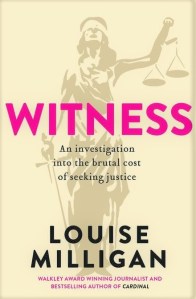
WITNESS; An Investigation Into the Brutal Cost of Seeking Justice
by Louise Milligan.
Louise Milligan is an investigative journalist with ABC Four Corners and is the bestselling author of CARDINAL; The Rise and Fall Of George Pell which won the Walkley Book Award and broke massive international news preceding the court case and successive appeals involving Cardinal George Pell.
In February 2021, WITNESS was awarded the Victorian Premier’s Literary Awards People’s Choice Prize.
In August 2021, WITNESS won the Davitt Award for Best Non-Fiction Crime Book.
*********************************************
*******************************************************************************************
At times, I found WITNESS very difficult to read. The treatment of victims of sexual abuse in the court room is brutal and intimidating; the seemingly endless humiliation of children in the witness box, who have come forward to report that they have been sexually abused, is all at once, shocking and heart-breaking.
This book is first and foremost an analysis and critique of the failures of the criminal justice system in sexual assault trials. A masterful and deeply troubling exposé, WITNESS is the culmination of almost five years’ investigative work for Louise Milligan. Charting the experiences of those who have the courage to come forward and face their abusers in high-profile child abuse and sexual assault cases, Milligan was profoundly disturbed by what she ultimately discovered.
Throughout the book there is a justified sense of outrage at those who choose to treat complainants and witnesses with a hostility causing its own trauma; a special kind of systemic abuse.
Milligan has two decades of experience as an investigative journalist, including her specialist work as a media court reporter and her sustained coverage of the trials of George Pell. Her analysis of the Criminal Justice System in Australia instructively affirms how the system is outdated and fails to meet the needs of complainants. She records in-depth interviews with prosecutors, defence counsel, solicitors, judges and academics. It is a gripping revelation of rarely-heard experts’ public opinions about the realities and flaws of criminal judicial procedure.
Why is the cost of seeking justice so monstrously high? Milligan asks.
Her visceral description of the attempted destruction of her own character and credibility in cross-examination by Robert Richter QC relating to her investigative journalism surrounding the case of George Pell, testifies to the brutality of many witnesses’ encounters with the criminal trial process. As Milligan states in the book, she had the ABC legal team supporting her in court and yet she found the experience traumatic. She kept thinking what a deeply traumatic experience it must be for children and young women who have no legal support whatsoever in court.
In her case, virtually every question was asked, she writes, in a belittling or insulting way. By the end of the day, she “had never felt more alone”, despite all her experience, preparation, and team of lawyers. What hope do complainants have, she asks, who lack these resources, and who were already traumatised?
Milligan’s account of her own cross-examination during the Pell committal hearing by Robert Richter QC is exhaustive and compelling. Reflecting on the experience, she repeatedly references the Evidence Act S41 which imposes a duty on the court to disallow improper questions and improper questioning, including questions that are intimidating or humiliating, or are asked in an insulting way.
The author makes it clear that she felt insufficiently protected by this section of the Act, and by other laws giving the court control over how witnesses should be questioned.
“The system is broken. For sex crimes, rates of complaints, prosecutions, and convictions are persistently low. Sexual assault trials require more fundamental changes. Protections against humiliating treatment of witnesses need to be properly enforced by judges and prosecutors. As one QC admits to Milligan, reforms about judicial directions and improper questioning “don’t mean anything if the prosecutor doesn’t intervene and the judge or magistrate isn’t in control of the courtroom.”
Milligan also suggests that complainants would benefit from an expert advisor to assist them in navigating the system, and to protect against unduly “intimidatory tactics”. She argues that sexual abuse victims who are required to give evidence against the accused, should have the right to legal advocates in court. She discusses this issue with several barristers and judges as an integral part of her research and the way forward.
So many of the formal protections that witnesses deserve already exist: judicial intervention powers; legislative protections against demeaning and misleading questioning; complaints mechanisms. She delves into the “emotional architecture” of Australia’s criminal courts, in particular, the trial culture of élite defence barristers, which one source memorably describes as “a very lucrative psycho-politics of humiliation”.
“[Witnesses/Victims] come before the court, to be cross-examined, potentially by a fierce advocate, with years of experience, completely alone. To have to relive their disgusting trauma and to have it doubted again, with no one to make sure that their human rights are not being abrogated, that the Evidence Act is not being breached, that the barrister isn’t acting in a way that breaks the rules he or she is bound by. “
“Yes, there is a judge and a prosecutor, but so often, for a multitude of reasons, they do not do it as well as they might.”
Dr Mary Iliades, a criminologist from Melbourne’s Deakin University writes in a 2019 paper on the subject: “The reluctance to recognise victims as anything other than a prosecution witness, stems from a concern that victims will invite potentially subjective and thus prejudicial submissions on matters of state concern which could compromise the objective and public nature of the criminal justice system and hinder an accused person’s due process rights to a fair and impartial trial.”
“Essentially, this means that the law is concerned that elevating the role of the complainant witnesses – victims – will give an unfair advantage to the Crown in proving the prosecution case beyond reasonable doubt and that people accused of, say, child rape, won’t get justice. But the flow-on consequences of these concerns are not good for victims.” Testament to which this impressive investigation by Milligan lays bare.
***************************
This is a book that had to be written. Thank you, Louise Milligan, for taking on this monumental task.
-Anne Frandi-Coory. 5 February, 2021



 anne frandi-coory