Archive

Tag Archives: paganism

The Closing of the Western Mind; The Rise of Faith and the Fall of Reason

By Charles Freeman, published 2002

><

For anyone who is interested in the roots of Christianity, how it developed, and eventually swept the Western world, this book is the book to read. Greek philosophical tradition and paganism, were the losers.

To me personally, the most interesting chapters in the book, were those which dealt with the way in which a particular sect of Christianity became the state religion of the Roman Empire; Roman Catholicism.  It was largely because of political expediency; more power and control over the masses, by Roman emperors. I was fascinated by  the fierce in-fighting surrounding the  ‘correct’ early  interpretation and establishment of Christian dogma, as early as the 4th Century ACE.  It largely centred around the ‘Godhead’ of Christianity: God, Jesus, and the Holy Spirit, and whether or not all three were as ‘one’ or of three levels, (to put it very simply).  Part of the problem was that early Christian dogma was formulated from several different sources: scriptures, gospels, old testament, Greek philosophy, Hebrew, Latin and Greek translations.  Also  taken into account was the life and status of Jesus, and in this case, there were so many disputed ‘facts’ about who he was and how he lived, that it appears the Jesus we know, could have been a ‘collage’ of several different prophets or holy men who lived around the same time.

In the book, Freeman writes about Emperor Julian (who ruled from 361) – Dismayed by the vicious infighting he saw around him…Experience had taught him that no wild beasts are so dangerous to man as Christians are to one another.  Ammianus Marcellinus further suggests that  Emperor Julian believed that the Christians left to themselves would simply tear each other apart. Julian was well aware of the brutality of Christian generals and emperors.

-Anne Frandi-Coory 27 October 2011

><><><><

One more review of many:

“One of the best books to date on the development of Christianity…beautifully written and impressively annotated, this is an indispensible read for anyone interested in the roots of Christianity and its implications for our modern world view….Essential.”

-Choice
More here on Anne Frandi-Coory’s Facebook page 

https://www.facebook.com/myhomelibrary/

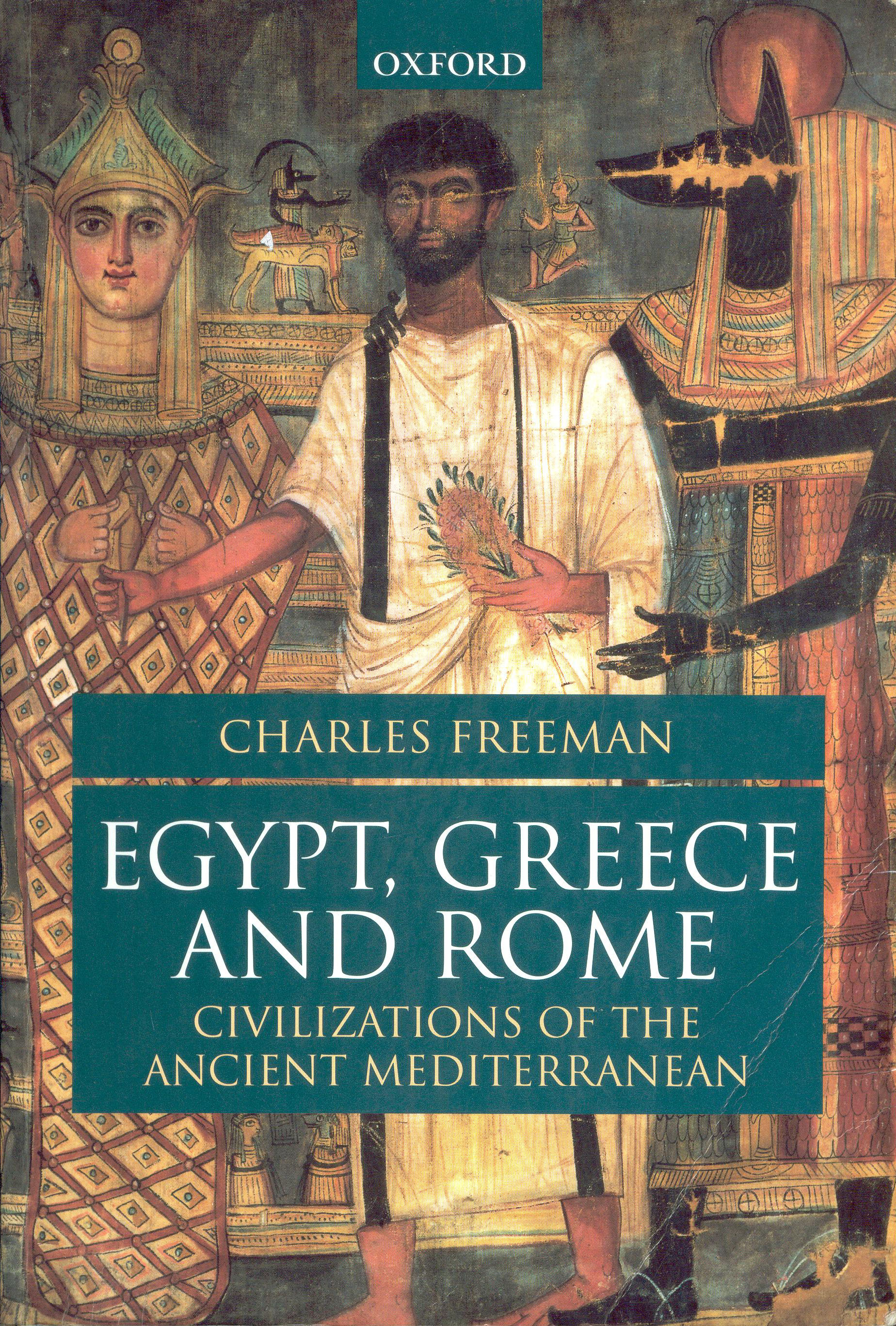
Charles Freeman’s book about civilisations of the Ancient Mediterranean

I have just been reading Egypt, Greece and Rome; Civilisations of the Ancient Mediterranean by Charles Freeman , published 1999.  What an amazing book of 638 pages.

Not as much of a chore to read as you might think. The author breaks the book into easy to follow chapters and titled paragraphs.  He uses date charts, date lists, events and maps to great effect and to which I referred constantly during the reading of the book.

The book has given me a better insight into the pre-history of these amazing civilisations, and to their relevance today. Mr Freeman takes the reader on an epic journey from Egypt in 4,500 BC to Eastern and Western Empires up to 1000 AD.  He brings together the most interesting and salient stories. In one sense, not much has changed.  Constant wars, plagues, atheism, religious diversity,polemics, politics, the fight for democracy, all played a part.

Carthage (now Tunisia) , for instance, was a prosperous and thriving Phoenician city in the 5th Century BC, and Greece was pioneering philosophy and   theatre.   Greek philosophers travelled the Mediterranean teaching students to “look” at both sides of an argument.  Trading goods between the various states was the chief activity that brought so many disparate groups together.  What I also loved about this book, are the references to legend and myth, and how they intertwined everyday life across the Mediterranean world. I especially enjoyed the sections on Classical Greece, a favourite era of mine, and the references to its literature.

In Chapter 14, Mr Freeman expands on the 5th Century origins of drama (one of the greatest of Athenian Inventions, by no means a universal human experience),  poetry, tragedy, theatre with such names as Aeschylus, Sophocles and Euripides, and Aristophanes, that satirical playwright extraordinaire.

During these times, beliefs in various gods were tied in with natural events,  human frailty and excesses.  Travel was relatively easy throughout Greece and the Mediterranean, and even non-citizens could find skilled work. Differing versions of the genealogy of gods wasn’t a hindrance, and most visitors ‘slotted in’ with local lore.

It was interesting to read the section on Sophists. The original meaning of the word ‘Sophist’ was anyone with exceptional talent.  However, members of this group were attacked  by both Plato and Aristophanes (satirically) for daring to present arguments  for and against any motion. Sophists can be credited with pioneering the study of religion as a social and anthropological phenomenon according to Mr Freeman. They disagreed strongly with the belief that there was some divine principle at work in the Universe. (Modern atheists, take note!) The Sophist, Protagoras, spent most of his life as a travelling teacher. He wrote: “Concerning the gods, I am unable to discover whether they exist or not, or what they are like in form; for there are many hindrances to knowledge, the obscurity of the subject and the brevity of human life.”  He proclaimed: “Man is the measure of all things.”   Athens was implementing democratic governance at this time and Protagoras’ proclamation could be taken as the slogan of democratic Athens.  Other Sophists suggested that gods originated in man’s experience of nature. The various gods had been created as personifications of natural phenomena such as the sun, moon, rivers, water and fire. To the Sophists men of shrewd and subtle minds invented for man the fear of the gods, to “frighten the wicked even if they acted, spoke or thought in secret.”  By the end of the century free thinking on religious matters was less tolerated.  Pestilence, war, tyrants and destruction killed optimistic fervour.

I wonder, is this what is happening in our world now?


-Anne Frandi-Coory  1 February 2011


*****

Also here on Anne Frandi-Coory’s Facebook page: 

https://www.facebook.com/myhomelibrary/

Mary & Jesus? No, actually Ancient Greek statue Tyche or Fortuna, the centre figure of a flourishing cult