
Dear Penny
I just had to put this down on paper, because I know you love Elena Ferrante’s books as much as I do.
*************************************************
Frantumaglia…wow Penny, I don’t know if you have read this book, but Elena Ferrante’s words keep punching me in the stomach.
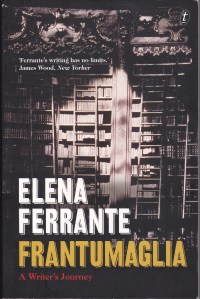
As you know, Frantumaglia translates into English as ‘a jumble of fragments’ but this book is far from a jumble. I don’t read a lot of modern fiction because I find that non-fiction has more ‘punch’ ’emotion’ and less hollow creative writing. But much of Ferrante’s life is in her books of fiction; so much of the streets of Naples, and of course, so much about our mothers. I can identify with what she says, even though I spent my infancy and childhood only with nuns, while dolls were my security until my teens. I was close to no females until the birth of my daughter when I was 23 years old… and as Ferrante says: “Dolls are not merely a miniaturisation of the daughter. They can be stand-ins for women…” Perhaps real women was what I needed, women whose bodies I could see? Ferrante talks at length of the ‘shapelessness’ of mothers’ bodies, and I know full well what she means, although in a completely different context. And of course, nuns were also subservient to their men; god in heaven, priests and bishops here on earth!
…
I had decided, after reading the Neapolitan Novel Quartet and The Days Of Abandonment not to read Ferrante’s two other earlier books Troubling Love and The Lost Daughter. That is until I read Frantumaglia; then, how could I resist?
…
Ferrante says of mothers she knew in Naples, including her own: ‘They are cheerful and foul-mouthed women, silent victims, desperately in love with males and male children, ready to defend and serve them even though the men crush and torture them to become even more brutish. To be female children of these mothers wasn’t and isn’t easy. Their vital, obscene, suffering subjugation, full of plans for insurrection that end in nothing, makes both empathy and disaffected rejection difficult. We have to escape from Naples [Italy] to escape from them as well. Only later is it possible to see the torture of women, to feel the weight of the male city on their existence, feel remorse of having abandoned them, and learn to love them, to make them, as you say, a point of leverage in order to redeem their hidden sexuality, and start again from there.’ And in my case, to forgive them.
…
Frantumaglia – A Writer’s Journey, is a collection of correspondence between Ferrante and her Italian publishers, interviews with film makers, and responses to readers’ questions, all conducted by email through her publishers to protect her anonymity. Every piece of writing in the form of correspondence between Ferrrante and her readers is full of passion, and I believe, she exposes her very soul to us. Here is an example in which Ferrante discusses with a reader, her insights into the fragmentation felt by mothers. Her own mother used the term ‘frantumaglia’ to explain her feelings of ‘disintegration’. The Days Of Abandonment is the story of Olga’s slow disintegration and fragmentation after her husband informs her that he is leaving her and their children for a much younger woman.
…
Interviewer: Do you think that this emotional journey, this coming apart into a jumble of fragments and then putting oneself back together, is an inevitable passage in the lives of women, with or without analysis?
…
Ferrante: In the women I feel close to it was. In some cases it seemed to me that feeling literally in pieces could be traced back to that sort of original fragmentation that is bringing into the world-coming into the world. I mean feeling oneself a mother at the price of getting rid of a living fragment of one’s own body; I mean feeling oneself a daughter as a fragment of a whole and incomparable body.
…
Ferrante then goes on to say: What counts in the end is the collective flow of generations. Even when there is both merit and luck, the efforts of a single individual are unsatisfying.
…
Ferrante could easily have been writing about my Italian mother, grandmother and great grand grandmothers. I researched and studied their lives from their childhoods, to try and understand why my own mother abandoned me in an orphanage, and why so many mothers in my family tree had such fragmented and brutal lives. Everything Ferrante writes deeply resonates within me. Thank you Penny, for introducing me to Elena Ferrante.
***********************
-Anne Frandi-Coory 13 February 2017
 anne frandi-coory