Archive

Tag Archives: Reviews Of Books In My Collection

***************************************************************

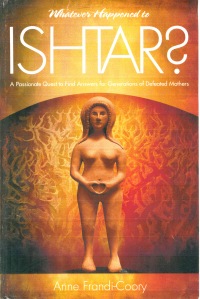
Whatever happened To Ishtar? – A Passionate Quest To Find Answers For Generations Of Defeated Mothers. 1st, 2nd and 3rd editions cover: pub.2010-2019

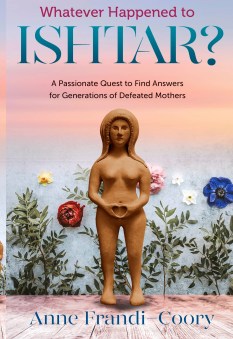
   Whatever Happened To Ishtar? A Passionate Quest To Find Answers For generations Of Defeated Mothers. 4th edition pub. 2020 in paperback and Kindle ebook.

Dragons, Deserts and Dreams: Poems, Short Stories & Artworks. 1st edition pub.2017. 2nd edition pub. 2020 in paperback and Kindle ebook.

********************************************************

For more information about the author of  these books, along with reviews:

Anne Frandi-Coory  works from her home studio in Melbourne as a painter, poet, short story writer and book reviewer. In 2010 she published the bestselling Whatever Happened To Ishtar? A Passionate Quest To Find Answers for Generations Of Defeated MothersIt is a raw and powerful memoir woven into her Italian and Lebanese family history, over-arched with the detrimental effects  patriarchal Catholic Church dogma  inflicted on generations of women and children…  Continued  HERE: 

**********************************************************

Anne’s story is one of lost generations…

What is most fascinating about ‘Whatever Happened To Ishtar?’ are the ancestral genealogies of the author’s Lebanese father and her Italian mother. This does assist readers to understand what hardships 19th century immigrants to the United Kingdom and New Zealand endured. With no access to birth control, women faced multiple pregnancies or secretly resorted to self-induced abortions.

The personal stories Anne has researched for this book go some way to explain why her parents were compelled to make the life choices they did. This memoir will stay in your memory as it covers universal issues of female sexuality, women’s roles and limited options, mental illness, and societal harsh judgments that have defeated mothers for generations… Continued HERE: 

*******************************************

All three books by Anne Frandi-Coory are available in paperback and Kindle ebook format here at  AMAZON BOOKS

****************************************

 *LEBANESE FAMILY TREE AND PHOTOS PAGE LINK HERE*

*ITALIAN FAMILY TREE AND PHOTOS PAGE LINK HERE*

img20190206_11165675
I received the wonderful Christmas gift of Michelle Obama’s autobiography, ‘BECOMING’.
and I did enjoy reading this beautifully written book. I  thoroughly recommend it.
What an inspirational and intelligent woman she is. Michelle Obama’s life journey begins with her childhood in a poor, black neighbourhood in Chicago, and takes us through her years at school, university, as a corporate lawyer, and on to the eight years in which she reluctantly gives up her much loved career to become the First Lady of the United States of America
.
Michelle (a descendant of African slaves) wastes not one minute of her time as First Lady, establishing:   a huge vegetable garden in the White House grounds to which she invites disadvantaged families to share in, mentoring programmes in schools and universities for disadvantaged children, healthy food delivered to schools for millions of children across the US, a movement to encourage schools to implement at least 60 mins of exercise every day… and these are just a few of her accomplishments. There is so much more that this amazing woman achieved, and most of it with an aim to better the lives of disadvantaged children, especially girls and young women. For as Michelle explains in her book, so many boards and influential meetings she attended over many years, were mostly made up of white males, where so often she was the only woman present, or the only African American or mixed race person in a group of world leaders.
I think readers will agree with me when they reach the last pages of this book, that Michelle Obama, by her example of selflessness and high standards in attaining her achievements, has inspired many women of mixed race in the USA to garner their inner strengths and voices, to explore their choices in life, and to aim for higher ideals.  One of the last paragraphs in the book reads:
“There are portraits of me and Barack now hanging in the National Portrait Gallery in Washington, a fact that humbles us both. I doubt that anyone looking at our two childhoods, our circumstances, would ever have predicted we’d land in those halls. The paintings are lovely, but what matters most is that they’re there for young people to see – that our faces help dismantle the perception that in order to be enshrined in history, you have to look a certain way. If we belong, then so too, can many others.”
-Anne Frandi-Coory

5 *****  

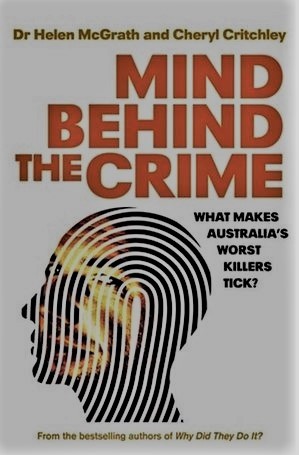
mind-behind-the-crime


Dr Helen McGrath is currently an adjunct professor at both Deakin and RMIT Universities.

Cheryl Critchley is a prolific investigative journalist.


The fifteen crimes analyzed in this book, all carried out in Australia,  involve three women and twelve men. The criminals were generally not diagnosed with a severe mental illness, however, they were all diagnosed as having a mental disorder, such as a personality disorder, and they were well aware that what they were doing was wrong. The difference between mental illness and a personality disorder is explained in detail at the beginning of the book.

The various personality disorders are delved into at length by the authors. MIND BEHIND THE CRIME is well set out, divided into chapters and parts  e.g. each chapter is devoted to one specific crime with the offender and victim/s involved in that particular crime listed at the beginning of the relevant chapter. Parts of the book are divided up into the specific, diagnosed disorders as they relate to each perpetrator’s behaviour and decision-making in the lead up to their horrendous crime.

PART 1: Filicide and familicide – Killing Your Own Family

‘Men commit nearly all familicides and filicides (92-97 %) and there is evidence that such mass murders are increasing in Australia.’

Filicide is the term used to describe a situation in which a parent intentionally kills one or more of their children …the parent may or may not then kill themselves. The motive and case history of each of these crimes is explored thoroughly.  Familicide and familicide-suicide are the two terms most commonly used to describe a situation in which one family member kills or attempts to kill all members of their direct family and then often suicides. Classification schemes are used to aid the reader in identifying the behaviours and mental disorders that motivated these murderers.

Family annihilation is described as a subcategory of mass murder, defined as the killing of four or more members of the one family in one location and during one event. Family annihilators are mostly men.

‘Associate professor Carolyn Harris Johnson, a leading expert in filicide and familicide…points out that the media frequently romanticises (saying they acted out of love) and sanitises this type of crime, to soothe the anxieties of the audience because the subject matter of child murder is taboo, or too confronting for most people. But this approach distorts the public’s understanding of why these events occur and the extent of the perpetrator’s responsibility. This makes it much more difficult to identify actions that can be taken as early warning signs and prevent such child murders in the future.’ [my emphasis]

A summary of each of four categories are:

The self-righteous killer-seeks to blame their partner for damage to family, breakdown of relationship, etc. Has been controlling and possessive in the past, engages in over- dramatic behaviour and comments, may attempt suicide to avoid facing the criminal justice system.

The disappointed killer – concludes their family has let them down, their family is an extension of their own needs and aspirations, self-obsession prevents them from seeing their children as separate entities.

The anomic killer – perceives they have damaged their family’s income or lifestyle, have lost their economic status, lost their job.

The paranoid killer – perceives there is an external threat (real or imagined) that will destroy their family e.g. social services may take their children.

 PART 2: Narcissistic personality disorder and malignant narcissism – arrogant, dangerous and sometimes vulnerable.

PART 3: Dependent personality disorder – desperately needy.

PART 4:  Paranoid personality disorder – you can’t trust anyone

PART 5: Antisocial personality disorder – Life outside the rules. People with ASPD can be dangerous and difficult to detect. They lurk in homes and workplaces, playing the role of the perfect partner or colleague until they decide to use and abuse those around them for their own ends.

PART 6: Criminal autistic psychopathy and sexual sadism disorder –

a dangerous combination:

1. autistic spectrum disorder.

2. Asperger’s syndrome.

3. pervasive developmental disorder.

A diagnosis of this disorder can be made when there is evidence of behaviours such as those listed in the following two categories:

1. behaviours that indicate deficits in social communication and interaction. (Deficits in social communication and interaction are listed in more detail in this section).

2. restricted and repetitive patterns of behaviour, interests or activities.

Every one of the above disorders is explained at length in each section to help the reader understand the mind and behaviours of the perpetrator at the time the crime was committed.

All of the cases chosen for this book are recent high-profile Australian murders most readers will already know about.  MIND BEHIND THE CRIME refers to the Diagnostic Statistical Manual and other classification schemes to help explain each disorder and the subsequent motives of the perpetrators involved.

The authors argue that no amount of mild to moderate depression excuses killing those closest to you. It is never justified and the perpetrators should be called what they are – murderers. They go on to say:

“A common myth about these crimes is that parents who kill their children do so out of love and that the extreme love they feel for their child/children means they can’t bear to be separated from them…loving fathers and husbands don’t kill their kids. And unless the public’s perception of these murderers changes, other men will continue to feel that if life gets too tough they, too, can take this option and be eulogized by their loved ones in the media rather than condemned  as they should be.’ Most children were killed in a brutal and violent way; in their last moments knowing that it was their father who killed them.

‘The positive way many of those who kill their children are described in the media has the potential to influence others to commit the same crimes. Such coverage also detracts from the victims’ suffering and makes the crimes seem less horrifying. It implies that nothing can be done about these killings because they are neither predictable nor preventable. This would not be the case if, as a society, we accepted the hard reality about these crimes and focused more on identifying potential warning signs.’

It is clear at the outset that the authors care deeply about the victims involved in these crimes. They warn of the dangers that men with these disorders pose to their wives/partners and children. There is an appendix at the rear of the book: ‘Where to go for help and support’.

This is a book for our times, and I recommend it to readers who may know of someone in their family who is at risk, or for anyone interested in trying to make sense of why these murders are occurring across Australia. There is also widespread concern that Australia’s Family Court system requires reform to ensure that justice is done and that families and children are better protected.

-Anne Frandi-Coory 14 December 2018


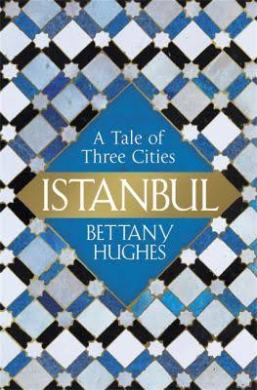
A Tale Of Three Cities ISTANBUL 

-Bettany Hughes

*****

A Book Review – 5 stars *****


Byzantion of Greece’s ancient past,  the capital of the Christian Byzantine Empire, famed Constantinople of New Rome and Muslim Ottoman Empire that today goes by the name of Istanbul, Turkish republic.

‘Istanbul is the city of many names’, writes Bettany Hughes: Byzantion, Byzantium, New Rome, Stambol, Islam-bol are just a few of them. And Istanbul today ‘is lapped by the Golden Horn, the Bosphorus, and the Sea of Marmara; to the north is the Black Sea and to the south, through the Hellespont or Dardanelles, the Mediterranean.’

A diamond mounted between two sapphires and two emeralds…the precious stone in the ring of a vast dominion which embraced the entire world as described in ‘The Dream of Osman’ c. AD 1280.

Hughes guides the reader around the city that I wish I had visited. It is obvious from reading this book that the author has walked Istanbul’s streets and knows the city well, and she has meticulously researched  its 8000 years of history. I can assure you that this is no dreary history book the likes of which bored us to tears at school. The ancient town of Byzantion’s King Byzas (legend has it that his father was Poseidon, his grandfather, Zeus) was well located at the intersection of trade routes. Eventually the Roman emperor Constantine decided that ‘Old Rome’ was too far away from all the action and over time the City of Constantine became Constantinople, the New Rome, capital of the Roman Empire itself. The gateway between East and  West. Constantinople’s Christian name was changed to Istanbul around 1923 after the fall of the Ottoman Empire.

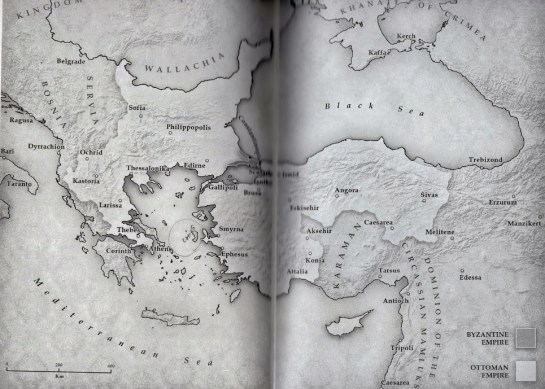
The book has short chapters with clear and helpful titles, dated in both Western and Islamic calendar formats where appropriate.  It enables readers to navigate this vast book in piecemeal fashion, but I found it difficult to  put this book aside; it is so well researched and written, with personal written accounts from people who were present during many of the historical events, which made the book all the more fascinating. I particularly enjoyed the frequent references to current and recent archaeological digs the findings of which verify historical accounts.  Hughes includes several maps and colour plates, which I constantly referred to as I was reading. It is evident that the West owes far more to Eastern cultures than we have been ready to believe in the past. The Roman Empire pillaged much wealth from Egypt and the East and in turn the Ottomans pillaged from Roman territories. It is arguable that the rabble that made up early Western civilisation reached a turning point when it invaded and colonised Egypt.

*****

Ottoman and Byzantine territory in the east Mediterranean c. AD 1451


*****

Muslim and Christian lived in relatively peaceful harmony during the Ottoman era but both sides could be extremely brutal whenever their territories or power were threatened. The Ottomans, however, were far more than their harams and baths, which titillated and attracted travellers; they were skilled diplomats and traders. Christian slave boys ‘harvested’ from the West were trained as interpreters.  Called Dragomans, one of their critical attributes was their facility with languages, and some of them could speak up to seven languages which enabled the empire to spread its culture and bargain with valuable commodities to negotiate peace. When the Ottoman Empire began to crumble at the beginning of the twentieth century, Germany, France and Britain ‘fought over the spoils’ and it is apparent that the after-effects of this breaking up of once cohesive territories helped to turn Christianity and Islam against each other which we are still witnessing in modern times. Millions of refugees were displaced during the carve up of territories, and millions died.

This book, as well as being a great read, informs readers on how the current geo-political era came into being, and it does not always put the West in a good light. We owe so much of the great advances and wealth in our Western civilisation to the East, and let us not forget, to Islam

-Anne Frandi-Coory  27 October 2017

*****

Also here on Anne Frandi-Coory’s Facebook page: 

https://www.facebook.com/myhomelibrary/

***

A new Hero is in Town!

Serpent 1

This is another epic, spell binding story I could not put down! One of my favourite authors, Luciana Cavallaro writes in a way that places you smack in the middle of whatever is happening in Ancient Greece, Ancient Egypt, or in Perth, Western Australia!  There is nothing about Ancient Greek gods Luciana hasn’t researched and studied, and when Zeus appears before Evan Chronis to give him an urgent Herculean task, you are there to witness it! – Anne Frandi-Coory

Also on Anne Frandi-Coory’s facebook page https://www.facebook.com/myhomelibrary/

The Search for the Golden Serpent is on……… 

Read on *************************

Meet Evan Chronis, a talented architect from Perth, Australia with a chronic sleeping problem. His dreams are so vivid they feel real. Did he actually go for a swim while he slept? They begin to affect his work and health.  He seeks medical help to find out what’s happening to him.

In Search for the Golden Serpent (eBook published March 27) Evan meets Zeus, the King of the Gods. Zeus tells him in order to get back home he must journey through forgotten worlds, lost in antiquity.

***

Here’s more:

serpent 2It’s not where he appears, it’s when.

What if you’re born during another time, grew up in the 21st century and then were thrust back into the past? Confused? So is architect, Evan Chronis.

Evan, drawn by screams, ventures out to his backyard and sees blood trickling down the limestone stairs. He steps off the veranda and finds himself in the days of great and marvellous power, a time when the gods ruled the universe.

To return to the 21st century life he longs for, he must risk his life in search of powerful, treasured relics older than the Holy Grail. But what he finds might be more than he expected.

Will Evan find the relics and return home or will he remain forever stuck in a world so different from his own?

Order your copy from:

Amazon

Smashwords

Historical fiction fantasist Luciana Cavallaro, and a secondary teacher, meanders from contemporary life to the realms of mythology. Luciana has always been interested in Mythology and Ancient History but her passion wasn’t realised until seeing the Colosseum and the Roman Forum. From then on, her inspiration to write Historical Fantasy was borne.

She is the author of 5 ebooks and 1 paperback and has spent many lessons promoting literature and the merits of ancient history. Subscribe to her free short story at http://www.luccav.com.

You can connect with Luciana Cavallaro via:

serpent 3Website

Twitter

Facebook

Google+

LinkedIn

Pinterest

Amazon http://www.amazon.com/Search-Golden-Serpent-Servant-Gods-ebook/dp/B00TO8TT9W/ref=sr_1_6?ie=UTF8&qid=1424238434&sr=8-6&keywords=luciana+cavallaro

Smashwords https://www.smashwords.com/books/view/520605

MORE REVIEWS of books written by Luciana Cavallaro: https://frandi.wordpress.com/2013/12/30/accursed-women-book-review/

….

Father Kevin O'Donnell

Paedophile Father Kevin O’Donnell

><><><><><><><><><><><><><><><><><><><><><><><><><><><><

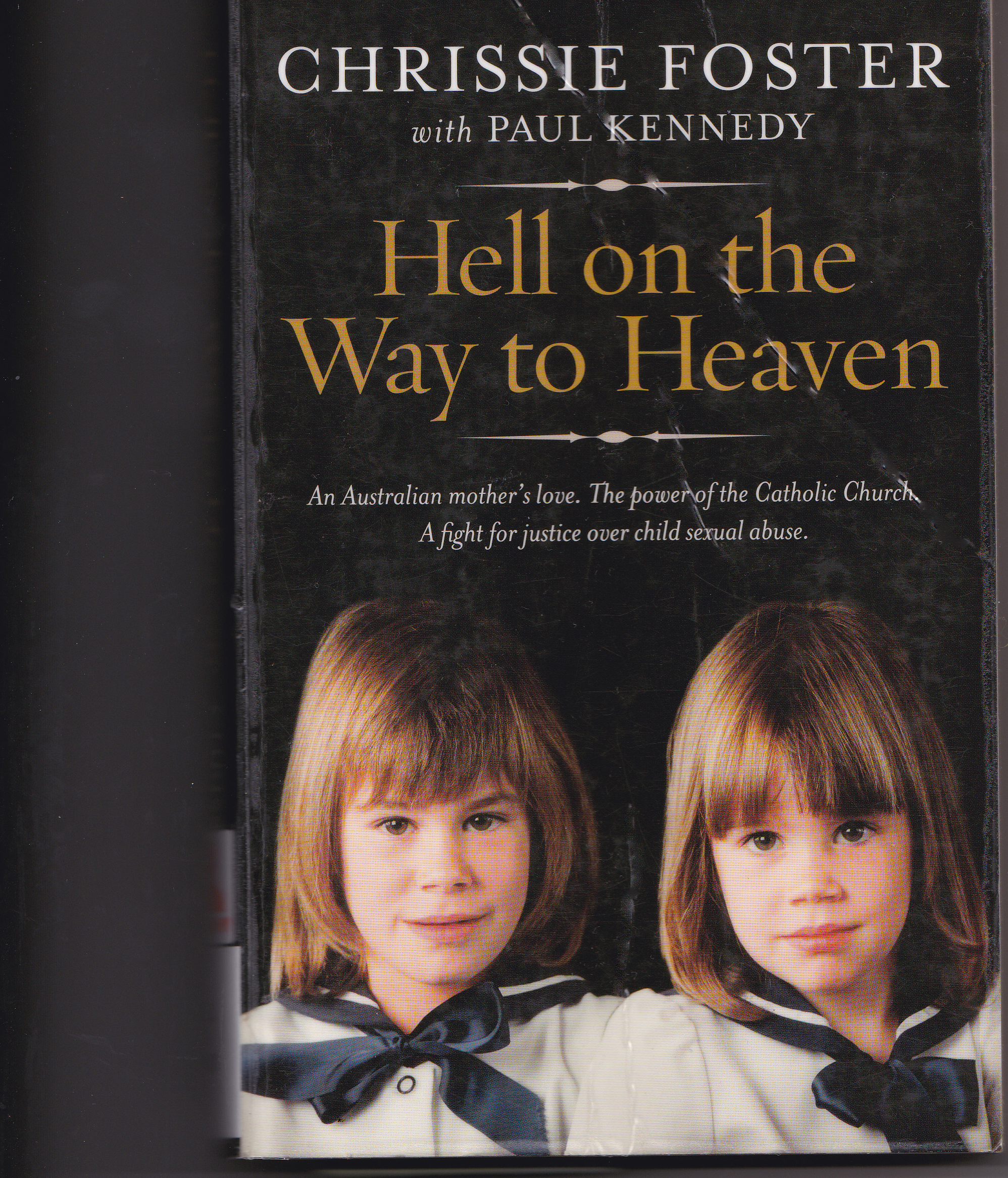
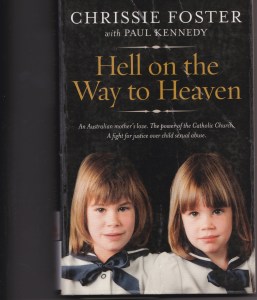
In my blog post dated 2 July 2013 How Catholic Dogma Aided Paedophile Priests’ I wrote about Chrissie and Anthony Foster’s book in which they describe how two of their daughters’ lives were destroyed when they were repeatedly raped from the age of five, by Catholic paedophile priest, Father Kevin O’Donnell.

<><><><><><><><><><><

Hell on way to heaven

><><><><>>><><

During the long battle to save their oldest daughter Emma, from more attempts at suicide by drug overdose and self-harm, she was admitted to one psychiatric unit / detox. clinic after another, over the years. Emma struggled, with some success, along with the loving help of her family, to overcome her addictions. It was a one-step-forward and a two-steps-back progress. Try as she might, Emma could not erase from her memory, what Father Kevin O’Donnell had done to her.

Emma was fast running out of psychiatric unit options because of her continual breaking of the units’ rules. However, one day in desperation, her mother found her a placement in a clinic run by the Catholic Church. Although she was hesitant about sending Emma there, she was comforted after being reassured that all the counsellors were professionals. But Emma had only been in the unit for a few days, when she phoned her mother and told her that a woman at her counselling sessions was a ‘practising Catholic and wore a cross’.  Emma was agitated and anxious. This woman was pressuring Emma to admit she was at fault for the abuse she was subjected to. Later that day, Mrs Foster rang the manager of the unit and explained her concerns about what Emma had told her. The manager stated that it wouldn’t have been a qualified counsellor and she had no idea who the woman was. She suggested Emma may have been speaking to a tea lady or cleaning staff.

A few months before she died at 26 years of age, from an overdose of her medication, Emma refused to see or talk to her mother. Chrissie Foster was hurt and bewildered. She was devoted to her daughter’s welfare and recovery, as was Mr Foster and their extended family. In the past, Emma had written many notes and diary entries, declaring how much she loves her family and how supportive of her they always are. But, she adds, her mother is the one she loves the most; she is always there for her.  That’s why Mrs Foster found it difficult to understand why Emma didn’t want to talk to her. She was hopeful that it meant Emma was trying to stand on her own two feet, and this could be a good turn of events.

Following Emma’s death, Mrs Foster had the heartbreaking task of packing up Emma’s belongings from her bedroom in the house she had loved, had decorated and furnished herself.  Loose sheets of paper were lying about all over the place. After collecting them up in a bundle, Mrs Foster sat reading the many notes Emma had jotted down in her neat hand writing.  A few of the diary notes covered her stay at the Catholic unit. She writes about the counselling sessions she attended and how traumatic they were because the counsellor was very critical and angry:  Why had she not run away? Why had she not told anyone about the abuse at the time? Why didn’t she call out?  Emma wrote: I told her I was five or six, he had all the power. Emma also wrote that she was made to feel it was her fault she had been abused. Anyone who has read Chrissie Foster’s book will know how those options would have been impossible for Emma given her age, the school environment in which the sexual abuse took place and her Catholic upbringing.  But most of all, they would have been impossible because Kevin O’Donnell was a paedophile with over 50 years experience. His victims describe him as an old man who was  frightening and angry. He continuously told them they were evil while he raped them.

Mrs Foster could not stop thinking about this ‘practising Catholic’ who was posing, unchallenged, as a psychiatric counsellor.   She believed no psychiatric unit in the 21st Century in Australia should be employing untrained counsellors. The woman obviously wouldn’t believe a priest was capable of sexually abusing children.  The ‘counsellor’ had intimated to a troubled Emma that she held priests in the highest esteem but despised the victims who claimed that priests had sexually assaulted them.

A distraught Mrs Foster phoned the Catholic Psychiatric Unit on a Sunday morning to enquire after a counsellor.  To her shock and horror, the helpful receptionist informed Mrs Foster that there was a nun on duty 24/7 to talk to patients.  So it was a nun who was employed as a professional counsellor at the unit and who was responsible for turning Emma against her mother. Emma had said to another person not long before her death, that the abuse was her mother’s fault, her own fault, and that the counsellor had angrily told her that Father O’Donnell had not raped her.

It becomes clear in Chrissie Foster’s book ‘Hell On The Way To Heaven’ how much Emma’s stay in the Catholic psychiatric unit affected and undermined her inner resolve to overcome her addictions and get her life back on track once again.  The years of addictions and self harm had taken their toll, but Emma was making progress, albeit slow. However, once she was coerced into severing ties with her family, and to rely completely on the unit for all her support,  she had come full circle; under the control of staff who preached Catholic dogma. Her fragile psychiatric condition could no longer put up a fight. She died alone in the house her parents had helped her buy with her share of the compensation money the Catholic Church had finally awarded to her and her family, after years of legal battles.

chrissieanthonyfoster1

Anthony and Chrissie Foster

I know full well, from my time as an observant and devout Catholic child, the esteem and reverence in which most nuns hold priests. They too believe that priests are representatives of God himself upon this earth, and can do no wrong. Nuns are true brides of Christ.

……….

-Anne Frandi-Coory 7 July 2013  …  Read more here: How Catholic Dogma Aided Paedophile Priests

Hell on way to heaven

Emma and Katie Foster 

.Updated 2 November 2016

*****Chrissie Foster, author of  Hell On The Way To Heaven has just been nominated for the 2017 Victorian Local Hero award

At the Royal Commission into Institutional Responses To Child Sexual Abuse, Catholic Archbishop of Melbourne, Denis Hart, made the astonishing statement that “celibacy has worked well for the Church…… men do not need a sexual outlet…..”

He went on to say that if priests couldn’t cope without sex, they were quickly defrocked.  Why were paedophile priests not instantly defrocked, but sent to poor parishes like Ballarat and Doveton, for instance?
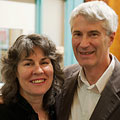
Chrissie&AnthonyFoster1

Chrissie and Anthony Foster

Well, I also want to know why thousands and thousands of girls and boys worldwide, over centuries, have been raped by Catholic priests? Celibacy is the biggest joke the Catholic Church has played on us…priests have mistresses, visit prostitutes and rape children!

 Jesus, if he existed at all, was not a celibate; in fact he married twice. Even the most saintly man finds celibacy difficult!

Former PM Tony Abbott, while LNP Leader of the Opposition, a failed Catholic priest, threatened to demolish the Royal Commission by withholding extra funding. It took an atheist female Prime Minister, Julia Gillard, to set up the Royal Commission into Institutional Responses To Child Sexual Abuse.

…………

I have just finished reading  Hell On The Way To Heaven by Chrissie Foster.

Mrs Foster’s story was highlighted when there was a push in Victoria for an investigation into the sexual assault of hundreds of children throughout the state of Victoria by paedophile Catholic priests and Brothers, over several decades.

In the book, Mrs Foster describes how the lives of her two young daughters, Emma and Katie, were destroyed by a paedophile priest. They were both raped at around 5 years of age by Father Kevin O’Donnell who was then aged in his seventies.  Emma and Katie were raped repeatedly over several years and eventually Emma killed herself with an overdose of drugs. She had attempted suicide many times over the years.

><><><><><><>
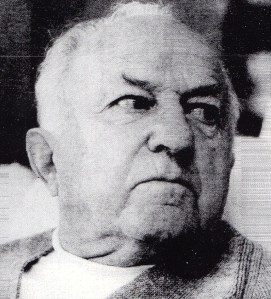
Father Kevin O'Donnell

Paedophile priest Father Kevin O’Donnell

><><><>><>

Katie tried to drown her memories of what Kevin O’Donnell did to her with alcohol and now suffers from severe brain damage.  When Katie was 15 years old she was hit by a car driven by a drunken driver while crossing a road after a drinking binge.  The resultant brain damage left her with no short term memory. The memories of her repeated rape by O’Donnell are the clearest and she lives with them everyday. If that isn’t hell, well I don’t know what is!  The book is harrowing reading because of what a Catholic priest did to these innocent young girls and the hundreds of other boys and girls he raped and sexually assaulted over a period of some 50 years.  There is also evidence that he had young men calling on him in the early hours of the morning for sex. Whether or not he had sexually assaulted these young men when they were boys, we will probably never know.

Mrs Foster blames herself for blindly following her Catholic faith which she believes prevented her from recognising the early signs that her daughters were being sexually assaulted by this beast.  But the really devastating truth about the sexual assault of hundreds of children is that the Catholic Church did nothing to stop it. Over the years several children and their parents complained to Bishops, including George Pell, and other priests, about Kevin O’Donnell’s behaviour, but they were not believed.  Or O’Donnell was shifted elsewhere. One priest told a worried parent to keep her accusation quiet.

Emma and Katie were attending a Catholic school in Victoria when Kevin O’Donnell was the priest in charge of the local diocese. His control was all-encompassing; the local church, local schools, principals and teachers. His commands were law. As Mrs Foster puts it, this was the perfect setup for a paedophile. Without the knowledge of parents, O’Donnell could call into any classroom he liked, request a particular child to go with him on some fictitious errand. Or he would simply walk amongst the children on the playground until he sighted a child who would fulfil his loathsome needs.  He would then take that girl or boy to a locked room at the back of the school hall or a disused Church cottage, and do whatever he liked with them. That was of course after they drank the drugged can of coke he offered them. He was cunning and experienced. To ply these very young children with alcohol would alert their teachers by smell and behaviour, that something was amiss. The children would all have to return to their classrooms after this disgusting excuse for a human being was finished with them. Mrs Foster and her husband, Anthony Foster, never found out what drug O’Donnell used to subdue their daughters, although a doctor did suggest that it was probably some form of valium.

If teachers complained about O’Donnell’s behaviour and his practice of taking children out of classrooms during school hours without parental consent, they bore the brunt of O’Donnell’s foul temper and some even lost their teaching positions. If nuns issued complaints to the Church hierarchy, they were ignored. There was nowhere else to turn; Father Kevin O’Donnell had the diocese and parish in his tight grip. Even when some parishioners were told of O’Donnell’s offending, they refused to believe it and so O’Donnell was able to continue sexually assaulting children with impunity.

Mr Foster is an atheist who had promised to bring his children up as Catholics and send them to Catholic schools as part of the marriage agreement with his future wife, a devout Catholic. Mrs Foster believes it was her own upbringing as a Catholic that allowed her to trust so much in priests. After all, weren’t they the representatives of God here on earth?  Weren’t priests placed in the Catholic community to protect children and support parents?  Even when she thought O’Donnell’s behaviour odd, Mrs Foster believed that he was always right in all things. He took his instruction from the pope who was infallible. To disobey a priest was a mortal sin.

You will be in disbelief, as were the Fosters, at some of the tactics used by the Catholic Church to exonerate itself from any blame for paedophile priests, such as the entrenched loophole in the truth called  Mental Reservation, or mentalis restrictio in the Latin. It is a theological strategy dating back centuries.  In effect, the idea of truths ‘expressed partly in speech and partly in the mind.’ e.g. A priest could answer with lies, obfuscation and ambiguity in court, under oath, but then under his breath tell Jesus that he lied to protect the Church.  This follows Canon Law, but not perjury laws of the Australian Legal system. Survivors of Catholic paedophilia who witnessed Pell and other clergy give evidence,  believe that George Pell, his priests and bishops, used Mental Reservation  time and again to protect paedophile Christian Brothers and Catholic priests, including when answering questions at the Melbourne Royal Commission Into Institutional Responses Into Sexual Abuse Of Children.

I have often wondered over the years if my mother had not been such a devout Catholic, would she have been able to overcome her traumatic childhood? She never stopped praying to God and relying on priests and nuns to help her through all the difficult times. And there were many of those.The Catholic Church always seemed to let her down when she most needed its support. Perhaps if she hadn’t been so indoctrinated, so reliant on a non-existent god, she may have sought some other avenue of support, like professional counselling. When you are in the Catholic system, it is very difficult to get off the treadmill. The spectre of committing a sin, with the prospect of going to hell, is a great deterrent for those with a strong faith. If you needed guidance or counselling, you visited your parish priest.  If you were having problems with your children, you sent them to a priest for a talking to.

Mr & Mrs Foster were hopeful of gaining support and empathy when they were finally given an appointment with Archbishop George Pell after numerous letters, and requests to talk to him, were ignored. They asked him to take action against O’Donnell and had prepared a huge file on the suffering of their two daughters at the hands of O’Donnell. But the newly promoted Archbishop Pell was arrogant, evasive and rude, while refusing to believe that O’Donnell was a paedophile. Pell insisted that…  ‘It’s all gossip until proven in court. And I don’t listen to gossip!’ The Fosters would have to go to court before the Catholic Church would give them financial assistance for all the doctors’, psychiatrists’ and hospital bills that were mounting around the disintegration of their daughters’ lives.  Much later they were offered $50,000 for Emma by Pell, but they would have had to sign a confidentiality clause and would not be able to sue the Church. The Fosters turned it down.

Eventually the Fosters did receive compensation after many years pursuing the Church with the help of lawyers. It’s a testament to this couple that their marriage has survived the years of suffering they and their three daughters have endured at the hands of the Catholic Church. Their youngest daughter only escaped O’Donnell’s debauchery because by the time she was at school, he had retired from the parish.  He died before the Fosters and police could take any action against him.  The Church would protect its priests and the reputation of the Catholic Church at all costs. It was clearly evident in Pell’s actions and his  treatment of the Fosters, that the welfare of the victims of paedophile priests was of no concern to him.  In fact one of the official excuses that the Church relied on was that it was unaware of the harmful effect sexual assault had on children and that’s the reason they hadn’t taken any action against offending priests! Their role was to support priests and shield them from State Law.

I can relate to Mrs Foster’s claim in the book that it was only in the years following the shock of discovering what had happened to her daughters, and the loss of her faith, that she realised how brainwashed she had been by the Catholic system. Going to church every Sunday, regular confessions even though she had committed no sin, prayers every night.  Of course total obedience to priests was mandatory under Canon Law, which she faithfully inculcated into her daughters, as her own mother had done with her. By the time she could see her past without the blinkers of blind trust, she was 40 years old. I was 17 and had just entered the workforce when I began to suspect that what I had been taught in all the Catholic institutions I’d lived in, on and off for the previous 17 years, was not based on reality. But it took much longer to throw off the yoke of indoctrination,

I too had it so clear in my mind, that when I went out into the world, I would be looked after by God because I had been such a good Catholic girl. This is what religious brainwashing does to you. You believe everything priests tell you, even if it overrules what your parents tell you. Or even what common sense might tell you!  I can still remember when I was a little girl in class asking the nun if I had to love God more than my own father. She had just told us that we had to love God more than anyone else in the world because he was our true ‘father’. She insisted that was the case. I never stopped thinking about it and even believed I was committing a sin because I didn’t think I could love God more than my father. But I still trusted in God for everything in life.

Through all that the Fosters were suffering, Mrs Foster researched the way paedophiles groom children for their own sexual gratification. She was part of a group that wanted to alert other parents to the dangers by giving them information to help identify the signs children might exhibit if they were being sexually assaulted. Meanwhile the Catholic Church did nothing to inform parents that O’Donnell may have sexually assaulted their children and to seek help if they had any suspicions.  Mrs Foster also used her daughters’ recollections of how O’Donnell was able to lure them away from safe environments. She tells us that no child can know how to protect themselves from a determined paedophile, and Father Kevin O’Donnell was a paedophile with 50 years’ experience.

Mrs Foster did her best while O’Donnell was still alive, to urge Archbishop Pell to defrock O’Donnell so that he could never use his priesthood to harm other children. But Pell would not hear of it, even though O’Donnell had recently been convicted for several counts of past sexual assaults on young boys. At the time O’Donnell was convicted for these particular sexual offences, the victims were grown men. The police informed the Fosters that these were representative charges only as there were so many it would have taken years for them all to be processed and heard in court! The police were anxious to do what Cardinal Pell & his church would not do; get O’Donnell behind bars where he could no longer sexually assault children. The Fosters’ other concern was that when O’Donnell was released from prison, the fact he was still a priest  would enable him to use his position of trust to go on offending.

When O’Donnell was retired he was sent to live in a unit close to St Mary’s Church in his former parish of Dandenong. He began officiating at Mass on Saturdays. When complaints were made to Father Noel O’Brady that children were visiting O’Donnell at his unit, he took those complaints to the archdiocese.  The ‘appropriate authority’ instructed Father O’Brady that  ‘It’s not happening on Church property…we’re not responsible.’  O’Donnell was supported and protected by the Catholic Church until he died.  It couldn’t have done this if he had been laicised. Obviously the Church knew what O’Donnell had been doing for decades, and right up until the end of his life, his welfare came before the hundreds of children whose lives he had totally destroyed. Many have committed suicide, many will never come forward, most continue to suffer.

I urge all parents who send their children to a Catholic school or intend sending their children to one, please read Chrissie Foster’s book ‘Hell On The Way To Heaven’ if only to be aware of the telling signs that your child might be vulnerable to sexual assault and to ensure that what happened to her beautiful girls will never happen again.

Think clearly and make sure you know what is contained in the Catholic Catechism the schools use to instruct the children in Catholic dogma.

-Anne Frandi-Coory … read more here about ‘Hell On The Way To Heaven’ 

*******************

Visit: Royal Commission Into Sexual Abuse Of Australian Children

><

A Remarkable Book In More Ways Than One

A Remarkable Book In More Ways Than One

>< It’s true – Terroni is a pejorative word as explained by Pino Aprile. However, this is the word Northern Italians use when referring to Southern Italians. The author has written about an Italy that I never knew existed. But then history is usually written by conquerors and oppressors. When I wrote my Italian family history, Whatever Happened To Ishtar?   I had no idea of the massacres, rapes and sackings which took place in the South in the name of RISORGIMENTO (Unification). My mother’s paternal grandfather, Aristodemo Giovanni Frandi from Pisa, (Born in Pistoia, 1833) fought with Garibaldi and before that, as a conscripted soldier with the Austrian army, in the north of Italy.  I know that he followed the Garibaldini to Southern Italy because he and others wanted to rid Italy of foreign armies fighting battles for supremacy in Italy. There was never any mention, as far as I am aware, of the North backing the Risorgimento for the sole purpose of oppressing the South. But then Garibaldi died a broken man, betrayed by politicians he trusted. Perhaps he was gullible too. Aristodemo emigrated with his wife and three children to New Zealand when known Garibaldi supporters were harassed and vilified following the Unification. ><

Aristodemo Frandi blog

Anne Frandi-Coory’s maternal great grandfather Aristodemo Giovanni Frandi

*****************************

One thing Aristodemo did speak of, was the betrayal of Garibaldi and his followers, by priests and nuns, as they looked for shelter and food on their way to the South “to convince Southerners to support the Risorgimento”.

My Greco (Grego) ancestors lost their lands in southern Italy and moved up the peninsula as did many of their compatriots. They eventually emigrated to the UK.

><

Emmie's wedding 2

Anne Frandi-Coory’s maternal great grandparents Raffeala (nee Mansi) and Filippo  Greco 

******************************

Terroni is full of the horrors of civil war, and today the oppression of the South by the North continues. Aprile even discusses the possibility that the ‘elitist’ North is doing everything in its power to divide Italy in half and jettison the South.  The author believes that the people of Southern Italy are set to fight back. Thirteen to twenty million Southerners fled the south during and after the Unification and their descendants now realise what has been taken from them.  Unlike in the past, Southern Italians and their descendants are proud to talk of their history in a pre-united Italy.

This book is a must-read for all Italians, inside and outside Italy, and for anyone who has a passion for Italy.

Thank you Pino Aprile for the courage you have shown in writing this book and for bringing us the ‘other side’ of the Risorgimento.

-Anne Frandi-Coory 23 January 2013

><

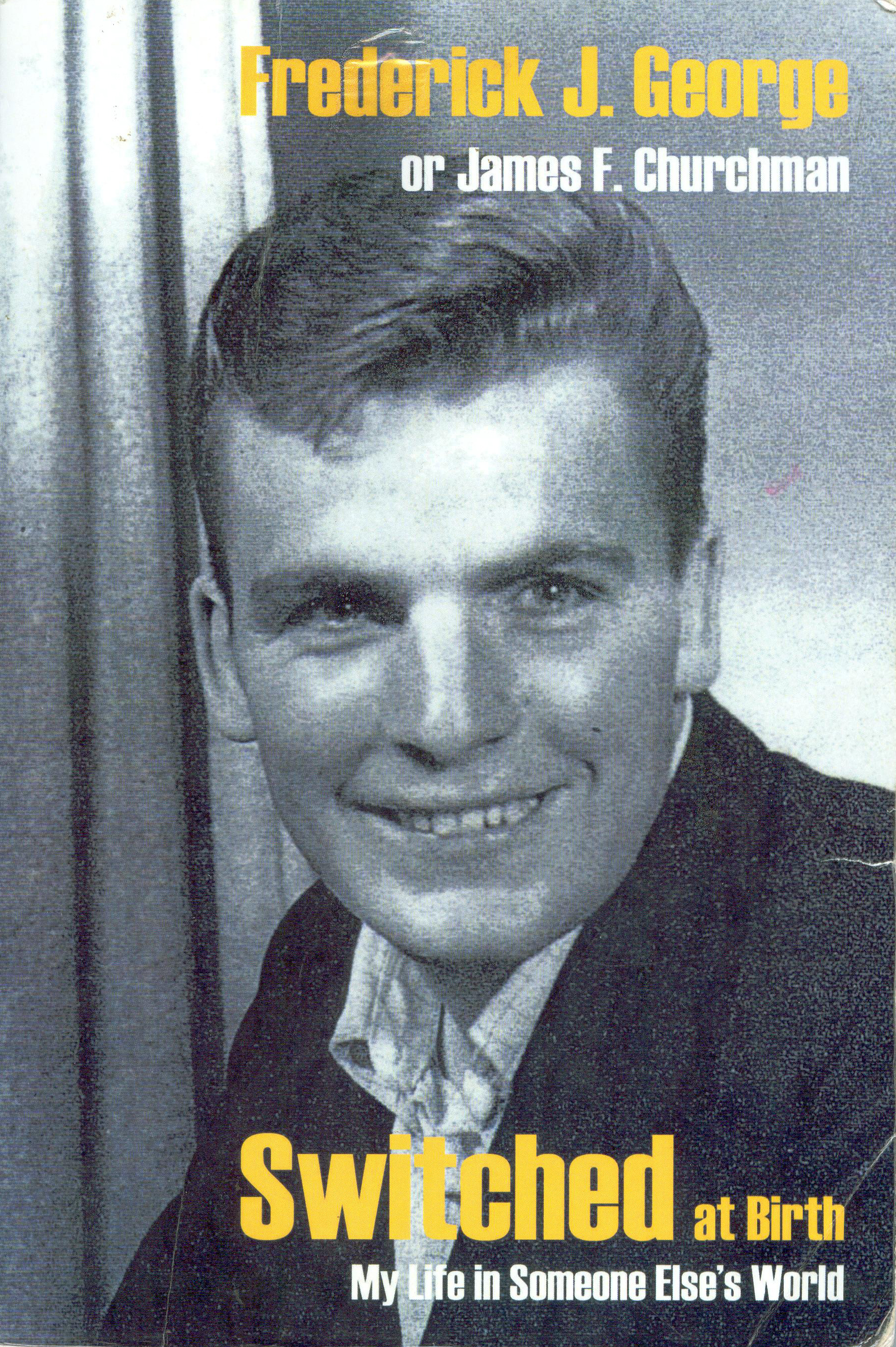
SWITCHED AT BIRTH

by Frederick J George (or James F Churchman)

><

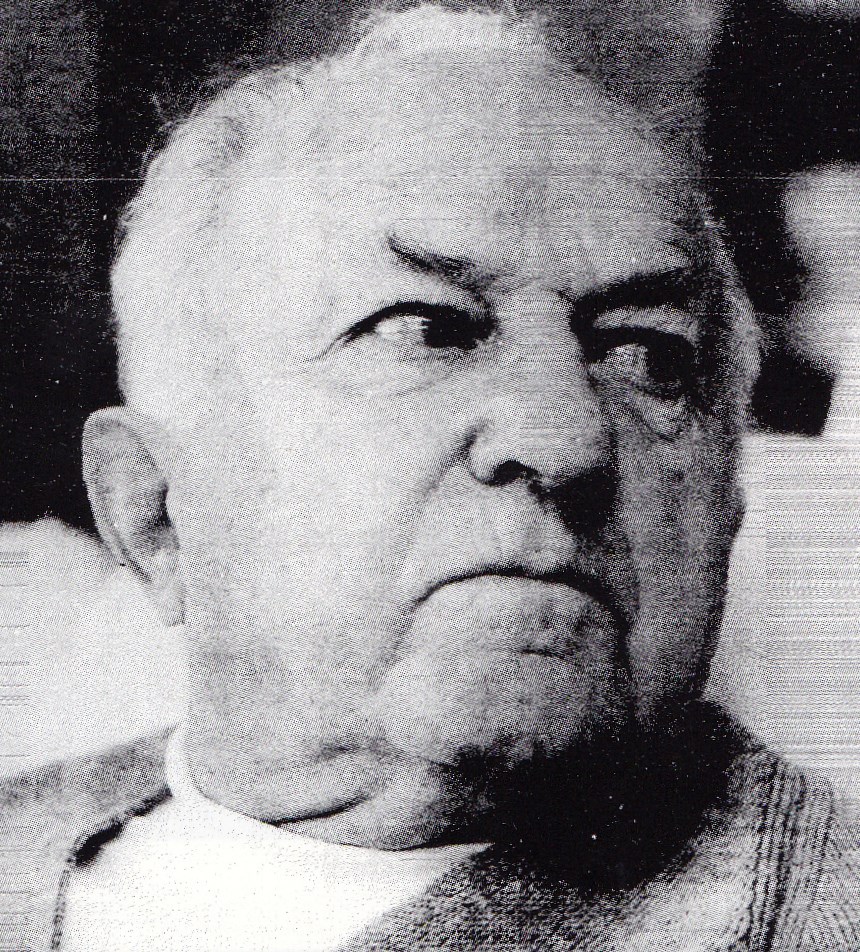
Who is this man?

><

As a book lover I have been given many wonderful books, including biographies. One biography in particular stands out for its poignancy, Switched At Birth by Frederick J George in 2007.

Frederick George and James Churchman were switched at birth; we will never know the full story behind the switch. However, what we do know is that the respective mothers of Frederick and James loved their sons as they would their own flesh and blood.

It has meant much to Frederick that his biological mother, Helen Churchman was still alive when he discovered the truth of his birth. One of the things she was able to tell him was that although she never consciously doubted that James was her own son, she remembers remarking to the nurse a few days after the boys were born, ‘I think I may have Mrs George’s baby’ and that both women laughed.  Mrs Churchman’s ‘son’ James had a thatch of black hair, while Mrs George’s ‘son’ Frederick was blonde like Mrs Churchman and the rest of  her family.

In 2010 I had my own book published “Whatever Happened To Ishtar?” which like ‘Switched At Birth’ is about life in an immigrant Roman Catholic Lebanese family in Dunedin, New Zealand, during the mid to late 20th Century. At the time I wrote my book  I knew nothing of Frederick’s story, although I knew of the large extended George family, and often saw family members around the streets of Dunedin. For various reasons, I didn’t know any of them well enough to engage in conversation.  I had no knowledge of the Churchman family, even though James’ and Frederick’s families lived in close proximity to one another.  This, as it turns out, is one of the most poignant aspects of the whole saga, but also one of its saving graces: at least the boys grew up together and knew their biological parents, albeit superficially.

In the book, Frederick recalls in detail his life growing up with the George family. His has mixed feelings about his ‘father’ John George and his volatile temper, (Not I might venture to say, unusual in Lebanese men). He further writes that the subject of his ‘suspicious’ parentage only ever came up within his immediate family when his father was angry about something Frederick had done that had displeased him.  Then he would accuse his wife, Ngaire, of sleeping with another man when she conceived Frederick because he ‘sure doesn’t look Lebanese!’  Ngaire George, who was not Lebanese, would respond good naturedly and tell her husband not to be so ridiculous.

As fate would have it the George boys and the Churchman boys were good friends and hung around together playing sport and engaging in other social activities.  The main difference between the Churchman and George families, apart from ethnicity, was religion; Presbyterian and Roman Catholic respectively.

The boys from both families were involved in the hustle and bustle of family life and the issue of the blonde boy in the Lebanese family and the black- haired boy in the Anglo-Saxon family, by and large remained unquestioned, at least publicly. But privately, Frederick  writes: ‘I used to have these peculiar feelings …of being in another world, or in someone else’s identity’. He goes on to say ‘Actually, I was in someone else’s world, and so was Jim Churchman…he was in the world I belonged in and I was in the world he belonged in.’  James told Frederick that he used to have those same feelings.  Ngaire George often said to Frederick, ‘You live in your own world!’ … ‘She was right, I did’.

Both mothers genuinely believed that each of their boys’ odd-one-out complexions were some sort of throwback to their genetic roots.  Frederick writes of the many coincidences and parallel life experiences of members of the two families, and they are compelling, in hindsight and in light of knowledge of the switch.

Years later, the suspicion of a switch at birth became an urgent issue for ‘James Churchman’ (the real George boy) when he became seriously ill. In his fifties, he had a severe heart attack. This was particularly significant, because there was no history of heart attacks in the Churchman extended family, but there was in the George extended family.  While James was recovering in hospital, he asked his best friend, Frederick’s Lebanese brother, to contact Frederick who was then living in the US and ask him to organise a DNA test for himself, while he James would do the same. The tests proved beyond any doubt that Frederick and James had been switched at birth.

As you can imagine, the news was life-changing for both families, but particularly for the men themselves.  The saddest thing for James was that he never knew his biological parents intimately and never would. Out of both sets of parents, only Helen Churchman was still alive when the test results were revealed, and she was then in her eighties.  James often spoke to Ngaire George when he called on her sons, not knowing who she was in reality.

Frederick says at the end of the book that he is left wondering what life would have been like with his biological family.  What had he missed out on, if anything?  How different would his life have been? Questions that will remain unanswered.

-Anne Frandi-Coory  24 February 2012

The Closing of the Western Mind; The Rise of Faith and the Fall of Reason

By Charles Freeman, published 2002

><

For anyone who is interested in the roots of Christianity, how it developed, and eventually swept the Western world, this book is the book to read. Greek philosophical tradition and paganism, were the losers.

To me personally, the most interesting chapters in the book, were those which dealt with the way in which a particular sect of Christianity became the state religion of the Roman Empire; Roman Catholicism.  It was largely because of political expediency; more power and control over the masses, by Roman emperors. I was fascinated by  the fierce in-fighting surrounding the  ‘correct’ early  interpretation and establishment of Christian dogma, as early as the 4th Century ACE.  It largely centred around the ‘Godhead’ of Christianity: God, Jesus, and the Holy Spirit, and whether or not all three were as ‘one’ or of three levels, (to put it very simply).  Part of the problem was that early Christian dogma was formulated from several different sources: scriptures, gospels, old testament, Greek philosophy, Hebrew, Latin and Greek translations.  Also  taken into account was the life and status of Jesus, and in this case, there were so many disputed ‘facts’ about who he was and how he lived, that it appears the Jesus we know, could have been a ‘collage’ of several different prophets or holy men who lived around the same time.

In the book, Freeman writes about Emperor Julian (who ruled from 361) – Dismayed by the vicious infighting he saw around him…Experience had taught him that no wild beasts are so dangerous to man as Christians are to one another.  Ammianus Marcellinus further suggests that  Emperor Julian believed that the Christians left to themselves would simply tear each other apart. Julian was well aware of the brutality of Christian generals and emperors.

-Anne Frandi-Coory 27 October 2011

><><><><

One more review of many:

“One of the best books to date on the development of Christianity…beautifully written and impressively annotated, this is an indispensible read for anyone interested in the roots of Christianity and its implications for our modern world view….Essential.”

-Choice

More here on Anne Frandi-Coory’s Facebook page 

https://www.facebook.com/myhomelibrary/