Archive

Tag Archives: Rome

Winner of THE PEGASUS PRIZE FOR LITERATURE …


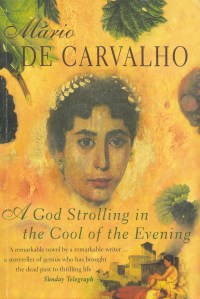
Mario De Carvalho’s book A God Strolling in the Cool of the Evening is well researched which is apparent when he takes the reader back to Rome around the time of Jesus.  The narrator is a Roman provincial official with whom we travel on  his rounds of duties in the township where he lives, in amongst slaves and the rest of the populace.

We learn how Roman officials spent their days and how they treated their women and their slaves.  He describes in detail his living quarters and official buildings and how governing decisions of the time were reached.  The book is  set in the era of Jesus’ preaching and that of his ragtag bands of followers.  Rome was then suspicious of their motives, before the time when Rome would eventually embrace this new religion as the state’s own.  Added to that, many felt threatened and alarmed by the way these ‘new sect’  devotees dressed and behaved.  It just wasn’t the Roman way.  Persecutions and killings of Jesus’  followers was rife but in spite of this, the bands grew in number and they willingly became martyrs for their new beliefs; they felt close to Jesus  spiritually, copied his  acts of compassion for the poor.  His God seemed a more humane one than the various Roman gods.

Rome and her officials were sinking into corruption and the poor suffered greatly at their hands.  For a Roman official to speak out for a pleb or a slave, was not self-serving; demotion or exile from one’s town,  often both,  would be the outcome.

This is a novel which offers a colourful insight into the beginnings of Christianity and the twilight years of the Roman Empire; although the second edition was published in 1999 it is still relevant, and a great read, today.  The Roman Catholic Church grew from these humble and dark beginnings into the massive and wealthy ’empire’ it is today.

The Daily Telegraph described Carvalho as: ‘…a storyteller of genius who has brought the dead past to thrilling life.’ That he has.

-Anne Frandi-Coory.  22 January 2020

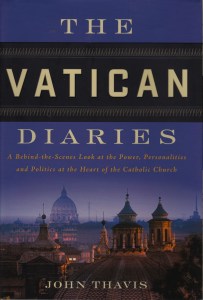
THE VATICAN DIARIES  A Behind-The-Scenes Look At The Power, Personalities and Politics At The Heart Of The Catholic Church

A Book Review by Anne Frandi-Coory
Vatican Diaries


**********************

It really is a joke that the Vatican considers itself a city state in its own right! More like a private boarding institution full of petulant school boys with eccentric masters in control of such departments as Congregation For Catholic EducationCongregation For The Causes of SaintsCongregation For The Clergy, Congregation For Institutes of Consecrated Life And Societies Of Apostolic Life etc. and where the competition for supremacy  over doctrinal matters is fierce.

What bothered me the most about the goings on in the Vatican as revealed in this book, was the total shutdown of any discussion about the thousands of cases of sexual abuse of children in USA, Australia and Ireland; the total lack of any consideration of the harm done to children by paedophile priests. The Vatican is a well-oiled machine that protects the Church at all costs, and I mean ‘all costs’!

The only noteworthy global/political stance the Vatican has taken in recent times, in my view,  was when Pope John Paul ll warned the USA of the terrible consequences if it invaded Iraq: ‘Four years earlier [George W ] Bush had dismissed Pope John Paul’s cautionary warnings about war during the build-up to the invasion of Iraq, leaving deep resentment at the Vatican. In the aftermath of Saddam Hussein’s demise, as terrorism, factional fighting and anti-Christian attacks increased, the Vatican said, essentially, “We told you so.”‘

It is truly incredulous how petty and ridiculous are the secrecy, the bitchiness, and to think this is the headquarters that directs the Catholic Faith for followers around the world! What a waste of time and money!! All the money the Catholic Church rakes in globally would surely feed the world’s poor? Instead it allows the clergy and the pope, to live in palaces, eat like kings, and be waited on day and night!

Just like Mother Teresa was a ‘cash cow’ for the Catholic Church, so too was the Legion of Christ whose Mexican founder, Marcial Maciel Degollado,  fathered several children to several different women but who the Vatican sponsored and feted because of the huge numbers of new priests flocking to his seminaries and the vast amounts of money his order collected in donations. He also embezzled millions for his own private use, and was accused of sexual abuse, but the Vatican protected him until he died.

And heresy isn’t a problem for the Catholic Church either these days, not if it brings in billions of dollars worldwide like the Lefebvrists do. This schism within the Holy Church, for which several bishops and priests were excommunicated, strongly advocates for the pre-Vatican Council ll Tridentine Rites, including the use of Latin for Mass. For this faction of Catholicism, strict Tradition is everything. It does show how little the sexual abuse of children by paedophile priests concerns the Vatican hierarchy when compared to apostasy.

The chapter in the book titled SEX   lays open the arguments within the Church about the problem of homosexuality of priests and it’s  very interesting indeed. There is little doubt that homosexual relationships between priests are condoned within the Vatican, and within parishes. In one case, a priest was caught on a hidden camera, attempting to seduce a young man on a white couch in his office!  It was a set up, and the whole affair was broadcast on Italian TV.  A few years ago, an investigation carried out by the Church,  employing expert psychiatrists, confirmed what the Church has always denied; that the Catholic priesthood is a haven for homosexuals and that teenage seminarians are the attraction. Also, research has revealed that by far the largest numbers of child abuse victims are pre-pubescent boys. One particular psychiatrist believes that celibacy is the prime cause of the fact that so many paedophiles join the priesthood. Many followers are dismayed that the Church will not soften its stance on celibacy, even though it allows its Eastern Orthodox priests to marry. One psychiatrist went so far as to advise the Vatican that allowing priests to marry would encourage more ‘socially mature’ men to become priests. The following is a significant expert opinion quoted by the author: ‘Dr Martin P Kafka, a psychiatry professor at Harvard Medical School, said he thought homosexuality, while not a cause of sexual abuse, was a “likely risk factor” that deserved further study. He stated that in comparison with the general population, abuse cases in the Church disproportionately involved homosexual male adults who’d molested adolescent males. The no-gay-priests faction did its best to ignore the fact that Dr Kafka had also wondered whether celibacy could also be a ‘risk factor’ in sexual abuse.  [My emphasis]

Is there a secret document emanating from the Congregation for Catholic Education, which oversees seminaries around the world, stating the Vatican’s new position on admitting homosexuals into the priesthood? Nothing has been confirmed, but… “The document’s position is negative based in part on what the Catechism of the Catholic Church says in its revised edition, that the homosexual orientation is ‘objectively disordered.’ Therefore independently of  any judgment on the homosexual person, a person of this orientation should not be admitted to the seminary and, if it is discovered later, should not be ordained.” One can’t help wondering whether the Catholic Church is no longer attracting enough priests into its fold because of the dwindling faith of its congregations or perhaps because of its restriction on the ordination of homosexuals?

This chapter also reveals the Vatican’s rules on the use of condoms and other forms of contraception, and once again I am amazed at the ridiculous pettiness of the detail of what is and isn’t allowed! For instance: “condoms are acceptable for prostitutes, because the sex they engage in is already sinful”…but some in the Vatican are concerned because that “would lead the Church to support the use of condoms for all ‘fornicators’ including sexually active teenagers.” I won’t go into the detail of the Vatican’s rules about the use of condoms for the prevention of the spread of HIV/AIDS, but they border on the utterly ludicrous!

The Vatican Diaries is a must read, especially for the faithful, because you really should know the truth of what is happening within your own Church!  It is not just a salacious exposé…John Thavis has written an engaging and at times, very funny book. He obviously has friends within the Vatican whom he trusts and admires, and he has been working as a journalist in this field for over thirty years. I did enjoy the chapters about the Vatican Museum, and the character of an irreverent priest who translated documents into Latin, and who constantly embarrassed tourists and the Vatican hierarchy who  would have dearly loved to have fired him, if he hadn’t been such a brilliant Latinist!

The comings and goings, the antiquated white and black smoke  used to inform an anxiously waiting public about progress in the election of a new pope, are enlightening, humourous, and left me wondering why an extremely wealthy city state still used smoke signals, emitted from a belching, cough inducing stove. Oh that’s right, Tradition.


-Anne Frandi-Coory 31 August 2016

Also here on Facebook: https://www.facebook.com/myhomelibrary/


A Book Review by Anne Frandi-Coory

…….

Michelangelo Pope's Ceiling_0001

….


Michelangelo Pope's Ceiling_0003

Michelangelo And Raphael In The Vatican. (Special edition for museums and papal galleries)

>><><><><><><><

‘Michelangelo & The Pope’s Ceiling’ by Ross King…  

…is a wonderful book all artists should read if they haven’t already. But then, anyone interested in the genius of Michelangelo would love it also.

The author, Ross King, intertwines Michelangelo’s private life and his many anxieties into the long and arduous travail that was the painting of the Sistine Chapel. And amidst all of this the disputes between the painter and Pope Julius II over money  and design give an insight into how closely the Vatican kept tabs on artists and the subjects of their works.

Compared to Raphael, Michelangelo was practically a saint. He worked long hours in Rome on the Pope’s most ambitious ‘project’ while at the same time handling all his family’s many problems, financial and otherwise, back at his home in Florence.

Michelangelo believed any sort of sexual liaison was dangerous to one’s wellbeing; ‘sapping’ a person’s vitality.  It is believed Michelangelo was celibate while his competitor Raphael, and Pope Julius, both had appetites for food, wine, and sex that were legendary. In fact, Raphael died in his late 30s from ‘a night of debauchery’. The pope suffered from syphilis and malaria. Many popes from that era suffered from syphilis and many had children. During this era, Rome, with a population of around 50,000, was infamous for the thousands of prostitutes working in that city. It goes without saying that among their clients were numerous Catholic clergy.

Often a pope’s son and heir, nephew,  or other relative, followed in his footsteps as head of the Roman Catholic Church. In those days, Popes and Bishops even went to war to win back papal states in Italy seized during invasions by other powerful countries. The fact that the Church used soldiers from ‘friendly’ countries to boost their own fighting power wasn’t a problem, neither were their looting and rampaging!

Being a history buff, I also enjoyed reading about the politics and life in Italy during the 15th and 16th Centuries. This book is well researched and equally well written.

In particular, I was fascinated by the techniques Michelangelo and Raphael used to paint their frescos. This method was used  to paint walls of palaces and churches, as well as the Sistine ceiling or ‘vault’. I always believed that the artists just painted the walls as though they were canvases. Not so. The method is painstaking, and requires much skill and patience. Several ‘plasterers’ are needed to assist the painter in mixing the correct ingredients and the painter applied pigments and sketches either to wet or dry plaster, depending on the effect required.

While I was in Rome in 1992, I bought a large book full of coloured glossy reproductions of Michelangelo’s and Raphael’s works during the reign of Pope Julius. I am so glad I did because there are no coloured plates in Ross King’s book,  therefore it would have been difficult for me to follow some of his more detailed discussions. For instance, as King explains in detail the various characters Michelangelo painted onto the Sistine ceiling, I was able to study them in this amazing book. It  made King’s book even more interesting from an artist’s perspective.

…….

Raphael-School-of-Athens

School of Athens by Raphael

The author also discusses at length, one of my favourite paintings by Raphael, ‘The School Of Athens’. This was commissioned by Pope Julius for a stanza in his new apartments. Donato Bramante, Pope Julius’ favourite architect helped Raphael paint the monumental and palatial scenes in ‘The School’. My glossy book of reproductions also has wonderful individual full coloured reproductions of the various students and ‘professors’ in ‘The School’, such as Plato and Aristotle.

plato aristotle twitter

Plato and Aristotle from ‘The School of Athens’


euclid

A glossy plate taken from ‘The School of Athens’ showing Euclid and his students


-Anne Frandi-Coory 25 November 2013

Also here on Anne Frandi-Coory’s Facebook Page:

https://www.facebook.com/myhomelibrary/


Charles Freeman’s book about civilisations of the Ancient Mediterranean

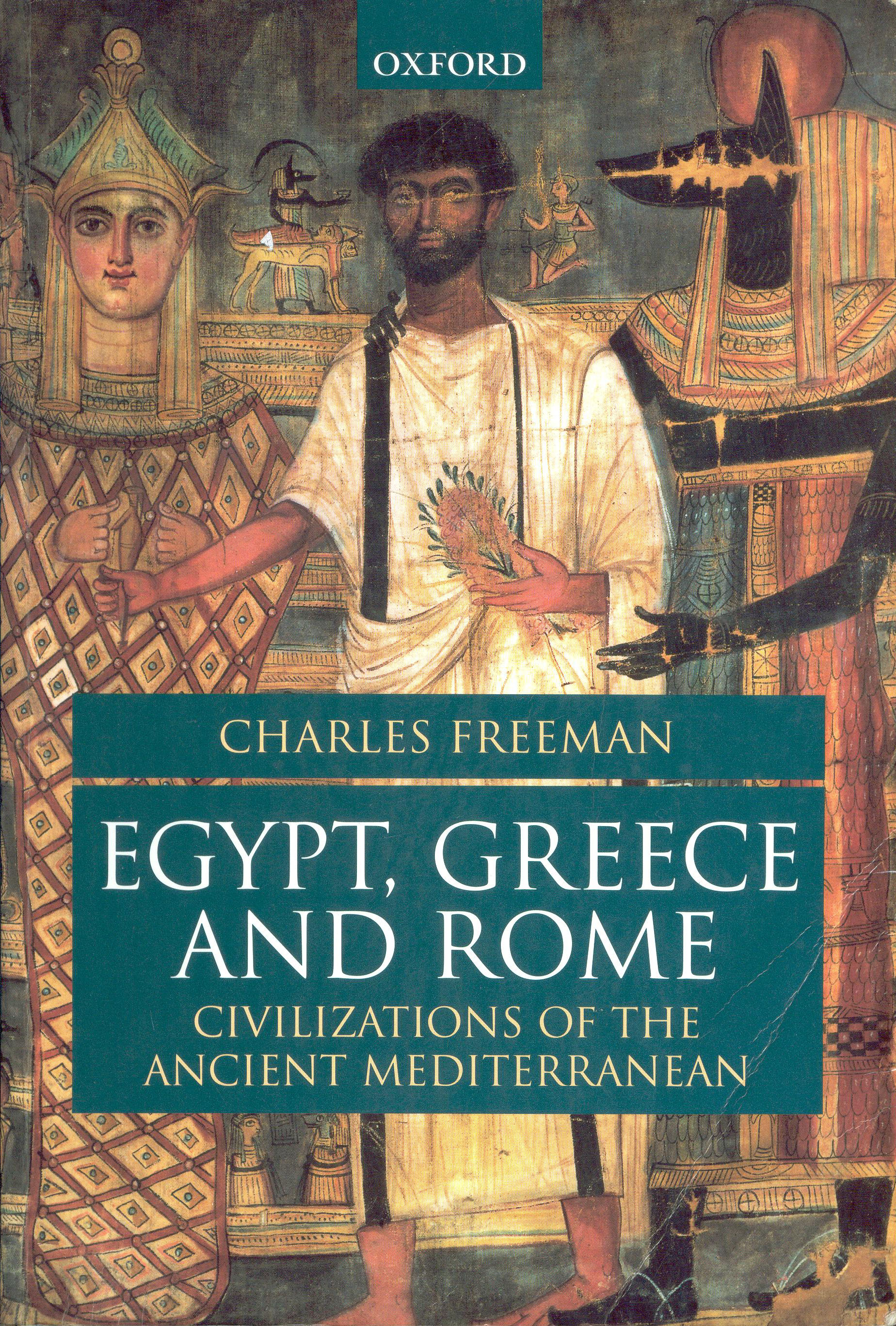
I have just been reading Egypt, Greece and Rome; Civilisations of the Ancient Mediterranean by Charles Freeman , published 1999.  What an amazing book of 638 pages.

Not as much of a chore to read as you might think. The author breaks the book into easy to follow chapters and titled paragraphs.  He uses date charts, date lists, events and maps to great effect and to which I referred constantly during the reading of the book.

The book has given me a better insight into the pre-history of these amazing civilisations, and to their relevance today. Mr Freeman takes the reader on an epic journey from Egypt in 4,500 BC to Eastern and Western Empires up to 1000 AD.  He brings together the most interesting and salient stories. In one sense, not much has changed.  Constant wars, plagues, atheism, religious diversity,polemics, politics, the fight for democracy, all played a part.

Carthage (now Tunisia) , for instance, was a prosperous and thriving Phoenician city in the 5th Century BC, and Greece was pioneering philosophy and   theatre.   Greek philosophers travelled the Mediterranean teaching students to “look” at both sides of an argument.  Trading goods between the various states was the chief activity that brought so many disparate groups together.  What I also loved about this book, are the references to legend and myth, and how they intertwined everyday life across the Mediterranean world. I especially enjoyed the sections on Classical Greece, a favourite era of mine, and the references to its literature.

In Chapter 14, Mr Freeman expands on the 5th Century origins of drama (one of the greatest of Athenian Inventions, by no means a universal human experience),  poetry, tragedy, theatre with such names as Aeschylus, Sophocles and Euripides, and Aristophanes, that satirical playwright extraordinaire.

During these times, beliefs in various gods were tied in with natural events,  human frailty and excesses.  Travel was relatively easy throughout Greece and the Mediterranean, and even non-citizens could find skilled work. Differing versions of the genealogy of gods wasn’t a hindrance, and most visitors ‘slotted in’ with local lore.

It was interesting to read the section on Sophists. The original meaning of the word ‘Sophist’ was anyone with exceptional talent.  However, members of this group were attacked  by both Plato and Aristophanes (satirically) for daring to present arguments  for and against any motion. Sophists can be credited with pioneering the study of religion as a social and anthropological phenomenon according to Mr Freeman. They disagreed strongly with the belief that there was some divine principle at work in the Universe. (Modern atheists, take note!) The Sophist, Protagoras, spent most of his life as a travelling teacher. He wrote: “Concerning the gods, I am unable to discover whether they exist or not, or what they are like in form; for there are many hindrances to knowledge, the obscurity of the subject and the brevity of human life.”  He proclaimed: “Man is the measure of all things.”   Athens was implementing democratic governance at this time and Protagoras’ proclamation could be taken as the slogan of democratic Athens.  Other Sophists suggested that gods originated in man’s experience of nature. The various gods had been created as personifications of natural phenomena such as the sun, moon, rivers, water and fire. To the Sophists men of shrewd and subtle minds invented for man the fear of the gods, to “frighten the wicked even if they acted, spoke or thought in secret.”  By the end of the century free thinking on religious matters was less tolerated.  Pestilence, war, tyrants and destruction killed optimistic fervour.

I wonder, is this what is happening in our world now?


-Anne Frandi-Coory  1 February 2011


*****

Also here on Anne Frandi-Coory’s Facebook page: 

https://www.facebook.com/myhomelibrary/

Mary & Jesus? No, actually Ancient Greek statue Tyche or Fortuna, the centre figure of a flourishing cult

God’s Callgirl-a memoir

My childhood was spent in Roman Catholic institutions and my mother was a novice nun before her marriage (see ‘Whatever Happened To Ishtar?’), so  this book was of personal interest to me.   But of course it is also a well written and interesting book in its own right, well worth the reading. Another great read I found in a second hand book shop.

Carla Van Raay’s book God’s Callgirl is a perspective of the depths, in my opinion,  of how far Catholicism has sunk since the beginnings of Christianity and the teachings of Jesus.  Carla tells us  about her life from her upbringing within a strict Catholic family,  sexual and physical abuse by her father,  to her entry into a convent as a teenager and her later life as a sex worker. Her life in the convent was spent in prayer and unpaid drudgery, such as cleaning, teaching and needlework (which the convent sold) and when she finally leaves the convent she discovers her parents, who were not well off, were charged by the nuns for Carla’s board and keep!  She re-enters the real world as an innocent in every sense of the word. The convent was run by spiteful and cruel nuns within a strict hierarchy.  The convent’s inhabitants were called ‘The Faithful Companions of Jesus’, ironic to say the least.  Carla triumphs despite the best efforts of her parents and Catholicism.

My mother’s life was also one of hardship and emotional abuse in her convent which was called the ‘Home Of Compassion’.  My mother and I,  like Carla,  never experienced or witnessed any real and heart-felt compassion in any Catholic institutions!  In light of what is being exposed within the Catholic Church in recent times, it brings to my mind that saying  ‘The higher you fly, the further you fall’.

-Anne Frandi-Coory 8 July 2010

<><><><><><><><><><><><><><><><><><><><><><><><><><><><><><><><><><><><><>