Archive

Tag Archives: sexual abuse victims

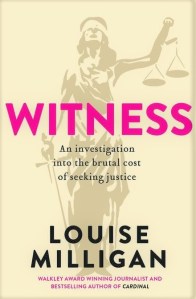
WITNESS; An Investigation Into the Brutal Cost of Seeking Justice

by Louise Milligan.

Louise Milligan is an investigative journalist  with ABC  Four Corners and is the bestselling author of CARDINAL; The Rise and Fall Of George Pell  which won the Walkley Book Award and broke massive international news preceding the court case and successive appeals involving Cardinal George Pell.

In February 2021, WITNESS was awarded the Victorian Premier’s Literary Awards People’s Choice Prize.

In August 2021, WITNESS won the Davitt Award for Best Non-Fiction Crime Book.

*********************************************
*******************************************************************************************

At times, I found WITNESS  very difficult to read. The treatment of victims of sexual abuse in the court room is brutal and intimidating; the seemingly endless humiliation of children in the witness box,  who have come forward to report that they have been sexually abused, is all at once, shocking and heart-breaking.

This book is first and foremost an analysis and critique of the failures of the criminal justice system in sexual assault trials. A masterful and deeply troubling exposé, WITNESS  is the culmination of almost five years’ investigative work for Louise Milligan. Charting the experiences of those who have the courage to come forward and face their abusers in high-profile child abuse and sexual assault cases, Milligan was profoundly disturbed by what she ultimately discovered.

Throughout the book there is a justified sense of outrage at those who choose to treat complainants and witnesses with a hostility causing its own trauma; a special kind of systemic abuse.

Milligan has two decades of experience as an investigative journalist, including her specialist work as a media court reporter and her sustained coverage of the trials of George Pell. Her analysis of the Criminal Justice System in Australia  instructively affirms how the system is outdated and fails to meet the needs of complainants.  She records in-depth interviews with prosecutors, defence counsel, solicitors, judges and academics. It is a gripping revelation of rarely-heard experts’ public opinions about the realities and flaws of criminal judicial procedure.

Why is the cost of seeking justice so monstrously high? Milligan asks.

Her visceral description of the attempted destruction of her own character and credibility in cross-examination by Robert Richter QC relating to her investigative journalism surrounding the case of George Pell, testifies to the brutality of many witnesses’ encounters with the criminal trial process. As Milligan states in the book, she had the ABC legal team supporting her in court and yet she found the experience traumatic. She kept thinking what a deeply traumatic experience it must be for children and young women who have no legal support whatsoever in court.

In her case, virtually every question was asked, she writes, in a belittling or insulting way. By the end of the day, she “had never felt more alone”, despite all her experience, preparation, and team of lawyers. What hope do complainants have, she asks, who lack these resources, and who were already traumatised?

Milligan’s account of her own cross-examination during the Pell committal hearing by Robert Richter QC is exhaustive and compelling. Reflecting on the experience, she repeatedly references the Evidence Act S41 which imposes a duty on the court to disallow improper questions and improper questioning, including questions that are intimidating or humiliating, or are asked in an insulting way.

The author makes it clear that she felt insufficiently protected by this section of the Act, and by other laws giving the court control over how witnesses should be questioned.

“The system is broken. For sex crimes, rates of complaints, prosecutions, and convictions are persistently low. Sexual assault trials require more fundamental changes. Protections against humiliating treatment of witnesses need to be properly enforced by judges and prosecutors. As one QC admits to Milligan, reforms about judicial directions and improper questioning “don’t mean anything if the prosecutor doesn’t intervene and the judge or magistrate isn’t in control of the courtroom.”

Milligan also suggests that complainants would benefit from an expert advisor to assist them in navigating the system, and to protect against unduly “intimidatory tactics”. She argues that sexual abuse victims who are required to give evidence against the accused, should have the right to legal advocates in court. She discusses this issue with several barristers and judges as an integral part of her research and the way forward.

So many of the formal protections that witnesses deserve already exist: judicial intervention powers; legislative protections against demeaning and misleading questioning; complaints mechanisms. She delves into the “emotional architecture” of Australia’s criminal courts, in particular, the trial culture of élite defence barristers, which one source memorably describes as “a very lucrative psycho-politics of humiliation”.

“[Witnesses/Victims] come before the court, to be cross-examined, potentially by a fierce advocate, with years of experience, completely alone.  To have to relive their disgusting trauma and to have it doubted again, with no one to make sure that their human rights are not being abrogated, that the Evidence Act is not being breached, that the barrister isn’t acting in a way that breaks the rules he or she is bound by. “

“Yes, there is a judge and a prosecutor, but so often, for a multitude of reasons, they do not do it as well as they might.”

Dr Mary Iliades, a criminologist from Melbourne’s Deakin University writes in a 2019 paper on the subject: “The reluctance to recognise victims as anything other than a prosecution witness, stems from a concern that victims will invite potentially subjective and thus prejudicial submissions on matters of state concern which could compromise the objective and public nature of the criminal justice system and hinder an accused  person’s due process rights to a fair and impartial trial.”

“Essentially, this means that the law is concerned that elevating the role of the complainant witnesses – victims – will give an unfair advantage to the Crown in proving the prosecution case beyond reasonable doubt and that people accused of, say, child rape, won’t get justice. But the flow-on consequences of these concerns are not good for victims.”  Testament to which this impressive investigation by Milligan lays bare.

***************************

This is a book that had to be written. Thank you, Louise Milligan, for taking on this monumental task.

-Anne Frandi-Coory.  5 February, 2021
Update: May 2015 …Pope Benedict has since been stood down, and Pope Francis has been elected. Time will tell if anything will change. 

….

vatican

……

Pope Benedict XVI’s letter relating to the Cloyne Report has infuriated Ireland’s Prime Minister and the Irish victims of paedophile priests.  People from several countries have been hoping for constructive comments in the letter from the Vatican regarding sex abuse scandals, but they will once again be disappointed. ><

Pope Benedict XVI

>< Vatican-approved cover-ups of the sexual abuse of children at the hands of priests, have been going on for centuries in parishes and schools.  My own great-grandmother, then 14 years old, was raped by a Catholic priest in Rome in the 19th Century.  She was sent off to London to have the resultant baby while the priest’s name was protected. I’d hate to imagine how many other girls might have suffered the same fate because the Vatican turned a blind eye.   The Vatican has never put children’s welfare first in these horrendous scandals.  Foremost in the Vatican’s responses to thousands of allegations of abuse, is to protect the Catholic Church at all costs, then the abusing priests.  Some see the present Pope’s position as difficult because he was formerly the head of the Congregation for the Doctrine of the Faith (Once The Holy Office of the Holy Inquisition), which makes, and enforces, doctrinal laws. See previous post:  The Case of the Pope; From a legal perspective.

>< It is sickening to me, to see and hear the pope expressing love for ‘God’s children’ while allowing their  torture and rape to continue.  I use the word ‘allowing’ deliberately, because that is what the present Pope is doing, and what his predecessors have done;  the Vatican’s secrecy and  inaction have ensured the abuse continues.  The scandals that first emerged in Canada and Australia in the 1980s, followed by Ireland in the 1990s, the United States this decade and, in recent months, Benedict’s German homeland, are but the tip of the iceberg.  And no-one has even begun to examine accusations coming out of Africa where many paedophile priests are sent for their protection from Western countries’ legal systems.

><

Comments regarding the Pope’s letter and the Cloyne Report: Maeve Lewis, head of  ONE IN FOUR victims’ group, stated that the Pope “passed up a glorious opportunity to address the core issue in the scandal; the deliberate policy of the Catholic Church, at the highest levels, to protect sex offenders, thereby endangering children”. “The Pope speaks only of failures in the Irish church and neglects the role of the Vatican. If the church cannot acknowledge this fundamental truth, it is still in denial”.  She said she was “astounded” at the Pope’s previous assertion that  ‘the roots of clerical sexual abuse lie in the secularization of Irish society, the falling off of religious devotion, and failures to adhere to canon law.’

“This shows a complete misunderstanding of the dynamics of sexual violence and creates little hope that the church will ever respond effectively to the problem.” Author and survivor Andrew Madden said issues highlighted by him and others in a letter to the Pope had been ignored.  He said there had been no responsibility taken by the Catholic Church, regarding the sexual abuse of so many children, and its protection  of paedophile priests.   Mr Madden  goes on to say that Pope Benedict has repeated his apology for the hurt caused to those abused but then states that the Church’s only  role has been its failure to deal with criminal and sinful acts’.  According to Mr Madden, the Catholic Church didn’t fail to act; it acted very clearly to protect itself and left the abused children to fend for themselves. Another survivor, Marie Collins said she welcomed the order that church leaders should co-operate with police, but she said there had been no mention of the Vatican’s role in the cover-ups which allowed the abuse to continue.  [In fact it is not an ‘order’ but a ‘guideline’].

Alan Shatter, Justice Minister in the Irish parliament also lashed out at the Pope, saying:  “We should never again tolerate a foreign state issuing directives to members of the hierarchy and other clerics in this state to violate Irish law by concealing reports of child sexual abuse and not reporting such allegations. Nor should we ever again tolerate a foreign state requiring that an oath of any nature be taken by an adult or child to maintain a veil of secrecy over incidents of sexual abuse.” The latter was a reference to a case involving current Cardinal Sean Brady, who in 1975 swore two young children to an oath not to reveal their abuse. The Cloyne report into Catholic clerical child abuse in Ireland released on Wednesday 20th July, will identify 19 Catholic priests who allegedly sexually assaulted children in the 1990s.

The report into abuse allegations in the Catholic diocese of Cloyne, has been approved for publication by the Irish government. The report, known officially as the Commission of Investigation Report into the Catholic Diocese of Cloyne, will be published by Ireland’s minister for justice, Alan Shatter, and the minister for children, Frances Fitzgerald. The last Irish government agreed to extend the Murphy commission’s remit to include Cloyne, as well as the Dublin archdiocese. The commission’s Dublin report found widespread clerical abuse and cover-up in the Irish capital which was devastating for the Catholic Church. It also found child protection practices in the Dublin diocese to be ‘inadequate and in some respects dangerous’. The commission was later asked to investigate the handling of sex abuse allegations in Cloyne by church and state authorities between 1 January 1996 – when the church’s first-published guidelines, its Framework Document, came into play – and 1 February 2009. Minister Alan Shatter said the report’s findings were unambiguous. “We cannot correct past wrongs perpetrated on our children, but we can take action to prevent, insofar as is possible, the wrongs of the past being perpetrated on our children in the future,” he said.  “We cannot depend on the undertakings of others to correct failings and introduce robust and effective structures of protection. The Cloyne Report  irrefutably confirms that some who, in the past, gave such undertakings, acted in bad faith,” the Minister told Parliament.

>><><><><

Irish Prime Minister Enda Kenny has launched an unprecedented attack on the Catholic Church,  saying the relationship between church and state in Ireland could not be the same again following the Cloyne report. The Vatican chose to focus on the interests of the Church rather than the children abused by its clergy and shielded by its leaders. The Catholic News Service reports Mr Kenny accused the Vatican of adopting a “calculated, withering position” on abuse.   He said that “the Irish people, including the very many faithful Catholics who – like me – have been shocked and dismayed by the repeated failings of Church authorities to face up to what is required; deserve and require confirmation from the Vatican that they do accept, endorse and require compliance by all Church authorities herewith, the obligations to report all cases of suspected abuse, whether current or historical, to the state’s authorities.”

“The revelations of the Cloyne report have brought the Government, Irish Catholics and the Vatican to an unprecedented juncture. It’s fair to say that after the Ryan and Murphy reports Ireland is, perhaps, unshockable when it comes to the abuse of children. But Cloyne has proved to be of a different order. Because for the first time in Ireland, a report into child sexual-abuse exposes an attempt by the Holy See, to frustrate an inquiry in a sovereign, democratic republic . . . as little as three years ago, not three decades ago. And in doing so, the Cloyne Report excavates the dysfunction, disconnection, elitism . . . the narcissism . . . that dominate the culture of the Vatican to this day.”

PM Kenny said the Cloyne report told “a tale of a frankly brazen disregard for protecting children”. He said although the report had shown the need for the Vatican “to get its house in order”, it also revealed how the State had failed victims too.  “For too long Ireland has neglected its children,” he said.  “This is not Rome. This is the Republic of Ireland 2011, a republic of laws,” Mr Kenny said.

The Prime Minister was speaking during a Government motion on the report that “deplores the Vatican’s intervention which contributed to the undermining of the child protection frameworks and guidelines of the Irish State and the Irish bishops”. It expresses “dismay at the disturbing findings of the report and at the inadequate and inappropriate response, particularly of the Church authorities in Cloyne, to complaints and allegations of child sexual abuse.” >< Italy, another predominantly Catholic country, has a similar tale to tell.

See Post:  Paedophilia in Italy

Most recent post: 

Clerical Paedophilia; Centuries Old Time Bomb