
A Tale Of Three Cities ISTANBUL
-Bettany Hughes
*****
A Book Review – 5 stars *****
Byzantion of Greece’s ancient past, the capital of the Christian Byzantine Empire, famed Constantinople of New Rome and Muslim Ottoman Empire that today goes by the name of Istanbul, Turkish republic.
‘Istanbul is the city of many names’, writes Bettany Hughes: Byzantion, Byzantium, New Rome, Stambol, Islam-bol are just a few of them. And Istanbul today ‘is lapped by the Golden Horn, the Bosphorus, and the Sea of Marmara; to the north is the Black Sea and to the south, through the Hellespont or Dardanelles, the Mediterranean.’
A diamond mounted between two sapphires and two emeralds…the precious stone in the ring of a vast dominion which embraced the entire world as described in ‘The Dream of Osman’ c. AD 1280.
Hughes guides the reader around the city that I wish I had visited. It is obvious from reading this book that the author has walked Istanbul’s streets and knows the city well, and she has meticulously researched its 8000 years of history. I can assure you that this is no dreary history book the likes of which bored us to tears at school. The ancient town of Byzantion’s King Byzas (legend has it that his father was Poseidon, his grandfather, Zeus) was well located at the intersection of trade routes. Eventually the Roman emperor Constantine decided that ‘Old Rome’ was too far away from all the action and over time the City of Constantine became Constantinople, the New Rome, capital of the Roman Empire itself. The gateway between East and West. Constantinople’s Christian name was changed to Istanbul around 1923 after the fall of the Ottoman Empire.
The book has short chapters with clear and helpful titles, dated in both Western and Islamic calendar formats where appropriate. It enables readers to navigate this vast book in piecemeal fashion, but I found it difficult to put this book aside; it is so well researched and written, with personal written accounts from people who were present during many of the historical events, which made the book all the more fascinating. I particularly enjoyed the frequent references to current and recent archaeological digs the findings of which verify historical accounts. Hughes includes several maps and colour plates, which I constantly referred to as I was reading. It is evident that the West owes far more to Eastern cultures than we have been ready to believe in the past. The Roman Empire pillaged much wealth from Egypt and the East and in turn the Ottomans pillaged from Roman territories. It is arguable that the rabble that made up early Western civilisation reached a turning point when it invaded and colonised Egypt.
*****
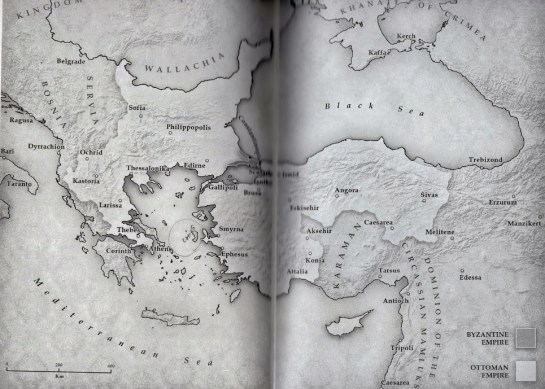
Ottoman and Byzantine territory in the east Mediterranean c. AD 1451
*****
Muslim and Christian lived in relatively peaceful harmony during the Ottoman era but both sides could be extremely brutal whenever their territories or power were threatened. The Ottomans, however, were far more than their harams and baths, which titillated and attracted travellers; they were skilled diplomats and traders. Christian slave boys ‘harvested’ from the West were trained as interpreters. Called Dragomans, one of their critical attributes was their facility with languages, and some of them could speak up to seven languages which enabled the empire to spread its culture and bargain with valuable commodities to negotiate peace. When the Ottoman Empire began to crumble at the beginning of the twentieth century, Germany, France and Britain ‘fought over the spoils’ and it is apparent that the after-effects of this breaking up of once cohesive territories helped to turn Christianity and Islam against each other which we are still witnessing in modern times. Millions of refugees were displaced during the carve up of territories, and millions died.
This book, as well as being a great read, informs readers on how the current geo-political era came into being, and it does not always put the West in a good light. We owe so much of the great advances and wealth in our Western civilisation to the East, and let us not forget, to Islam
-Anne Frandi-Coory 27 October 2017

 anne frandi-coory