Archive

Tag Archives: Syria

Excerpt from ‘Whatever Happened To Ishtar?; A Passionate Quest To Find Answers For Generations Of Defeated Mothers’ 

><><

***This page is copyright to author Anne Frandi-Coory. No text or images can be copied or downloaded from this page without the written permission of Anne Frandi-Coory.***

><><>

Granddad Jacob, that’s an amazing spiritual journey….

jacob coory fb 2

Jacob Coory (Fahkrey), my grandfather, as I remember him. (photo: Wendy Coory Gretton)

><><

My extensive research into the murky past, which was partly buried in the Aramaic language and ancient names, reveals how much I didn’t know about my paternal grandfather, Jacob Habib El Khouri Eleishah Fahkrey. Nevertheless, my limited personal contact with Jacob left a significant impact. I deeply mourn that he died before I ever had the chance to talk with him about our extremely rich genetic and cultural heritage. If only I’d known as a child that he was such a valuable resource for our Lebanese family history. But then, what child can really comprehend such a thing? That, beyond their narrow sphere of existence, a family history has been woven as intricately as any tapestry, replete with human drama, personal tragedy and war, set in countries at opposite ends of the world. As a child my whole world stretched no further than a few urban blocks in Dunedin – The Catholic orphanage at one end and the Coory family home at the other.

Jacob and my grandmother, Eva, both spoke a Semitic language, an ancient form of Aramaic. Jacob’s forebears most likely descended from an ancient tribe of Israelites originating in the ancient Canaan, now known as Israel and Jordan. From there, some Canaanite clans including, I believe, those of Jacob’s distant ancestors, migrated to the rich and ancient area in the plains of Mesopotamia, close to the life-giving Euphrates River. There is linguistic evidence the Semitic tribes first arrived in Mesopotamia around 4000 BCE. The Aramaeans (speakers of Aramaic)  were a nomadic tribe when they first encountered Mesopotamia. Over the centuries they gradually moved in a westerly direction then south down the Euphrates River, eventually settling in to form kingdoms. The consolidation of the Aramaeans into settled kingdoms allowed the re-establishment of the trade routes through Palestine (Philistine) and Syria, and allowed the temporary Israelite expansion. Some of the Aramaean tribes continued to migrate west across Mesopotamia, their fortunes greatly improved due to the relative stability of the settlements in the area.

><<>

jacob&eva

Jacob Fahkrey (Coory) on his arrival in New Zealand c.1898

><><

Early Coory Clan

L to R: Amelia, Jacob with Phillip on his knee, Michael, Joseph (Anne Frandi-Coory’s father), Elizabeth, and standing at rear is Eva holding Neghia

><<><><><><                                                                                                                                                           ><><><><><><>

The Bible mentions the Aramaeans and links the Israelite Patriarchs with them. The ancient Israelites had to profess their faith by pronouncing ‘my father was a wandering Aramaean’. It was probably during their settlement in Mesopotamia that the clans mixed with the seafaring Phoenicians, recorded there as early as 2300 BCE. The first key port of the Phoenicians was at Sidon in Lebanon. For the remainder of the pre-Christian period, around 300 BCE, Mesopotamia was safely in the hands of the Seleucids (Greeks) while the two-millennia-old Babylonian civilisation was dying. Since the turn of the millennium, both socially and linguistically, Aramaeans had been penetrating Babylonia; their tribal systems overtook the cities, and their language eventually superceded the ancient Akkadian.

Some of the native Syriac dialects, as well as ancient Hebrew, merged with Aramaic, one of the Semitic languages which has been known since almost the beginning of human history. The Semitic languages, which include Hebrew, Arabic, Akkadian, Aramaic and Ethiope, were first glimpsed in ancient royal inscriptions around 900-700 BCE. The Aramaeans introduced their language to Syria when they settled there during the second millennia BCE. The Persians gave Aramaic official status, and throughout the Greek and Roman eras it remained the principal vernacular language. Babylonian and Persian Empires ruled from India to Ethiopia, and Assyrians employed Aramaic as their official language from 700-320 BCE, as did the Mesopotamians. The Aramaic script in turn derived from the Phoenicians, who most likely extracted it from the Canaanites. Writing derived from Phoenician, began to appear in Palestine around the tenth century BCE.

><><><><><><><><><><><><><><><><><><

map Middle East

National Geographic Map of Ancient Middle East

><><><><><><><><><>><><><><><><><><><><

There is general agreement among scholars that the linear alphabet had its beginnings somewhere in the Levant during the second millennium BCE. The Etruscans were the first among Italic Peoples to adopt the linear alphabet script and it spread rapidly throughout the Italian peninsula. The Phoenicians and the Etruscans had close trading and religious ritual links. These days, Aramaic is only spoken by small Christian communities in and around Lebanon, and in a small Christian village in Syria. The word Aramaic derives from the word Aram, fifth son of Shem, from which the word shemaya (semitic for ‘high up’ or ‘mountain’) is derived. Around 721-500 BCE, the ancient Hebrew language of the people of Palestine was overtaken by Aramaic, and much later the message of Christianity spread throughout Palestine, Syria, and Mesopotamia via this Semitic vernacular. Aramaic survived the fall of Babylon in 539 BCE and continued to be the predominant language. But Arabic spread and gradually took over as the lingua franca in the Middle East, around the thirteenth century CE. It seems reasonable to assume that, as speakers of this ancient language and in conjunction with their familial names, the Fahkrey forebears were originally members of a Judaic tribe, the Canaanites, who, over the centuries, mixed with other ethnic groups such as Hittites, Phoenicians, Akkadians, Greeks, and Macedonians to name a few. The word Fahkrey probably derives from the Aramaic word fagary, which means ‘the solid one’. There is plenty of evidence to support this, as Jacob and his descendants are of short, stocky build with strong arms and legs.

Many Canaanite menhirs (religious rock emblems) have been found in Lebanon and Syria. It’s interesting to note that at Baalbek, in the mountains of Lebanon, there is evidence of sacred ritual prostitution (male and female); a long-established Phoenician institution, associated with the cult of Astarte, the Goddess, also called Ishtar (Esther). Within the Phoenician realm, the great mother goddess Ishtar/Astarte was venerated in caves and grottos. A number of these sacred caves later evolved into sanctuaries dedicated to the Virgin Mary. Adoration grew into a cult, elevating Mary to the status of ‘Protectress of Lebanon’. My paternal family’s stocky build, soft round features and fairer complexion add a little mystery to their ancestry in a region where many inhabitants have dark features.

We have very little archaeological or written evidence, and so much of this history is conjecture. What we do know is that the Greeks overran and were prominent in the Levant from at least 1200 BCE. The Romans invaded in the first century BCE and Roman rule strengthened after this time. Judea later became a Roman province. And there were other ethnic groups which invaded the area from time to time in between. Ancient Damascus played an important role in the destiny of the Fahkrey tribe. Around the ninth century BCE, Damascus’s political and economic strength enticed both Palestinian Kingdoms , Israel and subsequently Judea, to seek alliance with it. At the time there was a direct and vital communication route between Tyre in Lebanon and Damascus via the Beqa (Bekka) Valley.  In 64 BCE Damascus had become part of the Roman Empire and thrived as a city-state, converting to Christianity very early on in the Christian era. The leaders of the Roman Empire would later see the infrastructure of the Catholic Church as a beneficial conduit of power for their vast empire and name it as their official religion…

During the 630s CE, Jacob’s distant ancestors were on the move again towards Damascus, ahead of the Muslim armies rampaging across the Arabian peninsula. Muslim armies attacked and eventually occupied Damascus in 635 CE, then converted Syria to Islam. Those tribes living in and around Damascus would have been familiar with the safe haven of Bcharre in the hills of Lebanon. Damascus is the oldest continuously inhabited city in the world and was once a central sphere of  influence and prosperity. Around the fourteenth century our Fahkrey ancestors moved on from Damascus and up into Lebanon’s protective mountains…

<><><><><

The Roman Catholic Church aligns itself with the Maronites  (the religion of my grandparents) in the mountains of Lebanon:…

More Here: THE MARONITES IN HISTORY

<><><><><><><
More…..Walking Around Lebanon With 2Famous

Post by Robert Fisk in The Independent 3 December 2011

Updated by afcoory 16 September 2013

Photo: Jane Sweeney; Blogging Beirut

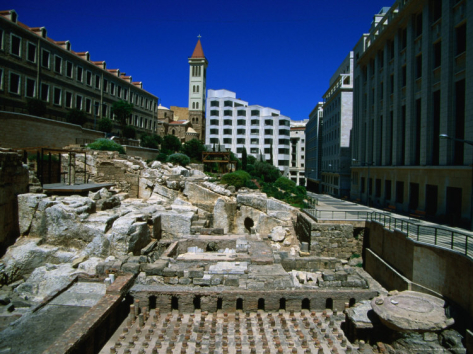
Ancient ruins of Beirut in the midst of modernity. Photo: Jane Sweeney; Blogging Beirut

><

On a clear day in Beirut, you can see back into its Phoenician past – Robert Fisk

><

Phoenician Footprints All Over Beirut – by Robert Fisk

I walked down a Phoenician street the other day, built under Persian rule.

A bit bumpy and uneven underfoot – like many a street in modern day Iranian and Lebanese cities – but this one happened to be about 2,600 years old. It ran down to a small harbour, lined by covered stone sewers and drainage ditches on each side, massive door lintels before private homes and a row of shops and warehouses and possibly a temple, five streets and 18 buildings over an area of 3000sq m.

I should say at once that this street constructed under Persian occupation is scarcely two miles from my home on the Beirut seafront, one of the great excavations which the rebuilding of the post-civil war city opened up for future generations, layer after layer of Paleolithic, Phoenician, Greek, Roman and Ottoman Beirut. The place was originally known as “byrt” – which possibly means cistern or well, according to researcher Josette Elayi – then it became Berytos in Greek, Berytus in Latin and now, of course, Beirut. The names are sandwiched together like the layers of streets. This street even yielded up terracotta figures of a woman with outstretched arms,  probably the [Goddess] ASHTART/ ISHTAR (see below) 

And, true to so much of Lebanese history, Beirut was, in effect, under occupation. In the first millennium BC (875-332BC), all the cities of Phoenicia were under first Assyrian and then Babylonian and then Persian control. Beirut belonged to Sidon – it always seems to belong to someone else – which is now a scruffy Crusader seaside port 30 miles to the south of the modern Lebanese capital. So the coins found in Beirut are Sidonian; the local military power was Sidonian; it was Sidon which dealt directly with the Persians. Beirut was a fishing and trading port, its wooden vessels with their high prows sliding out to Greece, Italy and distant Carthage.

Archaeologists have found sycamore wood here, Egyptian blue pigment, marble, silver, iron, jars for carrying Phoenician olives, olive oil, wheat, walnuts, grapes and wine across the Mediterranean. There’s even a stone with a carved graffito of a Phoenician merchant ship, mast fixed with ropes to the sides, two oars tied together as a rudder. It reminds me of the fishing boats carved into the Tudor wood of the old port of Rye, still visible today on the south side of the Sussex churchyard long after the sea has withdrawn from this cinque port.

Today, the Persian-ruled city in Lebanon is exposed beneath the new souks of Beirut. It is part of the city’s “Heritage Trail” – in Lebanon, the word heritage means what it says and does not carry the grotty reputation of Britain’s tawdry historical re-creations – so that future generations can walk around the old/new city and “watch” its creation over the centuries in Roman streets and Crusader walls, a project overseen by Amira Solh, the young Cornell-trained urban planner who works for Solidere, the company that rebuilt Beirut. She has dreams of an interactive film display behind the underground Persian streets – and promises me there will be no English-style guides flouncing around in Persian costumes. This is serious history for serious people.

Nothing, of course, could be more serious than finding yourself under Persian rule. Roula el-Zein, an archaeologist and consultant for Solidere, described Beirut at the time as “just a small city belonging to Sidon, the city which had all the power”. The Phoenicians, she says, “accepted Persian rule after the Babylonians left, and without any problem in assisting the Persian wars against Egypt. Sidon and Tyre were with the Persian kings” – King Baalshillem the Second and King Abdashart, for those who want to know. But when the Persians decided to attack Phoenician Carthage, things quickly went wrong.

“According to Herodotus,” el-Zein says, “the Phoenicians of Sidon refused to build ships for the Persians and help them. And because of this, the Persians never finished their north African project.” It makes sense. Why should the Phoenicians of Sidon and Beirut help their masters attack the Phoenicians of Carthage? It would be left to the Romans (“Carthaga delenda est”) to destroy the city whose remains lie in modern-day Tunisia and whose land was sown with salt so that it could never be re-inhabited.

It’s always the same when you think you’ve got the Lebanese on your side. First they are your friends – the French thought that after the 1914-18 war – and then they become subversive and upset all your military plans, the amiable historical mosquito that bites you when you least expect it and then poisons you. It doesn’t hurt until you realise what has happened. Message: leave the Phoenicians/ Lebanese alone. Ask the Israelis.

And so the Persians should have left the Beirutis to their dyeing trade – there are murex shells and wood charcoal aplenty to prove it – and their fishing boats. In the old Roman cities of Europe – in Rome or at Corbridge on Hadrian’s Wall – I like to run my hand along the rutted highways of antiquity, where the barrows and horse-drawn carts and chariot wheels of history slowly carved their passage into the great stone Roman roads. Humans didn’t just build this; they lived here and travelled here. Those double ruts in the road are fingerprints.

And old Phoenico-Persian Beirut has some “fingerprints” of its own. In the old port, now under rue Allenby – another imperial name, victor of Gaza and humble conqueror of Jerusalem – there is an ancient stone bollard, and cut into it are two natural slits, created during the decades of Persian power. They are the marks worn down by the ropes tying Phoenician ships to the quayside, the stone gradually worn away as the hawsers cut into it, pulled back and forth by the same Mediterranean tide which sloshes away outside my home.

Thank you Robert Fisk- A great post about a great civilization

************************************

*Read more about Goddess Ishtar HERE*


From Lebanon’s poet & writer, Khalil Gibran: Poetry is not an opinion expressed. It is a song that rises from a bleeding wound or a smiling mouth. >< In memory of all the poets, journalists and writers who have died in the Middle East peacefully pursuing freedom for their country. ><

Sketch by Khalil Gibran who understood deeply the pain of his people

>< Ibrahim Qashoush, whose lyrics moved thousands of protesters in Syria, and who sang his jaunty verses at rallies, has been found dumped in the Orontes river with his voice box cut out.  A symbolic message from Bashar’s brutal regime. Qashoush had been forced into a car while on his way to work in central Hama. ><

Ibrahim Qashoush in peaceful repose

>< The father of three boys, Ibrahim Qashoush, was a fireman in the central Syrian city of Hama who wrote poetry in his spare time. Before the uprising in Syria began in March, he’d write about love or the struggling  times.  His friends say all his poems and songs were  instinctual. He’d sit with his friends and suddenly begin reciting a poem from memory.  Ibrahim’s star rose with protests in the city. At nearly every protest, the crowds were singing his most popular lyric, “Come on, Bashar, time to leave.” His poems and songs rang with a down-to-earth, jokey, rhythm. Obviously, Bashar and his government fear the pen or the poet more than the sword!  It is the same with other current dictatorships around the world; they will kill anyone who dares to write the truth about their corrupt and murderous practises.  Human Rights are a poet’s dream. Journalists, poets, writers,  all fair and easy game.  But despots can’t unwrite was has been written nor tear out what is in people’s hearts. Bashar quote: ”If you say ‘God, Syria and Bashar’, I say ‘God, Syria and My People’. I, Bashar AlAssad, will remain dutiful and faithful to my people…”  Hollow words from a man who will not relinquish power. Another Arab leader who must be terrified in their thinking about  where  and when the Arab Spring will end. As a child, I often heard my Lebanese grandmother, Eva Arida Fahkrey, rail against “Syria” and what it had done to her Lebanon.  I didn’t understand then, but I now know Syria never let Lebanon forget that she had been carved out of Syria’s land mass by the West.   My hope is that a new Syria will cease to interfere in Lebanon’s self-rule;she has enough problems with Iran, but that is another story. RIP Ibrahim Qashoush.