
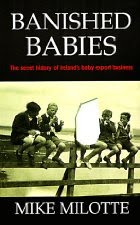
The book ‘Banished Babies’ by Mike Milotte, is about babies born in Ireland to unmarried mothers. But we now know, banished babies were also born to illegitimate mothers in New Zealand, Australia, America and England. More countries where this practise took place may yet come to light. Australian Banished Babies want an apology. You might say “But this happened last Century”. The thing is, the wounds left in these heartbreaking cases, never heal.
><
See Adoption: The Open Wound That Never Heals
><
‘Banished Babies’ were those babies taken from their unmarried mothers at birth. I believe that the word ‘taken’ in this instance is a misnomer. It should read ‘ripped’, because that’s how it felt to the young mothers. I know this personally from my own mother’s case. This ‘baby snatching’ as others call it, was not for altruistic purposes; rather it was following Catholic dogma issued by the Vatican’s Office of the Congregation For the Doctrine of the Faith (formerly Office of the Holy Inquisition). It was certainly not for the welfare of the infants, or their mothers. No. It was to remove these babies from their mothers who were seen by the Catholic Church as sinners who had to be punished. In the nuns’ minds, indoctrinated by the Church, the babies themselves were being saved from the clutches of satan and were ‘sold’, mostly to wealthy American couples, who, it was stipulated, had to be of the Catholic Faith. It was strictly enforced by the Church, that neither mother or infant would ever be able to trace each other, and this caused even more heartbreak decades later. (See my post about Philomena Lee). Large sums of money were exchanged for the privilege of ‘buying a newborn’, donation being the euphemism used. Ironic, isn’t it? So much of that wealth the Church received, is now being paid out to even more victims of the Catholic Church; in the form of compensation to thousands of families whose children were sexually abused by paedophile priests.
><
For all the mothers and babies who never found each other
><
Between the end of WWII and 1965 more than 2,200 Irish infants were adopted out of the country, mostly by hopeful parents in the U.S. All the adoptive parents were, by mandate of the church in Ireland, Catholic. Until the late 1990’s and the work of Irish journalist Michael Milotte this was a fact known to few in Ireland and fewer in the U.S. In Ireland Milotte’s work, emphasising both the emotional and physical brutalisation of the birth mothers and the country’s loss of vital human capital, led to a great furor.
><
In 2001, the Washington Post reported:
Milotte, a senior reporter for the Irish television network RTE, says life was particularly hard for the mothers in these convents, which were largely self-sustaining thanks to the women’s labour but also received public funding. In some cases, he says, the priests and nuns received money from the adoptive parents, who paid “confinement and medical costs” associated with their child’s birth.
“Where did the money go?” he wonders. “It sustained the people who ran the institutions in a manner they wouldn’t have otherwise enjoyed.” But money likely wasn’t the primary motivator, he says. Rather, there was a demand for children, and many of the nuns believed they were doing God’s work by sending some of Ireland‘s social outcasts to a better life in the land of opportunity.
“They thought they were doing good,” says Milotte in a phone interview from Dublin. “The fact that people might have rights didn’t enter into their thinking. They thought they knew best. If, in doing the best thing, there was an opportunity to make money, that was all the better.” In those postwar days, it was not uncommon for Irish children to be adopted by U.S. military and government employees living abroad, Milotte says.
The birth mothers of these children spent their pregnancies and post-natal, pre-adoption lives in varioushomes, often convents, for girls and women who were seen by the conservative Catholic culture as shame-worthy moral degenerates. The horrific conditions that these women underwent was recently dramatized in the movie the Magdelene Sisters.
><
Milotte spoke with NPR’s Daniel Zwerdling upon release of his book Banished Babies in May of 1998:
Many of these women were seen as the next thing to prostitutes, and were very often told that when their identities became known. Even when girls got pregnant, very often they didn’t get married even if — because there was the stigma attached to having had sex before marriage. So even where a relationship endured, the child would be given up for adoption. And it was all done in secret.
I am one of those kids given up for adoption. It was in that interview in May of 1998, two days after I returned to Chicago following my mother’s funeral, that I learned of the controversy. I have always known that I was adopted, that I was a ‘true Irishman’, and I had always been proud and honored by the distinction. In the days immediately following my mom’s death I told my Dad that I had never for a second doubted who my ‘real’ parents were, that he and my mom were the only ones who can lay claim to me. I feel no different today.
None-the-less, as the NPR story continued I found myself getting information that I’m sure even they didn’t have.
ZWERDLING: Here’s one of the most curious aspects of this story.It’s hard enough for most women to give up a baby for adoption during the first few hours or weeks of its life. But church officials forced the young mothers to stay in their convents and raise their own infants for at least one year or more before adoptive families could come and get them.Reporter Mike Milotte says he’s turned up cases where young women changed their minds after their babies were born and tried to leave the convents. (This also happened to my mother in New Zealand). But the nuns sent guards to capture the women and bring them back.For her part, Mary O’Connor says, she knew she’d have to give her baby away. She felt she literally had no choice. But by the time the nuns came to take her son, she’d been raising him for 17 months. Then one evening, O’Connor says, a nun told her, “Get him ready. We’re giving him away in the morning.”
O’CONNOR: So she just carried it over to the convent. There was two parts, like there was a hospital part where the children were kept and then there was the convent part. And the child was brought over to the convent part. And there was three steps up. You went in the side door and there were three steps up. And they went to the top of the steps and they said, “Just say goodbye now. That’s it.”
<
-Anne Frandi-Coory 25 July 2011
For more about my mother’s lost children & the heartlessness of the Catholic Church:


 anne frandi-coory