Archive

Tag Archives: vatican bank

I first read In God’s Name in the early 1990s when I was at university, and although I was by then a lapsed, disillusioned Catholic, nothing prepared me for the revelations in the book. Until then I had no idea how deeply corrupt the Vatican/Catholic Church was, and specifically, the Vatican Bank. I have recently read it again.

Then I saw a Daily Mail post:

Mobster claims he helped Poison Pope John Paul I with cyanide and threatened to kill Pope John Paul II because they both tried to expose a billion dollar stock fraud scam involving cardinals and gangsters in Vatican City. (see full post below).

Needless to say, this time I was more prepared, what with the child sexual abuse scandal that has since rocked the Church to its core. The comments by the mobster confirm everything that investigative journalist David Yallop had revealed in  his book about the murder of a  pope… In summary:

During the late evening of September 28th or the early morning of September 29th,1978, Pope John Paul I, Albino Luciani, known as the smiling pope, died only thirty-three days after his election. The cause of death (Vatican officials refused to allow an autopsy) was announced to the world by the Vatican as ” myocardial infarction”. Yallop interviewed many people when he was writing In God’s Name including the pope’s  long  time personal physician. The doctor was absolutely shocked because as he told Yallop, his patient, a relatively young pope in his 60s,  was in perfect health and the only pills he took, were extra vitamins and  mild medication for low blood pressure.

During his research for the book, Yallop uncovered a huge chain of corruption  linking leading figures in financial, political, criminal, and clerical circles around the world in a conspiracy. The new pope was, although a humble man who enjoyed a simple lifestyle, a fierce opponent of corruption with an inner strength that must have alarmed his ‘minders’ when he ordered an investigation into the Vatican Bank, and the  methods employed by its President, Archbishop Paul Marcinkus. Yallop’s intensive research over three years maps the subsequent cover-ups and  upheavals within the Vatican,  and the actions of the mysterious and illegal branch of Freemasonry called P2  extending far beyond Italy in its accumulation of wealth and power , and also penetrating the Vatican.

In God’s Name is an informative and educational  read for Catholics and non-Catholics alike; for anyone who still believes that religious organisations are  in existence purely to set humanity’s moral compass or to direct the worship of culturally specific gods.  -Anne Frandi-Coory 

****************

The Daily Mail Post:
Mobster claims he helped Poison Pope John Paul I with cyanide and threatened to kill Pope John Paul II because they both tried to expose a billion dollar stock fraud scam involving cardinals and gangsters in Vatican City.

A mobster from the Colombo mafia family claims he helped poison Pope John Paul I with cyanide 33 days into his reign to stop the pontiff from exposing a billion dollar stock fraud scam. The startling revelation comes from 69-year-old Anthony Raimondi’s new novel When the Bullet Hits the Bone [published 2019].

Raimondi was a loyal member of the Colombo family – one of the notorious five Italian mafia families in New York City.

The Colombo family dealt in a host of criminal enterprises, including racketeering, contract killing, arms trafficking and loansharking.

The scene begins in 1978 when Raimondi, the nephew of infamous godfather Charles ‘Lucky’ Luciano, was recruited by his cousin Paul Marcinkus, who ran the Vatican bank in Vatican City.

The New York Post reports that Raimondi’s job was to learn the Pope’s daily habits and be there when Marcinkus spiked John Paul’s nightly cup of tea with Valium.

Raimondi notes that the Valium worked so well that the Pope wouldn’t have woken up ‘even if there had been an earthquake.’

He said: ‘I stood in the hallway outside the Pope’s quarters when the tea was served.’

‘I’d done a lot of things in my time, but I didn’t want to be there in the room when they killed the Pope. I knew that would buy me a one-way ticket to hell.’

Meanwhile, Marcinkus prepared a dose of cyanide for the Pope.

‘He measured it in the dropper, put the dropper in the Pope’s mouth and squeezed. When it was done, he closed the door behind him and walked away,’ Raimondi said.

Shortly after, a papal assistant reportedly checked on the Pope and screamed that ‘the Pope was dying!’

At which point, Marcinkus and two other cardinals rushed into the bedroom and pretended to be horrified by what they saw.

Raimondi said if the Pope had kept his mouth shut, ‘he could have had a nice long reign.’

Next on the list was John Paul II, who seemed set on exposing the inside job as well.

Raimondi, a [self] made man, was called back to the Vatican and told to prepare for a second murder at the behest of the fraudsters.

He reportedly told them: ‘No way. What are you going to do? Just keep killing popes?’

Knowing he risked being killed by the mobsters, John Paul II allegedly chose to keep quiet about the illegal dealings.

John Paul II would go on to serve the second longest reign in modern history before he died at age 84 in 2005.

This apparently prompted days of drunken partying for the mobsters and corrupt cardinals in Vatican City.

Raimondi said: ‘We stayed and partied for a week with cardinals wearing civilian clothes, and lots of girls.’

‘If I had to live the rest of my life in Vatican City, it would have been OK with me. It was some setup. My cousins all drove Cadillacs. I am in the wrong business, I thought. I should have become a cardinal.’

Raimondi dismisses those who question his story or say it closely resembles ‘The Godfather III.’

‘It was a terrible movie. To tell you the truth I don’t really remember it,’ Raimondi told The Post.

‘What I said in the book I stand by till the day I die. If they take [the pope’s body] and do any type of testing, they will still find traces of the poison in his system.’

Follow Anne Frandi-Coory’s blog HERE at: Frandi.blog

********
 

Updated 10 March 2018

The Catholic Church is the largest, most powerful, most efficient bureaucracy in the world…every child, from the day they’re baptised, is tracked wherever they go in the world; the Church catches up with them again upon confirmation, and later when they marry. The Church owns you! You didn’t really think baptism was about saving humans from ‘original sin’ did you, people? How else could the Church know when every new baby was born?

*********************************

At last the Vatican’s centuries of corruption and hypocrisy have caught up with it.   I guess that the Catholic Church has millions of  sexual abuse compensation claims outstanding and this close scrutiny of its bank could not have come at a worse time for it.

See my previous  posts:

Islam, Christianity & The Vatican Library

Vatican Bank or Office of Religious Works

Sexual Abuse;  The Pope & The Vatican


ARTICLE BELOW – Source:

VICTOR L. SIMPSON and NICOLE WINFIELD, Associated Press


VATICAN CITY – This is no ordinary bank: The ATMs are in Latin. Priests use a private entrance. A life-size portrait of Pope Benedict XVI hangs on the wall.   Nevertheless, the Institute for Religious Works is a bank, and it’s under harsh new scrutiny in a case involving money-laundering allegations that led police to seize euro23 million ($30 million) in Vatican assets in September. Critics say the case shows that the “Vatican Bank” has never shed its penchant for secrecy and scandal.

The Vatican calls the seizure of assets a “misunderstanding” and expresses optimism it will be quickly cleared up. But court documents show that prosecutors say the Vatican Bank deliberately flouted anti-laundering laws “with the aim of hiding the ownership, destination and origin of the capital.” The documents also reveal investigators’ suspicions that clergy may have acted as fronts for corrupt businessmen and Mafia.  The documents pinpoint two transactions that have not been reported: one in 2009 involving the use of a false name, and another in 2010 in which the Vatican Bank withdrew euro650,000 ($860 million) from an Italian bank account but ignored bank requests to disclose where the money was headed.

The new allegations of financial impropriety could not come at a worse time for the Vatican, already hit by revelations that it sheltered paedophile priests. The corruption probe has given new hope to Holocaust survivors who tried unsuccessfully to sue in the United States, alleging that Nazi loot was stored in the Vatican Bank. Yet the scandal is hardly the first for the centuries-old bank. In 1986, a Vatican financial adviser died after drinking cyanide-laced coffee in prison. Another was found dangling from a rope under London’s Blackfriars Bridge in 1982, his pockets stuffed with money and stones. The incidents blackened the bank’s reputation, raised suspicions of ties with the Mafia, and cost the Vatican hundreds of millions of dollars in legal clashes with Italian authorities.

On Sept. 21, financial police seized assets from a Vatican Bank account at the Rome branch of Credito Artigiano SpA. Investigators said the Vatican had failed to furnish information on the origin or destination of the funds as required by Italian law.  The bulk of the money, euro20 million ($26 million), was destined for JP Morgan in Frankfurt, with the remainder going to Banca del Fucino. Prosecutors alleged the Vatican ignored regulations that foreign banks must communicate to Italian financial authorities where their money has come from. All banks have declined to comment.

In another case, financial police in Sicily said in late October that they uncovered money laundering involving the use of a Vatican Bank account by a priest in Rome whose uncle was convicted of Mafia association.  Authorities say some euro 250,000 euros, illegally obtained from the regional government of Sicily for a fish breeding company, was sent to the priest by his father as a “charitable donation,” then sent back to Sicily from a Vatican Bank account using a series of home banking operations to make it difficult to trace.

“I don’t trust them,” he said. “After the previous big scandals, they [The Vatican] said ‘we’ll change’ and they didn’t. It’s happened too many times.”   He said the structure and culture of the institution is such that powerful account-holders can exert pressure on management, and some managers are simply resistant to change.   The list of account-holders is secret, though bank officials say there are some 40,000-45,000 among religious congregations, clergy, Vatican officials and lay people with Vatican connections.

The bank chairman is Ettore Gotti Tedeschi, also chairman of Banco Santander’s Italian operations, who was brought in last year to bring the Vatican Bank in line with Italian and international regulations. Gotti Tedeschi has been on a very public speaking tour extolling the benefits of a morality-based financial system.  “He went to sell the new image … not knowing that inside, the same things were still happening,” Nuzzi said. “They continued to do these transfers without the names, not necessarily in bad faith, but out of habit.”  It doesn’t help that Gotti Tedeschi himself and the bank’s No. 2 official, Paolo Cipriani, are under investigation for alleged violations of money-laundering laws. They were both questioned by Rome prosecutors on Sept. 30, although no charges have been filed.  In his testimony, Gotti Tedeschi said he knew next to nothing about the bank’s day-to-day operations, noting that he had been on the job less than a year and only works at the bank two full days a week.

As the Vatican proclaims its innocence, the courts are holding firm. An Italian court has rejected a Vatican appeal to lift the order to seize assets.  The Vatican Bank was founded in 1942 by Pope Pius XII to manage assets destined for religious or charitable works. The bank, located in the tower of Niccolo V, is not open to the public, but people who use it described the layout to the AP.  Top prelates have a special entrance manned by security guards. There are about 100 staffers, 10 bank windows, a basement vault for safe deposit boxes, and ATMs that open in Latin but can be accessed in modern languages. In another concession to modern times, the bank recently began issuing credit cards.   In the scandals two decades ago, Sicilian financier Michele Sindona was appointed by the pope to manage the Vatican’s foreign investments. He also brought in Roberto Calvi, a Catholic banker in northern Italy.

Sindona’s banking empire collapsed in the mid-1970s and his links to the mob were exposed, sending him to prison and his eventual death from poisoned coffee. Calvi then inherited his role.  Calvi headed the Banco Ambrosiano, which collapsed in 1982 after the disappearance of $1.3 billion in loans made to dummy companies in Latin America. The Vatican had provided letters of credit for the loans.  Calvi was found a short time later hanging from scaffolding on Blackfriars Bridge, his pockets loaded with 11 pounds of bricks and $11,700 in various currencies. After an initial ruling of suicide, murder charges were filed against five people, including a major Mafia figure, but all were acquitted after trial.   While denying wrongdoing, the Vatican Bank paid $250 million to Ambrosiano’s creditors.

Both the Calvi and Sindona cases remain unsolved.

See  JP Morgan Closes Its Branch At The Vatican

___

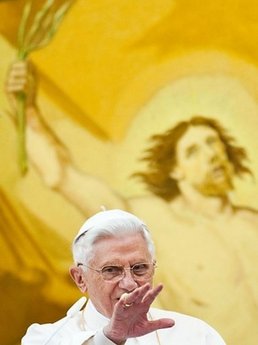
Pope Benedict meets the head of the bank

Associated Press Article below about one of the world’s most corrupt institutions:

ROME (AFP) – Pope Benedict XVI met Sunday with the head of the Vatican bank in a show of support for the banker despite Italian authorities investigating him as part of a money laundering probe, ANSA news agency reported.

The pope received bank president Ettore Gotti Tedeschi and his wife at his Castel Gandolfo residence outside Rome, the news agency said.

“It is an obvious sign of his respect and confidence. The meeting in front of numerous witnesses publicly demonstrated in a clear manner the pope’s closeness and support to the banker chosen to lead the IOR towards complete transparency,” ANSA quoted a Vatican source as saying.

The bank is officially known as Istituto per le Opere di Religione (IOR)  [Office for Religious Works] 

Gotti Tedeschi has been accused of violating laws put in place in 2007 that have tightened rules on disclosure of financial operations to the Italian central bank in a bid to stamp out money laundering.  (guess where the mafia banks?)

The investigation was launched after the financial intelligence office at the Bank of Italy noticed two IOR operations it deemed suspicious.

The first one was a transfer of 20 million euros to JP Morgan Frankfurt, while the other was a three-million-euro transfer to Italian bank, Banca del Fucino, Italian media reported.

Gotti Tedeschi, whose appointment in 2009 was greeted as a move towards greater transparency at the bank implicated in a major scandal in the 1980s, has said he was “profoundly humiliated and mortified” by the probe opened Tuesday.

The bank’s chief executive Paolo Cipriani is also under investigation.

><

More – The Corrupt Vatican…

><

More – JP Morgan & The Vatican = Transparency?