Archive

Tag Archives: Whatever Happened to Ishtar?

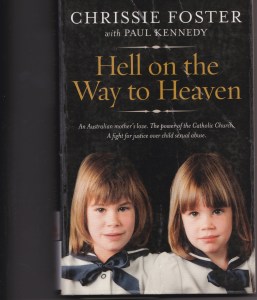
Hell on way to heaven

Emma and Katie Foster 

.Updated 2 November 2016

*****Chrissie Foster, author of  Hell On The Way To Heaven has just been nominated for the 2017 Victorian Local Hero award

At the Royal Commission into Institutional Responses To Child Sexual Abuse, Catholic Archbishop of Melbourne, Denis Hart, made the astonishing statement that “celibacy has worked well for the Church…… men do not need a sexual outlet…..”

He went on to say that if priests couldn’t cope without sex, they were quickly defrocked.  Why were paedophile priests not instantly defrocked, but sent to poor parishes like Ballarat and Doveton, for instance?

Chrissie&AnthonyFoster1

Chrissie and Anthony Foster

Well, I also want to know why thousands and thousands of girls and boys worldwide, over centuries, have been raped by Catholic priests? Celibacy is the biggest joke the Catholic Church has played on us…priests have mistresses, visit prostitutes and rape children!

 Jesus, if he existed at all, was not a celibate; in fact he married twice. Even the most saintly man finds celibacy difficult!

Former PM Tony Abbott, while LNP Leader of the Opposition, a failed Catholic priest, threatened to demolish the Royal Commission by withholding extra funding. It took an atheist female Prime Minister, Julia Gillard, to set up the Royal Commission into Institutional Responses To Child Sexual Abuse.

…………

I have just finished reading  Hell On The Way To Heaven by Chrissie Foster.

Mrs Foster’s story was highlighted when there was a push in Victoria for an investigation into the sexual assault of hundreds of children throughout the state of Victoria by paedophile Catholic priests and Brothers, over several decades.

In the book, Mrs Foster describes how the lives of her two young daughters, Emma and Katie, were destroyed by a paedophile priest. They were both raped at around 5 years of age by Father Kevin O’Donnell who was then aged in his seventies.  Emma and Katie were raped repeatedly over several years and eventually Emma killed herself with an overdose of drugs. She had attempted suicide many times over the years.

><><><><><><>
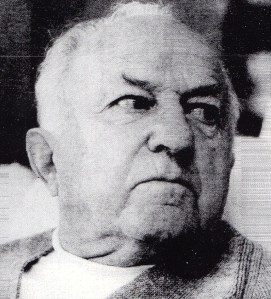
Father Kevin O'Donnell

Paedophile priest Father Kevin O’Donnell

><><><>><>

Katie tried to drown her memories of what Kevin O’Donnell did to her with alcohol and now suffers from severe brain damage.  When Katie was 15 years old she was hit by a car driven by a drunken driver while crossing a road after a drinking binge.  The resultant brain damage left her with no short term memory. The memories of her repeated rape by O’Donnell are the clearest and she lives with them everyday. If that isn’t hell, well I don’t know what is!  The book is harrowing reading because of what a Catholic priest did to these innocent young girls and the hundreds of other boys and girls he raped and sexually assaulted over a period of some 50 years.  There is also evidence that he had young men calling on him in the early hours of the morning for sex. Whether or not he had sexually assaulted these young men when they were boys, we will probably never know.

Mrs Foster blames herself for blindly following her Catholic faith which she believes prevented her from recognising the early signs that her daughters were being sexually assaulted by this beast.  But the really devastating truth about the sexual assault of hundreds of children is that the Catholic Church did nothing to stop it. Over the years several children and their parents complained to Bishops, including George Pell, and other priests, about Kevin O’Donnell’s behaviour, but they were not believed.  Or O’Donnell was shifted elsewhere. One priest told a worried parent to keep her accusation quiet.

Emma and Katie were attending a Catholic school in Victoria when Kevin O’Donnell was the priest in charge of the local diocese. His control was all-encompassing; the local church, local schools, principals and teachers. His commands were law. As Mrs Foster puts it, this was the perfect setup for a paedophile. Without the knowledge of parents, O’Donnell could call into any classroom he liked, request a particular child to go with him on some fictitious errand. Or he would simply walk amongst the children on the playground until he sighted a child who would fulfil his loathsome needs.  He would then take that girl or boy to a locked room at the back of the school hall or a disused Church cottage, and do whatever he liked with them. That was of course after they drank the drugged can of coke he offered them. He was cunning and experienced. To ply these very young children with alcohol would alert their teachers by smell and behaviour, that something was amiss. The children would all have to return to their classrooms after this disgusting excuse for a human being was finished with them. Mrs Foster and her husband, Anthony Foster, never found out what drug O’Donnell used to subdue their daughters, although a doctor did suggest that it was probably some form of valium.

If teachers complained about O’Donnell’s behaviour and his practice of taking children out of classrooms during school hours without parental consent, they bore the brunt of O’Donnell’s foul temper and some even lost their teaching positions. If nuns issued complaints to the Church hierarchy, they were ignored. There was nowhere else to turn; Father Kevin O’Donnell had the diocese and parish in his tight grip. Even when some parishioners were told of O’Donnell’s offending, they refused to believe it and so O’Donnell was able to continue sexually assaulting children with impunity.

Mr Foster is an atheist who had promised to bring his children up as Catholics and send them to Catholic schools as part of the marriage agreement with his future wife, a devout Catholic. Mrs Foster believes it was her own upbringing as a Catholic that allowed her to trust so much in priests. After all, weren’t they the representatives of God here on earth?  Weren’t priests placed in the Catholic community to protect children and support parents?  Even when she thought O’Donnell’s behaviour odd, Mrs Foster believed that he was always right in all things. He took his instruction from the pope who was infallible. To disobey a priest was a mortal sin.

You will be in disbelief, as were the Fosters, at some of the tactics used by the Catholic Church to exonerate itself from any blame for paedophile priests, such as the entrenched loophole in the truth called  Mental Reservation, or mentalis restrictio in the Latin. It is a theological strategy dating back centuries.  In effect, the idea of truths ‘expressed partly in speech and partly in the mind.’ e.g. A priest could answer with lies, obfuscation and ambiguity in court, under oath, but then under his breath tell Jesus that he lied to protect the Church.  This follows Canon Law, but not perjury laws of the Australian Legal system. Survivors of Catholic paedophilia who witnessed Pell and other clergy give evidence,  believe that George Pell, his priests and bishops, used Mental Reservation  time and again to protect paedophile Christian Brothers and Catholic priests, including when answering questions at the Melbourne Royal Commission Into Institutional Responses Into Sexual Abuse Of Children.

I have often wondered over the years if my mother had not been such a devout Catholic, would she have been able to overcome her traumatic childhood? She never stopped praying to God and relying on priests and nuns to help her through all the difficult times. And there were many of those.The Catholic Church always seemed to let her down when she most needed its support. Perhaps if she hadn’t been so indoctrinated, so reliant on a non-existent god, she may have sought some other avenue of support, like professional counselling. When you are in the Catholic system, it is very difficult to get off the treadmill. The spectre of committing a sin, with the prospect of going to hell, is a great deterrent for those with a strong faith. If you needed guidance or counselling, you visited your parish priest.  If you were having problems with your children, you sent them to a priest for a talking to.

Mr & Mrs Foster were hopeful of gaining support and empathy when they were finally given an appointment with Archbishop George Pell after numerous letters, and requests to talk to him, were ignored. They asked him to take action against O’Donnell and had prepared a huge file on the suffering of their two daughters at the hands of O’Donnell. But the newly promoted Archbishop Pell was arrogant, evasive and rude, while refusing to believe that O’Donnell was a paedophile. Pell insisted that…  ‘It’s all gossip until proven in court. And I don’t listen to gossip!’ The Fosters would have to go to court before the Catholic Church would give them financial assistance for all the doctors’, psychiatrists’ and hospital bills that were mounting around the disintegration of their daughters’ lives.  Much later they were offered $50,000 for Emma by Pell, but they would have had to sign a confidentiality clause and would not be able to sue the Church. The Fosters turned it down.

Eventually the Fosters did receive compensation after many years pursuing the Church with the help of lawyers. It’s a testament to this couple that their marriage has survived the years of suffering they and their three daughters have endured at the hands of the Catholic Church. Their youngest daughter only escaped O’Donnell’s debauchery because by the time she was at school, he had retired from the parish.  He died before the Fosters and police could take any action against him.  The Church would protect its priests and the reputation of the Catholic Church at all costs. It was clearly evident in Pell’s actions and his  treatment of the Fosters, that the welfare of the victims of paedophile priests was of no concern to him.  In fact one of the official excuses that the Church relied on was that it was unaware of the harmful effect sexual assault had on children and that’s the reason they hadn’t taken any action against offending priests! Their role was to support priests and shield them from State Law.

I can relate to Mrs Foster’s claim in the book that it was only in the years following the shock of discovering what had happened to her daughters, and the loss of her faith, that she realised how brainwashed she had been by the Catholic system. Going to church every Sunday, regular confessions even though she had committed no sin, prayers every night.  Of course total obedience to priests was mandatory under Canon Law, which she faithfully inculcated into her daughters, as her own mother had done with her. By the time she could see her past without the blinkers of blind trust, she was 40 years old. I was 17 and had just entered the workforce when I began to suspect that what I had been taught in all the Catholic institutions I’d lived in, on and off for the previous 17 years, was not based on reality. But it took much longer to throw off the yoke of indoctrination,

I too had it so clear in my mind, that when I went out into the world, I would be looked after by God because I had been such a good Catholic girl. This is what religious brainwashing does to you. You believe everything priests tell you, even if it overrules what your parents tell you. Or even what common sense might tell you!  I can still remember when I was a little girl in class asking the nun if I had to love God more than my own father. She had just told us that we had to love God more than anyone else in the world because he was our true ‘father’. She insisted that was the case. I never stopped thinking about it and even believed I was committing a sin because I didn’t think I could love God more than my father. But I still trusted in God for everything in life.

Through all that the Fosters were suffering, Mrs Foster researched the way paedophiles groom children for their own sexual gratification. She was part of a group that wanted to alert other parents to the dangers by giving them information to help identify the signs children might exhibit if they were being sexually assaulted. Meanwhile the Catholic Church did nothing to inform parents that O’Donnell may have sexually assaulted their children and to seek help if they had any suspicions.  Mrs Foster also used her daughters’ recollections of how O’Donnell was able to lure them away from safe environments. She tells us that no child can know how to protect themselves from a determined paedophile, and Father Kevin O’Donnell was a paedophile with 50 years’ experience.

Mrs Foster did her best while O’Donnell was still alive, to urge Archbishop Pell to defrock O’Donnell so that he could never use his priesthood to harm other children. But Pell would not hear of it, even though O’Donnell had recently been convicted for several counts of past sexual assaults on young boys. At the time O’Donnell was convicted for these particular sexual offences, the victims were grown men. The police informed the Fosters that these were representative charges only as there were so many it would have taken years for them all to be processed and heard in court! The police were anxious to do what Cardinal Pell & his church would not do; get O’Donnell behind bars where he could no longer sexually assault children. The Fosters’ other concern was that when O’Donnell was released from prison, the fact he was still a priest  would enable him to use his position of trust to go on offending.

When O’Donnell was retired he was sent to live in a unit close to St Mary’s Church in his former parish of Dandenong. He began officiating at Mass on Saturdays. When complaints were made to Father Noel O’Brady that children were visiting O’Donnell at his unit, he took those complaints to the archdiocese.  The ‘appropriate authority’ instructed Father O’Brady that  ‘It’s not happening on Church property…we’re not responsible.’  O’Donnell was supported and protected by the Catholic Church until he died.  It couldn’t have done this if he had been laicised. Obviously the Church knew what O’Donnell had been doing for decades, and right up until the end of his life, his welfare came before the hundreds of children whose lives he had totally destroyed. Many have committed suicide, many will never come forward, most continue to suffer.

I urge all parents who send their children to a Catholic school or intend sending their children to one, please read Chrissie Foster’s book ‘Hell On The Way To Heaven’ if only to be aware of the telling signs that your child might be vulnerable to sexual assault and to ensure that what happened to her beautiful girls will never happen again.

Think clearly and make sure you know what is contained in the Catholic Catechism the schools use to instruct the children in Catholic dogma.

-Anne Frandi-Coory … read more here about ‘Hell On The Way To Heaven’ 

*******************

Visit: Royal Commission Into Sexual Abuse Of Australian Children

><

A Remarkable Book In More Ways Than One

A Remarkable Book In More Ways Than One

>< It’s true – Terroni is a pejorative word as explained by Pino Aprile. However, this is the word Northern Italians use when referring to Southern Italians. The author has written about an Italy that I never knew existed. But then history is usually written by conquerors and oppressors. When I wrote my Italian family history, Whatever Happened To Ishtar?   I had no idea of the massacres, rapes and sackings which took place in the South in the name of RISORGIMENTO (Unification). My mother’s paternal grandfather, Aristodemo Giovanni Frandi from Pisa, (Born in Pistoia, 1833) fought with Garibaldi and before that, as a conscripted soldier with the Austrian army, in the north of Italy.  I know that he followed the Garibaldini to Southern Italy because he and others wanted to rid Italy of foreign armies fighting battles for supremacy in Italy. There was never any mention, as far as I am aware, of the North backing the Risorgimento for the sole purpose of oppressing the South. But then Garibaldi died a broken man, betrayed by politicians he trusted. Perhaps he was gullible too. Aristodemo emigrated with his wife and three children to New Zealand when known Garibaldi supporters were harassed and vilified following the Unification. ><

Aristodemo Frandi blog

Anne Frandi-Coory’s maternal great grandfather Aristodemo Giovanni Frandi

*****************************

One thing Aristodemo did speak of, was the betrayal of Garibaldi and his followers, by priests and nuns, as they looked for shelter and food on their way to the South “to convince Southerners to support the Risorgimento”.

My Greco (Grego) ancestors lost their lands in southern Italy and moved up the peninsula as did many of their compatriots. They eventually emigrated to the UK.

><

Emmie's wedding 2

Anne Frandi-Coory’s maternal great grandparents Raffeala (nee Mansi) and Filippo  Greco 

******************************

Terroni is full of the horrors of civil war, and today the oppression of the South by the North continues. Aprile even discusses the possibility that the ‘elitist’ North is doing everything in its power to divide Italy in half and jettison the South.  The author believes that the people of Southern Italy are set to fight back. Thirteen to twenty million Southerners fled the south during and after the Unification and their descendants now realise what has been taken from them.  Unlike in the past, Southern Italians and their descendants are proud to talk of their history in a pre-united Italy.

This book is a must-read for all Italians, inside and outside Italy, and for anyone who has a passion for Italy.

Thank you Pino Aprile for the courage you have shown in writing this book and for bringing us the ‘other side’ of the Risorgimento.

-Anne Frandi-Coory 23 January 2013

><

email received by Anne Frandi-Coory 8 June 2012:
><
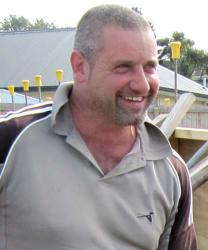
Jason Frandi

Jason Frandi (alleged murderer of Czech tourist)

I know that Jason lived with Arthur [his father] in Waimate and attended his funeral along with his brother or half brother as ———– (my husband) went with them.  After he died Jason purchased his father’s Smith St home in 2005.

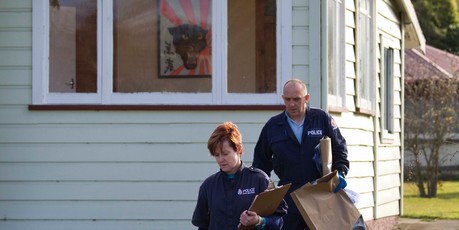
Police search Jason Frandi’s house in Waimate NZ

><
Jason worked in forestry first and set the standard, he was such a hard worker that no one could come close to what he could do in a day.  After that he drove the Waimate rubbish truck and like everything for him,  that was also a piece of cake and he put everything he had into it.  He also worked for Smiths in Timaru driving a digger which was his passion, he would be miles ahead of what anyone else would do and they had trouble keeping up with him.  After that he decided to work closer to home and went to Leethwick’s driving a digger. He was offered a brand new one but Jase being Jase said he didn’t want a new one, what he had was perfectly fine and he would stay on that.  ———- knows what he did between the rubbish truck and Smiths but  I’m not sure.
><
When we built our house Jason came up and cut down the retaining walls, then leveled the dirt for the lawn later.  If he didn’t get it finished that day he would say, ‘don’t worry I’ll be back tomorrow’.  He would sit on the digger all day and refuse to stop and eat lunch or have a break and when it broke he would calmly sort out how to fix it and sort it out without a fuss.
><
He carried a photo of his son ——— in his wallet; when he was up this way he would stop in but after a while would say he had to get going because the wee fella would be awake soon and he wanted to go and visit him.  Jason was so proud but as time went on he saw less and less of his son with his ex partner making excuses. But he would always say calmly with never a bad word, ‘that’s how she wants it then I can’t do anything about it. No point causing trouble and she just makes it harder for me’.  His ex said she [was] allergic to Latex, while they were together she became very moody and difficult so Jase decided to end it later finding out that she was pregnant but I think they had burned their bridges by then and she had decided to make it very hard for Jase to be part of his son’s life.  Jason saw him when he could and was always talking about new things he was looking to buy for him for birthdays and at Christmas time.  It was very sad, he just wanted to be a good dad to his son and not miss out.
><
He was an incredible guy with the kindest heart, respect for everyone and was so much more talented than he would ever give himself credit for.  We’re so extremely gutted we know what we [would] do now and think there are so many things we could have said and done to at least try and help him through his dark patch. I’m sure just knowing there were people that really loved and cared about him, that he could rely on to talk to about absolutely anything without feeling ashamed or embarrassed, and to help, may have stopped him from ever getting to the point he did.  We both agreed today if he was still alive now after what happened we would both still be here for him because the real Jase was just lonely, very troubled and dying for someone to help him with the issues he carried around for so long.
><
He should have been given help when he was in prison in 2001, he admitted then he was crying out for someone to help him and it went completely ignored.  We never asked exactly what happened and I don’t know if anyone ever did; we thought we would be prying and it was just a minor offence until they plastered it all through the newspaper, internet and television recently last month.  It was a secret until it was too late.  I’m angry about the stupid way that makes no sense, it’s too late now so people don’t need to know things with some of it being fabricated anyway.  Your life’s only private until you’re dead and it’s too late.
><
Something that I’ve never forgotten is how every time he was here he would put his hand on the window to leave a hand print in the kitchen or dining room and jokingly say, ‘that’s in case I ever go missing, people will know I was here’. Was that his way of asking for help?
><
I just want to know that he has been put to rest with the respect he still deserved and if it is somewhere public [to enable us to go] and make peace, and to know he is somewhere safe.  It looks as though someone has started or may have finished clearing his house out but apart from that I have nothing.  If you do ever find or hear from anyone can you please let me know or pass on my details so they can contact me; I would be eternally grateful. I really can’t let this go until I know, he meant too much to me to just let it slide.
><
Thank you very much, I’m glad I found your blog and was able to talk to you. x
– From a friend of Jason’s
><

If Jason’s father Ateo (Arthur) Frandi had been reported and convicted for sexually abusing his sister and his step children,  (and possibly others) would Dagmar Pytlickova have been murdered?

_________________________________________________________________

Source for article below: The Christchurch Press 31 May 2012 & Herald Sun 30 May 2012

><

Jason Frandi

>< Waimate police were looking for Jason Frandi the day before his body and that of a Czech hitchhiker tourist were found. Frandi had earlier been informed by a member of the public that a sexual allegation had been made against him and police were worried about what action he might take. The bodies of Frandi, 43, and Dagmar Pytlickova, a 31-year-old woman from the Czech Republic, were found in a rugged forest area near Waimate, on New Zealand’s South Island last  Sunday. It’s alleged that Frandi raped Pylickova before cutting her throat. It’s also alleged that Frandi had admitted 12 years earlier that he planned to rape a young woman and then kill himself. This is a pretty chilling scenario considering what happened at the weekend. Frandi was jailed for three and a half years in 2000 for abducting a 19-year-old Oamaru woman, with the intent of having sex with her.  Media reports at the time said the woman was pushing her bicycle down the street when Frandi forced her into his vehicle. Police praised a bystander who heard her screams and tried to intervene, grabbing the door handle then taking the registration number of the car as it sped off.  Despite his previous convictions, police weren’t keeping a specific eye on Frandi.  Pytlickova, also known as Dasha, arrived in New Zealand in January and had been working at a Cromwell-area vineyard until recently, police said yesterday.  They said she left Cromwell on Saturday and was hitchhiking to the Timaru area when she was picked up by Frandi somewhere between Omarama and Kurow. His car was found parked among some trees near Waimate yesterday, and the hitchhiker’s back pack was found inside the car. ><

Czech Republic tourist, Dagmar Pytlickova

><

Police believe the pair walked from the car to the spot where their bodies were found by charity event riders, about 3km away. Empty alcoholic drink bottles were scattered around the scene.  Pytlickova’s mobile was turned off at 6.40pm.  Autopsies were conducted yesterday in Christchurch.

Frandi was known around the community as a man with a troubled past.  “I know he could be violent when he was drinking,” resident Annette Dungey, who had known him for many years, said.  “I know that because he told me himself.”

_______________________________________________________________________

See my essay   My Right To Write My Memoir is it right to expose inter-family abuse?


I found the above news item particularly disturbing in view of that fact that Jason Frandi  was a member  of my maternal extended family. I wrote a book  Whatever Happened To Ishtar?; A Passionate Quest To Find Answers For Generations Of Defeated Mothers’  (published 2010 and 2014) after interviewing descendants from the Lebanese and Italian branches of  my family tree, and perusing myriad documents.  In this post about Jason Frandi’s background, I am concentrating on the Italian branch.  During research for Ishtar? I discovered an Italian family history of abandonment, and sexual and physical abuse.

There were many reasons why I wrote ‘Ishtar?’ and although I started writing to exorcise past demons, among them to understand why my own mother, Doreen Frandi, abandoned me when I was an infant, it quickly developed into a far-reaching saga.  See  Letters to Anne Frandi-Coory

Jason Frandi  (43) was the son of Ateo (Arthur) Frandi, b. Wellington, 8 April 1934.  When I interviewed Arthur’s immediate family for my book, they told me that Arthur sexually assaulted his younger  sister in their family home when he was a  teenager.  The only reason the abuse stopped was because Arthur was caught abusing his sister by another brother. Consequently, no other family members knew of the abuse, and it was never reported to police. Following the failure of Arthur’s first marriage to Jason’s mother, Arthur married a woman who had four children from a previous relationship. The marriage broke up when his wife discovered he was a paedophile who had been molesting her children.  I have carefully contemplated this section of the Frandi family history and I wonder whether the rape and  murder of an innocent tourist, Dagmar Pytlickova, by Jason Frandi in May 2012 could have been prevented if his father had been brought to justice many years ago. It appears that Arthur was an abuser from a young age, and there is the possibility that there are many more of his victims out there who are yet to come forward.   It is also possible that Arthur sexually abused his own children, including Jason.

The Frandi family history seems to have taken a wrong turn when Jason’s ancestors, my great grandparents, Annunziata and Aristodemo Frandi fled Italy in 1875 and settled in the barren and wind-swept Okuru Settlement on the West Coast of the South Island of New Zealand.  I can’t know for absolute certainty, but according to the Frandi family, their life in Italy was privileged until  the aftermath of the Garibaldi uprising and Risorgimento (Unification). The environment  at Okuru was harsh with no medical facilities, no schools and a lack of food supplies. After persevering at a subsistence level for almost four years the family was moved to Wellington in the North Island, at the cost of the NZ government.  The three children Annunziata and Aristodemo brought with them from Italy were the stalwarts of the family, but later born siblings seemed to have been hewn from a different mould. During my research, I uncovered another paedophile within the family’s ranks, and I write about that extensively in my book.

My grandfather Alfredo Frandi was the youngest son of Annunziata and Aristodemo, and Arthur’s grandfather Francesco was their oldest son.   Francesco had three sons including William who was Arthur’s father.  I interviewed William’s middle son extensively, (Arthur was his oldest son) as well as his wife who told me that her husband had a violent ‘Frandi’ temper which terrified her and her children at times. He also had a severe speech impediment which he himself put down to very poor communication and his deep fear of speaking when he was a child.

This is a small window into the extended family my mother was born into; she witnessed horrendous violence toward her own mother at the hands of her father, Alfredo.  The question is, how much family violence is due to environment and how much is genetic? William Frandi  was abandoned by his mother when he was a toddler and he never really overcame his deprived childhood . She ran off with another man and later moved to Tasmania, and he never saw her again. He had a large extended family who did what they could for William, his two brothers and sister, but the damage was done. All four adult siblings were considered either ‘strange’ or ‘intellectually slow’. All had very troubled and unsettled early lives. According to William’s family, he was a man of very few words and barely spoke to his sons at all. He moved to Waimate soon after his marriage to escape the gossip about his mother.  William was too timid to approach a girl in person so he put an advertisement in the local paper, and eventually married a woman from England.

After writing Ishtar? I came to the conclusion that perhaps one of the best things that ever happened to me was that I was placed in an orphanage at ten months old, as traumatic as that turned out to be.  In my case, I hope it is nurture over nature.

><

Jason Frandi – He Was My Friend

Excerpt from ‘Whatever Happened To Ishtar?; A Passionate Quest To Find Answers For Generations Of Defeated Mothers’ 

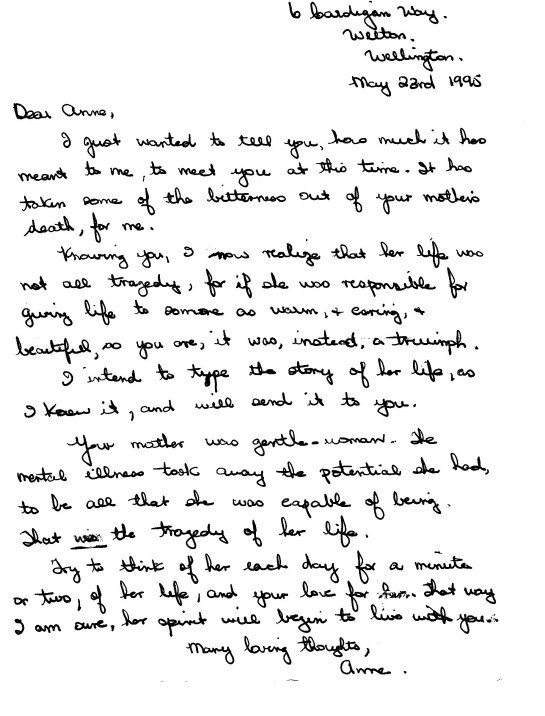
The following letters were written by Anne Frandi Albert to her niece, Anne Frandi-Coory, following the death of her mother, Doreen Marie Frandi.  Anne Albert died in 2001 shortly after writing the last of several letters to her niece, but if she had not met her niece at Doreen’s funeral. the two would not have known each other and there is so much about Doreen’s life that her daughter would never have discovered.

><

***This page is ©copyright to author Anne Frandi-Coory. All Rights reserved 1st  April 2012. No text or photograph can be copied or downloaded from this page without the written permission of Anne Frandi-Coory.***

><><>

Doreen Maria Betty Anne

Doreen Frandi, Maria Frandi (mother of the other 3 women) Betty Gentz, Anne Albert

***************

img20180704_16110931


**************

Letter from Anne Albert 2


Doreen was such a beautiful child that on the ship which brought her, her brother and parents to New Zealand, a genuine childless couple offered her parents money to allow them to adopt her.  Doreen had a cloud of bright red curls that framed her pretty face.  How different Doreen’s life would have been had the adoption gone ahead.  Life within the Alfredo Frandi family was an uneasy one, so inclined was he to uncontrollable bouts of violent rage, during which he would throw furniture around the room and punch holes in doors.  Often it was his wife, Maria, a pale and nervous woman,  who felt the force of his fists.  Maria was in a perpetual state of acute anxiety and her concern about their lack of money exacerbated this state.  Alfredo was a labourer and work was hard to come by.  They had four children they could barely feed and clothe so any subsequent  pregnancies were aborted  with a knitting needle.  Unfortunately, as the oldest daughter, Doreen was needed to assist with the cleaning up after these procedures.  Maria had no conception of the trauma this was causing her daughter, and which was to haunt Doreen for the rest of her life.

When Doreen was sixteen years old, I was born, but I have never quite known why I was not aborted.  I can only suppose that my mother may have been experiencing symptoms of the menopause and may have been unaware of the pregnancy in  time.  So unexpected was my birth, that an apple crate was all that my parents had to lay me in.  Doreen was thrilled about the new baby and set about lining the crate with material and making it look pretty for me.  This was the beginning of Doreen’s devotion to me which was to last all her life.

Doreen was a very gentle girl and she was a help to her mother in caring for  the younger children, but she loathed house work of any kind.  She was adept at shopping for bargains and was a very good sewer.  Catholicism began to influence her life early on, as it brought her a peace and beauty so missing from her home environment.  Significantly, the nuns at the convent school she attended, recognized her potential for a vocation and one nun, Sister Anne, encouraged Doreen all she could to think about entering the convent.  As Doreen approached womanhood she exhibited no interest in boys or other worldly things, so firmly were her sights set of becoming a Catholic nun.  Alfredo was dead against his eldest daughter becoming a nun and turned the house upside down to show how much he detested the very idea.  This turmoil only made her more determined, and after a short time working in a department store and following her debut at the annual charity ball, for which she made her own stunning gown,  Doreen entered the convent. 

><><><

Doreen's debut

Doreen’s Debut in the dress she made herself

><><><

Initially Doreen loved her life as a nun, but after almost a year of doing nothing but housework, she asked if she could train as a nurse.  Her wish was to care for severely handicapped children.  However, her request was greeted with profound disapproval because to actually ask to be able to do what one wanted, was against the very  strict rules of the convent  as well as a denial of the vow of absolute obedience.  Doreen was severely reprimanded and as a result sunk into a deep depression.  The nuns could not understand Doreen’s depression;  they believed that if you had a true vocation faith was enough to protect you from such things.  They then put pressure on Doreen constantly questioning her commitment to her vocation.  Doreen became hysterical which appalled the nuns, and they subsequently demanded that her mother remove her from the convent.  They could not know that bi polar disorder was manifesting itself in Doreen and would consequently ruin her life.

Doreen recovered very slowly from her first breakdown but she was devastated that her vocation was at an end and that she had broken her vow to God.  Doreen did  finally find acceptance and there followed a succession of jobs, which began a pattern set for the rest of her life;  employment interspersed with breakdowns.  In the 1940’s not much was known about bi polar disorder nor were there any satisfactory drugs available at the time.  Doreen was then subjected to countless ECT treatments without anaesthetic which really amounted to torture.  Around this time Doreen’s Aunt Italia, Alfredo’s only sister who was then 70 years of age, decided to take more of an interest in her niece. Italia  regaled Doreen with stories of the privileged   life the Frandi family lived in Italy before they arrived in New Zealand [Italia was born in Pisa, Italy in 1869]. Aristodemo, Italia’s father, had to flee Italy because he was a political agitator alongside Garibaldi, and Italia showed Doreen the fine silver and linen they had brought over with them.  Italia also dazzled Doreen with stories about the family riding in a grand carriage and people bowed with respect for them. Whenever  Doreen  was in the manic phase of her illness, she had illusions of grandeur, and would repeat all that her aunt had told her about their previous  life in Italy.  In these early stages of her illness, Doreen would spend money she did not have and would charge up accounts to her Aunt Italia and sometimes even stay in expensive hotels, all charged against her aunt’s name.  Following these episodes Doreen would then sink into the depths of depression. 

Shortly before the end of the war Doreen joined the Air Force.  It was while she was in  the Force that Doreen met the father of her first child, Kevin. Phillip Coory  neglected  to mention that he was already married with a young  son, Vas, until Doreen informed him  that she was pregnant.  Phillip Coory  believed at the time that that was the end of the matter and he had rid himself of her, but then his brother Joseph came on the scene.  Joseph was a kind and simple man, who did his best to make Doreen happy.  Sadly, his family conspired  against Doreen from the outset; perhaps they did not approve of her good looks or the way the marriage came about.  The marriage ended in disaster;  Joseph was not her intellectual equal and her illness would have been extremely difficult to live with. About three years after their marriage Anne was born and eighteen months later, came Anthony.  Following a severe bout of  bi polar disorder, the children were taken from her and placed in an Orphanage for the Poor in South Dunedin.

The permanent loss of  her children caused Doreen great anguish from which she never really recovered.  In later years she had contact with her daughter Anne, but Doreen was never able to accept that the child did not blame her mother for her abandonment.  Years later, her youngest son, Anthony moved to Wellington to live, but that feeling of guilt never left her and obviously prevented her from having an emotional relationship with her son, although he did make a futile attempt at it.  Doreen and Kevin lived a life of great hardship and near poverty, with Doreen frequently suffering nervous breakdowns, which culminated in her being  admitted to Porirua Psychiatric Hospital.  Kevin had to learn to deal with his mother’s extreme mood swings from a very early age which made his young life intolerable at times.  I have no idea how she coped during those years but I am sure that sometimes  she must have prayed for death, yet through it all her faith in God  never wavered and carried her through until the day she died.

At the peak of her loneliness, Doreen met a man, Edward Stringer, and spent a night with him.  Of course, given her luck, or lack thereof, it ended in pregnancy.  During the weeks after the birth of her daughter, Florence, and suffering from depression, Doreen signed adoption papers for her daughter.  Sometime later, Edward and Doreen met up again, and with the sole intention of getting her daughter back, she married Edward.  Heartbreakingly for Doreen, it was much too late; the adoption was quite legal and binding. Once again life had defeated Doreen and during a severe bout of mania, Edward left, unable to cope with his new wife’s disorder.  From this, there followed a period of dreariness, when Doreen and Kevin lived in a state house at 56 Hewer Crescent Naenae, Lower Hutt in Wellington, and she obtained a reasonably stable job in a factory close by.  At least the disorder left Doreen in peace for an extended period, in which Doreen developed a love of cats, and she had up to six at one time or another.

Kevin started up a very successful restaurant, Bacchus, in Courtney Place in Wellington.  Doreen was employed by Kevin in the kitchen of the restaurant, and she appeared to enjoy her time there.  Sadly her mother died on 10 March 1980, which caused Doreen to have another nervous breakdown.  Following her recovery, Doreen retired from work and moved into a council flat in Daniell Street, Newtown in Wellington.  During this time, she appeared to me to be doing no more than going through the motions of living.  My heart ached to see her like that, with no apparent interest in anything.  Kevin’s bankruptcy and his consequent  permanent move to Sydney, took the utmost toll on her spiritual well being.  Doreen then lapsed into a serious bout of her  disorder, suffering yet another complete nervous breakdown, and she was admitted once again to Porirua Hospital for a considerable time.

I have no doubt whatsoever, that it was not only Doreen’s manic depressive illness that had such a destructive effect on her life.  I sincerely believe that she carried guilt feelings from her experiences as a young girl,  witnessing  her mother’s self inflicted abortions, made worse by Doreen’s Catholic beliefs.       I realized this to be true, with great clarity, when I visited her at the hospital during her final stay there in 1995. She led me out into the hospital gardens, and pointed to a bed of purple pansies in bloom.  “There you see” she told me with infinite sadness, “there are all the little babies”  – Anne Albert.

><><><><

Letter from Anne Albert 3

*****************************

Copy of Doreen's headstone

Whenua Tapu cemetery, Wellington, New Zealand

*********************************

Read more here:My Mother Was A Catholic Nun 

********************************************

Doreen’s Children….

Kevin

Kevin Coory

Anne and Anthony at first Santa photo session

Anne and Anthony Coory

n1599200414_105847_5269

Florence – adopted out (now Hudayani Gleeson)


Vincent aka Bruce 2

Bruce – adopted out (now Bruce McKenzie)


**************************************

More:  ‘Whatever Happened To Ishtar? – A Passionate Quest To Find Answers For Generations Of Defeated Mothers’

***This page is ©copyright to author Anne Frandi-Coory. All Rights Reserved 8th  March 2012. No text or photograph can be copied or downloaded from this page without the written permission of Anne Frandi-Coory.***

Anne blog

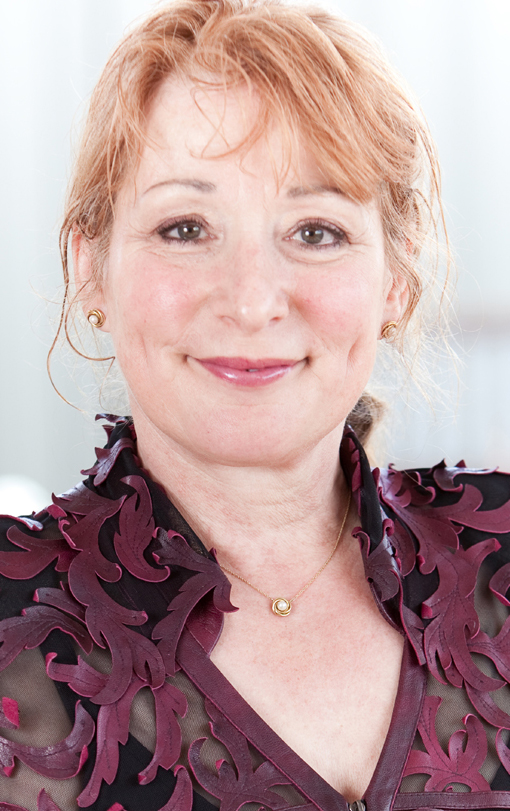
Anne Frandi-Coory 2010

Since I wrote ‘Whatever Happened To Ishtar?’ in 2010, a tell-all book about life within immigrant Lebanese and Italian families, I have received thousands of hits on my blog. Some relatives’ views are critical of my baring family ‘secrets’ for all to read. Some refuse to read the book. Most descendants of the people, places, I write about, along with the photos that have come to light, are appreciative. The majority of readers say they empathise with what I have to say in the book; that it has influenced them to be more tolerant of mental illness, and to understand more deeply, the emotional harm that can be caused to children, when they and their mothers are constantly abused, vilified and demonised.

The very personal memoirs I write about, including my own, are told with heartbreaking honesty because sometimes you have to shock readers into the realities of life for those women and children who are abused, neglected, and who have no safe haven.

There are times in life, in every culture, when marriages fail, parents die or become ill, families fall on difficult times.  Everyone understands this, and we have to make the best of it. However, when physical and emotional abuse is meted out to innocent children by their own family, then that is entirely another matter.  The same is true when children witness that same level of abuse toward their mothers. The post traumatic stress that grips these vulnerable children, can be every bit as devastating as that suffered by children who have lived in the midst of a violent war.

><

Anne's first year at St Patrick's

Anne Frandi-Coory at Catholic Mercy Orphanage for the Poor in Dunedin, New Zealand

><

This is the premise of my book. Motherhood and childhood can be difficult enough, but when you are alone, with no family support, life is precarious. I researched my paternal Lebanese and maternal Italian family histories extensively for the book, but nothing could have prepared me for the soul destroying stories I uncovered; the brutality of husbands and fathers, the sexual abuse, the hypocrisy and heartlessness of the Catholic Church.  Not to mention the fateful abandonment of children by their mothers. But the most fundamental insight I gained from all the research, is that, like ripples in a pond, the ongoing psychological effects are transmitted down through succeeding generations.  As one of the reviewers of my book wrote:


“What is ironic is that she [Anne] uncovers the rich cultural history of these families and the fact that such wonderful traits and traditions were all but lost to modern generations as her family tree fractures again and again.”


Someone has to be brave enough to tell the truth. Powerful families can leave children they do not favour, on the scrapheap of life, with no prospect of being accepted into other good families within their community, either through marriage or friendships. They are ‘tainted’ goods, and have to break all family ties just to survive.  Few people who have not experienced this life event can comprehend the courage it takes to wipe all your extended family from your life, even an abusive family. It can take years for the emotional scars inflicted on such children, to heal. An adult deprived of a loving childhood has to learn how to play, to make lasting friendships, in effect, to be ‘socialised’ at the same time as healing is taking place. It takes enormous amounts of energy and soul searching. This is vital if they are to become a contributing member of the community they eventually choose to live in. Some of us make it, many of us don’t.

The answer isn’t just in education, although of course this is important. The answer lies in the memoirs left behind, the minutiae of everyday lives within abusive families, because if we don’t read our negative history, whether it’s family, country, or world history, how are we going to know what changes to make so that what happened in the past, isn’t perpetuated into the future.  Very often, personal stories can be the motivation to change behaviours and even laws. Because when we read these survivors’ biographies, we are in a way, walking in their shoes, reliving with them all the abuse and trauma. I know that it can take decades to change entrenched cultures. But even one person can make a difference, in one lifetime.

Published in The Australian Writer issue #377 December 2012

<><><><><><><><><><><><>

Poem PHOTOGRAPH and Photographic Image  © Copyright To Anne Frandi-Coory

– All Rights Reserved  7 February 2012 

*****

My poem *PHOTOGRAPH

Dedicated to my Lebanese father, Joseph Jacob Habib Eleishah Coory

Photograph

A fleeting encounter

like an unopened rose

remains eternally

inside a withered heart

never to blossom

on a summer’s day

never to slowly fade.

Time mellows into memory

his face, his voice

cushioning past intensity

once a storm

now just a photograph

The man who was but shouldn’t have been

**********

My father Joseph, a long awaited first son, was a very sick new-born who wasn’t expected to survive. But against all odds, he lived. However, so certain were his parents that he would not survive, they neglected to register his birth. He spent the rest of his life, prone to illnesses. He ate a very limited diet and for all legal matters used another Lebanese man’s birth certificate, whose surname therein was spelt ‘Coori’.  When I discovered my father’s fake birth certificate with the misspelled name and the wrong birth date, I assumed that the department of Births, Deaths and Marriages in Dunedin, had made the mistakes. During my extensive research into my Lebanese family tree and history, the truth was laid bare. – Anne Frandi-Coory

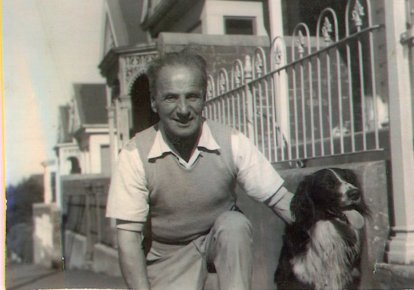
BELOW: Joseph with his beloved dog, Tim, outside 103 Maitland Street, Dunedin, New Zealand, where I lived with him during my early teens. 

Joseph and Tim 103 Maitland St Dunedin

*******************

 DRAGONS DESERTS and DREAMS

*****

2nd edition (2020) Dragons Deserts and Dreams

Available now in Kindle e book and paperback 

HERE at AMAZON BOOKS 

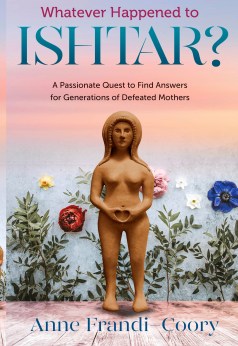
Whatever Happened to Ishtar_cover 2020

Excerpt below from WHATEVER HAPPENED TO ISHTAR? A Passionate Quest To Find Answers For generations of Defeated Mothers. Read more about my book HERE: https://frandi.wordpress.com/2010/04/15/publicaton-of-whatever-happened-to-ishtar/

*****************************************************

***This page is copyright to author Anne Frandi-Coory. No text or images can be copied or downloaded from this page without the written permission of Anne Frandi-Coory.***

Painting below, by Anne Frandi-Coory – acrylic on board and framed.

………………………………………………………………………….

Doreen Marie Frandi

Several times I had offered my mother the airfare to come and visit for Christmas, or at some other time, but she always refused. She was always in my thoughts, as I knew she would be missing Kevin dreadfully; this son who’d been everything to her for most of her adult life.

I visited her  a couple of times, as I longed to talk to her and ask her about her life, but she barely spoke. By then, her bipolar disorder, the drugs and the electroconvulsive therapy (ECT), had taken their toll on her mental faculties. For, as any person with experience or knowledge of this disorder will tell you, the cure can be worse than the disease; vitality and creativity are sucked dry and emotions are flattened – their whole personality, the person they are, is suppressed.

Once when my daughter Gina and I visited my mother in her little council flat in Newtown, we just sat quietly with her. In an attempt to extract some response, I asked her mundane things like what she was eating, what pills she was taking, anything to make conversation with her, but it was very difficult. She did explain, however, that the pills she was taking ‘stop me feeling anxious all the time’. Her emotionless voice filled me with sadness; her response was to please me, a rehearsed phrase. My heart ached to just take her in my arms and cuddle her, but whenever I had tried to do so, it was like cuddling a piece of wood. Gina and I had planned to spend the day with her, but Gina left for about two hours to visit a friend nearby. My mother and I were left sitting in her pint-sized sitting/dining room, she chain-smoking all the while. I tried again.

‘Do you have any photographs we could look at?’

‘No’ was the soft reply, ‘I sent them all to my sister Betty in America’.

Whenever I think back to that day and her answer, I feel like weeping. She answered my question as though I was a stranger of whom she felt apprehensive. I always got the impression she was anxious I would suddenly confront her about her abandonment of me, so I tread very gently. As we sat on her couch, waiting for Gina’s return, she suddenly turned to me in a cloud of smoke and said in an unusually confident tone, ‘You have a lovely daughter, Anne’. That was it. She turned away again and reverted to her state of narcosis; her fallback position, puffing away while gazing fixedly at nothing in particular.

The years of ECT and powerful mood-control drugs had eliminated every shred of my mother’s vibrancy that I remembered as a child. That bright red hair, that dazzling smile that had once propelled me to obsessively search for her everywhere among the crowds in Dunedin was gone.

ECT was introduced into Porirua Psychiatric Hospital in 1944, where it was used without anaesthetic on patients suffering from acute depression or ‘over-excitability’. My mother was admitted there again and again from the late 1950s onwards, sometimes in the throes of psychotic delusions. Towards the end of her life she would admit herself, looking for comfort and safe haven from the relentless demons which never allowed her any solace in her life, not even at the end of it. When Gina returned from visiting her friend, my mother decided to make us a cup of tea, and as she pottered in her cupboard of a kitchen, Gina said to me gently, ‘Mum, she is never going to love you’. My heart broke again. I didn’t want to hear that, not even as a woman fast approaching middle age. But I knew in my heart that she was too terrified to love me, or anyone else for that matter, except Kevin. She knew the terrible cost and she’d lived her life with the overwhelming guilt of it all.

><

I loved my mother dearly, and if not her physical being, which, sadly no photographs of her and her children together can bear witness, and without remembered mother and daughter cuddles, then certainly, through a deep primal memory of her, which is still with me today and often overwhelms me. I emotionally clutch my childhood memories, of fleeting visits with her in Dunedin that my father secretly instigated, and the ones when she would creep somewhere to snatch a moment with me, no matter how fleeting. What haunts me is that radiant smile that had a way of spreading over her face and crinkling up her eyes, all framed in wild red hair. I wonder, how did she manage that smile while living in her hell? Those must have been the only fleeting joyful moments in a lifetime for her.

…..

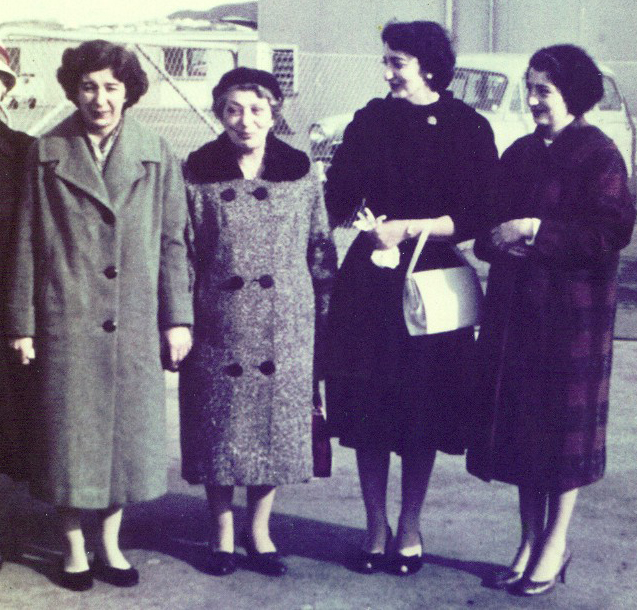
Frandi girls

Anne Frandi-Coory’s mother Doreen Marie Frandi and her two younger sisters

Excerpt from ‘Whatever Happened To Ishtar?; A Passionate Quest To Find Answers For Generations Of Defeated Mothers’ 

><><

***This page is copyright to author Anne Frandi-Coory. No text or images can be copied or downloaded from this page without the written permission of Anne Frandi-Coory.***

><><>

Granddad Jacob, that’s an amazing spiritual journey….

jacob coory fb 2

Jacob Coory (Fahkrey), my grandfather, as I remember him. (photo: Wendy Coory Gretton)

><><

My extensive research into the murky past, which was partly buried in the Aramaic language and ancient names, reveals how much I didn’t know about my paternal grandfather, Jacob Habib El Khouri Eleishah Fahkrey. Nevertheless, my limited personal contact with Jacob left a significant impact. I deeply mourn that he died before I ever had the chance to talk with him about our extremely rich genetic and cultural heritage. If only I’d known as a child that he was such a valuable resource for our Lebanese family history. But then, what child can really comprehend such a thing? That, beyond their narrow sphere of existence, a family history has been woven as intricately as any tapestry, replete with human drama, personal tragedy and war, set in countries at opposite ends of the world. As a child my whole world stretched no further than a few urban blocks in Dunedin – The Catholic orphanage at one end and the Coory family home at the other.

Jacob and my grandmother, Eva, both spoke a Semitic language, an ancient form of Aramaic. Jacob’s forebears most likely descended from an ancient tribe of Israelites originating in the ancient Canaan, now known as Israel and Jordan. From there, some Canaanite clans including, I believe, those of Jacob’s distant ancestors, migrated to the rich and ancient area in the plains of Mesopotamia, close to the life-giving Euphrates River. There is linguistic evidence the Semitic tribes first arrived in Mesopotamia around 4000 BCE. The Aramaeans (speakers of Aramaic)  were a nomadic tribe when they first encountered Mesopotamia. Over the centuries they gradually moved in a westerly direction then south down the Euphrates River, eventually settling in to form kingdoms. The consolidation of the Aramaeans into settled kingdoms allowed the re-establishment of the trade routes through Palestine (Philistine) and Syria, and allowed the temporary Israelite expansion. Some of the Aramaean tribes continued to migrate west across Mesopotamia, their fortunes greatly improved due to the relative stability of the settlements in the area.

><<>

jacob&eva

Jacob Fahkrey (Coory) on his arrival in New Zealand c.1898

><><

Early Coory Clan

L to R: Amelia, Jacob with Phillip on his knee, Michael, Joseph (Anne Frandi-Coory’s father), Elizabeth, and standing at rear is Eva holding Neghia

><<><><><><                                                                                                                                                           ><><><><><><>

The Bible mentions the Aramaeans and links the Israelite Patriarchs with them. The ancient Israelites had to profess their faith by pronouncing ‘my father was a wandering Aramaean’. It was probably during their settlement in Mesopotamia that the clans mixed with the seafaring Phoenicians, recorded there as early as 2300 BCE. The first key port of the Phoenicians was at Sidon in Lebanon. For the remainder of the pre-Christian period, around 300 BCE, Mesopotamia was safely in the hands of the Seleucids (Greeks) while the two-millennia-old Babylonian civilisation was dying. Since the turn of the millennium, both socially and linguistically, Aramaeans had been penetrating Babylonia; their tribal systems overtook the cities, and their language eventually superceded the ancient Akkadian.

Some of the native Syriac dialects, as well as ancient Hebrew, merged with Aramaic, one of the Semitic languages which has been known since almost the beginning of human history. The Semitic languages, which include Hebrew, Arabic, Akkadian, Aramaic and Ethiope, were first glimpsed in ancient royal inscriptions around 900-700 BCE. The Aramaeans introduced their language to Syria when they settled there during the second millennia BCE. The Persians gave Aramaic official status, and throughout the Greek and Roman eras it remained the principal vernacular language. Babylonian and Persian Empires ruled from India to Ethiopia, and Assyrians employed Aramaic as their official language from 700-320 BCE, as did the Mesopotamians. The Aramaic script in turn derived from the Phoenicians, who most likely extracted it from the Canaanites. Writing derived from Phoenician, began to appear in Palestine around the tenth century BCE.

><><><><><><><><><><><><><><><><><><

map Middle East

National Geographic Map of Ancient Middle East

><><><><><><><><><>><><><><><><><><><><

There is general agreement among scholars that the linear alphabet had its beginnings somewhere in the Levant during the second millennium BCE. The Etruscans were the first among Italic Peoples to adopt the linear alphabet script and it spread rapidly throughout the Italian peninsula. The Phoenicians and the Etruscans had close trading and religious ritual links. These days, Aramaic is only spoken by small Christian communities in and around Lebanon, and in a small Christian village in Syria. The word Aramaic derives from the word Aram, fifth son of Shem, from which the word shemaya (semitic for ‘high up’ or ‘mountain’) is derived. Around 721-500 BCE, the ancient Hebrew language of the people of Palestine was overtaken by Aramaic, and much later the message of Christianity spread throughout Palestine, Syria, and Mesopotamia via this Semitic vernacular. Aramaic survived the fall of Babylon in 539 BCE and continued to be the predominant language. But Arabic spread and gradually took over as the lingua franca in the Middle East, around the thirteenth century CE. It seems reasonable to assume that, as speakers of this ancient language and in conjunction with their familial names, the Fahkrey forebears were originally members of a Judaic tribe, the Canaanites, who, over the centuries, mixed with other ethnic groups such as Hittites, Phoenicians, Akkadians, Greeks, and Macedonians to name a few. The word Fahkrey probably derives from the Aramaic word fagary, which means ‘the solid one’. There is plenty of evidence to support this, as Jacob and his descendants are of short, stocky build with strong arms and legs.

Many Canaanite menhirs (religious rock emblems) have been found in Lebanon and Syria. It’s interesting to note that at Baalbek, in the mountains of Lebanon, there is evidence of sacred ritual prostitution (male and female); a long-established Phoenician institution, associated with the cult of Astarte, the Goddess, also called Ishtar (Esther). Within the Phoenician realm, the great mother goddess Ishtar/Astarte was venerated in caves and grottos. A number of these sacred caves later evolved into sanctuaries dedicated to the Virgin Mary. Adoration grew into a cult, elevating Mary to the status of ‘Protectress of Lebanon’. My paternal family’s stocky build, soft round features and fairer complexion add a little mystery to their ancestry in a region where many inhabitants have dark features.

We have very little archaeological or written evidence, and so much of this history is conjecture. What we do know is that the Greeks overran and were prominent in the Levant from at least 1200 BCE. The Romans invaded in the first century BCE and Roman rule strengthened after this time. Judea later became a Roman province. And there were other ethnic groups which invaded the area from time to time in between. Ancient Damascus played an important role in the destiny of the Fahkrey tribe. Around the ninth century BCE, Damascus’s political and economic strength enticed both Palestinian Kingdoms , Israel and subsequently Judea, to seek alliance with it. At the time there was a direct and vital communication route between Tyre in Lebanon and Damascus via the Beqa (Bekka) Valley.  In 64 BCE Damascus had become part of the Roman Empire and thrived as a city-state, converting to Christianity very early on in the Christian era. The leaders of the Roman Empire would later see the infrastructure of the Catholic Church as a beneficial conduit of power for their vast empire and name it as their official religion…

During the 630s CE, Jacob’s distant ancestors were on the move again towards Damascus, ahead of the Muslim armies rampaging across the Arabian peninsula. Muslim armies attacked and eventually occupied Damascus in 635 CE, then converted Syria to Islam. Those tribes living in and around Damascus would have been familiar with the safe haven of Bcharre in the hills of Lebanon. Damascus is the oldest continuously inhabited city in the world and was once a central sphere of  influence and prosperity. Around the fourteenth century our Fahkrey ancestors moved on from Damascus and up into Lebanon’s protective mountains…

<><><><><

The Roman Catholic Church aligns itself with the Maronites  (the religion of my grandparents) in the mountains of Lebanon:…

More Here: THE MARONITES IN HISTORY

<><><><><><><

More…..Walking Around Lebanon With 2Famous

Updated 30 June 2015

Comment  on my post dated 9/12/2011,  from David Anthony in America:

To Anne Frandi-Coory: – What a touching note.   [from post: My Father, Joseph Jacob Habib Eleishah Coory].

Anne blog

Anne Frandi-Coory

><><><><

David writes: You mention Aramaic: I have a little story for you…

About 30 years ago, about 1978-1980, my jidoo [grandfather] was visiting my house when a distant cousin from Lebanon visited.  My jidoo’s parents came to America in 1892. He was raised speaking what he and we thought was Arabic. He spoke it fluently- after all, it was what was spoken in his household growing up.

Well, when my cousin, who recently came from Lebanon fleeing the civil war, visited, they (my cousin and my grandfather) both spoke to each other in [what they thought was] Arabic. They couldn’t understand one another. My cousin said my grandfather wasn’t speaking Arabic, but a language much older. He said it was like an Italian listening to Latin.

So I came to find out that my jidoo didn’t really speak Arabic. The language he spoke so fluently was ancient Syriac- as you know, a version of Aramaic. The “Arabic” words I picked up as a youth tended much more towards Aramaic. In fact, many years after my jidoo passed away, a very good friend of mine from Zahle told me that the few Lebanese Aramaic words my dad and I spoke had a strong northern (Ehden) accent. :-)

Just one other note: Anxiety runs rampant in the Lebanese side of the family. For some, the levels of anxiety run so high that it’s disabling. I’m wondering if there’s a similar issue in your family.

Two reasons; 1) Lebanese boys were forced to sit in the back of all classes. Italian and Irish boys sat in front. 2) As my dad had terrible nearsightedness, and he wasn’t allowed to sit in the front of the class because of his skin color, he could never see the blackboard. In order to take any notes, he’d copy notes from the student sitting next to him. When he got caught by a nun, which was often, he’d get sent to the Principal for copying notes. The Principal would tell him to put out his hand, which would then get beaten pretty badly.

Finally,one day, when he was in 8th or 9th grade or so, he came home with such a beaten hand that my sitoo [grandmother] noticed. After she insisted he tell her what happened, my dad then explained what happened. Right away they went and bought him his first pair of glasses. After that, he could see the blackboard better- and his grades went sky high.

But the damage was done. By tenth grade, he left school to work in a factory, partly driven, I’m sure, by the beatings.– David Anthony.

><

A very old photo of my grandmother, Eva Coory’s mother and brother, taken in Bcharre, Lebanon.

><

Dear David

How wonderful to hear your story. Yes, Aramaic is derived from an ancient form of Syriac and is now spoken only by small pockets of Syrian peasants and by Maronites in Bcharre, Lebanon. It was also the language that Jesus spoke. I did much research into my grandparents’ history and the history of Lebanon in general. My grandfather’s ancestors moved to the hills of Lebanon (Bcharre) around the 14th Century, from Iraq.

It is uncanny how similar are our fathers’ stories. My father, Joseph, was also beaten by the Catholic Brothers at school, and finally one day he ran home and refused to return to school. He was also shortsighted and told me he was often beaten because he couldn’t speak English, only Aramaic!

You may be interested in my book ‘Whatever Happened To Ishtar?’ A personal story, but which also delves deeply into the ancient history of my ancestors and the Aramaic language, which was eventually swamped by the advance of Islam and Arabic, which became the lingua franca of the Middle East.  BTW, Zahle is a name that pops up in my grandfather, Jacob Habib Fahkrey’s family tree.

Anxiety runs deep in my family tree as well.  In both the Lebanese and Italian sides of my family, volatile personalities reign.  My children have inherited the tendency to anxiety, although nowhere near as intense as preceding generations. Of course, both Lebanese and Italian peoples express the whole range of emotions vividly, which can sometimes be quite intimidating to others.

I agree with you about the blatant racism that thrived in those times. Once again, both my Lebanese and Italian ancestors experienced this.

I would love to hear more of your story.

Best wishes,
Anne

Read Here:  The Maronites In History